
BAS-440 · Lesson 12 of 12 · 24 min
Capstone: automating a small commercial building
▶ Video coming soon A video version of this lesson is on the way.
For the capstone, Margit gave Callie a job that was real and not yet won. Declan had brought the drawings and Tamsworth Engineering's draft specification for the Sandmere Branch Library renovation into the office on Friday, November 13, so that Quillon could price the controls to the mechanical contractor in December. Callie had already drafted the sequence of operation at her kitchen table on Sunday, November 15, and Sophie's review of it was booked for Tuesday, November 17. Margit's instruction was to carry the job on paper from the drawings to handover, using every course in the program, as if Quillon had won it.
So this lesson is a plan. Everything up to November 15 has happened: the drawings, Prakash's notes on the network section of the specification and Callie's draft sequence. Everything after that is how the job would run if Quillon wins it, and the dates are planned dates. Declan will compare Callie's estimate with his own before the December price.
1 The building and the scope
Sandmere is a one-storey branch library of 1,150 m² (12,400 ft²), owned by the city's library board and designed by Coralie Vantreight of Tamsworth Engineering. The renovation replaces its heating, ventilating and air conditioning, and the mechanical contractor, who would be Quillon's customer, asked for a controls price.
| Equipment | Description | Physical points |
|---|---|---|
| RTU-1 | VAV rooftop unit, 3,500 L/s, minimum outdoor air 1,000 L/s; two stages of DX cooling, hot water heating coil, supply fan on VFD, economizer with outdoor airflow station, relief fan | 20 |
| VAV-1 to VAV-8 | VAV boxes with hot water reheat and discharge air sensors; occupancy sensors in rooms 104, 105 and 112 | 43 |
| Boiler plant | Two 120 kW condensing boilers, B-1 and B-2, with pumps P-1 and P-2 | 11 |
| Program room | 60 seats, two CO2 sensors; ventilation from 24 to 174 L/s through VAV-6 | 2 |
| EF-1 | Washroom exhaust fan | 2 |
| Total | 78 |
The scope note follows the same pattern as Declan's for Marlow Lane in lesson 2. Quillon would supply and install the controllers, field devices, network and front end, program and test them, provide documents and training, and supply the control valves for the mechanical contractor to install. Exclusions would include line-voltage power to panels and equipment (electrical contractor), installing valves and wells (mechanical contractor), the duct smoke detector and fire alarm work beyond the interface (fire alarm contractor), and the library's network equipment beyond the agreed connection point (library IT).
2 The system architecture
Tamsworth's draft specification set the architecture in more detail than most. It asked for BACnet/SC on every building-level controller, a primary hub on the supervisory controller and a failover hub on the front end, the VAV boxes on MS/TP behind an SC router, certificates issued by the owner's certificate authority and HTTPS only for every web interface. Prakash's notes from November 13 had raised the questions the specification left open: who would run the certificate authority for a small library, how certificates would be renewed, and how the library's IT department wanted the controls network connected. Callie's first note on the specification had been to ask the library's IT department which it preferred.
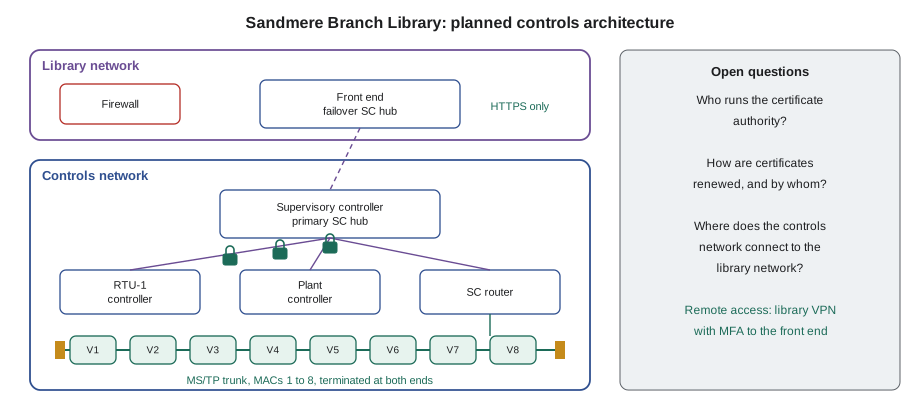
| Device | Role | Network |
|---|---|---|
| Front end | Operator interface, trends, alarms; failover hub | BACnet/SC; HTTPS to operators |
| Supervisory controller | Schedules, global values; primary hub | BACnet/SC |
| RTU-1 controller | Rooftop unit program | BACnet/SC |
| Plant controller | Boilers, pumps, EF-1 | BACnet/SC |
| SC router | Joins the MS/TP trunk to the SC network | BACnet/SC and MS/TP |
| VAV-1 to VAV-8 controllers | Box programs; program room DCV on VAV-6 | MS/TP, MACs 1 to 8 |
Callie also wrote down the security requirements she would carry through the job from BAS-430: personal accounts for every operator and technician, with roles; no shared accounts; remote access only through the library's VPN with multi-factor authentication; certificates and accounts recorded in the inventory and handed over securely; and a backup and restore test before handover.
3 The estimate
Callie built a practice estimate with Quillon's labour units from lesson 2, using the new-construction unit because the renovation would gut the building's ceilings and mechanical rooms. Declan's warning was that it was a teaching exercise: his own estimate would include site conditions, the mechanical contractor's schedule and material quotes she did not have.
| Category | Basis | Hours |
|---|---|---|
| Point installation | 78 points × 1.2 h (open renovation) | 94 |
| Controllers and panels | RTU panel 16, plant panel 10, 8 box controllers × 0.75 | 32 |
| BACnet/SC set-up | Hubs, certificates, router, testing with library IT | 12 |
| Engineering and submittals | Drawings, points list, sequences, product data | 24 |
| Programming | RTU 20, VAV template 8 + 8 × 0.25, plant 8, EF-1 1 | 39 |
| Front end and graphics | Small site, Quillon templates | 30 |
| Commissioning | Checkout, test support, burn-in, training | 40 |
| Project management | Meetings, schedule, changes | 24 |
| Record documents | Record drawings, O&M content | 10 |
| Total | 305 |
Worked problem
Checking the estimate
Callie's total is 305 hours for 78 physical points. What is that per physical point, and how does it compare with Marlow Lane's 3.4 hours per physical point?
Show solution
- 305 ÷ 78 ≈ 3.9 hours per physical point.
- Marlow Lane: 781 ÷ 232 ≈ 3.4 hours per physical point.
Answer: Sandmere is higher per point although its installation unit is lower, because a small job carries fixed costs that do not shrink with the point count: the front end, BACnet/SC set-up, submittals, commissioning meetings and project management. Declan said that was the right result, and the reason small jobs are easy to underprice.
Callie added a list of risks for Declan to price or exclude: the certificate authority question, which could add work if Quillon had to run one for the library; the library IT department's approval time; the economizer and cooling tests, which might have to be deferred to summer; and the engineer's review of her sequence, which might change the program.
4 Submittals and documents
If Quillon wins the job, the submittal would follow the list in lesson 3, with three additions the specification called for: BTL listings showing BACnet/SC support for each building-level controller, a certificate plan showing who issues, installs and renews each certificate, and an accounts and roles list for review by the library. The sequence in the submittal would be the version Coralie approves and stamps after Sophie's review, not Callie's first draft.
| Submittal item | Sandmere specifics |
|---|---|
| Architecture drawing | SC hubs, router, trunk, device instances, IP addressing agreed with library IT |
| Wiring diagrams | RTU-1, VAV with reheat and discharge sensor, boiler plant, EF-1, program room CO2 |
| Points list | 78 physical points plus software points, with alarms and trends |
| Sequences | The engineer-approved sequence from Callie's draft |
| Protocol listings | BTL listings including BACnet/SC |
| Security | Certificate plan; accounts and roles; remote access design |
| Valve schedule | RTU-1 heating valve, eight reheat valves, boiler plant valves if any |
5 Coordination
The coordination plan starts with a responsibility matrix like the one in lesson 4, agreed with the mechanical contractor at the first meeting. Sandmere adds the library's IT department as a party from the start, because BACnet/SC and remote access cannot be finished without it, and the fire alarm contractor for the duct smoke detector and the shutdown interface.
- Mechanical contractor (Quillon's customer): schedule, valve and well installation, RTU-1 and boiler start-up, payment.
- Electrical contractor: power to the controls panels and the rooftop unit; locked-off circuits until Quillon is ready.
- Testing and balancing firm: VAV box airflows, minimum outdoor air at RTU-1, program room airflow range.
- Fire alarm contractor: duct smoke detector and shutdown relay; interface test witnessed.
- Library IT: connection point, addressing, VPN accounts, certificate authority decision.
- Tamsworth Engineering and the commissioning provider, if appointed: sequence approval, submittal review, functional tests.
Callie's lookahead plan put the links in order: valves and wells before box controllers are wired; panel power before checkout; checkout before balancing; balancing before functional tests; library IT's connection before the front end can be finished. The critical path for controls would run through panel power, checkout, balancing and functional tests, exactly as at Marlow Lane.
6 Installation, checkout and testing
The installation plan uses the habits from BAS-210 and BAS-420: panels built and bench-tested in the shop, sensor cables marked at both ends, actuator direction recorded, terminal strips photographed, every controller addressed to the site plan before connection, the MS/TP trunk checked with a meter for about 60 Ω before power-up, and a backup with firmware recorded after each controller is loaded.
Checkout follows Quillon's sheets from BAS-410: each of the 78 points from device to front end, with outputs watched moving. Functional tests would follow the approved sequence: RTU-1 start, stop and safeties; supply air and static pressure resets; economizer and minimum outdoor air; boiler enable, rotation and reset; VAV dual maximum and discharge air limits; occupied standby in the three rooms with occupancy sensors; and the program room's ventilation ramp from the higher of its two CO2 sensors, with full ventilation on a failed sensor. Cooling tests that cannot be run in cold weather would be deferred and scheduled.
Worked problem
Program room ventilation check
The program room's ventilation ramps from 24 L/s at 700 ppm to 174 L/s at 1,000 ppm. During the test, the higher sensor reads 850 ppm. What airflow should the test expect?
Show solution
- Fraction of the ramp: (850 − 700) ÷ (1,000 − 700) = 150 ÷ 300 = 0.5.
- Airflow: 24 + 0.5 × (174 − 24) = 24 + 75 = 99 L/s.
Answer: About 99 L/s, within the balancer's measurement tolerance. The test then fails one sensor and expects 174 L/s and an alarm.
A burn-in week of one-minute trends would follow, reviewed against the owner's requirements before handover, with the issues log kept from the first submittal comment to the last open item.
7 Handover and training
Handover is where the library's staff take over a system most of them have never used. The library board's facilities staff would get a short, practical training session built around their real tasks: reading the home page, changing a schedule for a holiday, responding to an alarm, finding a trend, and knowing when to call Quillon. Callie's plan put the security items into the handover checklist rather than leaving them to the end.
| Handover item | Planned content |
|---|---|
| Record drawings | As installed and programmed, with final instances, MACs and addresses |
| Programs and backups | Every controller and the front end, with firmware versions; a restore test before handover |
| Accounts and certificates | Personal accounts for each staff member; certificate expiry dates in the inventory; credentials handed over securely |
| Training record | Agenda, attendance, materials |
| Interface contact sheet | Mechanical, electrical, fire alarm, library IT, Quillon |
| Warranty | Start and end dates; how to call for service |
8 After handover: service
Margit's rule from lesson 1 was that handover is the first day of the next sale, so Callie's plan ended with a service proposal for the library board. A small building needs a small agreement, and she built it from the task list in lesson 5.
Worked problem
A small PM agreement
Callie proposed four 4-hour visits a year, one 8-hour annual visit for safeties, stroking, certificate checks and the discovery sweep, and a 1-hour remote review each month. How many hours a year is that?
Show solution
- Quarterly visits: 4 × 4 = 16 h.
- Annual visit: 8 h.
- Remote reviews: 12 × 1 = 12 h.
- Total: 16 + 8 + 12 = 36 h a year.
Answer: About 36 hours a year, priced with travel and reporting. The certificate check matters more on Sandmere than on older sites: an expired certificate on a BACnet/SC network looks like a network failure, so the expiry dates go in the service plan as well as the inventory.
What the capstone showed
When Callie put the plan together, she noticed that almost every page used something from a different course. The points list came from BAS-120 and BAS-230; the controllers and panels from BAS-210; the program and tests from BAS-220 and BAS-410; the network from BAS-310 and BAS-430; the front end from BAS-320; the resets and fault rules from BAS-330; the fire alarm interface from BAS-340; the troubleshooting habits that shaped the installation from BAS-420; and the business side from this course. The job was small, but it needed the whole trade.
Margit read the plan and asked only one question: which page Callie would rewrite first if Quillon won the job. Callie said the estimate, because it was the part she had least experience with, and because Declan's comparison would teach her where her judgment was weakest. Margit wrote one word on the cover, "Good," and added a date for Callie's next development plan review.
Common mistakes
MistakeTreating a capstone as a set of separate exercises.
InsteadPlan the job as one connected sequence: scope, architecture, estimate, submittals, coordination, installation, testing, handover and service.
MistakeUnderpricing a small job by using per-point units alone.
InsteadAdd the fixed effort of front ends, network set-up, submittals, meetings and commissioning.
MistakeLeaving security to the end of the job.
InsteadCarry accounts, certificates, remote access and backups through the submittal, installation and handover.
MistakePresenting plans as facts.
InsteadMark what has happened and what is planned, with planned dates.
Summary and key terms
- Sandmere has an RTU, eight reheat boxes, a two-boiler plant, a program room with DCV and an exhaust fan: 78 physical points.
- The draft specification requires BACnet/SC with primary and failover hubs, an SC router for MS/TP and owner-issued certificates.
- Callie's practice estimate is 305 hours, about 3.9 hours per physical point, higher than a larger job because of fixed effort.
- Submittals add BACnet/SC listings, a certificate plan and an accounts list.
- Coordination includes library IT from the start; the critical path runs through power, checkout, balancing and tests.
- Testing follows the approved sequence; seasonal tests are deferred; burn-in and the issues log precede handover.
- Handover includes accounts, certificates and a restore test; a small service agreement follows.
- Capstone
- A final project that brings together the skills of a whole program.
- Certificate authority
- The body or system that issues and signs the certificates devices use to prove their identity.
- SC router
- A device that joins an MS/TP or other BACnet network to a BACnet/SC network.
- Handover package
- The documents, backups, accounts and training records given to the owner at handover.
Practice problems
Work each problem on paper first, then reveal the answer to check.
Why does Sandmere cost more per point than Marlow Lane?
Show answer
Fixed effort such as the front end, BACnet/SC set-up, submittals, meetings and commissioning is spread over fewer points.
At 900 ppm, what airflow does the program room ramp give?
Show answer
Fraction 200 ÷ 300 = 0.667; 24 + 0.667 × 150 = 124 L/s.
Name two open questions in the network section of the specification.
Show answer
Who runs the certificate authority, how certificates are renewed, and how library IT wants the network connected.
Why are certificate expiry dates in the service plan?
Show answer
An expired certificate on BACnet/SC looks like a network failure.
Lesson quiz · 5 questions
Score 60% or more to complete this lesson.
Create a free account to save your progress, take quizzes and earn a certificate.