
BAS-430 · Lesson 6 of 12 · 20 min
Secure protocols: BACnet Secure Connect
▶ Video coming soon A video version of this lesson is on the way.
Prakash had promised in BAS-310 that BACnet Secure Connect would get a session of its own, and when he kept the promise he brought a job file rather than a whiteboard. Declan had brought the drawings and draft specification for the Sandmere Branch Library renovation into the office on Friday, November 13, so that Quillon could price the controls, and Prakash had gone straight to the specification's section on the controls network. Tamsworth Engineering's draft asked for BACnet/SC on every building-level controller. "Five years ago I'd never seen that in a spec," Prakash said. "Now Coralie's asking for it on a library with one rooftop unit and eight boxes. So you'd better know what it is, and what it isn't."
Lessons 2 and 3 protected a building system by surrounding it: separate networks, firewalls and controlled remote access. That approach is needed because classic BACnet has no protection of its own. This lesson covers the other half of the picture: protocols that protect their own messages, starting with BACnet's own answer.
What classic BACnet/IP lacks
BAS-310 described BACnet/IP: messages carried in UDP packets, usually on port 47808, with broadcasts for discovery and BBMDs to carry those broadcasts between subnets. Three things are missing from it.
- Authentication. A device answers a read or accepts a write from anyone who can reach it. It has no way to check who is asking.
- Encryption. Messages travel in clear text. Anyone who can capture traffic on the network can read every value and every command.
- Integrity protection. A message changed on the way cannot be detected.
Those gaps were reasonable when BACnet was designed in the 1990s for private networks in a single building. They are why every BACnet/IP system today depends on the network around it for protection, and why that protection must be right.
BACnet Secure Connect
BACnet Secure Connect, usually written BACnet/SC, adds a secure way of carrying BACnet messages over IP networks. It was added to ANSI/ASHRAE Standard 135 by Addendum 135-2016bj, published in 2019, and it has been part of the standard itself, as a new data link layer, since the 2020 edition. The current edition is 135-2024. BACnet/SC changes how messages travel, not what they say: the objects, properties and services from BAS-310 are the same, so a front end reads a temperature or writes a setpoint exactly as before.
Its main features are these.
- Secure WebSocket connections. Each device opens a WebSocket connection, the same kind of long-lived connection web applications use, protected by Transport Layer Security (TLS) version 1.3, the same encryption that protects secure websites.
- Mutual authentication with certificates. Each device holds an operational certificate signed by the site's certificate authority, and the certificate of that authority so it can check others. When two devices connect, each proves its identity to the other. A device without a certificate from the site's authority cannot join.
- A hub instead of broadcasts. Devices connect to a hub, a function built into a controller, router or server, which relays messages between them. A device is configured with a primary hub and usually a failover hub, and connects to one at a time. Messages that would have been broadcasts are sent to the hub, which passes them to every connected device. There are no BBMDs and no foreign device registration.
- Optional direct connections. Two devices that exchange a lot of traffic can connect directly to each other instead of through the hub, if both support it.
- Firewall-friendly connections. Devices make outbound connections to the hub. The standard does not fix a port number; TCP 443, the usual port for secure web traffic, is a common choice. The connections work across IP subnets and through address translation, and on both IPv4 and IPv6 networks.
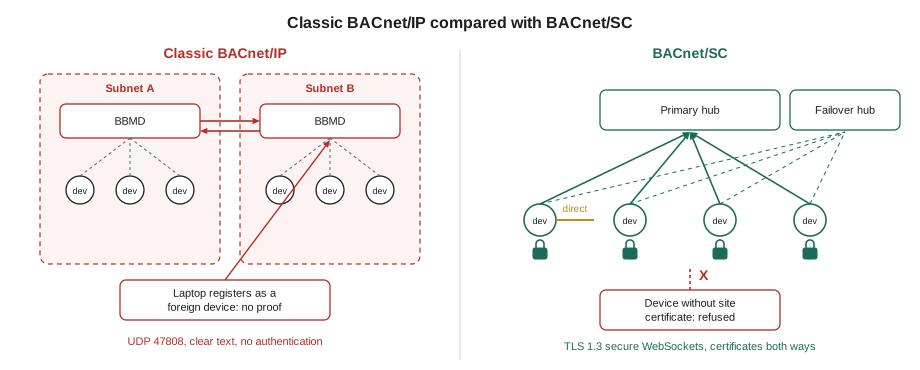
What BACnet/SC protects, and what it does not
It is easy to oversell a secure protocol. Prakash's summary for Callie was a two-column list.
| BACnet/SC protects | BACnet/SC does not protect |
|---|---|
| Messages on the network from being read: they are encrypted | Against a device that holds a valid certificate but has been misused or misconfigured |
| Messages from being changed unnoticed: TLS detects tampering | MS/TP trunks and other non-SC networks joined through routers |
| The network from devices that have no site certificate | Front-end user accounts, which still need roles, MFA and reviews |
| Against BBMD and foreign device misuse, because there are none | Against weak certificate management, such as a certificate authority key left on a laptop |
| Traffic crossing networks the owner does not control, such as a campus or a cloud link | Against unpatched software in the devices themselves |
The second column matters. A device that holds a valid certificate is trusted, so if it is compromised, it can still send any BACnet request that its software allows. BACnet/SC authenticates devices, not people; the front end still decides which person may command which point. And most buildings will keep MS/TP for terminal units for many years, connected to the SC network through routers, so the trunks still need the physical protection of lesson 3. BACnet/SC is a strong layer in defence in depth, not a replacement for the other layers.
Certificates and who manages them
Certificates are the part of BACnet/SC that is new to most controls technicians, and the part most likely to go wrong. A certificate is an electronic document that binds a device's identity to a cryptographic key and is signed by a certificate authority (CA) that the other devices trust. For BACnet/SC, the site normally has its own CA, which signs every device's operational certificate.
The life of a BACnet/SC certificate follows the same steps as any other.
- Issue. At commissioning, each device creates its own key pair. Its private key never leaves the device. It sends a certificate request to the CA, which checks it and returns a signed certificate.
- Install. The signed certificate and the CA's own certificate are loaded into the device, usually through the maker's configuration tool.
- Renew. Certificates expire. The site chooses how long they last when it sets up its CA, and renewal must happen before the expiry date, or the device drops off the network.
- Revoke or remove. When a device is replaced or removed, its certificate must stop being trusted, so that an old controller pulled from a ceiling cannot be reconnected.
- Protect the CA. Whoever holds the CA's private key can create trusted devices. It belongs to the owner, kept on a secured machine or service, and never on a technician's laptop.
Who runs the CA is a decision for the owner, made at design. A large owner such as a college or a city may want its IT department to run it, alongside the certificates it already manages. A small owner may ask the controls contractor to run it as part of a service contract, with the keys held in escrow so the owner can change contractors. Tamsworth's draft for Sandmere left the question open, and Callie's first note on the specification was to ask the library's IT department which they preferred.
Worked problem
Certificate expiry and renewal
A site commissions 24 BACnet/SC devices in March 2028 with certificates valid for 5 years. Quillon's practice is to renew 90 days before expiry. In what month does renewal work start, and what happens if it is forgotten?
Show solution
- Issued March 2028 + 5 years = expiry March 2033.
- 90 days before is about 3 months earlier: renewal starts in December 2032.
- If it is forgotten, each device's certificate expires in March 2033 and its connection to the hub fails, so all 24 devices drop off the network at about the same time.
Answer: Renewal starts in December 2032. The expiry date goes in the inventory and the service contract, because a forgotten renewal looks exactly like a network outage.
Certificate lifetimes for BACnet/SC are set by the site, so a five-year lifetime is a choice, not a rule. Certificates for public websites are different: the industry body that governs them, the CA/Browser Forum, has been shortening their maximum lifetime, to 200 days from March 2026, 100 days from March 2027 and 47 days from 2029. That matters for any front end published with a public certificate, and it is one more reason to automate renewal wherever possible.
Testing and specifying BACnet/SC
BACnet International's testing laboratory, BTL, tests products against the BACnet standard and lists the ones that pass. BTL test packages now cover BACnet/SC, and BTL listings include products with BACnet/SC functions, among them hubs. A specification that asks for BACnet/SC should ask for BTL-listed products that support the functions the design needs, such as hub, failover hub and direct connection, and should say who issues and manages certificates. Guideline 13, ASHRAE's guide to specifying building automation systems, includes cybersecurity considerations for the BAS and its network infrastructure in its 2024 edition, and is a common starting point for that section of a specification.
Tamsworth's draft for Sandmere asked for:
SANDMERE BRANCH LIBRARY: draft controls network requirements (Tamsworth, extract)
- Building-level controllers (RTU-1, boiler plant, supervisory) on BACnet/SC;
  BTL-listed for the BACnet/SC functions used.
- Primary hub on the supervisory controller; failover hub on the front-end server.
- Terminal units (8 VAV boxes) on BACnet MS/TP through a BACnet/SC router.
- Operational certificates signed by the owner's certificate authority;
  certificate lifetimes, renewal procedure and responsibilities documented
  at handover. [Owner's IT to confirm who operates the CA.]
- Front end served over HTTPS only; HTTP disabled.
- No inbound connections from the internet; remote access per owner's policy.
- All default credentials changed before connection to the network.
Callie noticed that the draft said nothing about how existing BACnet/IP tools would reach the controllers during commissioning. Prakash nodded. "The usual answer is that the commissioning laptop gets a certificate too, issued for the project and revoked at handover. Put it in your questions." Quillon's controls price goes to the mechanical contractor in December, and those questions will go with it.
Moving an existing site toward BACnet/SC
Existing sites move to BACnet/SC slowly, because every device on an SC network must support it, and most installed controllers do not. The usual pattern is to start at the top: the front end, the supervisory controllers and the routers between buildings or floors, where traffic crosses networks the controls contractor does not control. Routers that support both BACnet/SC and BACnet/IP or MS/TP join the old networks to the new one. Over the years, as controllers are replaced, more of the system moves across.
For Ninefield, Prakash's view was that BACnet/SC belongs in the long-term plan rather than this winter's work. The front end's January 2027 upgrade should be checked for BACnet/SC support, and any new IP-level device, such as a replacement floor router, should be bought with it. Meanwhile the classic network will be protected the way lessons 2 and 3 describe. At Harcastle, where BACnet traffic crosses the college's network between buildings, the case is stronger, and Callie added it to the list of questions for Gus's next budget.
Other secure protocols in a building
BACnet is not the only protocol in a building that has a secure and an insecure version. A security review checks that the secure one is used wherever the device supports it.
| Purpose | Insecure choice | Secure choice |
|---|---|---|
| Front-end and controller web pages | HTTP | HTTPS (TLS), with HTTP turned off |
| Command-line management of network devices | Telnet | SSH |
| Network device monitoring | SNMP versions 1 and 2c | SNMP version 3 with authentication and encryption |
| File transfer | FTP | SFTP or HTTPS |
| Modbus over IP | Modbus TCP (port 502) | Modbus/TCP Security, which adds TLS (port 802), where devices support it |
| Data to cloud platforms | MQTT without encryption (port 1883) | MQTT over TLS (port 8883) with per-device credentials |
Where a device supports only the insecure version, it is protected by the network instead, and the gap is recorded. Thistledown's feed from the edge gateway will use MQTT over TLS with credentials unique to the gateway, as BAS-340 planned, so nothing in it travels in clear text outside the building.
Common mistakes
MistakeThinking BACnet/SC makes firewalls and account controls unnecessary.
InsteadBACnet/SC authenticates devices and encrypts traffic; people, MS/TP trunks and device software still need the other layers.
MistakeLetting certificates expire unnoticed.
InsteadRecord every expiry date and schedule renewal well before it, or the devices drop off the network together.
MistakeKeeping the certificate authority's key on a technician's laptop.
InsteadThe CA belongs to the owner and its key is kept on a secured machine or service.
MistakeLeaving HTTP, Telnet or SNMPv1 enabled because they work.
InsteadUse HTTPS, SSH and SNMPv3 wherever devices support them, and turn the insecure versions off.
Summary and key terms
- Classic BACnet/IP has no authentication, encryption or integrity protection, so it depends on the network around it.
- BACnet/SC, added by Addendum 135-2016bj and part of Standard 135 since 2020, carries BACnet over TLS 1.3 secure WebSockets with mutual certificate authentication.
- Devices connect to a primary or failover hub; there are no broadcasts, BBMDs or foreign devices; direct connections are optional.
- BACnet/SC protects messages and keeps devices without site certificates out; it does not protect against a trusted device misused, MS/TP trunks or weak user accounts.
- Certificates must be issued, renewed, revoked and protected; the owner decides who runs the certificate authority.
- Specify BTL-listed products for the SC functions needed and say who manages certificates.
- Use secure versions of other protocols: HTTPS, SSH, SNMPv3, Modbus/TCP Security and MQTT over TLS.
- BACnet/SC
- BACnet Secure Connect: a BACnet data link that carries messages over TLS-protected WebSocket connections with certificate authentication.
- TLS
- Transport Layer Security: the protocol that encrypts and authenticates connections, as used by secure websites.
- Hub
- In BACnet/SC, the function that accepts device connections and relays messages between them, replacing broadcasts.
- Certificate authority (CA)
- The trusted party that signs certificates; for BACnet/SC, usually one per site, owned by the owner.
- Operational certificate
- The certificate each BACnet/SC device uses to prove its identity on the network.
- Mutual authentication
- A connection in which each side proves its identity to the other.
Practice problems
Work each problem on paper first, then reveal the answer to check.
Why do BACnet/SC networks need no BBMDs?
Show answer
Devices connect to a hub, which relays the messages that would have been broadcasts to every connected device.
A controller with a valid site certificate is compromised. Does BACnet/SC stop it sending writes?
Show answer
No. BACnet/SC trusts devices that hold valid certificates; other layers such as monitoring and the device's own security must catch misuse.
A public certificate lasts 47 days. About how many renewals does a front end need each year?
Show answer
365 ÷ 47 ≈ 7.8, so about 8 renewals a year, which is why renewal should be automated.
What question did Callie add about commissioning a BACnet/SC site?
Show answer
How commissioning laptops will connect: usually with a project certificate that is revoked at handover.
Lesson quiz · 5 questions
Score 60% or more to complete this lesson.
Create a free account to save your progress, take quizzes and earn a certificate.