
BAS-430 · Lesson 1 of 12 · 23 min
Why building systems are targets
▶ Video coming soon A video version of this lesson is on the way.
Margit Brodeur kept one file in her office that nobody else at Quillon was allowed to tidy. It was a grey binder labelled SECURITY, and it had started on the day Quillon took over Ninefield Tower's service contract, when the first check of the building's network found a port forward on the internet router pointing straight at the old front-end server. Ilona Vescovi had it removed the same afternoon, and Margit started the file that evening. "I'd been running a controls company for fifteen years," she told Callie, "and I had never once been asked who could reach our customers' buildings from the internet. That night I realized I didn't know either."
Over the fall, Margit walked Callie through the binder in short sessions fitted in wherever there was a gap in the week, often with Sophie or Prakash pulled in for the parts they knew best. This course follows those sessions. It is written from the defender's side throughout: how building systems are protected, how problems are noticed, how a site responds and recovers, and how the work is governed. It does not teach how to attack anything, and it treats real incidents only for what they teach defenders.
BAS-320 introduced user accounts, remote access and backups from the front end's point of view, and BAS-310 explained why classic BACnet has no security of its own. This course gathers those threads into one discipline. This first lesson asks a simple question: why would anyone bother with a building's heating and cooling?
From isolated panels to networked systems
Thirty years ago a building automation system was mostly isolated. Controllers talked to each other over a proprietary twisted-pair network, the operator's workstation sat in the engineering office, and the only way in from outside was a dial-up modem that a technician called when something broke. Security, such as it was, came from obscurity and distance.
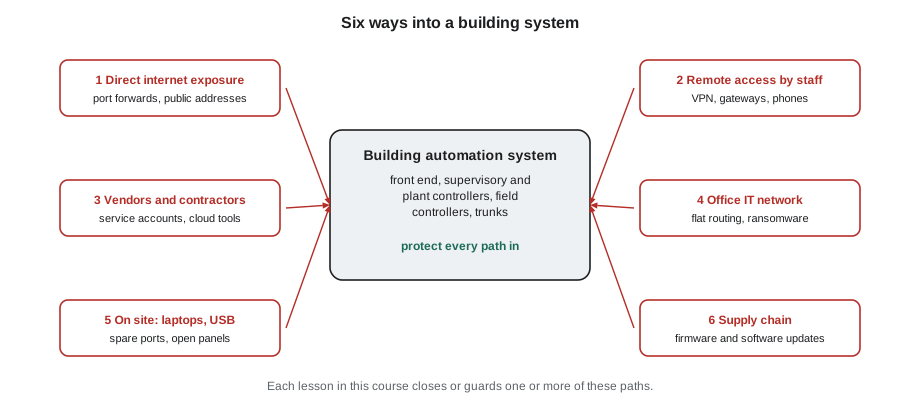
That world has gone. Today's systems run on Ethernet and IP for everything above the terminal units, the front end is a web server, operators expect to read alarms on a phone, analytics platforms pull trends to the cloud, tenants want a data feed, and the controls network often shares switches, cabling and sometimes even addresses with the owner's office network. The joining of information technology (IT) with the operational technology (OT) that runs physical equipment is usually called IT/OT convergence.
Convergence brings real benefits. Nell Nakagawa handled a boiler lockout from her kitchen in February because Harcastle's front end could be reached safely from home. Declan's analytics work in BAS-330 depends on getting data out of the building. But every new connection is also a new path in, and the controls industry spent many years connecting things first and securing them later.
Operational technology differs from office IT in ways that shape everything in this course:
- Availability usually comes first. An office server can be rebooted on a Sunday; a chiller plant serving a hospital or a server room cannot simply be switched off while someone investigates.
- Equipment lives a long time. Controllers installed in 2009 are still running Tilden Hall's air handlers. Many were designed before anyone expected them to be on a network, and some cannot be patched at all.
- Changes have physical effects. A wrong setpoint written to a valve or a damper affects people, equipment and sometimes safety, not just data.
- The people who run it are not IT staff. Operators and controls technicians are experts in heating and cooling, and the security tasks have to fit the way they work.
- Many classic building protocols, including BACnet/IP and Modbus, were designed to trust any device that can reach them. A controller will answer a read or accept a write from anyone on the network.
Who might go after a building system
It helps to think about who might cause harm and why, because the answer shapes the defence. Margit's binder grouped them into five kinds, from the most common to the least.
| Source | What they usually want | What it means for a building |
|---|---|---|
| Automated, opportunistic attacks | Any device they can take over, for a botnet or a foothold | An internet-exposed controller or front end is found and abused within days, whatever building it is in |
| Criminal groups | Money, usually through ransomware or theft of data | Front-end servers and engineering laptops on the office network get encrypted along with everything else |
| Hacktivists and vandals | Attention or disruption | Exposed control screens are changed to make a point |
| Insiders and former insiders | Revenge, curiosity or convenience | An old shared password still works after someone has left |
| Mistakes and accidents | Nothing; nobody intended harm | A laptop, a bad download or a wrong command causes the outage |
The first row matters most for buildings. Most building owners are not singled out by anyone. Instead, automated tools sweep the whole internet continuously, and search engines that index internet-connected devices make exposed building controllers easy to find. A controller left reachable from the internet is not hidden by being obscure; it is found because it is reachable. Canada's Cyber Centre warned in 2025 that hacktivists were tampering with internet-accessible industrial control systems at Canadian water, energy and agriculture sites, and US agencies have issued similar warnings. The advice in every case began with the same step: take control systems off the open internet.
The last row matters almost as much. Many outages blamed on attackers turn out to be accidents, and many real attacks begin with an ordinary mistake. Good security practice protects against both.
Three lessons from real incidents
Margit kept three short case summaries at the front of the binder. She chose them not because they are the most dramatic incidents on record, but because each one teaches a defender something specific about building and control systems.
The 2013 Target breach: the vendor's credentials
In late 2013, criminals stole data for about 40 million payment cards and personal information for about 70 million customers of the US retailer Target. Investigations later reported that the first foothold came from credentials stolen from Fazio Mechanical Services, a refrigeration and HVAC contractor, after malware reached the contractor through a phishing email. Those credentials opened a Target web application for vendors, used for billing and project management, and from there the intruders moved through Target's internal network until they reached the payment systems.
The HVAC controls themselves were not the target, and that is exactly the point. A contractor's login, issued for something as ordinary as billing, became a way into a much larger network because nothing stopped it from going further. The lessons defenders took were these: vendor access should be limited to exactly what the vendor needs; the systems vendors reach should be separated from everything else; remote access should require more than a password; and unusual activity inside the network should be noticed. A later US Senate committee review also found that the retailer's security tools had raised alerts that were not acted on, which is why lesson 7 is about monitoring that someone actually reads.
Oldsmar, 2021: a story that changed
In February 2021, officials in Oldsmar, Florida, announced that someone had used the water treatment plant's remote access software to raise the setpoint for sodium hydroxide, a chemical used to control the water's acidity, to a dangerous level, and that an operator watching the screen had seen the change and reversed it at once. The story was reported worldwide as an attack on drinking water. Federal advisories that followed noted that the plant's computers shared one remote access password, ran an operating system that was no longer supported and were connected to the internet without a firewall.
Two years later the story changed. In March 2023, the city manager at the time of the event said publicly that the FBI had found no evidence of outside access and that the most likely cause was an employee's mistake. The FBI declined to comment on its findings. Whatever happened that morning, the plant's weaknesses were real, and so were the protections that worked: an alert operator, process limits, and a second check on chemical levels downstream. Margit keeps Oldsmar in the file for both reasons. It shows how shared passwords and unmanaged remote access leave a site unable even to say who did what. It also shows why a team responding to an incident must keep an open mind about the cause, and why an incident report should separate what was observed from what was assumed.
Mirai, 2016: devices nobody was watching
In the fall of 2016, a piece of malware called Mirai took over hundreds of thousands of internet-connected devices, mostly security cameras, video recorders and home routers, and used them together to flood websites and internet services with traffic. On October 21, 2016, an attack on the DNS provider Dyn made many well-known websites unreachable for parts of a day. Mirai did not need a clever trick. It succeeded because huge numbers of small devices were reachable from the internet and still had their factory default passwords.
Buildings are full of small networked devices: cameras, lighting gateways, meter gateways, access panels, wireless sensor receivers, the controllers themselves. The owner of a device taken over by a botnet may never notice, because the device keeps doing its job while it attacks someone else. The defender's lessons are plain: change every default credential, never expose devices directly to the internet, keep firmware current, and know what is on your network.
What is at stake
Building systems are rarely the end goal, but harm to them has real consequences. It helps to list them, because the consequence decides how much protection a system needs.
- Comfort and business: tenants too hot or cold, a building that cannot open, lost rent and complaints. A fourth-floor tenant like Thistledown Analytics notices within an hour.
- Equipment: chillers started and stopped repeatedly, freeze protection disabled, pumps run dry, all of which cost money to repair.
- Safety: laboratory exhaust such as Tilden's EF-3, smoke control interfaces, stair pressurization, and server room cooling where an outage can damage equipment worth more than the building's controls.
- Privacy: access control events, occupancy data and tenant feeds can reveal when people come and go. Personal information carries legal duties, covered in lesson 10.
- A path elsewhere: as the Target case showed, a poorly protected building system can be the way into a much more valuable network.
- Energy and money: a building whose schedules have been changed can quietly waste thousands of dollars of energy before anyone notices.
One consideration overrides the others: equipment that protects life, such as fire alarm systems and the hardwired safeties that stop a fan on high static pressure or freezing air, must keep working regardless of what happens on the network. BAS-130 and BAS-340 made the point that safeties belong in hardwired circuits, not only in the program. That rule is also a security control. A hardwired freezestat cannot be switched off from a laptop.
Thinking in risk
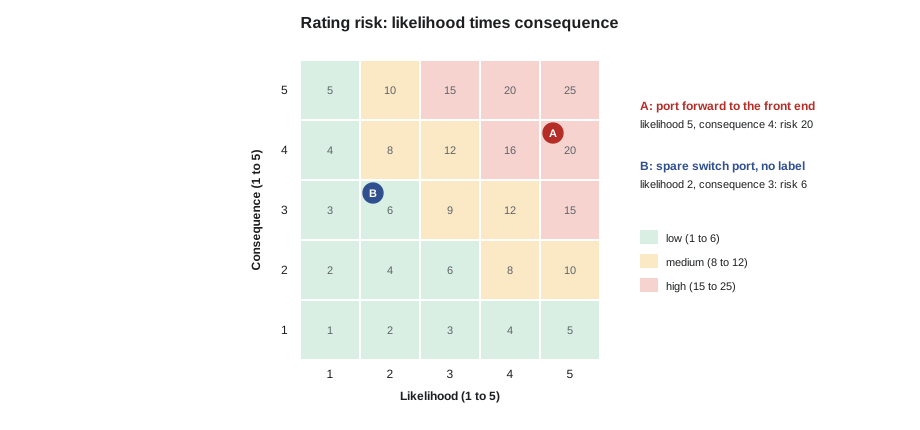
No building can be protected against everything, and trying to treat every point the same wastes effort. Security people talk about risk, which combines how likely a harmful event is with how bad its consequences would be. A simple way to use the idea is to rate each on a scale of 1 to 5 and multiply them.
Worked problem
Ranking two weaknesses
Margit's binder rated two findings from Ninefield using a 1 to 5 scale for likelihood and for consequence. Finding A: the old port forward to the front end, rated likelihood 5 (exposed web pages on the internet are found quickly) and consequence 4 (anyone who got in could change schedules and setpoints for the whole tower). Finding B: an unlabelled spare network port in the penthouse comms room, rated likelihood 2 (the room is locked and only a few contractors have keys) and consequence 3. Which should be fixed first?
Show solution
- Risk A = 5 × 4 = 20.
- Risk B = 2 × 3 = 6.
- Finding A carries more than three times the risk of finding B.
Answer: Fix the port forward first, which Ilona did the same day. Finding B still goes on the list: disabling unused switch ports is cheap, and lesson 3 returns to it.
The numbers are judgments, not measurements, and two people may rate the same finding differently. Their value is that they force a conversation about likelihood and consequence and produce a ranked list that an owner can act on. Lesson 11 shows how the ISA/IEC 62443 standards formalize the same idea with zones and target security levels.
Defence in depth
The idea that runs through the whole course is called defence in depth: several independent layers of protection, so that when one fails, as eventually one will, the next still holds. For a building system the layers are familiar from the lessons ahead.
- Keep the system off the internet and separate it from other networks (lessons 2 and 3).
- Make every person prove who they are, give them only what they need, and remove access when they no longer need it (lessons 4 and 8).
- Keep software and firmware current and configured securely (lessons 5 and 6).
- Watch for trouble, so that problems are found early (lesson 7).
- Be able to recover: backups, manual operation and a practised response plan (lessons 9 and 10).
- Govern all of it: someone owns security, decisions are written down, and the program is reviewed against recognized standards (lesson 11).
"None of these layers is clever," Margit said. "The port forward at Ninefield would have been stopped by the first one. The trades account at Harcastle by the second. The Morrow House firmware problem by the third. Most of this job is doing the boring things everywhere, every time."
Who is responsible
Security for a building system is shared, and confusion about who does what is one of the commonest weaknesses. The owner is responsible for the building and decides how much risk to accept. The owner's IT department or provider usually runs the network, the firewall and the internet connection. The controls contractor installs, configures and services the building automation system and often holds the most powerful accounts on it. Other contractors, such as the chiller service company, the fire alarm company, the lighting supplier and the access control company, each touch a piece. Tenants may bring their own devices and networks.
Quillon's rule, written on the first page of Margit's binder, is that every security task on a site has one named owner, agreed in writing with the client, and that Quillon never assumes the IT department is doing something without asking. When the Harcastle segmentation project in 2024 broke discovery for three days (BAS-310), the cause was not a bad decision; it was a good decision that nobody had told the controls contractor about. Lesson 12 ends with a responsibility table for Ninefield.
Common mistakes
MistakeAssuming a building is too unimportant to be attacked.
InsteadAutomated tools attack whatever they can reach. Exposure, not importance, makes a building a target.
MistakeTreating the building system as either pure IT or pure equipment.
InsteadIt is operational technology: availability, long life and physical effects shape every security decision.
MistakeLearning only the dramatic version of an incident.
InsteadRead the later findings too. Oldsmar shows that facts can change and that the weaknesses still matter.
MistakeRelying on one protection, such as a firewall.
InsteadUse defence in depth, with independent layers, so that one failure does not expose everything.
Summary and key terms
- IT/OT convergence connects building systems to IP networks, phones, clouds and tenants; each connection is a possible path in.
- OT differs from office IT: availability first, long equipment life, physical consequences and protocols that trust any device on the network.
- Most harm to buildings comes from automated attacks on exposed devices and from ordinary mistakes, not from attackers who chose that building.
- Target shows the danger of broad vendor access; Oldsmar shows the cost of shared remote access and the need to separate facts from assumptions; Mirai shows what default passwords and exposed devices lead to.
- Rate risk by likelihood and consequence to decide what to fix first.
- Use defence in depth: separation, identity, current software, monitoring, recovery and governance.
- Every security task needs a named owner agreed with the client.
- Operational technology (OT)
- Hardware and software that monitors and controls physical equipment, such as a building automation system.
- IT/OT convergence
- The joining of office information technology networks and services with operational technology.
- Botnet
- A large group of devices taken over by malware and controlled together, often for attacks on others.
- Ransomware
- Malware that encrypts or locks data and systems and demands payment to restore them.
- Risk
- A combination of how likely a harmful event is and how severe its consequences would be.
- Layered protection
- Several independent protections, so that one failure does not expose the whole system; also called defence in depth.
Practice problems
Work each problem on paper first, then reveal the answer to check.
Why does an internet-exposed controller get found even if the building is obscure?
Show answer
Automated tools and device search engines scan the whole internet continuously. Reachability, not reputation, is what gets a device found.
What was the main lesson of the Target breach for controls contractors?
Show answer
A contractor's credentials for an ordinary purpose became a way into a much larger network. Vendor access should be narrow, separated, protected by MFA and monitored.
Why does Margit keep the Oldsmar case in the file even though its cause was later questioned?
Show answer
The weaknesses were real (shared remote access password, unsupported software, no firewall), and the changed story teaches responders to separate observations from assumptions.
A finding has likelihood 3 and consequence 5. Another has likelihood 4 and consequence 2. Which ranks higher?
Show answer
3 × 5 = 15 against 4 × 2 = 8, so the first ranks higher.
Lesson quiz · 5 questions
Score 60% or more to complete this lesson.
Create a free account to save your progress, take quizzes and earn a certificate.