
BAS-430 · Lesson 12 of 12 · 20 min
Hardening a building automation system: a case study
▶ Video coming soon A video version of this lesson is on the way.
Thistledown's questionnaire asked for a hardening plan with the fit-out documents, and Margit gave the first draft to Callie. "Not because I think you'll get it right," she said. "Because by the time you've written it you'll understand every lesson in this binder, and because a plan written by someone who has to ask questions is better than one written by someone who thinks they know." Callie built the draft from records over the week after the questionnaire arrived: Prakash's numbering plan from BAS-310, Sophie's front-end exports from lesson 4, Declan's vendor list from lesson 8, her own network drawing from lesson 2 and the integration plan for the fourth floor from BAS-340.
This lesson follows that draft. Its later steps are plans: Margit and Sophie are to review it on Wednesday, November 18; Callie and Prakash are to check it on site on Wednesday, November 25, filling in the question marks; and Declan is to take it to Ilona in early December with the retro-commissioning proposal. The work it describes runs from December 2026 to the spring of 2027, alongside the podium rooftop units, the front-end renewal and Thistledown's fit-out.
Step 1: scope and inventory
The plan covers Ninefield's building automation system and everything connected to it: the front end, the controllers and trunks, the gateways and the network paths to other systems and to the internet. It does not cover the fire alarm, access control or elevator systems themselves, which belong to Signalpoint, Ironmark and the elevator contractor, but it does cover the interfaces between them and the BAS, as BAS-340 defined them.
NINEFIELD: inventory summary (from records; field check Nov 25 planned)
BACnet/IP (controls subnet, network 1) ........ 16 devices
  front-end server 1, supervisory controller 1, plant controllers 2,
  chiller cards 2, floor routers 9, lighting gateway 1
MS/TP trunks ................................. 13 trunks
  office floors 102-110 (9), penthouse 201-203 (3), podium 204 (1)
  about 140 box controllers, penthouse drives, RTU-1 controller
Gateways and converters ...................... protocol converter (RTU-2..4,
                                               to be removed after December)
Network equipment (owned by building IT) ...... internet router/firewall,
                                               VPN appliance, 2 managed switches
Planned ....................................... edge gateway (tenant feed),
                                               jump host (DMZ), RTU-2..4 controllers
Other systems with BAS interfaces ............. fire alarm (hardwired),
                                               access control (events by suite/time),
                                               generator (5 hardwired points),
                                               elevators (monitoring)
Question marks ............................... generator modem?, spare penthouse
                                               switch port, lighting gateway
                                               web settings, Signalpoint and
                                               Lumacor remote paths
The inventory confirmed one thing BAS-310 had already said: every BACnet/IP device at Ninefield sits on one subnet, behind floor routers for the trunks. That makes the design simpler than Harcastle's. It also made the BBMD on the front-end server (lesson 2) plainly unnecessary.
Step 2: findings and risk
Callie listed every weakness she could find in the records, rated each with the likelihood-and-consequence grid from lesson 1, and sorted them. Margit's only instruction was to write each finding so that someone who had not been in the room could understand it.
| # | Finding | L | C | Risk |
|---|---|---|---|---|
| 1 | Office VLAN and controls VLAN are routed by the building router with no filtering between them: any office PC can reach the controllers | 4 | 4 | 16 |
| 2 | VPN checks a password only (no MFA) and lands users on the controls subnet | 4 | 4 | 16 |
| 3 | Front end two versions behind since its maintenance agreement lapsed; known security fixes not applied | 3 | 4 | 12 |
| 4 | BBMD on the front-end server with foreign device registration enabled; not needed | 3 | 4 | 12 |
| 5 | Shared accounts (nightops, tenant7) and 4 accounts for people who have left | 3 | 3 | 9 |
| 6 | Lighting gateway web interface on HTTP, built-in account in use, password history unknown | 3 | 3 | 9 |
| 7 | No logging beyond the front-end audit trail; no monitoring of the controls network | 3 | 3 | 9 |
| 8 | Building has never practised running without the front end | 2 | 4 | 8 |
| 9 | Vendor access register incomplete; Tarrant's remote access request has no agreed design | 2 | 3 | 6 |
| 10 | Unlabelled live switch port in the penthouse communications room | 2 | 3 | 6 |
| 11 | Possible cellular modem in the generator controller (not a BAS path; to confirm) | 2 | 2 | 4 |
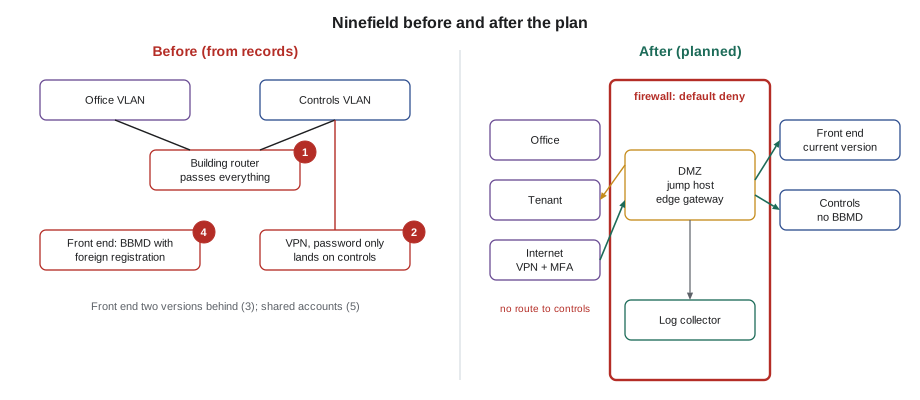
Finding 1 surprised Callie most, because nobody had chosen it. The building's network had been set up years before with separate VLANs for office and controls, which looked like segmentation on the drawing, but the router joining them passed everything. It was the lesson 2 warning about VLANs in real life. Margit was more surprised by finding 3. "We told Ilona the agreement had lapsed," she said. "We never told her it meant the security fixes stopped. That's our failure, not hers."
Step 3: the target design
The target design applies lessons 2, 3 and 6 to Ninefield's layout. It keeps every device where it is and changes only what is allowed to reach what.
- Zones: field controllers (the trunks), supervisory and plant (the controls subnet), site servers (the front end), boundary (a new small DMZ subnet), and outside (office, tenant networks and the internet).
- Conduits: the firewall rule set from lesson 3, with default deny between every zone, allow-lists naming specific hosts, outbound filtering and logging.
- Remote access: the existing VPN with MFA turned on, landing users in the DMZ on a jump host that alone reaches the front end and the controls subnet.
- Tenant feed: the edge gateway in the DMZ, reading the front end through a read-only service account and sending outbound only, over MQTT with TLS, to Thistledown's broker (BAS-340).
- No BBMD: the front-end server's BBMD function switched off once the walk-down confirms nothing uses it.
- Target security levels: as in the lesson 11 example, SL-T 1 for the trunks and SL-T 2 for the other zones, with compensating countermeasures for the supervisory zone until its devices can be replaced.
Step 4: the phased plan
Building systems cannot be rebuilt in a weekend, and Ninefield has tenants who notice every hour of downtime. Callie grouped the work into four phases, ordered by risk and by what else is happening in the building, and put a named owner on every line.
| Phase and timing (planned) | Work | Findings | Owner |
|---|---|---|---|
| 1: December 2026, quick wins | Turn on MFA for the VPN; remove leavers' accounts; replace nightops and tenant7 with personal accounts; disable the unlabelled port; complete the vendor access register | 2 (part), 5, 9 (part), 10 | Building IT (VPN, port); Quillon (accounts, register) |
| 2: January 2027, with the maintenance renewal | Upgrade the front end to the current version, with test, backup and window as in lesson 5; switch off the BBMD; change the lighting gateway to HTTPS and a personal account | 3, 4, 6 | Quillon, with Lumacor for the gateway |
| 3: January to March 2027, with the fit-out | Add filtering between office and controls VLANs; build the DMZ with jump host and edge gateway; apply the rule set; move VPN users to the DMZ; agree Tarrant's session-based access | 1, 2, 9 | Building IT (firewall, DMZ); Quillon (jump host, gateway) |
| 4: spring 2027, with the retro-commissioning | Send firewall, VPN and jump host logs to a collector; start the weekly security check; trial passive monitoring; run a manual operation exercise and a tabletop with Ilona | 7, 8 | Building IT (logs); Quillon (checks, exercise) |
Phase 1 costs almost nothing and removes most of the risk of finding 2, so it goes first even though finding 1 scores equally high: filtering the VLANs needs the DMZ and the rule set to be ready, or it would cut off every remote user at once. That kind of dependency is why a ranked list alone is not a plan.
Worked problem
Estimating Quillon's hours
Callie estimated Quillon's own hours for each phase: phase 1, 10 hours (account changes, register, user notes); phase 2, 18 hours (front-end upgrade under the renewal, gateway changes, BBMD); phase 3, 24 hours (jump host build, edge gateway, testing every remote path with building IT); phase 4, 12 hours (log review set-up, first weekly checks, exercise preparation and attendance). She then added 15 in 100 for coordination and the unexpected, rounding up to the next whole hour. What is the total?
Show solution
- Sum of phases: 10 + 18 + 24 + 12 = 64 hours.
- Allowance: 64 × 0.15 = 9.6 hours.
- Total: 64 + 9.6 = 73.6, rounded up to 74 hours.
Answer: About 74 hours of Quillon's time over five months, much of it overlapping visits already planned. Declan will price it as a separate line in the December proposal, with the building IT provider's work quoted by the provider.
Step 5: who owns what
Lesson 1 said every security task needs one named owner agreed in writing. The plan ends with a responsibility table for the parts of Ninefield's security that will continue after the project is finished.
| Task | Owner | Reviewed |
|---|---|---|
| Accepting risk and approving the plan | Ilona (for the owner) | Yearly |
| Firewall, VPN, switches and DMZ network | Building IT provider | Rule review yearly and after projects |
| Front end, controllers, jump host and edge gateway | Quillon | Each service visit |
| Accounts and roles on the front end | Quillon, approved by Ilona | Every three months |
| Vendor access approvals | Ilona or her deputy | Each session |
| Vendor access register and inventory | Quillon | Each service visit and after projects |
| Patching and firmware | Quillon (BAS); building IT (network devices) | Weekly advisory check |
| Backups and restore tests | Quillon | Quarterly test |
| Log review and weekly security check | Quillon, with building IT's alerts | Weekly |
| Incident response plan and exercises | Ilona, with Quillon and building IT | Yearly exercise |
Step 6: how the plan will be checked
A hardening plan is only finished when someone has checked that it worked. Callie's last section listed the checks for each phase.
- Phase 1: an MFA prompt on every VPN login, tested with each user; the front-end account export showing no shared or leavers' accounts; the penthouse port showing disabled on the switch.
- Phase 2: the front end at the current version in the inventory; no BBMD function on any Ninefield device; the lighting gateway reachable only by HTTPS.
- Phase 3: from a test PC on the office network, the controllers cannot be reached; from the DMZ jump host, they can; the firewall logs show the denied attempt and the allowed connection; the edge gateway's only outbound connection is to Thistledown's broker.
- Phase 4: the first month of weekly security checks on file; the manual operation exercise and the tabletop completed, with their findings added to the plan.
Each check is something someone can observe, not a statement that something was done. The checks for phase 3 will be carried out together by Quillon and the building IT provider, with Thistledown's IT manager invited to watch, which is the best answer to a questionnaire there is.
THISTLEDOWN QUESTIONNAIRE: draft answers (extract)
Q1  Network diagram ............ attached (Ninefield BAS, dated, with zones)
Q4  Separation from tenant ..... tenant networks are a separate zone; no
    network ...................... route to building controls (Phase 3)
Q7  Remote access .............. VPN with MFA to a jump host; vendor access
                                 per session, approved by building management
Q9  Data feed .................. edge gateway, read-only, outbound only,
                                 MQTT over TLS, per-device credentials
Q12 Patching ................... weekly advisory check; front end upgraded
                                 January 2027
Q15 Incident response .......... plan to be exercised spring 2027; tenant
                                 contact added to the call list
Q20 Framework .................. NIST CSF 2.0; ISA/IEC 62443-3-2 zones;
                                 Quillon to ISA/IEC 62443-2-4
What Callie learned
When Callie handed the draft to Margit, she wrote a short note on the cover, as Prakash had taught her to do with trouble files in BAS-420. It said that none of the eleven findings needed anything clever to fix; that most of them came from convenience, from things set up quickly for a good reason and never revisited; that the most dangerous finding was one that looked fine on a drawing; and that the plan's real product was not the list of fixes but the table of who owns what afterwards.
Margit read the note twice and put it in the front of the binder, behind the page about the port forward. "That's the course," she said. "Everything else is detail."
BAS-440 brings the whole program together. Security runs through all of it: every controller Callie installs, every account she sets up, every laptop she plugs in and every handover she writes is a chance to leave a building a little safer than she found it.
Common mistakes
MistakeFixing findings in order of risk score alone.
InsteadOrder the work by risk and by dependencies; a high-risk fix that would cut off remote users must wait for its replacement path.
MistakeEnding a hardening project when the changes are made.
InsteadEnd it when each change has been checked by observation and the ongoing owners have accepted their tasks.
MistakeWriting findings only the author can understand.
InsteadWrite each finding so someone who was not there can see what is wrong and why it matters.
MistakeLeaving the owner unaware of what a lapsed agreement or a deferred change means for security.
InsteadExplain the security consequence of every decision the owner makes, in writing.
Summary and key terms
- A hardening plan starts with scope and inventory, then lists findings rated by likelihood and consequence.
- Ninefield's highest risks were an unfiltered route between office and controls VLANs and a VPN without MFA landing on the controls subnet.
- The target design keeps devices in place and changes what may reach what: zones, a DMZ with a jump host and edge gateway, default-deny conduits and no unneeded BBMD.
- Phases are ordered by risk, cost and dependencies, and fitted to work already planned in the building.
- Every ongoing task gets a named owner and a review interval.
- Each phase ends with checks someone can observe.
- Most findings come from convenience; good security is ordinary work done consistently.
- Hardening
- Reducing a system's exposure and weaknesses by removing what is not needed and strengthening what remains.
- Finding
- A documented weakness, with enough detail for someone else to understand and fix it.
- Quick win
- A change that reduces risk substantially at little cost or disruption.
- Dependency
- A task that cannot be done until another is complete.
- Verification check
- An observation that shows a change has had the intended effect.
Practice problems
Work each problem on paper first, then reveal the answer to check.
Why did phase 1 come before the VLAN filtering, although both related findings scored 16?
Show answer
Turning on MFA is cheap and quick; filtering the VLANs depends on the DMZ and rule set being ready, or remote users would be cut off.
How will the plan show that office PCs can no longer reach the controllers?
Show answer
By testing from a PC on the office network after phase 3: the connection fails and the firewall logs the denial.
Phases take 8, 14, 20 and 10 hours. With a 15 in 100 allowance rounded up, what is the total?
Show answer
52 × 1.15 = 59.8, rounded up to 60 hours.
Who accepts risk for Ninefield in the responsibility table?
Show answer
Ilona, for the owner.
Lesson quiz · 5 questions
Score 60% or more to complete this lesson.
Create a free account to save your progress, take quizzes and earn a certificate.