
ARCH-500 · Lesson 9 of 12 · 22 min
Writing the thesis proposal
In week ten the studio goes quiet. The models move to the side tables, the laptops come out, and Leclerc begins the writing workshops. Many architecture students dread writing, and she addresses that first. 'You are not being asked to become a writer,' she says. 'You are being asked to make an argument that a reader can follow without you in the room. A thesis proposal is a contract. It says what you will find out, why it matters, how you will do it and what you will deliver. If it is clear, your committee will approve it and hold you to it. If it is vague, they will approve it and argue with you about it in April.'
The parts of a proposal
The school asks for a proposal of about 6,000 words, plus figures and references, with a standard structure. An abstract of about 250 words states the question, the claim, the site, the methods and what the thesis will produce. A section on the question and claim explains them and says how the claim could fail. A section on context and literature places the question in what is known, organized by theme. A section on the site and one on the program explain them with evidence. A section on methods and ethics describes how each part of the question will be answered, with the approvals obtained. A section on early explorations shows what the design research has found so far. A schedule and list of deliverables say what will be produced next term and when. A short conclusion restates the question in its sharpened form. References follow, in the chosen style.
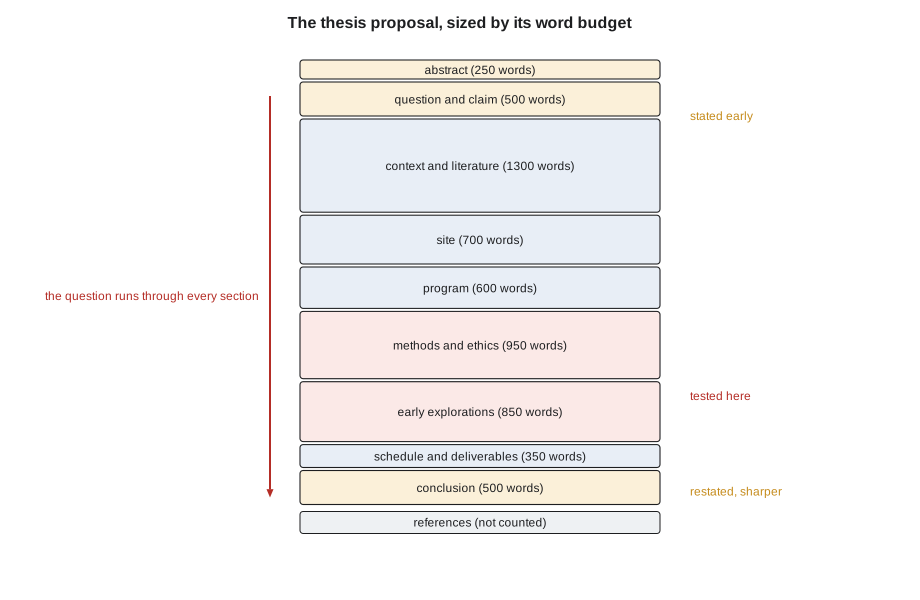
Leclerc's most important advice concerns the relation between the parts. The question and claim must be stated early and must reappear: the literature review should show why the question is open, the site and program should show where and for whom it is tested, the methods should show how, the explorations should show what has been found so far, and the conclusion should state the question again, sharper than at the start. 'A reader should be able to tear out any section,' she says, 'and still tell what your thesis is asking.'
Budgeting words
Ingrid's first draft of the context section is 2,400 words long, because she has read so much and wants to show it. Her methods section is 600 words, because she finds it dull. Leclerc points out that the committee will read the methods most carefully, because that is where most proposals are weakest, and that a long literature review often hides a writer who has not yet decided what the literature means. Ingrid writes a word budget for the proposal and compares her draft with it.
# Word budget for a thesis proposal of about 6,000 words
total = 6000
sections = {"abstract": 0.04, "question and claim": 0.08, "context and literature": 0.22, "site": 0.12,
            "program": 0.10, "methods and ethics": 0.16, "early explorations": 0.14, "schedule and deliverables": 0.06,
            "references (not counted)": 0.0, "conclusion": 0.08}
used = 0
for k, share in sections.items():
    n = round(total * share / 50) * 50
    used += n
    print(f"{n:5d}  {k}")
print(f"{used:5d}  total")
draft = {"context and literature": 2400, "methods and ethics": 600}
for k, n in draft.items():
    target = round(total * sections[k] / 50) * 50
print(f"{k}: draft {n}, target {target}, {'cut' if n > target else 'add'} {abs(n - target)}") 250 abstract
500 question and claim
1300 context and literature
700 site
600 program
950 methods and ethics
850 early explorations
350 schedule and deliverables
0 references (not counted)
500 conclusion
6000 total
context and literature: draft 2400, target 1300, cut 1100
methods and ethics: draft 600, target 950, add 350The budget tells her to cut the literature by more than 1,000 words and to add about 350 to the methods. Cutting is painful, and Leclerc gives her a method: for each paragraph of the review, write in the margin which theme it belongs to and what it adds to the argument. Paragraphs that only summarize a source without saying what it means for the thesis go first. Paragraphs that say the same thing as another go second. What remains is shorter and stronger. In the methods section, she adds the details the committee will ask about: the survey's sample and margin of error, the coding and the agreement check, the calibration of the simulation, the night walk protocol, and the conditions agreed with the community organization.
Writing an abstract
The abstract is the hardest 250 words in the proposal, because it must contain the whole argument in miniature. Leclerc asks the students to write it first, as a plan, and again last, as a summary. A good abstract answers five questions in order: what is the problem, what is the question, what is the claim, how will it be tested, and what will the thesis produce. It uses no jargon that the abstract does not define, cites no sources and makes no promise the thesis cannot keep. Ingrid's final abstract begins:
'In a long winter power outage, the residents least able to leave their homes are the most at risk, and most cities' plans assume they will travel to a large shelter far away. This thesis asks which existing buildings in a dense older district of Winnipeg could, with retrofit and one new building, keep the residents who most need it warm and safe for 72 hours without grid power, and how they should be linked. It claims that a school, a community hub and a church hall, joined by a lit and sheltered path and supplied by a small pavilion that stores heat and power, can do so for about 215 people overnight, and support many more by day. The claim is tested by calibrated simulation of how long each building stays habitable, a survey of 200 households and interviews with residents, and night audits of the routes between buildings, carried out with an Indigenous-led community organization. The thesis will produce a design for the network, its buildings and its path, and a method other districts can use to find their own.'
Leclerc reads it twice and says it is nearly right. Two changes: 'dense older district' should be replaced by a phrase that a reader from another city would recognize, and 'many more by day' should be a number or removed, because an abstract should not promise what it cannot quantify. Ingrid replaces the first with 'a district of older houses, walk-up apartments and a seniors' block', and the second with 'and feed and warm about twice as many by day'.
Writing clearly
The workshops cover a handful of habits that make academic writing readable. Each paragraph should make one point, stated in its first sentence, with the rest of the paragraph supporting it. Sentences should usually have a person or thing doing something: 'the survey found' rather than 'it was found by means of the survey'. Claims should be as strong as the evidence and no stronger; 'the results suggest' is honest where 'the results prove' is not, but endless hedging, 'it may perhaps be possible that', is as bad as overclaiming. Technical terms should be defined at first use and then used consistently: if the thesis calls it a 'warm room', it should not later become a 'refuge', a 'shelter' and a 'heated space'.
Figures in a thesis proposal are part of the argument, not decoration. Each figure should be referred to in the text, should have a caption that says what it shows and why it matters, and should be readable at the size it is printed. Leclerc asks the students to write captions as sentences that make a claim: not 'Figure 6: survivability results', but 'Figure 6: even with added thermal mass, the gym stays habitable for about 68 hours, short of the 72-hour target; stored heat from the pavilion closes the gap.' A reader who looks only at the figures and captions should be able to follow the argument.
Writing about methods and ethics has its own conventions. It should say exactly what was done, in enough detail that someone else could repeat it: how many surveys, how they were distributed, which questions, which software, which assumptions in the model. It should say what approvals were obtained and from whom, including the research ethics board's approval number, and the conditions agreed with the community. And it should name the limitations of each method plainly. A limitation acknowledged in the proposal is a strength; a limitation discovered by the committee is a weakness.
The other proposals
Each student's proposal has its own difficulty. Wren's context section must explain hydrology to a committee of architects without becoming a hydrology report; she uses three figures, a hydrograph of the river's spring rise, a map of past flood extents and a section through the bank with flood levels, and keeps the text to what the design needs. Callum's proposal must report test results honestly, including the failed first batch, and he worries that admitting the failure will weaken it. Szymańska tells him the opposite: 'The failure is the most convincing thing in your proposal. It shows you tested something that could fail.' Joon-ho's proposal relies on archival drawings and permit records, and he must explain how he read them and what they could not tell him, because the drawings of 1974 show the building as designed, not as built.
References and integrity
Every source used must appear in the references, every reference must be cited in the text, and every citation must point to the right page or section where a specific claim or quotation is used. Images and drawings by others must be credited in their captions. The school's policy on software tools is that students may use them to check grammar, translate their own text or analyze data, but must say so in a short note at the end of the proposal, and may not present text written by software as their own argument. Leclerc tells the class that the committee does not mind how a student finds words, as long as the thinking is the student's and the sources are honest.
Worked problem
Revising a paragraph
A draft paragraph reads: 'Many studies have been done on shelters. Some say they are good and some say they are not. It is clear that more research is needed.' How should it be revised?
Show solution
- Say which studies and what they found, by theme: 'Studies of winter shelters agree that warmth is easy to provide and trust is hard (author year; author year).'
- Say what the disagreement is about: 'They disagree about whether residents will travel to large central shelters.'
- Say what it means for the thesis: 'This thesis tests the alternative, a network of small, familiar buildings within walking distance.'
Answer: Replace vague summary with specific findings, the point of disagreement and its consequence for the thesis.
Exercise 9: draft the proposal
- Write the abstract first as a plan, answering the five questions in order.
- Write a word budget and draft each section to it.
- Make sure the question and claim appear in every section, and that the conclusion restates them more sharply.
- Write each figure caption as a sentence that makes a claim.
- Describe methods well enough to be repeated, with approvals and limitations.
- Rewrite the abstract last, as a summary of what the proposal now says.
Self-check
- Could a reader follow your argument from the figures and captions alone?
- Have you named the limitations of your methods before the committee does?
Drafts and readers
Leclerc asks each student to write three drafts of the proposal and to have each read by someone different. The first draft goes to a classmate, who reads it as a stranger to the subject and marks every place they got lost. The second goes to the adviser, who reads it for the argument, the evidence and the methods. The third goes to the reader from outside, who reads it for whether it is true to the place and the people. Ingrid's classmate, Joon-ho, marks eleven places in her first draft where she used a term before defining it. Abernathy marks the methods. Flett reads the third draft slowly over a week and returns it with one comment in the margin of the abstract: 'You say most vulnerable. Say who. People know who they are.' Ingrid adds a sentence naming older people living alone, people who rely on powered medical equipment, and families without a car.
Common mistakes
MistakeWriting a long literature review to show how much you have read.
InsteadKeep only what the argument needs, organized by theme.
MistakeWriting the methods section last and briefly.
InsteadGive methods the detail the committee will look for.
MistakePromising in the abstract what the thesis cannot deliver.
InsteadState only what you will produce and can quantify.
MistakeUsing several names for the same thing.
InsteadDefine a term once and use it consistently.
MistakeHiding a failed test.
InsteadReport it; it shows you tested something that could fail.
Summary and key terms
- A thesis proposal is a contract: what you will find out, why, how and what you will deliver.
- Its parts are the abstract, question and claim, context, site, program, methods and ethics, explorations, schedule and conclusion.
- A word budget keeps the literature short and the methods full.
- A good abstract states problem, question, claim, test and product in about 250 words.
- Clear writing has one point per paragraph, claims as strong as the evidence, consistent terms and captions that make claims.
- Abstract
- A short summary of a thesis or proposal: problem, question, claim, method and product.
- Word budget
- A planned allocation of words among the sections of a document.
- Topic sentence
- The first sentence of a paragraph, stating its point.
- Hedging
- Qualifying a claim to match the strength of the evidence.
- Limitation
- Something a method cannot show, or a weakness in how it was applied.
- Caption
- The text under a figure, which should say what it shows and why it matters.
Practice problems
Work each problem on paper first, then reveal the answer to check.
Why does Leclerc call the proposal a contract?
Show answer
It states what the student will find out and deliver, and the committee holds them to it.
How long is the school's proposal, and how long is the abstract?
Show answer
About 6,000 words, with an abstract of about 250.
What did Ingrid's word budget tell her?
Show answer
Cut the literature by about 1,100 words and add about 350 to the methods.
Which two phrases in Ingrid's abstract did Leclerc ask her to change?
Show answer
'Dense older district' and 'many more by day'.
What makes a good figure caption?
Show answer
A sentence that says what the figure shows and why it matters, making a claim.
Why did Szymańska tell Callum to keep his failed test in the proposal?
Show answer
It shows he tested something that could fail, which is convincing.
Lesson quiz · 5 questions
Score 60% or more to complete this lesson.
Create a free account to save your progress, take quizzes and earn a certificate.