
ARCH-500 · Lesson 11 of 12 · 22 min
Refining the proposal
The two weeks after the second review are for refining. Leclerc calls them the most productive weeks of the term, because for the first time each student knows what the committee thinks, what the research has found and what the explorations have shown. 'Refining is not polishing,' she says. 'It is deciding. You will cut things you love, change your question a little, and commit to what you will do next term. A refined proposal is smaller and sharper than the draft, and it is more honest about what the thesis can and cannot do.'
Sharpening the question
Every question changes during the first term, and the proposal must show how and why. Leclerc asks each student to write the question as it stood in week two, as it stands now, and a sentence explaining the difference. Ingrid's week-two question asked which existing buildings could keep vulnerable residents warm for 72 hours without grid power. Her refined question asks which buildings and which people, organized how, could keep the district's most vulnerable residents warm and safe through a 96-hour winter outage, whether they come to the warm rooms or stay at home. The difference is two reframings: Flett's, that the network must reach people who stay home, and Abernathy's, that the design should be tested beyond the usual planning figure.
The other questions change too. Wren's moves from 'what kind of public building belongs on a riverbank that floods' to 'what public building can share a riverbank with the river, flooding every spring and returning to use within a week, so that the neighbourhood keeps its riverside year-round'. Callum's narrows from a structural system for mid-rise housing to a system of glued, finger-jointed aspen panels and beams for six-storey residential buildings, tested at the scale of the joint and designed at the scale of the building. Joon-ho's adds cost: which of downtown's postwar office buildings can become good homes at a cost the city could support, and what must change in a deep floor plate to make them so.
Cutting and keeping
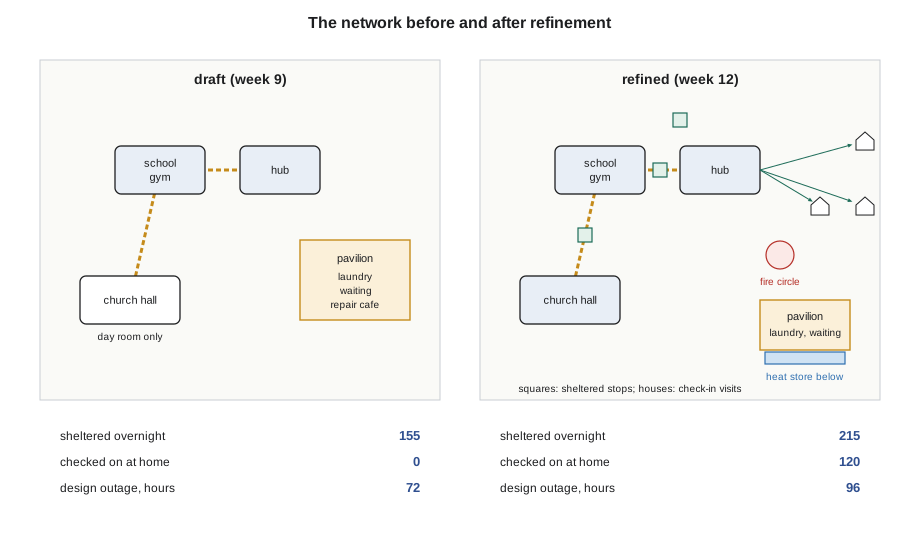
Refining means cutting, and Leclerc gives a test for each thing a student is tempted to keep: does it help answer the question? Ingrid cuts the repair café from the pavilion and moves it into the hub, where it fits and where it brings people every week. She cuts a section of the proposal on the history of shelters, keeping two paragraphs. She cuts a sixth building she had added to the network after the review, a small church farther north, because the night walk showed it was reachable only from a zone that the church hall already serves. And she cuts the idea of a new path roof along the whole route, which was lovely in the sketch but would cost more than all three retrofits together; instead, the lit path has three sheltered stops with benches, heated by the buildings beside them.
She keeps two things that might seem expendable. The fire circle on the hub's lot stays, because Flett asked for it and because it is the one place in the network designed for gathering outside, which matters to the people it is for. And the warm porches stay, the social layer of neighbours who take in neighbours, because the reframed question needs them: they are how the network reaches people who will not walk to the warm rooms.
Comparing the draft and the refinement
Leclerc asks each student to show the committee how the proposal changed, with numbers where possible. Ingrid compares her week-nine draft with the refined proposal.
# Comparing the proposal draft (week 9) with the refined proposal (week 12)
draft = dict(sheltered=155, at_home=0, hours=72, store=900, pavilion=410)
refined = dict(sheltered=215, at_home=120, hours=96, store=1400, pavilion=240)
labels = {"sheltered": "people sheltered overnight", "at_home": "people checked on at home",
          "hours": "design outage, hours", "store": "heat store, kWh",
          "pavilion": "pavilion gross area, m2"}
for k, name in labels.items():
    a, b = draft[k], refined[k]
    change = "" if a == 0 else f"  ({(b - a) / a:+.0%})"
    print(f"{name:30s} {a:>7,} -> {b:>7,}{change}")
served = refined["sheltered"] + refined["at_home"]
print(f"people supported on the worst night: about {served}")
need_low, need_high = 250, 380
print(f"share of the estimated need: {served / need_high:.0%} to {min(1, served / need_low):.0%}")people sheltered overnight 155 -> 215 (+39%) people checked on at home 0 -> 120 design outage, hours 72 -> 96 (+33%) heat store, kWh 900 -> 1,400 (+56%) pavilion gross area, m2 410 -> 240 (-41%) people supported on the worst night: about 335 share of the estimated need: 88% to 100%
The refined network shelters more people overnight, because the church hall's simulation showed it can stay warm, and it reaches about 120 more at home through the check-in team. Together, about 335 people are supported on the worst night, which is about 88% of the high estimate of need and all of the low estimate. The design outage is longer, so the heat store is larger, about 1,400 kWh, roughly a 24 m³ insulated tank of hot water under the pavilion floor. And the pavilion is smaller, because the café has moved and the laundry and waiting room have been tightened. The table makes the refinement visible in a way that a paragraph could not.
Limits and risks
A refined proposal states its limits plainly. Ingrid lists four. Her survey reached 196 households, short of the 200 she aimed for, and under-represents renters in the larger apartment buildings, whose managers did not allow door-to-door visits; she will say so and treat those results with care. Her simulation is calibrated against one weekend in one building; she will add a logger in the church hall over the winter break and calibrate that model too. Her design assumes that the school board and the church will agree to their buildings being used this way; she has letters of interest from both, but not commitments, and she will design so that the network still works if one of them withdraws. And her thesis is about warmth and safety in an outage, not about the cause of outages or the grid's reliability, which she will not try to solve.
She also lists risks to the thesis itself and what she will do about each. The largest is time: the second term must produce the design of a network, three retrofits, a new pavilion and a path, as well as the written thesis, and that is a lot. Her plan is to design the pavilion and the gym retrofit in full, the church hall and the path in less detail, and the warm porches and check-in team as an organizational diagram rather than buildings. Leclerc approves. 'A thesis that does a few things very well is better than one that does everything adequately,' she says.
The plan for next term
The refined proposal ends with a schedule for the second term and a list of deliverables. Ingrid's deliverables are a district plan of the network; the pavilion designed to the level of a design development set, with its heat store and battery; the gym retrofit and its warm room fit-out in plan, section and detail; the church hall and path at a schematic level; the check-in team and warm porches as a diagram with a short protocol; the calibrated simulations of all three buildings; a report back to the community organization in plain language; and the written thesis of about 20,000 words. Her schedule has a mid-term review in week six of the second term, a final review in week thirteen and the exhibition after that.
Each of the others commits in the same way. Wren will design the river station in full, test it against two years of corrected flood levels and design its spring clean-up as part of the architecture. Callum will run twenty specimens per batch for his final joint, use published values for the wood itself, and design the six-storey block and its small factory, with a life-cycle carbon comparison against a spruce cross-laminated timber version. Joon-ho will design the conversion of the Lindell Building, produce a cost study with an estimator, and sort the thirty surveyed buildings into a map that the city could use.
Worked problem
Deciding what to cut
A student's refined proposal still includes a new building, three retrofits, a landscape plan, a public art program and a policy report. The second term is thirteen weeks. How should the student decide what to cut?
Show solution
- List each part and ask whether it is needed to answer the question.
- Keep in full the parts that test the claim most directly, and reduce the others to a lower level of detail.
- Move parts that are valuable but not essential, such as the art program, to a short section of 'further work'.
- Check the reduced scope against a backward schedule for the second term.
Answer: Keep the parts that test the claim, reduce the rest, and name the remainder as further work.
Exercise 11: refine your proposal
- Write your question as it was in week two and as it is now, with a sentence explaining the change.
- For each part of the proposal, ask whether it helps answer the question; cut, reduce or keep.
- Compare your draft and refined proposals with numbers where you can.
- List the limits of your research and the risks to your thesis, with what you will do about each.
- Write the deliverables and schedule for the second term, and check them backward from the final review.
Self-check
- Is your refined proposal smaller and sharper than your draft?
- Have you kept anything only because you love it?
The refined proposal as a document
The refined proposal is not a new document but a revision of the draft, and Leclerc asks the students to keep the revisions visible to the committee. Each student adds a one-page memo at the front listing the conditions and comments from the second review and, for each, what was changed and where, or why it was not. Ingrid's memo has seven lines, matching her feedback tracker. Four say 'done' with a page number. Two say 'changed the design', with a reference to the comparison table. One, the suggestion to add a sixth building, says 'tested and declined: reachable only from a zone the church hall already serves'. The committee reads the memo first, and Abernathy says afterward that it saved her an hour.
The refinement also changes the figures. Ingrid replaces the district map with one that shows the check-in team's routes from the hub as well as the walking routes to the warm rooms, still with zones rather than homes; she adds the church hall's survivability curve to the gym's; and she redraws the program diagram so that each space shows its everyday use, its outage use and the people who run it in each mode. That last column was missing from the draft, and Morningstar had noticed: a network depends on people as much as buildings, and the proposal now says who they are.
Finally, she rewrites the title. The draft was called 'Warm Rooms'. The refined proposal is called 'The Warm Network: keeping a district habitable through a winter outage', because the thesis is no longer about rooms but about how buildings, paths and people together keep the district warm. Leclerc reads it and nods. 'A title that changed for a reason,' she says. 'Good.'
Callum, Wren and Joon-ho refine their titles too. Callum's draft, 'Aspen Structures', becomes 'Prairie Wood: a building system from regional aspen', because the thesis is about a system and a region, not only a species. Wren's draft, 'Flood House', becomes 'A Room on the River', because she no longer wants the flood to be the first thing a reader hears about; it is a condition of the building, not its subject. Joon-ho's 'Office to Home' becomes 'Second Lives: offices into homes', which he likes because it says that the buildings, like the people who will live in them, are getting another chance. Leclerc tells the class that a good title names the subject and hints at the claim, and that a title is worth an afternoon.
Common mistakes
MistakePolishing the draft instead of deciding.
InsteadUse the refinement to cut, reframe and commit.
MistakeHiding how the question changed.
InsteadShow the old and new questions and why they differ.
MistakeClaiming more than the research supports.
InsteadState limits plainly, such as an under-represented group or a single calibration.
MistakePromising to design everything in full.
InsteadDesign a few parts fully and the rest at a lower level of detail.
MistakeCutting the parts that matter to the people the thesis serves.
InsteadKeep them when they help answer the question, even if they seem small.
Summary and key terms
- Refining is deciding: cutting, reframing and committing to the second term.
- Ingrid's refined question asks which buildings and which people can keep vulnerable residents warm through a 96-hour outage, at the warm rooms or at home.
- The refined network shelters about 215 people and checks on about 120 at home, with a larger heat store and a smaller pavilion.
- A refined proposal states its limits and risks and what will be done about each.
- Each student commits to deliverables and a schedule for the second term.
- Refinement
- The stage of a thesis in which the question is sharpened and the scope decided.
- Scope
- The extent of what a thesis will design and study.
- Deliverables
- The drawings, models, reports and documents a thesis will produce.
- Limitation
- A weakness or gap in the research that the author states openly.
- Further work
- Valuable parts of a subject left for later study, named in the thesis.
- Letter of interest
- A written statement of willingness to take part, short of a commitment.
Practice problems
Work each problem on paper first, then reveal the answer to check.
What two reframings changed Ingrid's question?
Show answer
Flett's, that the network must reach people at home, and Abernathy's, to test beyond the 72-hour figure.
Why did Ingrid cut the sixth building?
Show answer
It was reachable only from a zone the church hall already serves.
What replaced the roof over the whole path?
Show answer
Three sheltered stops with benches, heated by the buildings beside them.
How many people does the refined network support on the worst night?
Show answer
About 335: about 215 sheltered and about 120 checked on at home.
How large is the refined heat store?
Show answer
About 1,400 kWh, roughly a 24 m³ insulated hot water tank.
Which group is under-represented in Ingrid's survey?
Show answer
Renters in the larger apartment buildings.
Lesson quiz · 5 questions
Score 60% or more to complete this lesson.
Create a free account to save your progress, take quizzes and earn a certificate.