
ARCH-500 · Lesson 12 of 12 · 22 min
Proposal presentation
The proposal presentations take place on the first Friday of December in the school's main review room, with the walls cleared and the chairs set out in rows for the first time all term. Each student has twenty minutes to present and twenty for questions, followed by a closed meeting of the committee, which decides whether to approve the proposal. The audience includes the committees, Leclerc, the readers from outside, students from every year and, for Ingrid, the director of the community organization, Flett and two residents who took part in the interviews. 'You are not presenting a building,' Leclerc reminds the class in the last week. 'You are presenting a question, the evidence that it matters, and a plan to answer it. If they leave knowing your question and believing you can answer it, you have done your job.'
Planning twenty minutes
Twenty minutes is shorter than it seems, and Leclerc teaches the students to plan it like a design. Start with the question, in one sentence, on the first board or slide, so the audience knows what to listen for. Say why it matters and to whom, with one piece of evidence that makes it real. Show the site and what the literature says, briefly. Spend the most time on methods and early explorations, because that is where the committee will judge whether the thesis can succeed. Show the program and the plan for next term. And end with the question again, sharpened by everything that came between.
Ingrid plans her presentation part by part and adds up the minutes, then checks how many words she will need to prepare at a comfortable speaking pace. She does not write a script to read; she writes the words to know how much she can say.
# A 20-minute proposal presentation: does the plan fit, and where is the question?
parts = [("the question in one sentence", 1.0), ("why it matters, and to whom", 2.5), ("site", 2.5),
         ("what the literature says", 2.5), ("methods and ethics", 3.0), ("early explorations", 4.5),
         ("program and next term", 2.0), ("the question again, sharpened", 1.0)]
limit = 20.0
t = 0
for name, minutes in parts:
    t += minutes
    print(f"{t:5.1f} min  {name}")
print("over by" if t > limit else "spare", f"{abs(limit - t):.1f} min")
words_per_min = 130
print("spoken words to prepare: about", int(round(t * words_per_min, -1)))1.0 min the question in one sentence 3.5 min why it matters, and to whom 6.0 min site 8.5 min what the literature says 11.5 min methods and ethics 16.0 min early explorations 18.0 min program and next term 19.0 min the question again, sharpened spare 1.0 min spoken words to prepare: about 2470
Her plan fits with a minute to spare, which Leclerc says is the right margin: the first presentation of any thesis runs long, because the student knows too much. Ingrid rehearses three times, once alone with a timer, once to Callum and Wren, and once to Abernathy, and cuts a minute from the literature after the first rehearsal and half a minute from the site after the second. The third rehearsal runs nineteen minutes.
Boards, slides and the room
The school asks for both: a set of boards pinned on the wall, which the committee can study before and after the presentation, and a short sequence of projected images for the talk itself. Leclerc's advice is that they should not be the same. The boards hold the full argument at a size readers can study: the question, the literature map, the site and district, the methods and ethics, the explorations, the program, the schedule. The projection holds the few images the talk needs, large and simple, one idea per image. 'If the audience is reading your slide,' she says, 'they are not listening to you.'
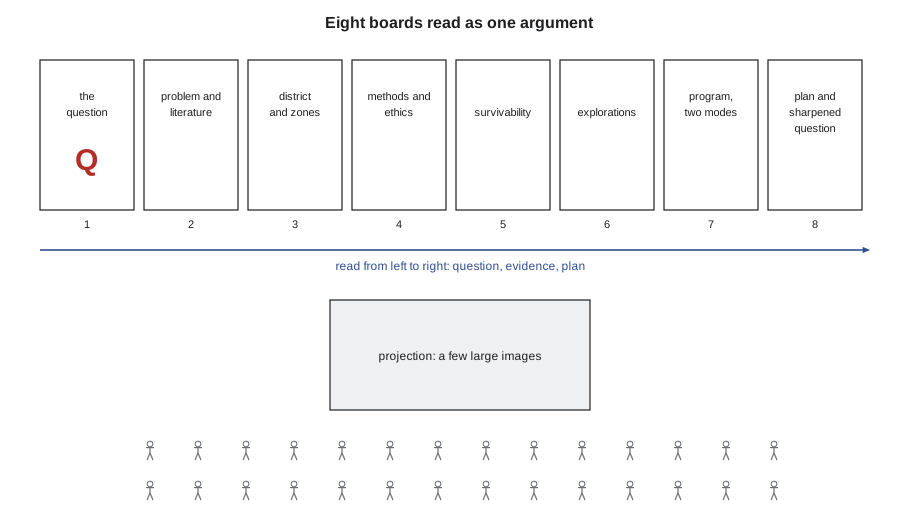
Ingrid lays out her eight boards to be read from left to right, with the question at the top left in the largest type on the wall and the sharpened question at the bottom right. She uses the same terms on every board that she uses in the proposal: 'warm room', 'warm porch', 'check-in team', 'pavilion', 'lit path'. Her district map shows zones, never homes. And she prints a small summary sheet, one page with the question, the network diagram and the plan, for each person in the room, which the residents take home.
Answering questions
The question period is where proposals are won or lost. Leclerc's advice is to welcome questions, to answer the question asked rather than the one the student hoped for, to say 'I don't know yet' when that is true and to say how the thesis will find out, and to keep answers short so that more questions can be asked. When a question is a challenge, the best answer is evidence from the research, briefly; when it is a suggestion, the best answer is thanks and a note. Arguing with a committee member in front of the audience rarely helps.
Ingrid's questions come quickly. Okonkwo asks whether a laundry is really the right everyday use for a building that must be trusted in an emergency, or whether it will become a place nobody cleans. She answers with her interviews: the district has no laundromat within a twenty-minute walk, residents in the walk-ups have no machines, and four interviewees named a laundry before she suggested one; the community organization has agreed to run it, which keeps it staffed. Abernathy asks what happens if the heat store's pump fails. Ingrid answers that the pump has a backup on the battery, and that the gym's added mass gives about 68 hours even without the store, so a pump failure shortens the margin rather than ending it. Morningstar asks the community organization's director, not Ingrid, whether the research has been done in a good way. The director says yes, and adds that the organization wants to use Ingrid's survey method in two other districts next year.
The hardest question comes from a younger student in the back row: if the thesis is about keeping people warm when the power fails, why not just make the grid more reliable? Ingrid answers that a more reliable grid is necessary and that she is not trying to replace it; her question is what happens in the hours or days when it fails anyway, and who is left alone when it does. Leclerc later says that it was her best answer, because it named the limits of the thesis without apologizing for them.
The committee's decision
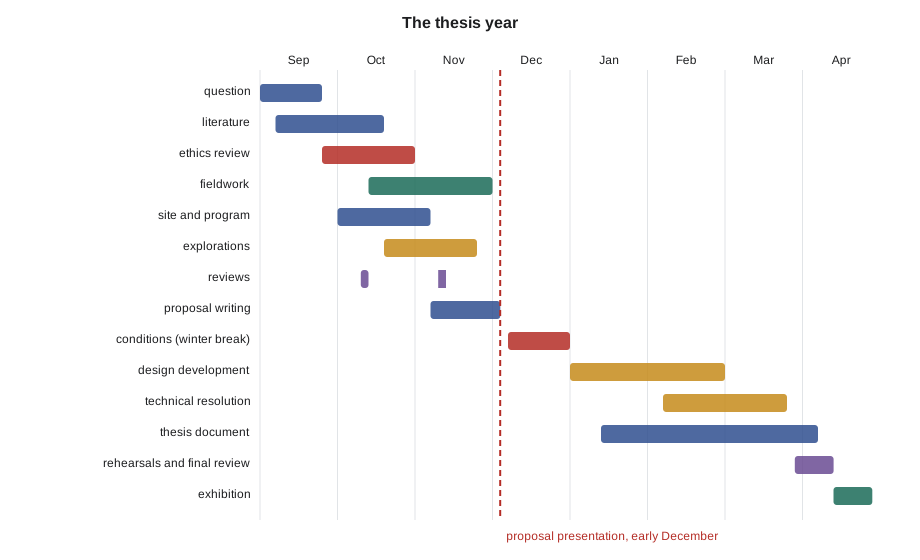
After the question period the committee meets in private for fifteen minutes. A proposal can be approved, approved with conditions, or returned for revision before the second term. Most proposals are approved with conditions, which are specific changes the student must make, usually by the start of the second term. Ingrid's proposal is approved with two conditions: that she adds the church hall's calibration over the winter break to her methods, and that she writes a short protocol for how the results will be returned to the community, in plain language and in the district's main languages, before any further fieldwork. Abernathy tells her that the committee was impressed most by the way the question changed. 'You let the evidence and the people change your question,' she says. 'That is the whole point of a thesis.'
The other three proposals are approved too. Wren's is approved with one condition, that she use the corrected flood levels from the downstream gauge throughout. Callum's is approved with the condition that the twenty-specimen test of his final joint be completed by mid-term. Joon-ho's is approved without conditions, and his external reader, the developer, asks for a copy of his building survey.
Four theses for the second term
The proposals become the briefs for Thesis Studio II. Ingrid's thesis is titled The Warm Network: keeping a district habitable through a winter outage. Its question asks which buildings and which people, organized how, could keep the district's most vulnerable residents warm and safe through a 96-hour winter outage, whether they come to the warm rooms or stay at home. Its site is the district around Burrows Avenue and Marlow Street: the school and hub corner, the church hall beside the seniors' block and the lit path between them. Its program is a retrofitted school gym as the main warm room, the church hall as an overnight room for older residents, the hub's kitchen, a small pavilion with a laundry, a warm waiting room and a heat store and battery, three sheltered stops, a fire circle, the warm porches and a check-in team. Her adviser is Abernathy, with Morningstar and Okonkwo on the committee and Flett as reader from outside.
Wren's thesis is titled A Room on the River. It asks what public building can share a riverbank with the river, flooding every spring and returning to use within a week, so that the neighbourhood keeps its riverside year-round. Its site is the riverside park in Point Douglas on the Red River. Its program is a river station: a raised public room for reading, events and warmth, a boathouse and terrace designed to flood, a flood-watch room and a community kitchen. Her adviser is Desrosiers, with the city hydrologist as reader from outside.
Callum's thesis is titled Prairie Wood: a building system from regional aspen. It asks whether glued, finger-jointed aspen panels and beams can carry six-storey residential buildings, and what architecture follows from them. Its sites are the rail yard parcel next to the Rail Yard Commons and the mill two hours north. Its program is a small factory for the system and a six-storey block of about 40 homes. His adviser is Szymańska, with the provincial forester as reader from outside. Joon-ho's thesis is titled Second Lives: offices into homes. It asks which of downtown's postwar office buildings can become good homes at a cost the city could support, and what must change in a deep floor plate to make them so. Its site is the Lindell Building of 1974 on Portage Avenue and the thirty buildings of his survey. Its program is housing from studios to three-bedroom apartments, two light slots through the upper floors and a public ground floor. His adviser is Bérubé, with the property manager as reader from outside.
Reflection
Leclerc ends the term with a short reflection, written by each student in the week after the presentation, on three questions. What did you believe in September that you no longer believe? What did you learn about your own way of working? What will you do differently next term? Ingrid writes that in September she believed a thesis was a building with research attached, and that she now believes it is research that ends in a building. She writes that she works best when someone outside the profession tells her she is wrong. And she writes that next term she will go back to the district every two weeks, not only when she needs data, because the people there are not her subjects but her readers.
Worked problem
Fitting a presentation
A student plans a 20-minute presentation: question 1 minute, why it matters 3, site 4, literature 4, methods 3, explorations 4, program and plan 2, closing 1. What is wrong with the plan?
Show solution
- The total is 22 minutes, two over the limit.
- Site and literature together take 8 minutes, more than methods and explorations at 7; the committee will judge the thesis mainly on methods and explorations.
- Cut a minute each from site and literature, and move a minute from literature to explorations: site 3, literature 2, explorations 5. The total is then 20.
Answer: It runs two minutes over and gives too little time to methods and explorations; rebalance toward the evidence.
Exercise 12: present your proposal
- Plan your presentation part by part, with the question first and last, and check that it fits with a minute to spare.
- Design boards that hold the full argument and a projection that holds only a few large images.
- Rehearse at least three times, once to your adviser, and cut after each rehearsal.
- Prepare short answers to the questions you most fear, with evidence.
- After the presentation, record the committee's conditions and write your reflection.
Self-check
- Will the audience know your question within the first minute?
- Have you invited the people your thesis serves, and given them something they can take home?
Common mistakes
MistakeStarting with the site or the history.
InsteadStart with the question in one sentence.
MistakePutting the boards on the screen.
InsteadUse boards for the full argument and the projection for a few large images.
MistakeRunning long because you know too much.
InsteadPlan with a minute to spare and rehearse with a timer.
MistakeArguing with a committee member in front of the audience.
InsteadAnswer briefly with evidence, or thank and take a note.
MistakeTreating the presentation as the end.
InsteadRecord the conditions and reflect before the second term begins.
Summary and key terms
- A proposal presentation shows a question, the evidence that it matters and a plan to answer it.
- Plan the twenty minutes with the question first and last and most time on methods and explorations.
- Boards hold the full argument; the projection holds a few large images.
- Answer the question asked, briefly, with evidence; say 'I don't know yet' and how you will find out.
- Ingrid's proposal is approved with two conditions, and the four theses become the briefs for Thesis Studio II.
- Proposal presentation
- The public presentation of a thesis proposal to the committee at the end of the first term.
- Approved with conditions
- A committee decision approving a proposal subject to specific changes.
- Board
- A large printed sheet pinned on the wall as part of a presentation.
- Rehearsal
- A timed practice run of a presentation.
- Summary sheet
- A one-page handout of the question, the key diagram and the plan.
- Reflection
- A short piece of writing on what has changed in the student’s beliefs and way of working.
Practice problems
Work each problem on paper first, then reveal the answer to check.
How long is each proposal presentation and question period?
Show answer
Twenty minutes each, followed by a closed committee meeting.
How did Ingrid answer the question about the laundry?
Show answer
With interview evidence: no laundromat within 20 minutes, no machines in the walk-ups, four residents suggested it, and the organization will run it.
What happens if the heat store's pump fails?
Show answer
A battery backs it up, and the gym's mass alone gives about 68 hours, so the margin shrinks rather than ends.
What were the two conditions on Ingrid's approval?
Show answer
Calibrate the church hall model over the winter break, and write a protocol for returning results to the community before more fieldwork.
What is the title of Callum's thesis?
Show answer
Prairie Wood: a building system from regional aspen.
What did Ingrid write about the people of the district in her reflection?
Show answer
That they are not her subjects but her readers.
Lesson quiz · 5 questions
Score 60% or more to complete this lesson.
Create a free account to save your progress, take quizzes and earn a certificate.