
ARCH-500 · Lesson 7 of 12 · 22 min
Design as research
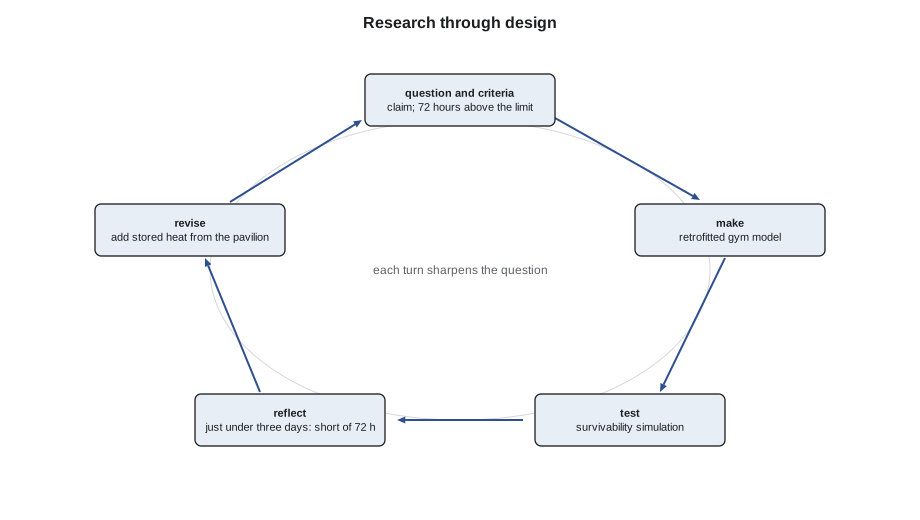
Arslan returns in week seven for the lesson that architects find both the most natural and the most difficult: design as research. 'You already know how to design,' she says. 'What you may not know is how to design so that someone else can learn from it. A design is research when it is made to answer a question, when the criteria for judging it are stated before you start, when the alternatives you tried are recorded, and when you say honestly what it showed, including when it showed you were wrong.'
Research into, for and through design
Arslan introduces a distinction that design researchers have used since the 1990s, when the design educator Christopher Frayling separated three relations between research and design. Research into design studies design itself: how architects work, how buildings were designed in the past. Research for design gathers knowledge that a design will use: surveys of users, measurements of a site, data on materials. Research through design uses the act of designing as the method: a drawing, a model or a prototype is made to find something out that could not be found any other way. Most theses do all three, but research through design is what makes an architectural thesis different from a thesis in history or engineering.
She also reminds them of Donald Schön, the philosopher of professional practice whose book The Reflective Practitioner (1983) described designing as a conversation with the situation. The designer makes a move, the drawing or model talks back, the designer sees something unexpected and makes another move. Schön called this reflection-in-action. A thesis makes that conversation visible: it records the moves, what the situation said back and why the next move followed.
Criteria before making
The first rule of design research is that the criteria come before the design. If a student designs first and then chooses the criteria by which the design looks best, the design proves nothing. Ingrid's criteria come from her program's performance targets: the warm room above about 12 °C for 72 hours without grid power; medical charging within an hour; every zone of greatest need within ten minutes' walk. Her qualitative criteria come from the interviews: the buildings must feel familiar and dignified, and families and pets must be able to stay together. She writes them on a card that she pins above her desk, so that every design move can be checked against them.
A simulation as a design experiment
Her first experiment asks whether the school gym, as it is, could serve as the warm room. She models the gym as a single thermal node: the heat stored in its air, its concrete floor and its block walls, leaking out through the envelope to the cold outside, with about 155 sheltered people adding their body heat. She runs the model for three cases: the gym as it is; the gym with a retrofitted envelope, new insulation on the roof, better windows and air sealing; and the retrofit plus added thermal mass, a layer of heavy material inside the walls and a thicker floor topping that store more heat.
# Design as research: how long does a room stay habitable after the power fails?
# A one-node model: heat stored in the room and structure leaks out through the envelope.
outdoor = -30          # design cold, C
start = 20             # indoor at the moment of the outage, C
limit = 12            # lowest habitable temperature, C
people_heat = 15500        # heat from about 155 sheltered people, W
cases = {"existing gym": (2400, 250000000.0), "retrofit envelope": (800, 250000000.0), "retrofit + thermal mass": (800, 640000000.0)}
for name, (ua, cap) in cases.items():
    t, hours = start, 0
    while t > limit and hours < 240:
        t += (people_heat - ua * (t - outdoor)) * 3600 / cap
        hours += 1
print(f"{name:25s} habitable for about {hours} hours")existing gym habitable for about 6 hours retrofit envelope habitable for about 27 hours retrofit + thermal mass habitable for about 68 hours
The results are the most important finding of her term so far. The existing gym, with its leaky envelope, stays habitable for only about six hours after the power fails in design cold. The retrofit buys about a day. Even with added mass, the gym stays above the limit for about 68 hours, short of the 72-hour target. The claim, as she wrote it, has failed one of its tests, and she is delighted. 'Now I know what the pavilion is for,' she says. A small amount of stored heat, from a well-insulated tank of hot water heated by a heat pump and solar collectors while the grid is up, or from a battery, piped or wired to the gym, would close the gap. Her design question sharpens: how much stored heat, and where?
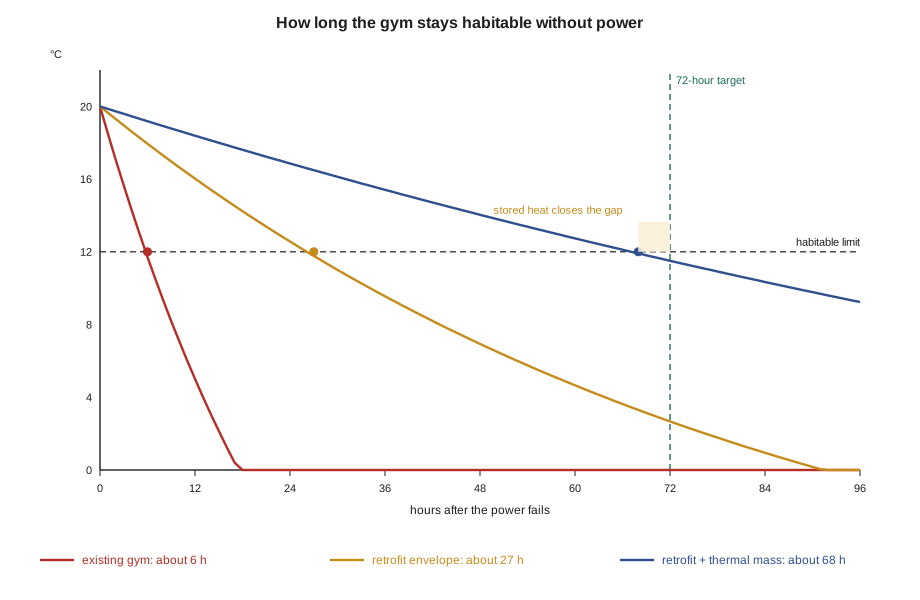
Abernathy asks two questions about the model. How sensitive is the result to the number of people? With fewer people, as on the first night before word spreads, the room cools faster, so the design must work with a smaller crowd too. And has the model been checked against reality? Ingrid's temperature logger in the gym over the cold weekend in October gave a cooling rate that the model, with its first inputs, overpredicted by about a fifth, so she adjusted the envelope's leakage until the model matched the logger. 'Now it is a research instrument,' Abernathy says, 'not a guess with decimals.'
Drawings and models as experiments
Not every design experiment is a simulation. Wren builds a tray model of her riverbank site in sand at a scale of 1 to 200, with the contours of the bank and the flood levels of the past twenty years marked on its side, and pours water into it to see where each flood would reach, how the existing boat launch channels the water and where silt would settle as the water falls. Her experiment is crude, but it shows something her drawings did not: the flood comes up the old launch first and then spreads sideways, so a building placed beside the launch, rather than at the top of the bank, would meet the water early but gently. She records each pour with photographs from a fixed point.
Joon-ho tests the Lindell Building's floor plate with daylight models. He builds a 1:100 model of one floor in card, places it under an artificial sky at the school's lighting lab, and measures the light at points across the floor through the existing windows. The middle of the floor, more than 12 m from any window, is far too dark for living rooms or bedrooms. He then cuts a courtyard into the model, measures again, and records how much of the floor reaches a usable daylight level in each version. The courtyard brings most of the floor within reach of daylight, at the cost of about a fifth of the floor area, which is a trade-off he can now quantify rather than guess.
Callum's experiments are physical in the strictest sense. With Szymańska's test protocol, he glues small beams from aspen strips, finger-jointed and laminated, and breaks them in the school's testing machine, recording the load and deflection at failure. His first five specimens fail at the finger joints, well below the strength the literature predicts for clear aspen. The failure is a finding: the joints, not the wood, govern the system. He changes the joint profile and the glue, cuts a new batch and tests again.
Recording the conversation
Design research is only useful to others if it is recorded. Leclerc asks each student to keep a design log: a dated record of every significant move, why it was made, what it showed and what followed. The log includes failures, which a portfolio would leave out. It is the raw material for the thesis document, which will tell the story of the research honestly, and it protects the student at review when a committee member asks 'did you consider...?' The answer is in the log.
Ingrid's log after two weeks has eighteen entries, from the first gym model to a sketch of a heated water tank under the pavilion floor. Entry 7 reads: 'Retrofit + mass gives 68 h. Short by 4 h. Fewer people on night one makes it worse. Claim fails as written. Need stored heat. Size it next.' Leclerc reads it aloud at the next pin-up. 'That is what research looks like,' she says.
Worked problem
Closing a survivability gap
A warm room loses about 800 W per °C of difference between inside and outside. Halfway through an outage the inside is 14 °C and the outside −30 °C, and the people inside give about 15.5 kW. How much extra heat would hold the temperature steady?
Show solution
- Heat loss: 800 × (14 + 30) = 35,200 W.
- Heat from people: 15,500 W.
- Extra heat needed to hold steady: 35,200 − 15,500 = 19,700 W, or about 20 kW.
- Over the last day of an outage, that is about 470 kWh of stored heat, a guide to the size of the pavilion's tank or battery.
Answer: About 20 kW, or roughly 470 kWh over a day.
Exercise 7: one turn of the loop
- Write the criteria for your first design experiment before you make anything.
- Make one experiment: a simulation, a drawing, a model or a prototype, designed to answer one part of your question.
- Test it against the criteria and record what it showed, including surprises and failures.
- Revise your question or your design in response, and record why.
- Start a design log and keep it from today.
Self-check
- Did you choose the criteria before you saw the result?
- Could another student repeat your experiment from your log?
What counts as a result
Arslan spends the end of the week on a question that troubles many students: when is a design experiment finished, and what counts as its result? A design experiment is finished when it has answered the question it was made to answer, well enough to decide the next move. Its result is not the drawing or the model itself but what the drawing or model showed: a number, a comparison, an observation, a surprise. Ingrid's gym model is finished when it shows how long each version stays habitable; its result is 'about three days with mass, short of 72 hours, with a gap of about four hours that stored heat must close'. Joon-ho's daylight model is finished when it shows how much of the floor reaches usable light with and without the courtyard; its result is the trade-off between daylight and floor area.
Results must be stated with their uncertainty. Ingrid's model is calibrated to one weekend in one building, so its answer is good to within a few hours, not to the hour. Callum's beams are a handful of specimens, so they show which part of the system fails and roughly at what load, not a design value. Wren's sand tray is not to scale for the movement of water and silt, so it shows the order in which places flood, not how fast. Stating these limits does not weaken the experiments; it tells the committee how much weight each can bear. 'A result with its limits stated,' Arslan says, 'is worth ten without them.'
She also asks the students to think about what another architect could do with their result. Ingrid's method, a calibrated one-node model of a candidate building run through a cold outage with the heat of the people inside, could be used by any district to sort its buildings into those worth retrofitting and those not. That is a contribution beyond her own design, and she notes it in her log as something the thesis should say clearly at the end.
Leclerc adds one practical point. Every experiment should be stored so that it can be found and rerun: the model file, its inputs and its outputs, the photographs from the fixed point, the test protocol and the raw readings. A committee member who asks in April how a number in December was produced deserves an answer in minutes, not a week of searching.
Common mistakes
MistakeChoosing criteria after seeing which design looks best.
InsteadWrite the criteria first and pin them above your desk.
MistakePresenting only the designs that worked.
InsteadRecord failures; they are often the findings.
MistakeTreating an uncalibrated simulation as evidence.
InsteadCheck it against measurement before relying on it.
MistakeTesting only under the kindest assumptions.
InsteadTest with fewer people, colder weather or weaker joints too.
MistakeKeeping no record of the design process.
InsteadKeep a dated design log of moves, results and reasons.
Summary and key terms
- A design is research when it answers a question, against criteria stated beforehand, with alternatives recorded and results reported honestly.
- Research into, for and through design are three relations between research and design; through design is the architect's distinctive method.
- Ingrid's survivability model shows the retrofitted gym with added mass lasts about 68 hours, short of 72; stored heat in the pavilion must close the gap.
- Wren's sand tray, Joon-ho's daylight model and Callum's bending tests are design experiments too.
- A design log records the conversation with the situation, including failures.
- Research through design
- Using drawings, models, prototypes or simulations as the method of finding something out.
- Reflection-in-action
- Schön’s term for the designer’s conversation with a situation while designing.
- Design experiment
- A design made to answer a question against stated criteria.
- Calibration
- Adjusting a model so that it matches measurement.
- Design log
- A dated record of design moves, what they showed and why the next move followed.
- Thermal mass
- Heavy material that stores heat and slows temperature change.
Practice problems
Work each problem on paper first, then reveal the answer to check.
What are Frayling's three relations between research and design?
Show answer
Research into, for and through design.
How long does the existing gym stay habitable after the power fails?
Show answer
About six hours.
Why was Ingrid delighted that her claim failed?
Show answer
It showed what the pavilion is for: stored heat to close the gap.
How did Ingrid calibrate her model?
Show answer
With a temperature logger in the gym over a cold weekend, adjusting the leakage until the model matched.
What did Callum's first specimens show?
Show answer
They failed at the finger joints, so the joints, not the wood, govern the system.
What did Wren's sand tray show?
Show answer
The flood comes up the old launch first and then spreads sideways.
Lesson quiz · 5 questions
Score 60% or more to complete this lesson.
Create a free account to save your progress, take quizzes and earn a certificate.