
ARCH-500 · Lesson 3 of 12 · 22 min
Literature and precedent research
By the third week each student has a question and a claim, and Leclerc sends them to the library. Not to the design section, where they would find monographs of famous architects, but to the reference desk, where a subject librarian for architecture and planning runs a two-hour workshop on finding what is already known. 'The most embarrassing moment in a thesis review,' Leclerc tells them beforehand, 'is when a committee member says that someone answered your question twenty years ago, and you have never heard of them.' The aim of the literature review is not to prove that you have read a lot. It is to find out what is known, what is argued about, and what is missing, so that your thesis can stand in the gap.
What counts as literature
In architecture, the literature is wider than in most fields. It includes peer-reviewed research in journals and conference papers, where claims have been checked by other researchers; books, from scholarly monographs to practitioners' manuals; reports from governments, utilities, research councils and nonprofit organizations, often called grey literature, which are not peer-reviewed but are frequently the best source on current practice and policy; codes, standards and guidelines; theses by earlier students; and the built work itself, documented in drawings, photographs, articles and visits. Each kind has its strengths and weaknesses. A journal paper is careful but narrow and may be years old; a government report is current but may serve an agenda; a magazine article about a building is vivid but written to celebrate it.
The librarian shows the students where to search. General academic databases and the university library's catalogue find books and journal articles across fields. Architecture has its own index of periodicals, which lists articles in architecture magazines and journals back to the nineteenth century. Specialized databases cover engineering, environmental science, planning and the social sciences. Government and agency websites hold reports and statistics. And the reference lists of good papers are themselves a search tool: following references backward from a key paper finds the work it built on, and searching for later papers that cite it finds the work that followed.
Searching with a plan
Ingrid starts by writing down the terms her question uses and the other words people might use for the same ideas. 'Passive survivability' is also called 'thermal resilience' or 'habitability during outages'. 'Warming centre' has cousins in 'resilience hub', 'community refuge' and 'cooling centre' in hot climates. She combines terms in searches, records every search and its results in a log so that she can repeat it, and reads abstracts quickly to sort papers into three piles: central, useful and irrelevant. After a week she has about forty central sources. She reads the ten most cited in full, and skims the rest for their findings and methods.
Leclerc warns against two traps. The first is reading forever. 'You will never have read everything,' she says. 'You stop when new sources keep telling you what the old ones did.' This point is sometimes called saturation. The second is reading only the sources that agree with your claim. Ingrid finds a paper arguing that residents rarely use public warming rooms, because they distrust them, cannot reach them or will not leave their pets and belongings; it is the most important paper she reads, because it threatens her claim and tells her what her design must solve.
Mapping the literature
A literature review is not a list of summaries. It is a map of a conversation: who has said what, who agrees and disagrees, what methods they used and what is still unknown. Ingrid draws a literature map, with clusters of sources around the main ideas and lines where sources cite one another or argue. Three clusters appear: building physics, about how long buildings stay warm without power; emergency management, about how cities run shelters; and community studies, about why people do or do not use them. The clusters barely touch. Engineers simulate buildings without asking who will come; emergency planners count cots without asking whether the room will stay warm; and community researchers describe trust without asking what kind of building earns it.
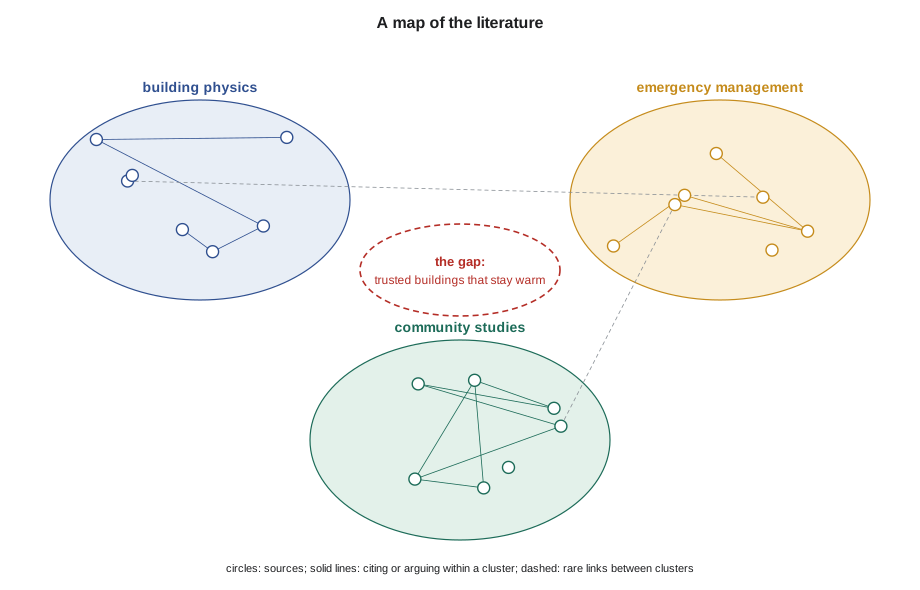
The empty space in the middle of the map is her gap. Her thesis can bring the three conversations together: a building that stays warm, that the emergency system can run, and that residents trust enough to use. Leclerc says that this is the strongest outcome a literature review can have. 'You found a gap that is not just unread; it is a gap between disciplines. Architects are good at those.'
Ingrid checks the gap with a quick count of which ideas appear together in the abstracts she has collected. The script is rough, but it confirms what the map suggests: physical words like 'habitable' and 'power' travel together, social words like 'trust' and 'community' travel alone, and almost no abstract uses both.
# Keyword co-occurrence across short abstracts: which ideas travel together in the literature?
from itertools import combinations
from collections import Counter
abstracts = [
    "extreme cold and power outages expose how few public buildings can shelter residents",
    "passive survivability measures how long a building stays habitable without power",
    "community resilience hubs combine shelter, food and information during outages",
    "libraries act as warming and cooling hubs for vulnerable residents",
    "thermal mass and airtight envelopes extend habitable hours without power",
    "trust and familiarity decide whether residents use a shelter in an emergency",
]
keys = ["cold", "outage", "shelter", "residents", "power", "habitable", "community", "trust", "envelope", "libraries"]
def has(text, k):
    return k[:5] in text
pairs = Counter()
for a in abstracts:
    present = [k for k in keys if has(a, k)]
    for p in combinations(sorted(present), 2):
        pairs[p] += 1
for (a, b), n in pairs.most_common(6):
    print(f"{n}  {a} + {b}")
alone = [k for k in keys if sum(has(a, k) for a in abstracts) == 1]
print("mentioned once:", ", ".join(alone))2 outage + shelter 2 residents + shelter 2 habitable + power 1 cold + outage 1 cold + power 1 cold + residents mentioned once: cold, community, trust, envelope, libraries
Precedents as evidence
Architecture adds a second kind of literature: precedents, built or unbuilt projects that answered a similar question. Leclerc asks the students to treat precedents as evidence, not as images. A precedent study asks what question the project was answering, what it did, what happened afterward, and what the student's thesis can learn from it. That last part requires information that the architect's own publicity rarely gives: how the building is used, what failed, what it cost and whether people like it. Interviews, visits, post-occupancy studies and local news are often more useful than glossy photographs.
Each student assembles about a dozen precedents. Wren studies buildings and landscapes designed to flood: the water squares of Rotterdam, where public plazas become stormwater basins in heavy rain; the Dutch national program that gave rivers room to spread by moving dikes and lowering floodplains; stilt houses and floating villages along the rivers of Southeast Asia; and riverside parks in North American cities that are designed to go under each spring and are cleaned afterward. Callum studies timber research and buildings: the tall timber residence at the University of British Columbia, beech laminated veneer lumber produced in Germany, and research reports on aspen and poplar from Canadian forest products laboratories. Joon-ho studies office-to-housing conversions in Calgary, whose downtown program has funded conversions since the early 2020s, and conversions of deep buildings elsewhere that cut courtyards or light wells into their floors.
Ingrid's precedents are the hardest to find, because most warming rooms are ordinary rooms in libraries, schools and recreation buildings that no architect designed for the purpose. She finds a handful of resilience hubs in North American cities, community buildings with solar panels and batteries that keep a room powered in an outage; Passive House schools in cold climates whose thermal performance has been measured; and post-disaster reports on what happened in shelters during long winter outages. She also includes one precedent from the district itself: the community hub's refuge room, designed in the second-year studio, which she now reads critically. 'We designed it for six hours,' she says. 'Nobody asked what happens on the third day.'
Keeping track and citing
A thesis needs a reference system from the first day, because reconstructing sources in the last week is miserable and error-prone. The school uses the Chicago Manual of Style, whose eighteenth edition appeared in 2024, and allows either its notes-and-bibliography system, common in history and the humanities, or its author-date system, common in the sciences and social sciences. Leclerc recommends author-date for theses with a lot of technical literature, and notes for theses built on archives and history. Joon-ho, whose thesis relies on archival drawings and city records, chooses notes; Ingrid, Callum and Wren choose author-date. All four use reference management software, which stores sources, notes and files and formats citations automatically.
Callum, who distrusts software he cannot see inside, writes a small tracker that stores sources as records and prints references and in-text citations in author-date form. It is not a replacement for a reference manager, but it shows what a reference manager does.
# A small literature tracker that prints Chicago author-date references and in-text citations
sources = [
    dict(kind="book", authors=["Groat, Linda N.", "David Wang"], year=2013,
         title="Architectural Research Methods", place="Hoboken, NJ", publisher="Wiley", ed="2nd ed."),
    dict(kind="article", authors=["Hutcheon, Neil B."], year=1963,
         title="Requirements for Exterior Walls", journal="Canadian Building Digest", vol="48"),
    dict(kind="book", authors=["Sch\u00f6n, Donald A."], year=1983,
         title="The Reflective Practitioner", place="New York", publisher="Basic Books"),
]
def names(a):
    if len(a) == 1: return a[0]
    return ", ".join(a[:-1]) + ", and " + a[-1]
def ref(s):
    head = f"{names(s['authors']).rstrip('.')}. {s['year']}. "
    if s["kind"] == "book":
        ed = f" {s['ed']}" if s.get("ed") else ""
        return head + f"{s['title']}.{ed} {s['place']}: {s['publisher']}."
    return head + f"“{s['title']}.” {s['journal']} {s['vol']}."
def cite(s, page=None):
    last = [a.split(",")[0] if i == 0 else a.split()[-1] for i, a in enumerate(s["authors"])]
    who = " and ".join(last) if len(last) < 3 else last[0] + " et al."
    return f"({who} {s['year']}" + (f", {page})" if page else ")")
for s in sorted(sources, key=lambda s: s["authors"][0]):
    print(ref(s))
print(cite(sources[0], 25), cite(sources[1]))Groat, Linda N., and David Wang. 2013. Architectural Research Methods. 2nd ed. Hoboken, NJ: Wiley. Hutcheon, Neil B. 1963. “Requirements for Exterior Walls.” Canadian Building Digest 48. Schön, Donald A. 1983. The Reflective Practitioner. New York: Basic Books. (Groat and Wang 2013, 25) (Hutcheon 1963)
Citation is not only a matter of form. Every claim in a thesis that depends on someone else's work must say whose work it is, and every quotation, image and drawing must be credited. Images of other architects' buildings may be used for criticism and study, with credit; copying another student's text or drawings without credit is plagiarism, and so is presenting text produced by software as your own words when the school's policy requires it to be disclosed. Leclerc asks the students to keep a short note of where and how they used any software tools to draft or analyze, so that they can explain it if asked.
Worked problem
A synthesis matrix
Ingrid has six central sources. How can she organize them to write a review rather than a list?
Show solution
- Make a table with sources as rows and the themes of the review as columns: building physics, emergency operations, trust and access, and methods.
- In each cell, note in a phrase what the source says on that theme, or leave it empty.
- Read down each column to write a paragraph on that theme, comparing sources and noting where they disagree.
- Look for empty columns and empty combinations: they are where the literature is silent.
Answer: A matrix by theme turns summaries into a comparison and shows the gaps.
Exercise 3: map what is known
- Run a planned search with synonyms for your key terms, and keep a log of every search.
- Sort sources into central, useful and irrelevant, and read the central ones in full.
- Draw a literature map with clusters and lines, and mark the gap your thesis will occupy.
- Assemble about a dozen precedents and, for each, write what question it answered and what happened afterward.
- Set up your reference system and cite as you read.
Self-check
- Have you found at least one source that argues against your claim?
- Can you say in two sentences what is known, what is disputed and what is missing?
Common mistakes
MistakeListing summaries of sources one after another.
InsteadOrganize the review by theme and compare sources within each theme.
MistakeReading only sources that agree with your claim.
InsteadSeek out the strongest argument against it.
MistakeTreating precedents as pictures to imitate.
InsteadTreat them as evidence: their question, their result and their aftermath.
MistakeLeaving citations for the last week.
InsteadCite from the first day with a reference manager.
MistakeReading forever.
InsteadStop when new sources repeat what earlier ones said.
Summary and key terms
- The literature review finds what is known, what is disputed and what is missing.
- Architecture's literature includes research, books, reports, codes, theses and the built work itself.
- A literature map shows clusters of conversation and the gaps between them.
- Precedents are evidence: the question they answered, what they did and what happened afterward.
- The school uses the Chicago Manual of Style, eighteenth edition (2024), in either author-date or notes form.
- Literature review
- An organized account of what is known and argued about a question.
- Report literature
- Reports and documents from governments, agencies and organizations that are not peer-reviewed, often called grey literature.
- Saturation
- The point at which new sources mostly repeat what earlier sources said.
- Citation chaining
- Following references backward from a source, and later citations forward from it.
- Precedent study
- Analysis of an earlier project as evidence for the thesis.
- Synthesis matrix
- A table of sources against themes, used to compare sources and find gaps.
Practice problems
Work each problem on paper first, then reveal the answer to check.
What is the aim of a literature review, according to Leclerc?
Show answer
To find what is known, disputed and missing, so the thesis can stand in the gap.
What are the three clusters in Ingrid's literature map?
Show answer
Building physics, emergency management and community studies.
Which source mattered most to Ingrid, and why?
Show answer
A paper showing residents rarely use warming rooms; it threatened her claim and showed what her design must solve.
What questions should a precedent study ask?
Show answer
What question it answered, what it did, what happened afterward and what the thesis can learn.
Which edition of the Chicago Manual of Style does the school use?
Show answer
The eighteenth, published in 2024.
Why does Joon-ho choose notes rather than author-date?
Show answer
His thesis relies on archival drawings and records, for which notes work better.
Lesson quiz · 5 questions
Score 60% or more to complete this lesson.
Create a free account to save your progress, take quizzes and earn a certificate.