
ARCH-500 · Lesson 1 of 12 · 23 min
What an architectural thesis is
The final year of the master's program begins in September with an empty room. The studio that held twelve desks of models and drawings last spring has been cleared to the walls, and on the long pin-up board at one end the thesis coordinator, Professor Margot Leclerc, has pinned a single sheet with a single sentence: 'A thesis is an argument you can walk through.' Leclerc is an architect and historian who has supervised more than sixty theses at three schools. She tells Wren, Callum, Ingrid and Joon-ho that this is the only studio in the program in which nobody will give them a brief. 'For six years you have answered questions other people asked,' she says. 'This year you ask one yourself, you find out what is already known about it, and you answer it with a building, a place or a way of building that nobody has drawn before.'
The thesis runs over two terms. This course, Thesis Studio I, covers the first: choosing a question, researching it, finding a site and a program, making the first design explorations and writing a thesis proposal that a committee can approve. The second course, Thesis Studio II, takes the approved proposal through design to a final review and an exhibition. Leclerc coordinates both courses; each student also has an adviser chosen for the subject of the thesis, and a committee of the adviser and two other readers who see the work at the reviews.
Why a school asks for a thesis
Leclerc gives three reasons why schools of architecture end with a thesis rather than one more studio. The first is independence. An architect in practice will spend a career framing problems as much as solving them: a client arrives with a request for a building, and the architect's best work is often to discover that the real problem is different. A thesis is a rehearsal for that discovery, made safely in school. The second is depth. Studios move quickly from project to project; a thesis gives a year to one subject, long enough to read the literature, talk to the people affected, test ideas and change your mind. The third is contribution. A good thesis adds something to what the profession knows: a method, a type, a way of seeing a place, or a careful demonstration that an idea works or does not.
The accrediting bodies expect this kind of work too. Programs in Canada are accredited by the Canadian Architectural Certification Board, whose conditions ask graduates to show research and the ability to frame and test design questions. Leclerc does not dwell on accreditation. 'The board is not your audience,' she says. 'Your audience is the people who will live with what you propose and the architects who will read your thesis in ten years and wonder whether you were right.'
Four kinds of thesis
Theses differ in how research and design relate. Leclerc sketches four kinds on the board and pins up an example of each from past years. In a research-led thesis, a question about the world comes first: how do older people in a district use public space in winter, or how much carbon is stored in the city's existing buildings. The research produces findings, and the design applies them to a site, testing whether they hold. In a design-led thesis, a proposition about architecture comes first: a new type of building, a way of using a material, a response to a kind of site. The design is the research; drawings and models are the experiments, and the written thesis explains what they show.
In a speculative thesis, the question is about a future that does not exist yet: a city after the car, a building for a climate that is coming, a public institution that the city does not have. Speculation is legitimate research when it is disciplined: the future must be plausible, its assumptions stated, and the design must show consequences that a reader can judge. In a community thesis, the question comes from a group of people and is answered with them: a neighbourhood organization that needs a building, a First Nation planning a school, a tenants' association facing redevelopment. The research methods are partly social, and the student must be accountable to the people involved, not only to the school.
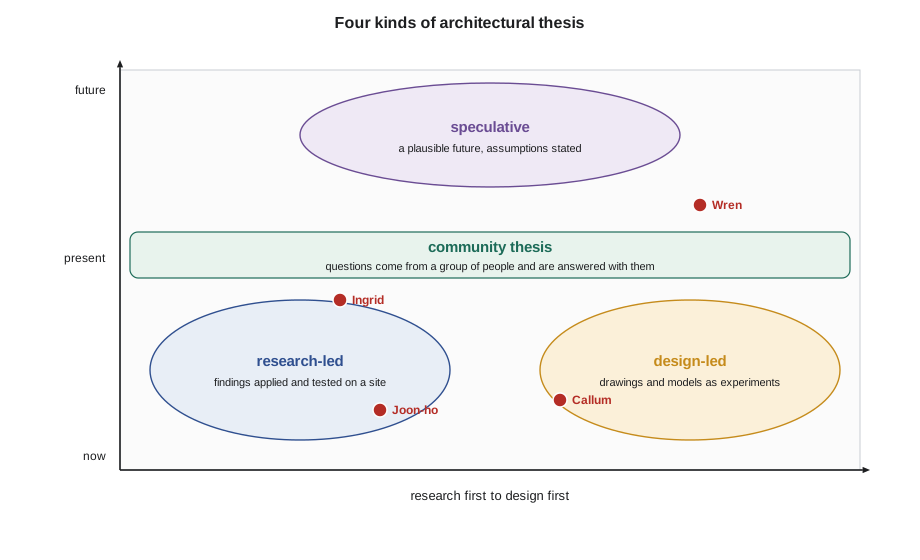
Most real theses mix the kinds. Leclerc asks each student to say which kind their thesis leans toward, because the kind decides what evidence the committee will expect. A research-led thesis must show its data and its methods; a design-led thesis must show its iterations and the criteria by which one design is better than another; a speculative thesis must show its assumptions; a community thesis must show who was involved and how they shaped the result.
Four students, four beginnings
The four students arrive with very different starting points, and Leclerc asks each to describe in two minutes what they want to work on. Ingrid begins with a memory: a week of deep cold in a recent winter, when the grid operator in a neighbouring province sent an emergency alert asking everyone to cut their use of electricity, and she wondered what would happen in her district if the power went out. Her studio work on the community hub, its heat pumps and its refuge room, made her curious about passive survivability, the number of hours a building stays habitable without power. She wants to work on how a whole district might keep its most vulnerable residents warm. Leclerc tells her this is a research-led thesis with a strong community side, and that it will need careful ethics.
Wren wants to work on the river. Her public library sat on the riverbank behind a setback, raised above the flood level, and she felt that it turned away from the water that made the site worth having. She asks whether a public building could be designed to flood every spring and return to use within days, the way some buildings in the Netherlands and along the Mekong do. Leclerc calls this design-led, with a speculative edge, and asks her what she would need to know about floods to make the speculation honest.
Callum wants to work on wood. Every timber building the class has designed used spruce, pine or fir glulam and cross-laminated timber shipped from British Columbia, the Pacific Northwest or Europe. The forests near the city are mostly trembling aspen and other poplars, which are used for pulp and oriented strand board but rarely for structure. He wants to know whether a structural system could be made from the wood that grows nearby, and what architecture would follow from its sizes and strengths. Leclerc calls this research-led and design-led at once: a material question that must end in a building.
Joon-ho wants to work downtown. Office buildings in the downtown have stood partly empty since the pandemic, and the city has started offering incentives to convert them to housing. He wants to know which of them can become good homes, and what has to change in a deep office floor to make apartments with light and air. Leclerc calls this a research-led thesis about reuse, and suggests that Professor Solange Bérubé, who taught the heritage course, would make a good adviser.
What a thesis is not
Leclerc spends the last part of the first seminar on misunderstandings, because each year some students lose a term to them. A thesis is not a topic. 'Housing' is a topic; 'how a deep office floor can be cut to bring daylight to apartments in a cold city' is the beginning of a question. A thesis is not a building type with a site attached. A student who says 'my thesis is a museum on the waterfront' has a program and a site but no question; the committee will ask what the museum is trying to find out. A thesis is not a manifesto. Strong convictions are welcome, but a thesis must allow the possibility that its first idea is wrong. And a thesis is not the last studio done more slowly. It needs research that a studio does not, and a written argument that stands beside the drawings.
The committee will judge a thesis by a few questions, which Leclerc writes on the board. Is the question clear and worth asking? Does the student know what has already been said and built about it? Are the methods suited to the question, and were they used carefully and ethically? Do the design and the writing answer the question, and is the answer convincing to someone who did not want to be convinced? Does the work add something that others can use? 'You will be asked these at every review,' she says. 'Write them inside the cover of your notebook.'
The year at a glance
The first term has a rhythm that the course follows. The first three weeks are for the question and the literature. Weeks four to six are for site, program and methods, with fieldwork starting as soon as ethics approval allows. Weeks seven to nine are for early design explorations, which test whether the question can be answered by design. A first review in week six and a second review in week ten bring in the committee. The last weeks are for writing and refining the thesis proposal, and the term ends with the proposal presentation, after which the committee approves the proposal, approves it with conditions, or asks for changes before the second term begins.
Ingrid, who likes plans, makes a backward schedule from the presentation date. She lists the tasks with the number of working weeks each needs and counts back from the presentation, to see when she must start each one.
# Backward planning: work back from the proposal presentation to today
from datetime import date, timedelta
present = date(2026, 12, 4)          # proposal presentation (end of term)
tasks = [                             # (task, working weeks needed), last task first
    ("rehearse and print the boards", 1),
    ("write and revise the proposal document", 3),
    ("second review and refinements", 2),
    ("early design explorations", 3),
    ("site and program studies", 2),
    ("literature, precedents and fieldwork", 3),
    ("choose and test the question", 1),
]
end = present
plan = []
for name, weeks in tasks:
    start = end - timedelta(weeks=weeks)
    plan.append((start, end, name))
    end = start
for start, finish, name in reversed(plan):
    print(f"{start:%d %b} to {finish:%d %b}  {name}")
first = plan[-1][0]
print("work must start by", f"{first:%d %b %Y}", "for", sum(w for _, w in tasks), "weeks of work")
term_start = date(2026, 9, 2)
slack = (first - term_start).days
print("slack before the first task:", slack, "days" if slack >= 0 else "days, so the plan does not fit the term")21 Aug to 28 Aug choose and test the question 28 Aug to 18 Sep literature, precedents and fieldwork 18 Sep to 02 Oct site and program studies 02 Oct to 23 Oct early design explorations 23 Oct to 06 Nov second review and refinements 06 Nov to 27 Nov write and revise the proposal document 27 Nov to 04 Dec rehearse and print the boards work must start by 21 Aug 2026 for 15 weeks of work slack before the first task: -12 days, so the plan does not fit the term
The answer is sobering: her plan needs fifteen weeks of work, and the term has only thirteen and a half, so the plan does not fit by about twelve days. Leclerc is not surprised. 'Everyone's first plan is too long,' she says. 'You will not get more weeks. Decide now what you will do less of.' Ingrid shortens the literature and fieldwork to two weeks by starting the survey design while she reads, and she overlaps the site studies with the early explorations, because her site and her program are bound together. Her second plan fits, with three days to spare.
Worked problem
Backward planning
A student's proposal presentation is on 4 December. Writing and revising the proposal needs three weeks, the second review and refinements two weeks, and rehearsal one week. When must writing begin?
Show solution
- Count back from 4 December: rehearsal takes one week, so writing must end by 27 November.
- Writing takes three weeks, so it must begin by 6 November.
- The second review and refinements must therefore fit between 23 October and 6 November.
Answer: Writing must begin by 6 November, and the second review must happen by about 23 October.
Exercise 1: a thesis in a paragraph
- Write one paragraph on what you want to work on and why it matters to you.
- Say which kind of thesis it leans toward: research-led, design-led, speculative or community, and what evidence that kind demands.
- List three things you already know about the subject and three you would need to find out.
- Make a backward schedule from the proposal presentation, and decide what to do less of if it does not fit.
Self-check
- Is what you have a topic, a program or a question?
- Could your first idea turn out to be wrong, and would you be able to tell?
- Who, apart from the school, would care about the answer?
Common mistakes
MistakeStarting with a building type and a site and calling it a thesis.
InsteadStart with a question that a building, a place or a method could answer.
MistakeTreating the thesis as the last studio done more slowly.
InsteadPlan research, writing and design as three parts of one argument.
MistakeWriting a manifesto that cannot be proven wrong.
InsteadHold your convictions, but state what evidence would change your mind.
MistakeAssuming there is plenty of time.
InsteadPlan backward from the presentation and decide early what to cut.
Summary and key terms
- A thesis is an argument you can walk through: a question, research on what is known, and an answer by design.
- Schools ask for a thesis for independence, depth and contribution.
- Theses lean toward research-led, design-led, speculative or community work, and each kind demands different evidence.
- Ingrid, Wren, Callum and Joon-ho begin with outage and warmth, the river, regional wood and empty offices.
- The first term moves from question to literature, site, methods, explorations and a thesis proposal, with two reviews.
- Thesis
- An independent argument, made in research, design and writing, that answers a question its author asked.
- Thesis proposal
- A document that states the question, its context, site, program, methods and plan, for a committee to approve.
- Adviser
- The faculty member who guides a thesis week to week.
- Committee
- The adviser and other readers who review and approve the thesis.
- Passive survivability
- The time a building stays habitable without power or fuel.
- Backward planning
- Scheduling from a fixed end date back to the start, to see when each task must begin.
Practice problems
Work each problem on paper first, then reveal the answer to check.
Name the four kinds of thesis Leclerc describes.
Show answer
Research-led, design-led, speculative and community theses.
Why is 'a museum on the waterfront' not yet a thesis?
Show answer
It is a program and a site without a question.
What did Ingrid's first schedule show?
Show answer
It needed 15 weeks of work in a 13.5-week term, so it did not fit by about 12 days.
Which kind of thesis must show who was involved and how they shaped the result?
Show answer
A community thesis.
What three reasons does Leclerc give for the thesis?
Show answer
Independence, depth and contribution.
What does a speculative thesis need in order to count as research?
Show answer
A plausible future, stated assumptions and consequences a reader can judge.
Lesson quiz · 5 questions
Score 60% or more to complete this lesson.
Create a free account to save your progress, take quizzes and earn a certificate.