
ARCH-450 · Lesson 3 of 12 · 21 min
Heritage law in Canada and the Standards and Guidelines
Élise Gagnon, the heritage consultant who advised the students on the Harland Building's neighbour in Design Studio V, joins the class for the third week. She arrives with a box of files on the Stanfield: the designation report, two applications for permits from the 1990s that were never built, a set of photographs from a survey in the 1970s and a thick folder of correspondence between the owner and the city. 'Charters tell you what good conservation is,' she says. 'Law tells you what you must do, and standards tell you how your work will be judged. You need all three, and you need to know which is which before you draw a line.'
How heritage is protected in Canada
Heritage protection in Canada is divided among the three levels of government, and most of the real protection of buildings happens at the provincial and municipal levels. The federal government designates places, people and events of national historic significance on the advice of the Historic Sites and Monuments Board of Canada, under the Historic Sites and Monuments Act of 1953. Designation as a national historic site is an honour that brings a plaque and a place in the national story, but for a privately owned building it brings no legal protection: the owner of a national historic site that the federal government does not own may alter or even demolish it unless a province or municipality protects it. Federal buildings are reviewed by the Federal Heritage Buildings Review Office, set up in 1982, and separate laws protect heritage railway stations and heritage lighthouses.
Canada has long been described as the only G7 country without a federal law protecting the historic places that the federal government itself owns. A bill to fix this, the Historic Places of Canada Act, was introduced in the House of Commons as Bill C-23 and reached second reading in March 2023. It would have given legal force to the designation of federal historic places, required federal owners to apply the federal conservation standards before changing them and to consult Parks Canada before altering or disposing of them, and added First Nations, Inuit and Métis members to the Historic Sites and Monuments Board. The bill died when Parliament was prorogued in January 2025, and heritage organizations were still pressing for new legislation in late 2025.
The provinces have their own heritage acts, and these give real protection. Manitoba's Heritage Resources Act allows the province to designate provincial heritage sites and enables municipalities to designate and protect municipal heritage sites. Under its Historical Resources By-law, the City of Winnipeg keeps a List of Historical Resources, together with a Nominated List and a Commemorative List. A building on the List of Historical Resources cannot be altered in ways that affect its character-defining elements, or demolished, without a heritage permit, and the city's heritage staff and committee review applications against the national standards. The Stanfield, listed by the city decades ago and standing within the Exchange District National Historic Site designated in 1997, is protected by this by-law, not by its place in the national historic site.
The Standards and Guidelines
The Standards and Guidelines for the Conservation of Historic Places in Canada were first published in 2003 as part of a federal, provincial and territorial initiative, and a second edition followed in 2010. Every jurisdiction in the country has adopted them as its benchmark for conservation work, and the federal government applies them to its own heritage buildings. When Winnipeg's heritage staff review a permit for the Stanfield, they ask whether the work follows the Standards and Guidelines.
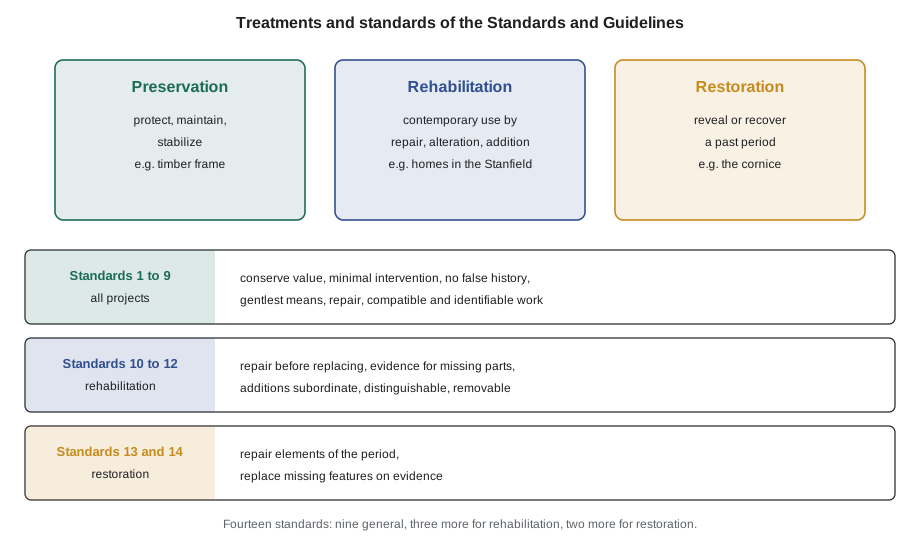
The document defines three conservation treatments. Preservation protects, maintains and stabilizes the existing materials, form and integrity of a historic place while protecting its heritage value. Rehabilitation makes possible a continuing or compatible contemporary use of a historic place through repair, alteration or addition, while protecting its heritage value. Restoration accurately reveals, recovers or represents the state of a historic place as it appeared at a particular period in its history, while protecting its heritage value. Most projects combine treatments: the Stanfield will be rehabilitated as a whole, while its cornice may be restored and its timber frame preserved.
There are fourteen standards. The first nine apply to every project. In paraphrase, they ask the designer to conserve the heritage value of a place and not to remove or substantially alter its intact or repairable character-defining elements; to conserve changes that have acquired heritage value over time; to conserve heritage value by adopting an approach that calls for minimal intervention; to recognize each place as a physical record of its time and use, and not to create a false sense of history by adding features from other places or properties or by combining features that never coexisted; to find a use that requires minimal or no change to character-defining elements; to protect and if necessary stabilize a place until a use is found, and to document and protect archaeological resources; to evaluate the condition of character-defining elements to determine the appropriate intervention, using the gentlest means possible; to maintain character-defining elements on an ongoing basis, repairing by reinforcing materials using recognized methods and replacing in kind only what is too deteriorated to repair, where there are surviving prototypes; and to make any intervention physically and visually compatible with the historic place and identifiable on close inspection, documenting it for future reference.
Three further standards apply to rehabilitation: repair rather than replace character-defining elements, and replace only with forms that are compatible in material and detail where the elements are too deteriorated to repair; replace missing parts of elements with new parts based on documentary and physical evidence, or, where evidence is insufficient, with new work compatible with the place; and make new additions and related new construction so that the essential form and integrity of the place would be unimpaired if the new work were removed in the future, with new work physically, visually and functionally compatible with, subordinate to and distinguishable from the historic place. Two further standards apply to restoration: repair rather than replace elements from the restoration period, and replace missing features from that period with new features based on documentary or physical evidence.
The Standards and Guidelines also describe a decision-making process in three steps. Understanding means investigating the place, its history and its condition and confirming its heritage value and character-defining elements. Planning means deciding on the primary treatment, identifying the use and the requirements of the project, and developing the design. Intervening means carrying out the work and documenting it. The guidelines that follow the standards are organized by type of historic place, including cultural landscapes, archaeological sites, buildings and engineering works, and by material, from masonry and wood to concrete and architectural metals, with recommended and not recommended actions for each.
Incentives for rehabilitation in Canada
Canada has no federal tax credit for heritage rehabilitation. A federal incentive fund for commercial heritage buildings ran in the early 2000s but was not continued, and heritage organizations have long argued for a federal credit modelled on the American one. Incentives in Canada therefore come mostly from provinces and cities. Winnipeg offers two main programs. The Heritage and Economic Development Incentive program provides grants of up to 80% of the increase in municipal property taxes that results from the redevelopment of a vacant or underused heritage building, for up to ten years. The Gail Parvin Hammerquist Fund offers smaller grants for capital projects that conserve heritage buildings and for research and interpretation. The province offers heritage grants as well.
# Heritage and Economic Development Incentive: grant estimate for the Stanfield
# Grant: up to 80% of the increase in municipal property tax, for up to 10 years
tax_before = 38_000          # municipal tax per year on the vacant building
tax_after = 214_000          # municipal tax per year after rehabilitation (estimate)
share, years = 0.80, 10
rate = 0.05                  # discount rate for present value
increment = tax_after - tax_before
grant = share * increment
pv = sum(grant / (1 + rate) ** t for t in range(1, years + 1))
print(f"tax increment {increment:,} per year")
print(f"grant {grant:,.0f} per year for {years} years, {grant * years:,.0f} in total")
print(f"present value at {rate:.0%}: {pv:,.0f}")tax increment 176,000 per year grant 140,800 per year for 10 years, 1,408,000 in total present value at 5%: 1,087,220
The grant is useful but modest. Its present value, a little over a million dollars, is a small fraction of the cost of rehabilitating a building of this size, and it is paid only after the work is complete and the new taxes are being collected. Gagnon explains that heritage projects in Canada are usually financed in the same way as other housing and commercial projects, with heritage grants added at the margin, and that the cost of the heritage work must be justified mostly by the value of the building itself.
Worked problem
Checking a proposed change against the standards
The owner's earlier scheme, from the 1990s, proposed to remove the timber floors in the middle third of the building to create an atrium, to replace all the windows with new aluminum units of a different pattern, and to add two storeys of glass on the roof flush with the avenue facade. Evaluate it against the Standards and Guidelines.
Show solution
- Atrium: removing a third of the timber floors removes character-defining elements and much of the open floor plates; the standards' requirement not to remove intact or repairable character-defining elements and to find a use requiring minimal change argue against it unless a smaller opening can meet the need.
- Windows: replacing repairable windows wholesale and changing their pattern is contrary to the standards on repair before replacement and in-kind replacement.
- Roof addition: two storeys flush with the facade would dominate the historic building rather than being subordinate to it.
- Conclusion: the scheme would not be approved as proposed; a revised scheme would retain the floors, repair the windows and set back a smaller addition.
Answer: The 1990s scheme fails on three counts, which is why it was never built; each failure points to a better design move.
Exercise 3: the regulatory map
- Find the heritage designation of a building near the school on the Canadian Register of Historic Places or the city's list, and summarize what it protects.
- Identify which level of government would review a proposed alteration to the Stanfield, and which standards it would apply.
- List the incentives that might help fund the Stanfield's rehabilitation, and estimate the value of one.
- Rewrite one of the standards in your own words and give an example of a design decision it would affect.
Self-check
- Can I distinguish between designation that recognizes a place and designation that protects it?
- Can I name the treatments in the standards I will use and explain which applies to the Stanfield?
- Can I explain the main incentives available for rehabilitation and what they require?
Working with the reviewers
Gagnon ends the week with advice on working with the city's heritage staff. Talk to them early, before the design is fixed, and show them the statement of significance and the condition survey before you show them a single drawing of new work. Ask which elements they consider most important, and whether they read the building's significance the same way you do. Bring options rather than a single scheme, and explain how each one meets the standards. Most heritage staff want the building to find a use and survive, and they are far more flexible with a team that has done its research and shows how each change was minimized than with one that arrives late with a finished design and a deadline. The heritage permit for the Stanfield will be decided by the city, but the conversation that leads to it starts this term.
She adds one warning about timing. The standards apply to the whole project, including work done before the heritage review is complete. An owner who strips the interior or replaces the windows while waiting for approval can lose a permit or an incentive for the entire building, because the damage cannot be undone. The students' first recommendation to Greenway Homes, therefore, is that no work other than urgent stabilization be done on the Stanfield until the conservation approach has been agreed.
Common mistakes
MistakeAssuming that national historic site designation protects a private building.
InsteadCheck provincial and municipal designation, which is where legal protection usually comes from.
MistakeTreating the standards as a list of rules about specific materials.
InsteadRead them as principles, and use the guidelines and technical briefs to apply them to specific elements.
MistakeChoosing restoration when the project is really a rehabilitation.
InsteadIdentify the primary treatment from the project's purpose; most changes of use are rehabilitations.
MistakeCounting on a federal tax credit.
InsteadPlan funding from provincial and municipal programs and from the project itself, because there is no federal credit.
Summary and key terms
- In Canada, real protection of private buildings comes mainly from provincial acts and municipal by-laws; national historic site designation honours but does not protect.
- A federal bill to protect federally owned historic places, Bill C-23, died in January 2025, and heritage groups continue to press for legislation.
- The Standards and Guidelines, adopted by every jurisdiction, define preservation, rehabilitation and restoration and set out fourteen standards.
- Winnipeg's incentives include a tax-increment grant of up to 80% for up to ten years and the Gail Parvin Hammerquist Fund.
- Every design decision on the Stanfield will be judged against these standards, so they shape the project from the beginning.
- National historic site
- A place designated by the federal Minister on the advice of the Historic Sites and Monuments Board as being of national historic significance.
- List of Historical Resources
- Winnipeg's register of protected heritage buildings, for which a heritage permit is needed for alterations.
- Preservation
- Protecting, maintaining and stabilizing the existing materials, form and integrity of a historic place.
- Rehabilitation
- Making a contemporary use possible through repair, alteration or addition while protecting heritage value.
- Restoration
- Accurately revealing, recovering or representing the state of a historic place at a particular period.
Practice problems
Work each problem on paper first, then reveal the answer to check.
Does designation as a national historic site prevent a private owner from demolishing a building?
Show answer
No. Legal protection comes from provincial or municipal designation.
Name the three treatments in the Standards and Guidelines.
Show answer
Preservation, rehabilitation and restoration.
How many standards are there, and how are they grouped?
Show answer
Fourteen: nine general standards, three more for rehabilitation and two more for restoration.
What does Winnipeg's Heritage and Economic Development Incentive provide?
Show answer
Grants of up to 80% of the increase in municipal property tax from redeveloping a vacant or underused heritage building, for up to ten years.
What happened to Bill C-23?
Show answer
It reached second reading in 2023 but died when Parliament was prorogued in January 2025.
Lesson quiz · 5 questions
Score 60% or more to complete this lesson.
Create a free account to save your progress, take quizzes and earn a certificate.