
ARCH-450 · Lesson 3 of 12 · 21 min
The National Register and the Secretary of the Interior's Standards
Élise Gagnon, the heritage consultant who advised the students on the Harland Building's neighbor in Design Studio V, joins the class for the third week. She arrives with a box of files on the Stanfield: the designation report, two applications for permits from the 1990s that were never built, a set of photographs from a survey in the 1970s and a thick folder of correspondence between the owner and the city. 'Charters tell you what good conservation is,' she says. 'Law tells you what you must do, and standards tell you how your work will be judged. You need all three, and you need to know which is which before you draw a line.'
How heritage is protected in the United States
Heritage protection in the United States is shared among the federal government, the states, tribal nations and local governments, and most of the regulation of private buildings happens at the local level. The National Historic Preservation Act of 1966 created the framework that still operates. It was passed after the demolition of New York's Pennsylvania Station in 1963 and 1964 and a widely read report, With Heritage So Rich, had shown how much of the country's heritage was being lost to highways and urban renewal. The act created the National Register of Historic Places, State Historic Preservation Offices, the Advisory Council on Historic Preservation and the review process known as Section 106, and it later added Tribal Historic Preservation Offices.
Listing on the National Register is mainly an honor and a key to incentives. The Register is maintained by the National Park Service and includes buildings, districts, sites, structures and objects. To be listed, a property must usually be at least fifty years old and must meet one or more of four criteria: association with significant events or broad patterns of history (Criterion A), association with significant people (Criterion B), distinctive characteristics of a type, period or method of construction, or the work of a master (Criterion C), or the potential to yield important information (Criterion D). It must also retain integrity, judged through seven aspects: location, design, setting, materials, workmanship, feeling and association.
Listing on the Register places almost no limits on what a private owner may do with a building using private money. The limits come from two other places. Section 106 requires federal agencies to consider the effects of any project they fund, license or permit on historic properties, and to consult with the State Historic Preservation Office and others before deciding. It is a process of consultation, not a veto, but it changes many projects. Local landmark ordinances give real control. Cities designate landmarks and historic districts, and a heritage preservation commission reviews changes to them. The Supreme Court upheld this kind of local regulation in Penn Central Transportation Co. v. New York City in 1978. The Minneapolis Heritage Preservation Commission reviews work in the Warehouse Historic District, which the city designated locally and which was listed on the National Register in 1989, and in which the Stanfield is a contributing building.
The Secretary of the Interior's Standards
The Secretary of the Interior's Standards for the Treatment of Historic Properties are the federal benchmark for work on historic buildings in the United States. They were first issued in the 1970s, are codified in federal regulations, and are accompanied by detailed guidelines that the National Park Service revised in 2017. They are mandatory for projects that use the federal historic tax credit or federal funds, and most local preservation commissions, including the one in Minneapolis, use them to review changes to landmarks and districts.
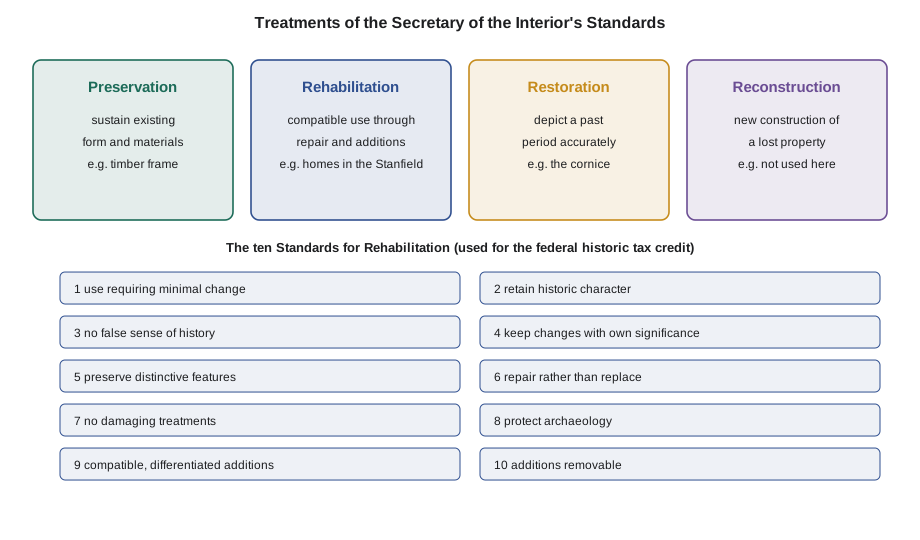
The Standards define four treatments. Preservation sustains the existing form, integrity and materials of a historic property, focusing on maintenance and repair rather than replacement. Rehabilitation makes possible a compatible use through repair, alterations and additions while preserving the features that convey historic, cultural or architectural values. Restoration accurately depicts the form, features and character of a property as it appeared at a particular period, removing evidence of other periods. Reconstruction depicts, with new construction, the form and features of a property that no longer survives. Most projects that change use, like the Stanfield, are rehabilitations, and the ten Standards for Rehabilitation are the ones architects use most often.
The ten Standards for Rehabilitation are short, and every architect who works on historic buildings knows them. In paraphrase: a property shall be used as it was historically or given a new use that requires minimal change to its distinctive materials, features, spaces and spatial relationships; its historic character shall be retained, and distinctive materials and features that characterize it shall not be removed; each property shall be recognized as a physical record of its time, place and use, and changes that create a false sense of history shall not be undertaken; changes that have acquired significance in their own right shall be retained; distinctive materials, features, finishes and examples of craftsmanship shall be preserved; deteriorated features shall be repaired rather than replaced, and where replacement is necessary the new feature shall match the old in design, color, texture and, where possible, materials, based on documentary and physical evidence; chemical or physical treatments that cause damage, such as sandblasting, shall not be used; archaeological resources shall be protected; new additions, exterior alterations or related new construction shall not destroy historic materials, features and spatial relationships, and shall be differentiated from the old and compatible with it in materials, features, size, scale, proportion and massing; and new additions and related new construction shall be undertaken so that, if removed in the future, the essential form and integrity of the property would be unimpaired.
The Standards are written in general terms on purpose. They do not say what kind of window may be installed or how high an addition may be. The guidelines that accompany them give recommended and not recommended approaches for each kind of feature, from masonry and windows to entrances, interiors, structural systems, building site and new additions, and they include sections on energy efficiency, accessibility and health and safety. The National Park Service also publishes Preservation Briefs on specific topics such as repointing mortar joints, repairing historic wooden windows and rehabilitating historic interiors, which the students will use throughout the course.
Gagnon explains how the Standards work in practice. In a tax credit project, the owner submits a three-part application through the State Historic Preservation Office to the National Park Service. Part 1 establishes that the building is a certified historic structure, either individually listed on the Register or contributing to a registered historic district. Part 2 describes the proposed rehabilitation in drawings and photographs and is reviewed against the Standards. Part 3 requests certification of the completed work. In its 2025 fiscal year the National Park Service certified 939 completed projects, representing about 8.6 billion dollars of rehabilitation and over ten thousand rehabilitated housing units.
Incentives for rehabilitation in the United States
The federal historic tax credit is the most important incentive for rehabilitation in the country. It provides a credit against federal income tax equal to 20% of the qualified rehabilitation expenditures on a certified historic structure that is used to produce income, such as rental housing, offices or shops. Since 2018 the credit has been claimed in equal parts over five years. To qualify, the rehabilitation must be substantial, meaning that the expenditures over a 24-month period exceed the greater of the building's adjusted basis or 5,000 dollars, and the work must be certified as meeting the Standards. Many states offer their own credits. Minnesota's historic structure rehabilitation credit lapsed and was reinstated by the Legislature, which extended it to 30 June 2030.
# Federal historic tax credit: substantial rehabilitation test and credit timing
adjusted_basis = 2_600_000    # owner's adjusted basis in the building (land excluded)
qre = 17_800_000              # qualified rehabilitation expenditures in 24 months
threshold = max(adjusted_basis, 5_000)
print("substantial rehabilitation:", qre > threshold, f"({qre:,} vs {threshold:,})")
credit = 0.20 * qre
per_year = credit / 5
print(f"federal credit {credit:,.0f}, claimed as {per_year:,.0f} a year for 5 years")
state = 0.20 * qre            # assumed state credit of the same rate for comparison
print(f"with an assumed state credit at the same rate: {credit + state:,.0f} in total")substantial rehabilitation: True (17,800,000 vs 2,600,000) federal credit 3,560,000, claimed as 712,000 a year for 5 years with an assumed state credit at the same rate: 7,120,000 in total
The numbers show why the credit matters. A credit of 20% on nearly eighteen million dollars of qualified work is worth over three and a half million dollars to an investor with tax to offset, and a state credit can roughly double that. Developers usually sell the credits to investors for equity, which Lesson 12 models. Because the credit depends on certification under the Standards, the Standards have shaped tens of thousands of rehabilitations since the late 1970s, and they shape the Stanfield's design from the first sketch.
Worked problem
Checking a proposed change against the Standards
The owner's earlier scheme, from the 1990s, proposed to remove the timber floors in the middle third of the building to create an atrium, to replace all the windows with new aluminum units of a different pattern, and to add two stories of glass on the roof flush with the avenue facade. Evaluate it against the Standards for Rehabilitation.
Show solution
- Atrium: removing a third of the timber floors destroys distinctive materials and spatial relationships, contrary to Standards 2 and 5; a smaller light court in a secondary location might be acceptable.
- Windows: replacing repairable windows wholesale with a different pattern is contrary to Standard 6, which calls for repair first and matching replacement.
- Roof addition: two stories flush with the facade would change the building's massing and would not be compatible in size, scale and proportion, contrary to Standard 9.
- Conclusion: the scheme would not be approved as proposed; a revised scheme would retain the floors, repair the windows and set back a smaller addition.
Answer: The 1990s scheme fails on three counts, which is why it was never built; each failure points to a better design move.
Exercise 3: the regulatory map
- Find a building near the school on the National Register database or the city's list of landmarks, and summarize its significance and what local designation protects.
- Identify which level of government would review a proposed alteration to the Stanfield, and which standards it would apply.
- Determine whether the Stanfield could qualify for the federal historic tax credit, and what documents would be needed.
- Rewrite one of the standards in your own words and give an example of a design decision it would affect.
Self-check
- Can I distinguish between designation that recognizes a place and designation that protects it?
- Can I name the treatments in the standards I will use and explain which applies to the Stanfield?
- Can I explain the main incentives available for rehabilitation and what they require?
Working with the reviewers
Gagnon ends the week with advice on working with the reviewers at the State Historic Preservation Office, the National Park Service and the city's heritage preservation commission. Talk to them early, before the design is fixed, and submit the Part 1 application and the condition survey before you show them a single drawing of new work. Ask which features they consider most important, and whether they read the building's significance the same way you do. Bring options rather than a single scheme, and explain how each one meets the Standards. Most reviewers want the building to find a use and survive, and they are far more flexible with a team that has done its research and shows how each change was minimized than with one that arrives late with a finished design and a deadline. Certification of the Stanfield's rehabilitation will be decided in Washington and its local permit by the commission, but the conversation that leads to both starts this term.
She adds one warning about timing. The standards apply to the whole project, including work done before the heritage review is complete. An owner who strips the interior or replaces the windows while waiting for approval can lose a permit or an incentive for the entire building, because the damage cannot be undone. The students' first recommendation to Greenway Homes, therefore, is that no work other than urgent stabilization be done on the Stanfield until the conservation approach has been agreed.
Common mistakes
MistakeAssuming that National Register listing prevents an owner from altering a building.
InsteadCheck local landmark designation and whether federal funds or permits trigger Section 106 review.
MistakeTreating the standards as a list of rules about specific materials.
InsteadRead them as principles, and use the guidelines and technical briefs to apply them to specific elements.
MistakeChoosing restoration when the project is really a rehabilitation.
InsteadIdentify the primary treatment from the project's purpose; most changes of use are rehabilitations.
MistakeAssuming the tax credit is automatic.
InsteadPlan for the three-part certification process and design to the Standards from the start.
Summary and key terms
- In the United States, the National Historic Preservation Act of 1966 created the National Register, State Historic Preservation Offices and Section 106 review.
- Register listing recognizes a property and enables incentives; local landmark ordinances, upheld in Penn Central in 1978, give real control.
- The Secretary of the Interior's Standards define preservation, rehabilitation, restoration and reconstruction, with ten Standards for Rehabilitation.
- The federal historic tax credit equals 20% of qualified rehabilitation expenditures, claimed over five years, and Minnesota's credit runs to 2030.
- Every design decision on the Stanfield will be judged against these standards, so they shape the project from the beginning.
- National Register of Historic Places
- The federal list of districts, sites, buildings, structures and objects significant in American history, architecture, archaeology, engineering or culture.
- Section 106
- The provision of the National Historic Preservation Act that requires federal agencies to consider effects on historic properties and consult before deciding.
- Certified historic structure
- A building listed on the National Register or certified as contributing to a registered historic district.
- Rehabilitation
- Making a compatible use possible through repair, alterations and additions while preserving features that convey historic value.
- Qualified rehabilitation expenditure
- A cost of rehabilitating a certified historic structure that counts toward the federal historic tax credit.
Practice problems
Work each problem on paper first, then reveal the answer to check.
Does National Register listing prevent a private owner from demolishing a building with private money?
Show answer
No. Local landmark ordinances or Section 106 review for federal projects give the real control.
Name the four treatments in the Secretary's Standards.
Show answer
Preservation, rehabilitation, restoration and reconstruction.
What are the seven aspects of integrity?
Show answer
Location, design, setting, materials, workmanship, feeling and association.
A building's adjusted basis is 1,200,000 dollars and the planned qualified rehabilitation expenditures are 900,000 dollars. Is the rehabilitation substantial?
Show answer
No. Expenditures must exceed the greater of the adjusted basis or 5,000 dollars, here 1,200,000.
Over how many years is the federal historic tax credit claimed?
Show answer
Five, in equal parts.
Lesson quiz · 5 questions
Score 60% or more to complete this lesson.
Create a free account to save your progress, take quizzes and earn a certificate.