
ARCH-450 · Lesson 2 of 12 · 23 min
Heritage charters and standards
The second week begins in the reading room of the school library, where Bérubé has laid out a row of thin documents on a long table. Some are only a few pages long. One is a single sheet. 'These are the charters,' she says. 'They have no force of law in most places, and nobody is fined for ignoring them. But every heritage standard you will use in practice, every review a heritage committee makes of your drawings and every argument you will have with an owner about a window traces back to the ideas on this table. If you understand where they came from, you will understand why the rules say what they say.'
Restoration and its critics
The modern idea of conservation was born in an argument. In the middle of the nineteenth century the French architect Eugène Viollet-le-Duc restored many of France's great medieval buildings, including the cathedral of Notre-Dame in Paris and the walled city of Carcassonne. He defined restoration boldly: to restore a building was to bring it to a complete state that might never have existed at any particular time. He added a spire to Notre-Dame, replaced worn sculpture with new carving of his own design and rebuilt the towers of Carcassonne with conical slate roofs that historians still debate. His work saved many buildings from collapse, but it also replaced a great deal of original fabric with his own idea of what the Middle Ages should have looked like.
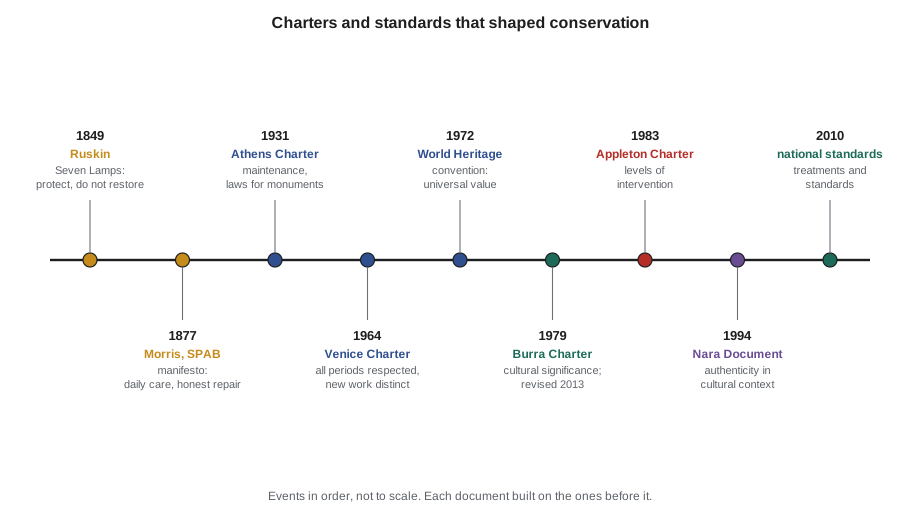
In England the critic John Ruskin attacked this approach. In The Seven Lamps of Architecture, published in 1849, he wrote that restoration was the most total destruction a building could suffer, because it replaced the work of the original builders, with all the marks of their hands and of the centuries since, with a modern copy. Ruskin urged owners to take care of their buildings so that they would not need restoring, to prop up a failing wall rather than rebuild it, and to accept the marks of age as part of a building's value. In 1877 William Morris founded the Society for the Protection of Ancient Buildings on these ideas. Its manifesto called for protection instead of restoration, for daily care and for repairs that were honest about being new.
The argument between Viollet-le-Duc and Ruskin has never been fully settled, and Bérubé says that every conservation architect carries a little of each. The Stanfield's missing cornice sections, for instance, could be left missing, repaired with pieces that match the old ones exactly, or replaced with a simpler modern profile that completes the line of the cornice without pretending to be original. Each choice reflects a different view of what conservation is for. What the charters did, in the century after Morris, was to turn these views into shared principles that architects in many countries could use.
The international charters
The first international statement of conservation principles came from a conference of architects and specialists in Athens in 1931. The Athens Charter for the Restoration of Historic Monuments favoured regular maintenance over full restoration, accepted the careful use of modern materials such as reinforced concrete to consolidate ancient structures, and asked that the setting of monuments be respected. It also called for countries to protect monuments by law, an idea that became general over the next decades.
After the destruction of the Second World War, when whole historic city centres had been rebuilt or replaced, a second congress met in Venice in 1964 and adopted the International Charter for the Conservation and Restoration of Monuments and Sites, known as the Venice Charter. The International Council on Monuments and Sites, ICOMOS, was founded the following year to carry its principles forward. The Venice Charter's articles are short and still widely quoted. It extends the idea of a monument to modest works that have acquired cultural significance with time, not only great buildings. It says that conservation is helped by putting a monument to a socially useful purpose, provided the use does not change its layout or decoration. It says that restoration must stop where conjecture begins, that any new work must be distinct from the original and bear a contemporary stamp, and that the contributions of all periods to a building must be respected, because unity of style is not the aim of restoration.
In 1972 UNESCO adopted the Convention Concerning the Protection of the World Cultural and Natural Heritage, which created the World Heritage List. Canada and the United States are both parties, and both have places on the list, from the historic district of Old Québec to Independence Hall. The convention matters to architects less for its rules than for the vocabulary it spread: outstanding universal value, authenticity, integrity and the idea that some places belong to all humanity.
The Burra Charter and the idea of significance
The most influential charter for practising architects today was written not in Europe but in Australia. Australia ICOMOS adopted the Burra Charter, named for the old mining town where it was first agreed, in 1979, and revised it several times, most recently in 2013. Where the Venice Charter spoke of monuments, the Burra Charter speaks of places, and it puts the idea of cultural significance at the centre of conservation. A place's significance is its aesthetic, historic, scientific, social or spiritual value for past, present or future generations, the same set of values the students used in the first lesson. Significance, the charter says, is embodied in the place itself, its fabric, setting, use, associations, meanings, records, related places and related objects.
The charter's most practical contribution is a process. First, understand the place: gather evidence, talk to the people who know it and assess its significance. Second, develop policy: decide what must be retained, what can change and what uses are compatible, taking account of the owner's needs, the physical condition and the law. Third, manage the place in accordance with that policy, and monitor and review the results. This sequence, understand before you act, is the logic of every conservation plan and of this course. The charter also gives architects a phrase they quote constantly: a conservation approach should do as much as necessary to care for the place and make it usable, but otherwise change it as little as possible, so that its significance is retained.
Canadian charters
Canada contributed two charters of its own in the early 1980s. The Deschambault Charter, adopted in Quebec in 1982, set out principles for the conservation of Quebec's heritage, with particular attention to the place of heritage in the life of a community. The Appleton Charter for the Protection and Enhancement of the Built Environment, adopted by ICOMOS Canada in 1983, gave Canadian practitioners a framework for choosing among levels of intervention, from maintenance and preservation through restoration and renovation to reconstruction and redevelopment, and for matching the level of intervention to the significance of the place and its condition. It insisted that work be based on research, that it respect the patina of age and later additions of value, and that new work be identifiable on close inspection while remaining in harmony with the old.
Bérubé points out how much of the Appleton Charter survives in the national standards the students will use. The idea that every intervention must be justified by research and documented, the preference for the least intervention that will do, and the requirement that new work be compatible yet distinguishable are all there. The Standards and Guidelines for the Conservation of Historic Places in Canada, which the next lesson examines, were built directly on this tradition.
Authenticity and the Nara Document
In 1994 experts from many countries met in Nara, Japan, and produced the Nara Document on Authenticity. The meeting was prompted by a question that European charters had not answered well. Some of the most revered wooden temples in Japan are periodically dismantled and rebuilt with new timber using traditional methods. By the standards of the Venice Charter, which equated authenticity with original material, such buildings were copies. By the standards of the cultures that built them, the continuity of form, craft, use and spiritual meaning was what mattered, and the rebuilt temples were entirely authentic.
The Nara Document accepted that authenticity must be judged within the cultural context of each place. It may lie in form and design, materials and substance, use and function, traditions and techniques, location and setting, and spirit and feeling. This wider view has been especially important for Indigenous places in Canada and the United States, where the significance of a site may lie in its use, its stories and the relationship of a people to the land rather than in any building. It also matters for ordinary buildings like the Stanfield, whose significance lies partly in the craft of its builders and the way it was used, and not only in the bricks themselves.
The principles in practice
From all these documents the students extract a short list of principles that will guide their work on the Stanfield. Understand before acting: research, document and assess significance first. Minimal intervention: do as much as necessary and as little as possible. Repair rather than replace: keep original fabric wherever it can be repaired, and replace only what is too deteriorated to repair, matching it in material and form. Respect all periods: later changes may have significance of their own and should not be removed just to return to an original state. Compatibility and distinguishability: new work should fit with the old in scale, material and character, but should be identifiable as new on close inspection. Reversibility: where possible, new work should be added so that it could be removed in the future without damaging the historic fabric. Document everything: record the place before, during and after the work, and keep the records.
Bérubé warns that the principles can conflict. Reversibility, for example, argues for a new stair to be built as a free-standing steel structure that touches the old floors as little as possible, while minimal intervention might argue for reusing the original stair opening even if it needs more alteration. Repair rather than replace might keep the original single-glazed windows, while the need to give the building a long life as homes argues for better thermal performance. The principles do not give answers. They give a way of reasoning about choices, and a vocabulary in which those choices can be explained to a heritage committee, an owner or the public.
# Choosing a treatment for each element of the Stanfield (a teaching aid, not a rule)
# condition: 0 sound .. 3 lost;  significance: 0 none .. 3 high
elements = [
    ("brick walls",           1, 3),
    ("pressed-metal cornice", 2, 3),
    ("timber posts and caps", 0, 3),
    ("upper-floor windows",   2, 2),
    ("1960s storefront",      1, 0),
    ("1930s mezzanine",       1, 1),
    ("missing original stair", 3, 1),
]
def treatment(cond, sig):
    if sig == 0:
        return "may be removed or replaced freely"
    if cond == 0:
        return "preserve: maintain and protect"
    if cond <= 2:
        return "repair in kind; replace only failed parts"
    return "new work, compatible and distinguishable" if sig < 3 else "replicate on firm evidence"
for name, cond, sig in elements:
print(f"{name:<24} condition {cond} significance {sig} -> {treatment(cond, sig)}")brick walls condition 1 significance 3 -> repair in kind; replace only failed parts pressed-metal cornice condition 2 significance 3 -> repair in kind; replace only failed parts timber posts and caps condition 0 significance 3 -> preserve: maintain and protect upper-floor windows condition 2 significance 2 -> repair in kind; replace only failed parts 1960s storefront condition 1 significance 0 -> may be removed or replaced freely 1930s mezzanine condition 1 significance 1 -> repair in kind; replace only failed parts missing original stair condition 3 significance 1 -> new work, compatible and distinguishable
The students like the clarity of the little program, and Bérubé lets them enjoy it before pointing out its limits. It treats each element on its own, but the significance of the Stanfield lies partly in how the elements work together. It cannot weigh the needs of the new use, the budget or the advice of a structural engineer. And it assumes that significance and condition are already known, which in a real project takes weeks of research and investigation. Used as a checklist to make sure nothing is forgotten, such a table is helpful. Used as a substitute for judgement, it is dangerous.
Worked problem
Applying the principles to the missing cornice
About a fifth of the Stanfield's pressed-metal cornice has been lost, leaving gaps along the top of the avenue facade. Historic photographs show the full cornice clearly. Recommend an approach and justify it with the principles.
Show solution
- Assess significance: the cornice completes the composition of the facade and aligns with the cornices of its neighbours, so it is a character-defining element.
- Assess evidence: the surviving sections and the photographs show the profile exactly, so replication would not be conjecture.
- Apply repair before replacement: repair and refasten the surviving sections, replacing only failed sheet metal and supports.
- Fill the gaps with new sections fabricated to match the profile, in compatible material, stamped or recorded with the date of the work so they can be identified on close inspection.
- Document the existing condition, the evidence and the new work.
Answer: Repair the surviving cornice and replicate the missing sections on the firm evidence of the photographs, marking the new work, because the cornice is significant and the evidence leaves no room for conjecture.
Exercise 2: reading the charters
- Read the Venice Charter and the Burra Charter, and list three principles they share and one on which they differ.
- Find a restoration in your region that follows the approach of Viollet-le-Duc and one that follows Ruskin, and compare them.
- For each of the seven principles in this lesson, describe a decision on the Stanfield that it would influence.
- Identify a place whose authenticity lies more in its use or traditions than in its materials, and explain how the Nara Document applies to it.
Self-check
- Can I explain the difference between restoration as Viollet-le-Duc understood it and conservation as Ruskin and Morris understood it?
- Can I describe the Burra Charter's process of understanding, policy and management?
- Can I state the principles of minimal intervention, repair before replacement, compatibility, distinguishability and reversibility?
- Do I recognize where the principles conflict?
Common mistakes
MistakeTreating the charters as rules with legal force.
InsteadTreat them as statements of principle that underlie the standards and laws that do apply.
MistakeRestoring a building to an imagined original state.
InsteadRespect the contributions of all periods and stop where evidence ends and conjecture begins.
MistakeMaking new work imitate old work so closely that it cannot be told apart.
InsteadMake new work compatible in scale and character but identifiable as new on close inspection.
MistakeEquating authenticity only with original material.
InsteadConsider form, craft, use, setting and meaning as well, as the Nara Document does.
MistakeApplying principles mechanically.
InsteadUse the principles to reason about choices, and explain how conflicts between them were resolved.
Summary and key terms
- Modern conservation grew from the nineteenth-century argument between restoration in the manner of Viollet-le-Duc and the protection of authentic fabric urged by Ruskin and Morris.
- The Athens Charter of 1931 and the Venice Charter of 1964 established international principles, including respect for all periods and distinguishable new work.
- The Burra Charter centres conservation on cultural significance and on a process of understanding, policy and management.
- The Appleton Charter of 1983 gave Canadian practice a framework of levels of intervention, and the Nara Document of 1994 widened the idea of authenticity.
- Core principles include minimal intervention, repair before replacement, compatibility, distinguishability, reversibility and documentation, and they can conflict.
- Charter
- A statement of conservation principles adopted by a professional body, usually without legal force.
- Cultural significance
- The aesthetic, historic, scientific, social or spiritual value of a place for past, present or future generations.
- Minimal intervention
- The principle of doing as much as necessary and as little as possible to a historic place.
- Reversibility
- The quality of new work that allows it to be removed in future without damaging historic fabric.
- Authenticity
- The degree to which a place truthfully expresses its significance through its form, materials, use, traditions, setting and spirit.
Practice problems
Work each problem on paper first, then reveal the answer to check.
What did Ruskin consider the most total destruction a building could suffer?
Show answer
Restoration, because it replaced the original fabric and the marks of time with a modern copy.
What does the Venice Charter say about the contributions of different periods to a monument?
Show answer
They must be respected, because unity of style is not the aim of restoration.
List the three stages of the Burra Charter process.
Show answer
Understand the place and its significance, develop policy, and manage the place according to that policy.
Why did the Nara Document widen the idea of authenticity?
Show answer
Because in some cultures significance lies in continuing form, craft, use and meaning rather than original material, as with periodically rebuilt timber temples.
Give an example of a conflict between reversibility and another principle on the Stanfield.
Show answer
A free-standing reversible steel stair touches less fabric, but reusing the original stair opening might be a smaller overall change, so the principles point different ways.
Lesson quiz · 5 questions
Score 60% or more to complete this lesson.
Create a free account to save your progress, take quizzes and earn a certificate.