
ARCH-450 · Lesson 1 of 12 · 26 min
Why conserve
The last course of the winter term meets not in the studio but in a building. On the first morning Professor Solange Bérubé leads the four students, Wren, Callum, Ingrid and Joon-ho, down the lane behind the site of their Design Studio V project and stops in front of a five-storey brick warehouse with boarded windows. It stands on Bannatyne Avenue, two lots west of the Harland Building, in the Exchange District. A faded painted sign high on the east wall still reads STANFIELD IMPLEMENT CO. The building was finished in 1911 for a wholesaler of farm machinery, and its upper floors have been empty since 2009. Bérubé, a conservation architect who spent twenty years restoring stone churches, mills and warehouses before she began teaching, unlocks a side door with a key borrowed from the owner. 'For the next twelve weeks,' she says, 'this is your client, your site and your teacher.'
Inside, the ground floor smells of damp plaster and old ink, because the last tenant was a print shop. A forest of square timber posts marches back into the dark, each one capped with a cast-iron bracket that carries a heavy timber beam. The floor above is made of planks laid on edge and nailed together, so thick that the students can see the cut ends where a stair was once removed. Light comes in only at the two ends, through tall windows with segmental brick arches. Bérubé lets the students walk for ten minutes without speaking. Then she asks them a question that will run through the whole course: why should anyone keep this building?
The question behind every heritage decision
It is not a rhetorical question. Every old building is kept, altered or demolished because someone decided it should be, and those decisions cost money, use materials and change neighbourhoods. A developer who owns a vacant warehouse can usually build something new on its lot more quickly and with fewer surprises than they can rehabilitate the old building. A city that protects a building limits what its owner can do with private property, and has to be able to explain why. An architect who works on a historic building has to decide, again and again, what to keep, what to repair, what to replace and what to add. None of these decisions can be made well without a clear answer to the question of why the building matters.
Joon-ho offers the first answer: the building is beautiful. Ingrid offers a second: it is old. Callum says it is part of the district, and the district would be poorer without it. Wren says it would be wasteful to throw away a building that still stands. Bérubé writes all four answers on the board and says that each of them is a real reason, but none of them is enough on its own. Plenty of beautiful buildings are demolished, plenty of old buildings are not worth keeping, and an argument from waste can be made for any building at all. What heritage conservation offers is a way of turning these instincts into a careful statement of value that others can test and that can guide the work.
What we mean by heritage value
Heritage professionals speak of the values a place holds. A value is a reason a place matters to people, now or in the future. The most widely used framework, developed in the charters that the next lesson describes, groups heritage values into a small number of kinds. Aesthetic value lies in the form, materials, craft and setting of a place: the rhythm of the Stanfield's arched windows, the warm red of its brick, the way its cornice lines up with its neighbours. Historic value lies in the place's association with people, events, activities and periods: the Stanfield is evidence of the years when Winnipeg was the wholesale gateway to the Canadian West and farm machinery arrived by rail to be sold to the farms that were being settled across the region.
Scientific or research value lies in what a place can teach: the Stanfield's heavy timber frame, its cast-iron post caps and its brick bearing walls are a nearly complete example of the construction that the building trades of the time called mill construction, and they can tell engineers and historians how such buildings were really built. Social value lies in the attachment of communities to a place: the people who worked there, the artists who rented studios in the 1980s, the neighbours who walk past it every day and use its ghost sign to give directions. Many frameworks add spiritual value, which matters most for sacred places and for Indigenous places whose significance is not always visible in their fabric.
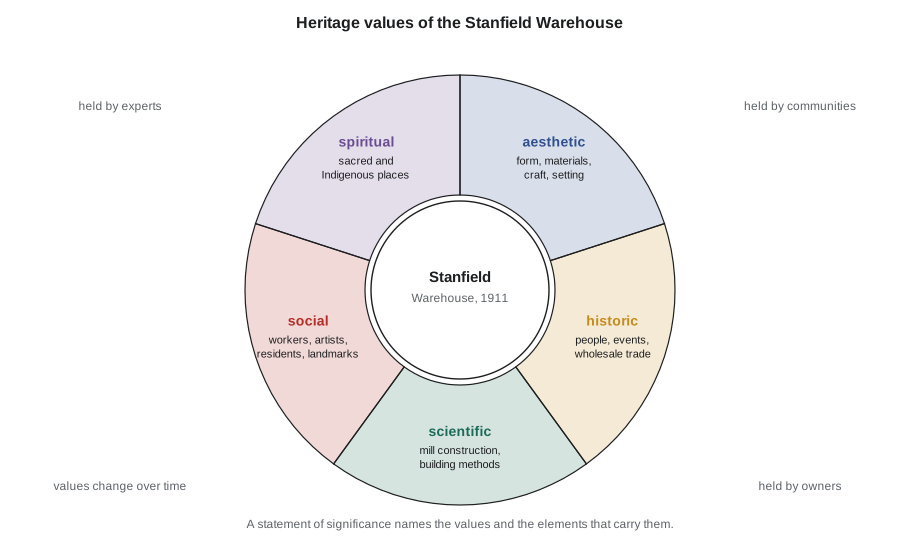
Values are held by people, not by bricks. This is one of the most important ideas in modern conservation, and one of the most difficult. A building does not have a value the way it has a height. It has value because people find meaning in it, and different people find different meanings. The historian who studies the wholesale trade, the artist who once had a studio on the fourth floor, the descendant of the clerk who worked in the shipping office, the developer who sees a brick shell with good bones and the young family who simply like the look of the street all value the Stanfield, but not in the same way. Part of the conservation architect's job is to find out who holds which values, and to make sure that the people with less power, such as former workers, nearby residents and Indigenous nations whose lands the city occupies, are heard as well as the experts.
Character-defining elements
Values become useful in design when they are tied to physical things. A character-defining element is a material, form, location, spatial configuration, use or cultural association that expresses a place's heritage value and must be retained to preserve that value. For the Stanfield the students begin a list on the first day. The red brick bearing walls with their segmental-arched window openings, the stone base and sills, the pressed-metal cornice, the painted sign, the heavy timber posts and beams with their cast-iron caps, the plank floors, the open, column-filled interior spaces, the freight elevator and loading dock on the lane, and the building's place in a continuous wall of warehouses along the avenue all carry some part of its significance.
Bérubé points out that some items on the list are not things but qualities. The open, repetitive interior, the long views between posts, and the way daylight falls off from the windows toward the middle of the floor are part of the character of a warehouse just as much as its bricks. A design that keeps every post but fills the floor with small rooms may keep the fabric while losing the space. Equally, not every old thing is character-defining. The 1960s aluminum storefront that replaced the original ground-floor windows, the dropped ceiling of acoustic tile in the former print shop and the concrete-block wall that closes off one bay of the basement are old, but they do not carry the values the students have identified, and they may be removed.
The habit of looking hard, listing and justifying is the foundation of everything that follows in the course. Bérubé asks each student to stand in a different part of the building, write down ten things they see, and then sort them into three groups: elements that are clearly character-defining, elements that clearly are not, and elements about which they are unsure. The unsure group turns out to be the most interesting. The print shop's ink-stained floor, the graffiti left by the artists who rented space in the 1980s and a mezzanine added in the 1930s all prompt arguments, because each tells part of the building's later history. Conservation is not the freezing of a building at one moment of its life, and later changes can acquire significance of their own.
Why conserve: four kinds of argument
With values and elements in hand, the students return to Bérubé's question and find that the arguments for conservation fall into four broad kinds. The first is cultural. Old buildings are evidence of how people lived, worked and built. They carry memory in a way that photographs and books do not, because people can walk through them, touch them and use them. A city that keeps its old buildings keeps a record of its own history that is open to everyone, not only to those who visit archives. Districts like the Exchange are valued because they make a period of the city's past legible as a whole, and the loss of one building weakens the whole.
The second argument is urban. Old buildings contribute to the character, scale and variety of a city. Jane Jacobs argued in 1961 that cities need old buildings because they offer low-cost space for new enterprises, and the history of districts like this one proves her right: artists, small manufacturers, architects, start-ups, restaurants and galleries moved into empty warehouses long before anyone built new housing there. Historic districts also tend to have the qualities that urban designers try to create in new neighbourhoods: narrow lots, continuous street walls, windows at the sidewalk and a fine grain of different owners.
The third argument is economic. Rehabilitation is usually more labour-intensive and less material-intensive than new construction, so a larger share of its cost goes to local trades. Historic districts often attract tourism, film production and businesses that want a distinctive address. Heritage designation can raise property values in some places and depress them in others, and the evidence is mixed, but the incentives that many governments offer for rehabilitation, which Lesson 3 describes, exist because rehabilitation can be a sound public investment. Against these benefits are real costs: the time and uncertainty of working with old fabric, the expense of skilled trades, and the limits on what owners can do.
The fourth argument, and the one that has grown fastest in recent years, is environmental. An existing building contains a great deal of embodied carbon, the emissions released in making and building its materials. Demolishing it and building new releases more, and the new building must operate for decades before its better energy performance makes up for the carbon spent in building it. Lesson 10 works through the numbers. For now it is enough to note that many architects now repeat the line coined by the preservation architect Carl Elefante, that the greenest building is the one that is already built, and that the environmental case has brought conservation and sustainable design much closer together.
# A simple heritage value scoring matrix for the Stanfield Warehouse
# Each value is scored 0 (none) to 3 (high) by three groups of people.
values = ["aesthetic", "historic", "scientific", "social", "spiritual"]
scores = {
    "historians":  [2, 3, 3, 1, 0],
    "residents":   [3, 2, 1, 3, 0],
    "owner":       [2, 1, 1, 1, 0],
}
weights = {"historians": 1.0, "residents": 1.0, "owner": 0.5}
total = [0.0] * len(values)
for group, row in scores.items():
    for k, s in enumerate(row):
        total[k] += weights[group] * s
wsum = sum(weights.values())
print("value       mean score  rating")
for v, t in zip(values, total):
    mean = t / wsum
    rating = "high" if mean >= 2 else "moderate" if mean >= 1 else "low"
    print(f"{v:<11} {mean:9.2f}  {rating}")
spread = {v: max(r[k] for r in scores.values()) - min(r[k] for r in scores.values()) for k, v in enumerate(values)}
print("largest disagreement:", max(spread, key=spread.get))value mean score rating aesthetic 2.40 high historic 2.20 high scientific 1.80 moderate social 1.80 moderate spiritual 0.00 low largest disagreement: historic
Bérubé is careful about the code. A table of scores is useful for organizing a discussion and for showing where groups disagree, and the result here, that residents and historians disagree most about the building's social value, is a genuine finding that tells the students whom to talk to next. But a score is not a measurement. Heritage value cannot be reduced to a number without losing most of what makes it meaningful, and a well-written statement of significance, built on research and on conversations with the people who hold the values, is always more important than a matrix.
The statement of significance
In Canada the values of a historic place are recorded in a statement of significance, the format used by the Canadian Register of Historic Places and by most provinces and municipalities. It has three parts: a description of the historic place, which says what is designated and where its boundaries lie; a statement of heritage value, which explains why the place matters; and a list of character-defining elements, which names the physical features that carry the values. Every decision in a conservation project should be traceable back to this document.
The students draft a short statement for the Stanfield by the end of the first week. Their first drafts are too long and too vague. Bérubé's corrections all point in the same direction: be specific. 'The building is a fine example of early twentieth-century architecture' says almost nothing. 'The building's five storeys of red brick bearing wall, with segmental-arched openings diminishing in height toward the top, its stone base and its pressed-metal cornice, express the restrained commercial style of the district's warehouses built between 1900 and 1913' says something that can guide a decision about a window or a cornice. The same discipline applies to the interior, to the setting and to the building's later history.
Worked problem
Drafting a statement of heritage value
Write two sentences of a statement of heritage value for the Stanfield's interior, and list four character-defining elements that follow from them.
Show solution
- Identify the value the interior carries: scientific value as an intact example of mill construction, and aesthetic value in its open, repetitive spaces.
- Name the evidence: square timber posts on cast-iron caps, heavy timber beams, nail-laminated plank floors, the freight elevator and the uninterrupted bays.
- Write the sentences: 'The Stanfield's interior is valued as a largely intact example of mill construction, the heavy timber and brick system used for the district's warehouses, with posts, caps, beams and plank floors that remain visible throughout. Its open, column-filled floors express the building's original use for the storage and display of farm machinery.'
- List the character-defining elements: the timber posts and beams and their cast-iron caps; the plank floors; the open floor plates with regular bays; the freight elevator shaft and loading dock.
Answer: A good statement ties each value to specific, visible elements, so that a designer can tell what must be retained.
Who decides, and what is at stake
A building is not conserved because an architect wants it to be. It is conserved because its owner chooses to keep it, because the law requires it, because incentives make it worthwhile, or because a community campaigns for it. Most of the time it is a combination. The Stanfield is protected by its designation, which Lesson 3 explains, but designation does not pay for a new roof. Its owner has kept it standing for fifteen years without a use, partly because demolition would require a permit the city is unlikely to grant and partly because the building is worth more as a rehabilitation project than as an empty lot. Bérubé reveals the course's project at the end of the first week: Greenway Homes, the non-profit housing provider the students worked with in Design Studio IV, has an option to buy the building and wants to know whether it can become affordable homes for artists and others, with a public gallery and a community print studio on the ground floor.
Conservation is never free of conflict, and Bérubé wants the students to see that from the start. Keeping every element exactly as it is would leave the building empty, and an empty building decays. Converting it to homes will require new windows in walls that never had them, new stairs, sprinklers, insulation, plumbing and perhaps a light court cut through the middle of the floors. Each of these changes will affect some value, and the art of conservation lies in choosing changes that keep the building's significance while giving it a new life. That balance, between keeping and changing, between values that conflict and between people who hold different values, is the subject of the whole course.
Exercise 1: reading a historic place
- Visit a historic building near the school and write down ten things you observe, inside and out, before you read anything about it.
- Sort your observations into character-defining elements, non-defining elements and elements about which you are unsure, and explain each choice in one sentence.
- Identify at least three groups of people who might value the building, and suggest how each might describe its importance.
- Draft a statement of heritage value of no more than 150 words, and test each sentence by asking whether it could guide a design decision.
Self-check
- Have I distinguished between a building being old and a building having heritage value?
- Have I tied each value to specific physical elements or qualities?
- Have I considered the values held by people other than experts?
- Have I recognized that later changes may themselves have significance?
Common mistakes
MistakeTreating every old element as equally important.
InsteadTie elements to the values in the statement of significance and distinguish what is character-defining from what is not.
MistakeWriting vague statements of significance.
InsteadName specific materials, forms, spaces and associations that a designer could act on.
MistakeAssuming that heritage value is a fixed property of the building.
InsteadRecognize that values are held by people and can differ between groups and change over time.
MistakeIgnoring the interior and the spaces in favour of the facade.
InsteadRecord spatial qualities, structure and interior features as well as exterior elements.
MistakeTreating conservation as freezing a building in time.
InsteadAccept that a place must be used to survive, and plan change that respects its values.
Summary and key terms
- Every heritage decision depends on a clear answer to the question of why a place matters.
- Heritage values include aesthetic, historic, scientific, social and spiritual value, and they are held by people rather than being fixed properties of buildings.
- Character-defining elements are the materials, forms, spaces, uses and associations that express a place's value and must be retained to keep it.
- Arguments for conservation are cultural, urban, economic and environmental, and they must be weighed against real costs.
- A specific, well-researched statement of significance is the document against which every later design decision is tested.
- Heritage value
- The aesthetic, historic, scientific, cultural, social or spiritual importance of a place for past, present and future generations.
- Character-defining element
- A material, form, location, spatial configuration, use or association that expresses heritage value and must be retained to preserve it.
- Statement of significance
- A document that describes a historic place, states its heritage value and lists its character-defining elements.
- Mill construction
- A system of brick bearing walls with heavy timber posts, beams and thick plank floors, used for warehouses and factories.
- Embodied carbon
- The greenhouse gas emissions released in making, transporting and installing a building's materials.
Practice problems
Work each problem on paper first, then reveal the answer to check.
Name the five kinds of heritage value described in this lesson.
Show answer
Aesthetic, historic, scientific or research, social and spiritual value.
Why is the 1960s aluminum storefront on the Stanfield not a character-defining element?
Show answer
It replaced the original ground-floor windows and does not express the values identified for the building, so it may be removed or replaced.
Give one example of a character-defining element that is a quality of space rather than a material.
Show answer
The open, repetitive interior with long views between posts and daylight falling off toward the centre of the floor.
What does Jane Jacobs's argument about old buildings add to the case for conservation?
Show answer
Old buildings provide low-cost space for new enterprises and help keep a city varied and lively.
Why does an empty historic building need a use?
Show answer
Without a use it is not maintained and it decays; a suitable use pays for its upkeep and keeps it alive.
Lesson quiz · 5 questions
Score 60% or more to complete this lesson.
Create a free account to save your progress, take quizzes and earn a certificate.