
ARCH-410 · Lesson 8 of 12 · 23 min
Liability and insurance
The third object on the table from the first week is the insurance policy, and in the eighth week it has company. Kevin Marsh is a risk manager with a professional liability insurer that covers several hundred design firms, and he has handled claims against architects for twenty-two years. He begins by asking how many of the students expect to be sued during their careers. No one raises a hand. Marsh says that the honest answer is most of them, at least once, and usually for something they did not think was their fault. The aim of this week is not to frighten them but to show that claims are a normal risk of practice, that most can be prevented, and that the ones that cannot be prevented can be survived.
Where liability comes from
An architect can be held legally responsible for loss in two main ways. The first is contract. The architect has agreed to provide certain services to a certain standard, and if they fail to do so the client can sue for breach of contract. The second is negligence, a part of the law of torts. An architect owes a duty of care to people who may foreseeably be harmed by their work, including not only the client but in some circumstances future owners, occupants and neighbours, and if they fall below the standard of a reasonably competent architect and someone suffers loss as a result, the injured person can sue. The two often overlap: a leaking roof caused by a poor detail may be both a breach of contract and negligence.
The standard of care is central to both. Marsh repeats what Sandoval said in the sixth week: an architect is not expected to be perfect, only to exercise the skill and care of a reasonably competent architect in similar circumstances. Whether an architect met that standard is usually decided with the help of expert witnesses, other architects who testify about what a competent architect would have done. A detail that leaks is not proof of negligence; a detail that ignored well-known principles of building science, or a code requirement that any competent architect would have known, probably is. This is why architects who keep up with their continuing education and follow good practice are better protected than those who do not.
Claims do not last forever. Provincial limitation laws set the time within which a claim must be started, usually a short basic period running from when the claimant discovered or should have discovered the problem, and a longer ultimate period after which no claim can be brought regardless of when the problem was found. The periods differ from province to province, and Marsh tells the students to look up the rules where they practise rather than rely on a number from another jurisdiction. Because a defect may not appear for years, architects can face claims long after a project is finished, which is one reason they must keep project records for many years.
Why architects are sued
Marsh has a chart of the causes of the claims his company has handled, and he is careful to say that it is a simplified picture drawn from experience rather than a published statistic. The largest groups of claims involve water: roofs, walls, windows and below-grade spaces that leak. Next come claims about errors and omissions in the drawings that cause extra construction cost, failures of coordination between architectural and engineering drawings, problems with construction administration such as certifying payment for defective work, cost overruns, accessibility and code violations, and injuries on site or in completed buildings. Running through all of them are a few underlying causes. Industry guidance from the AIA and insurers points to insufficient oversight of junior staff, weak internal coordination, poor communication with consultants, inadequate review of design changes made under time pressure, and non-standard or poorly worded contracts. Claims also rise when firms grow quickly.
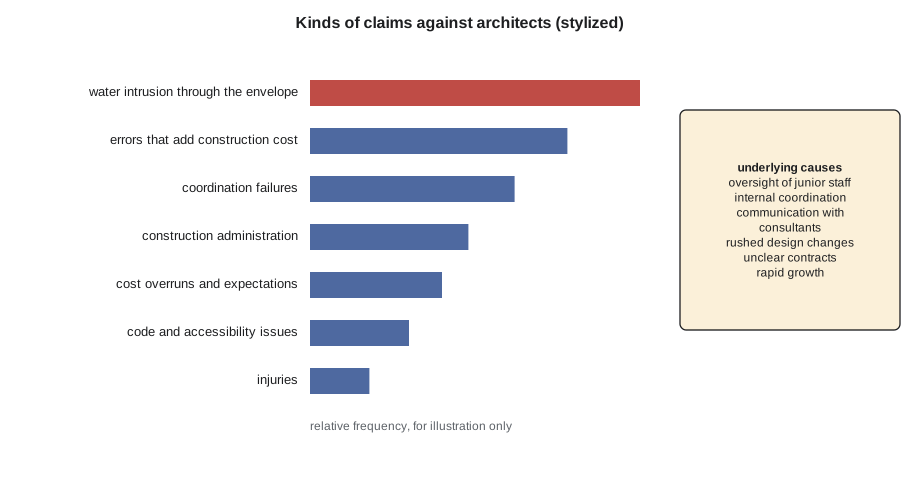
Marsh notes that many claims are not about the architect's design at all but about expectations. A client who believed the building would cost less, open sooner or perform better than it does may look for someone to blame, and the architect is the professional with the drawings. Clear contracts, honest communication about cost and schedule, and written records of decisions protect the architect against these claims as much as good details protect them against leaks.
Professional liability insurance
Professional liability insurance, often called errors and omissions insurance, protects the architect against claims that they were negligent in providing professional services. It pays the cost of defending a claim, which can be large even when the architect is not at fault, and any settlement or judgement up to the policy limit. It does not cover everything. Most policies exclude intentional wrongdoing, warranties and guarantees that go beyond the standard of care, fines and penalties, work outside the professional services described in the policy, and some kinds of pollution. That is why Sandoval warned against warranties: a firm that promises more than the standard of care may find that its insurance does not respond.
Almost all professional liability policies are written on a claims-made basis. The policy that responds is the one in force when the claim is made, not the one in force when the work was done. This has practical consequences. A firm must keep its insurance continuously, because a gap can leave it uninsured for work done years before. The policy has a retroactive date, before which work is not covered, and a firm that changes insurers must make sure the new policy keeps the old retroactive date. An architect who retires or closes a firm needs an extended reporting period, sometimes called tail coverage, so that claims made after the last policy ends are still covered.
Insurance is required in many Canadian provinces. In Ontario, architects must carry professional liability insurance through Pro-Demnity Insurance Company, an insurer established by the profession for that purpose. In Manitoba, The Architects Act requires corporations and partnerships that hold a certificate of approval to show proof of professional liability insurance or equivalent coverage that meets the council's requirements, and it allows the association to establish a claims fund and group insurance. Other provinces have their own arrangements. Clients often set higher limits in their contracts, and Document Six requires the architect to carry professional and general liability insurance unless the client provides project-specific professional liability insurance.
Professional liability is only one of the policies a firm needs. General liability insurance covers injuries and property damage that are not caused by professional services, such as a visitor slipping in the office. Workers' compensation covers employees injured at work. Property insurance covers the office and its equipment. Cyber insurance, increasingly important, covers losses from data breaches and ransomware attacks, which have hit many design firms. Automobile insurance covers staff driving to sites.
Limits, deductibles and the cost of a claim
Every policy has a limit, the most it will pay for a single claim and for all claims in a policy year, and a deductible, the amount the firm pays itself before the insurer pays. Some policies include defence costs within the limit, so that legal fees reduce the amount left for settlement; others pay defence costs in addition. Higher limits and lower deductibles cost more in premium. A small firm must balance the premium it can afford against the risk of a claim that exceeds its limit or a deductible it cannot pay. Many insurers offer reduced deductibles for firms that report potential claims early or use mediation to resolve them, because early reporting and mediation lower the insurer's costs too.
# Compare insurance options for a small firm over ten years (Canadian dollars).
# Expected claims are illustrative: one small claim every four years, one large claim every twenty.
options = {
    "limit 2M, deductible 10k":  {"premium": 26_000, "deductible": 10_000, "limit": 2_000_000},
    "limit 2M, deductible 25k":  {"premium": 21_500, "deductible": 25_000, "limit": 2_000_000},
    "limit 5M, deductible 25k":  {"premium": 30_000, "deductible": 25_000, "limit": 5_000_000},
}
small_claim, large_claim = 60_000, 2_800_000
years = 10
n_small, n_large = years / 4, years / 20
for name, o in options.items():
    premiums = o["premium"] * years
    paid_small = n_small * min(small_claim, o["deductible"])
    over_limit = max(0, large_claim - o["limit"])
    paid_large = n_large * (o["deductible"] + over_limit)
    total = premiums + paid_small + paid_large
print(f"{name:<26} premiums {premiums:>9,.0f} retained {paid_small + paid_large:>9,.0f} total {total:>10,.0f}")limit 2M, deductible 10k premiums 260,000 retained 430,000 total 690,000 limit 2M, deductible 25k premiums 215,000 retained 475,000 total 690,000 limit 5M, deductible 25k premiums 300,000 retained 75,000 total 375,000
The comparison is illustrative, because no firm knows its future claims, but it shows a pattern that Marsh sees often. The cheapest premium, with a 25,000-dollar deductible and a 2 million dollar limit, is not the cheapest choice once the risk of a large claim is counted: a single claim of 2.8 million dollars would leave the firm paying 800,000 dollars above the limit, which could close a small office. The 5 million dollar limit costs more each year but keeps the firm's expected total over ten years at about 375,000 dollars instead of 690,000. The right limit depends on the size of the projects the firm does and on what its contracts require.
What to do when something goes wrong
Marsh's most important advice is about the first days after a problem appears. Most policies require the firm to tell the insurer promptly about any claim, and many also ask to be told about circumstances that might lead to a claim, such as a client's angry letter, a failure on site or a discovered error. Early notice lets the insurer help: it can offer advice, appoint a lawyer and often resolve the matter before it becomes a lawsuit. Late notice can jeopardize coverage. The firm should not admit liability, offer to pay or agree to a settlement without the insurer's consent, but it should cooperate with the client to fix the problem, because a building that is repaired quickly costs less than one that is fought over.
Marsh draws a distinction between apology and admission. An architect can express regret that a problem has happened, take the client's concerns seriously and work with the contractor to fix it without saying that they were negligent, which is a legal conclusion for others to reach. Several provinces and states have apology laws that limit the use of an apology as evidence of liability, but the safest course is to involve the insurer early and let it guide the conversation. What the architect must never do is alter records, destroy documents or blame others falsely, all of which make a defensible claim indefensible.
Managing risk before it becomes a claim
Most of the course so far has been about risk management, even when it did not use the term. Choosing clients carefully, defining services clearly, using standard contracts, flowing terms down to consultants, communicating in writing and recording decisions all reduce claims. Marsh adds the practices that insurers see in firms with few claims. They have a quality management system: checklists, peer reviews of drawings at set stages, and a senior person who checks every set before it is issued. They coordinate drawings between disciplines formally, with clash reviews and coordination meetings. They supervise junior staff closely and give them time to learn. They visit sites regularly and record what they see. They keep good records for many years. And they are careful about growth, because firms that take on too much work too quickly make more mistakes.
| Risk | Prevention |
|---|---|
| Leaks at windows, roofs and walls | Building science review of key details; mock-ups; site review of flashings before they are covered |
| Errors that add construction cost | Staged quality reviews; coordination meetings; drawing checklists |
| Coordination failures with consultants | Clear responsibility matrix; shared model; clash reviews before issue |
| Certifying payment for defective work | Site visits at key stages; written reports; certifying only what can be observed |
| Cost overruns | Independent cost estimates at each phase; designing to budget; written warnings when scope grows |
| Unclear contracts | Standard forms; insurer review of non-standard clauses; no work before signing |
Worked problem
A leak after handover
Eight months after a community building is completed, the client reports water entering at the base of the curtain wall during heavy rain and asks who will pay to fix it. What should the architect do?
Show solution
- Notify the professional liability insurer the same day and follow its guidance.
- Visit the site with the contractor and, if needed, an envelope consultant to observe and document the leak, with photographs and notes.
- Review the project file: the detail as drawn, the specification, shop drawings, site reports and any substitutions or changes.
- Work with the client and contractor on a temporary fix to limit damage, without admitting fault or agreeing to pay.
- Let the insurer and its lawyer handle questions of responsibility, while continuing to communicate respectfully with the client.
Answer: Notify the insurer, document the problem, help limit the damage and leave questions of fault to the proper process.
Exercise 8: a risk review
- Choose a project from your studio work and list five ways it could lead to a claim.
- For each, describe one practice that would reduce the risk.
- Read a professional liability policy, or a sample policy, and identify the limit, the deductible, the retroactive date and three exclusions.
- Write the first email you would send to your insurer after a client's complaint letter.
Self-check
- Can I explain the difference between contract and negligence claims?
- Do I understand what a claims-made policy is and why continuous coverage matters?
- Do I know what my insurance does not cover?
- Do I know what to do in the first days after a problem appears?
Common mistakes
MistakeBelieving that a claim means the architect was negligent.
InsteadClaims are a normal risk of practice; negligence means falling below the standard of a reasonably competent architect.
MistakeLetting insurance lapse or changing insurers carelessly.
InsteadKeep continuous coverage and protect the retroactive date; buy tail coverage on retirement.
MistakeDelaying notice to the insurer.
InsteadReport claims and potential claims promptly, as the policy requires.
MistakeAdmitting liability or offering to pay without the insurer's consent.
InsteadExpress concern, help fix the problem, and let the insurer handle responsibility.
MistakeAccepting contract terms that the insurance will not cover.
InsteadHave non-standard clauses reviewed and avoid warranties beyond the standard of care.
Summary and key terms
- Architects can be liable in contract and in negligence; the standard of care is that of a reasonably competent architect.
- Provincial limitation laws set basic and ultimate periods for claims, which can run for many years after completion.
- Most claims involve water, errors that add cost, coordination failures, construction administration and expectations about cost and schedule.
- Professional liability insurance is written on a claims-made basis, has limits, deductibles and exclusions, and must be kept continuously.
- Prompt notice to the insurer, good records and a quality management system are the best defences.
- Negligence
- Failing to meet the standard of care owed to someone who suffers loss as a result.
- Claims-made policy
- An insurance policy that covers claims made while it is in force, for work done after its retroactive date.
- Retroactive date
- The date before which work is not covered by a claims-made policy.
- Tail coverage
- An extended reporting period that covers claims made after a policy ends, for example after retirement.
- Deductible
- The amount the insured pays on a claim before the insurer pays.
Practice problems
Work each problem on paper first, then reveal the answer to check.
What are the two main legal sources of an architect's liability?
Show answer
Contract, for failing to provide the agreed services, and negligence, for failing to meet the standard of care owed to people who may be harmed.
Why must a firm keep claims-made insurance continuously?
Show answer
The policy in force when the claim is made responds; a gap can leave earlier work uninsured.
Name three things professional liability policies commonly exclude.
Show answer
Any three of: intentional wrongdoing, warranties and guarantees beyond the standard of care, fines and penalties, services outside the policy's definition, some pollution.
What is the difference between an apology and an admission of liability?
Show answer
An apology expresses regret and concern; an admission states that the architect was at fault, which is a legal conclusion and should not be made without the insurer.
Name three practices of firms with few claims.
Show answer
Any three of: quality management and peer reviews, formal coordination, close supervision of junior staff, regular site visits, good records, careful growth, standard contracts.
Lesson quiz · 5 questions
Score 60% or more to complete this lesson.
Create a free account to save your progress, take quizzes and earn a certificate.