
ARCH-410 · Lesson 3 of 12 · 21 min
The path to licensure: CACB, internship and ExAC
In the third week Eberle asks each student to draw a timeline of the next few years of their life, from graduation to the day they stamp their first drawing. Wren's timeline is neat and short. Callum's has a gap where he plans to travel. Ingrid's includes a year working in a construction company, and Joon-ho's includes a possible move to another country. Eberle collects the drawings and says that all four are realistic, and that the path to licensure is long enough that a plan helps. The rest of the class is about the three parts of that path: education, experience and examination.
Eberle Moss has four interns this year. One is close to finishing her hours and sits the national examination in the autumn; one has just started recording experience; and two are somewhere in the middle. They join the class for an hour to describe what the path is really like, and their accounts give the rules a human shape.
Education
The first part is a professional degree in architecture from a program accredited by the Canadian Architectural Certification Board, or an education that the CACB certifies as equivalent. In Canada the professional degree is now almost always a master of architecture, taken after a pre-professional bachelor's degree, and the program at the University of Manitoba is one of the accredited programs. The CACB accredits programs by visiting them regularly, reviewing the students' work and checking it against a set of conditions and student performance criteria. It also certifies individual applicants: graduates of an accredited Canadian program are certified through their school, while people educated abroad or through the RAIC Syllabus, a part-time program that combines work and study, apply directly to the CACB for an assessment of their education.
Eberle points out that the four students are close to the end of this first part, and that the accredited degree is the foundation the others rest on. Accreditation exists because the regulator cannot examine everything a graduate knows. Instead it trusts an accrediting body to make sure that every accredited program teaches the knowledge and skills that a beginning architect needs, from history and theory to structures, building science, codes, accessibility, professional practice and ethics. This very course is one of the requirements.
Experience
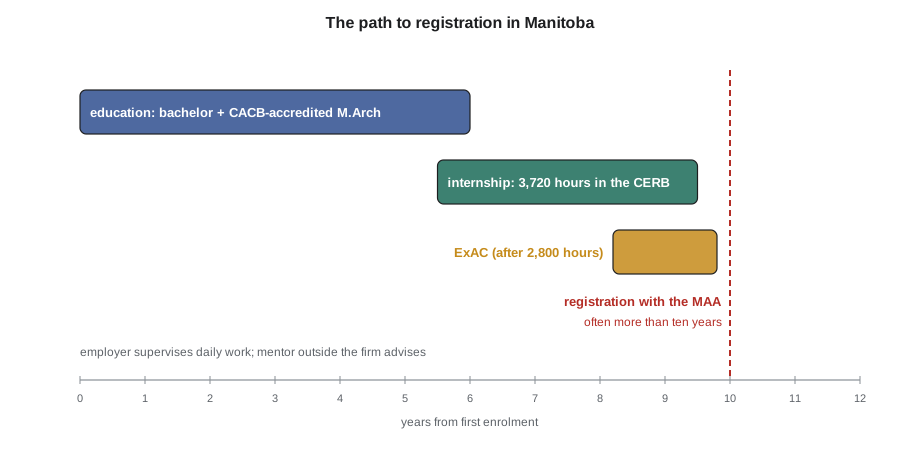
The second part is supervised experience, recorded through the Internship in Architecture Program used by all eleven Canadian regulators. An intern enrols with the regulator in the province where they work, finds an employer who is a registered architect and a mentor who is a registered architect outside the workplace, and records experience in the Canadian Experience Record Book. The minimum is 3,720 hours of experience in specified areas of practice, gained in an approved setting, and each area has its own minimum so that interns cannot satisfy the program by doing only drafting. In Manitoba each block of 900 to 1,000 hours must be submitted for review within eight weeks of the last entry, and late submissions carry a fee. The employer signs off on the work; the mentor, who is outside the firm, offers advice and an independent view of the intern's progress.
The interns at Eberle Moss say that the hardest part is not the hours but the range. A firm that designs schools may give an intern plenty of design and documentation time but little experience in contract administration or practice management, and the intern must ask for work on a building site or in the office's business side. Eberle says that good firms plan this, rotating interns through different roles, and that the mentor's job includes noticing when an intern has stalled in one area.
# Internship tracker: hours recorded against the program minimum.
# Area minimums here are illustrative; use the current program's experience area table.
minimums = {
    "pre-design and design": 1200,
    "documentation": 1300,
    "contract administration": 500,
    "management": 320,
    "professional and community": 400,
}
recorded = {
    "pre-design and design": 1460,
    "documentation": 1180,
    "contract administration": 210,
    "management": 140,
    "professional and community": 260,
}
total_min = 3720
total = sum(recorded.values())
print(f"{'area':<28}{'recorded':>9}{'minimum':>9}{'left':>7}")
for area, need in minimums.items():
    have = recorded[area]
    left = max(0, need - have)
    print(f"{area:<28}{have:>9}{need:>9}{left:>7}")
print(f"{'total':<28}{total:>9}{total_min:>9}{max(0, total_min - total):>7}")
blocked = [a for a in minimums if recorded[a] < minimums[a]]
print("areas still short:", ", ".join(blocked))area recorded minimum left pre-design and design 1460 1200 0 documentation 1180 1300 120 contract administration 210 500 290 management 140 320 180 professional and community 260 400 140 total 3250 3720 470 areas still short: documentation, contract administration, management, professional and community
The tracker shows a common pattern: the intern has more than enough design hours but is short in contract administration and management. Because surplus hours in one area do not make up for a shortfall in another, the total of 3,260 hours already recorded is less useful than it looks. The intern needs about a year of deliberate work on construction sites and in project management, which is exactly the conversation the mentor should start. The area minimums in the sketch are illustrative; the program's current table sets the real ones.
Examination
The third part is the Examination for Architects in Canada, the ExAC, which all the Canadian regulators use. It is written on paper over two consecutive days in four sections and is held once a year; in 2025 the sitting took place on 3 and 4 November. In Manitoba an intern may sit the examination after recording 2,800 hours of experience and submitting them for approval, and must be an intern in good standing. First-time candidates register for all four sections and must retake any failed section at the next sitting; a candidate who does not pass all four within three later sittings must start again as a new candidate. Manitoba stopped recognizing the American examination as a substitute at the end of 2018, so interns in the province take the ExAC.
The interns describe the examination as a test of practice rather than design. It asks about codes, contracts, project delivery, construction administration, structures, building systems, accessibility, the business of a firm and the architect's legal duties. Eberle says that the students' coursework will cover much of it, but that the examination rewards people who have worked on real projects and seen how decisions are made. The best preparation, he says, is to take the examination while the experience is fresh, to study in a group and to treat failed sections as information rather than defeat.
How long it takes, and why
Canadian regulators do not publish a single national figure for the time from first enrolment to registration, but the path rarely takes less than eight years and often more than ten: six years of university, then at least two years and usually three or four of internship before the examination and registration. The interns at Eberle Moss say that the time is often longer because experience in some areas is hard to find, and because people move between firms, leave practice to raise children or go back to school. Several regulators have studied why some people never finish the internship, and the reasons include cost, the difficulty of finding a mentor and the time needed for experience in areas such as contract administration.
Eberle encourages the students to plan. Start recording experience as soon as the program allows, choose employers who will give a range of work, find a mentor early, take the examination when you are eligible rather than waiting until you feel ready, and keep the record up to date so that hours are not lost to late reporting. A path that is planned is not necessarily short, but it is rarely as long as one that is not.
Alternative paths and international applicants
Not everyone follows the standard path. The RAIC Syllabus program allows people to study architecture part time while working, and its graduates are certified by the CACB. Architects educated abroad can have their education assessed by the CACB and their experience assessed by the regulator, and CALA runs a program for broadly experienced foreign architects who have practised for many years outside Canada. Each path ends at the same point, registration with a provincial regulator, and each has its own requirements and costs. Eberle points out that Canada depends on internationally trained architects, and that a firm that hires one should understand how long their path to registration may be.
Worked problem
Planning an internship year
An intern has recorded 2,900 hours, with design and documentation complete, but has 210 of the required contract administration hours and is short in management. The ExAC sitting is in November. Plan the year.
Show solution
- Confirm eligibility: with more than 2,800 hours submitted, the intern can register for the ExAC this year.
- Ask the employer for a role on a project in construction: site visits, shop drawing review, change orders, payment certificates and deficiency lists.
- Ask to join the project manager on fee proposals, schedules and staffing, which counts toward management.
- Agree a study schedule with two other interns sitting the examination, beginning in the summer.
- Meet the mentor or supervisor every two months to review progress and adjust the plan.
Answer: Close the shortfalls deliberately and run the examination in parallel.
Exercise 3: your own path
- Draw your own timeline from graduation to licensure, with the experience areas and the examination shown separately.
- Download the Canadian Experience Record Book and identify the areas in which you expect to have the most trouble finding experience.
- Interview an intern or recently licensed architect about their path and note one thing they would do differently.
Self-check
- Can I describe the three parts of the path to licensure where I intend to practise?
- Do I know the total hours of experience required and why each area has its own minimum?
- Do I know when I will be eligible to take the examination?
- Do I have a plan to find a mentor or supervisor?
What the path costs, and who pays
The path also costs money. An intern pays the regulator's enrolment and annual intern fees, fees for reviews of the experience record, the ExAC registration fee and the cost of study materials, and must pay again to rewrite any failed section. None of these fees is large on its own, but together with the years of lower intern salaries they add up, and they fall on people at the start of their careers. Eberle Moss pays its interns' examination fees and gives them paid time off to write, and it counts mentoring as part of each senior architect's job. Eberle tells the students to ask about these policies when they look for work. A firm that supports its interns is telling them something about how it treats people in general.
Firms gain from that support as well. A licensed architect can take responsibility for projects, sign drawings, lead teams and win the trust of clients, and a firm with more licensed staff can take on more work. A firm that lets its young staff drift for years without finishing their licensure loses them to competitors who will help them, or keeps people who are capable of more than they are allowed to do. Eberle says that the conversation about licensure should start at the job interview and continue at every performance review, and that the best mentors he knew treated an intern's progress as their own responsibility.
There is also a quieter cost: the gap between what school teaches and what practice needs. The interns at Eberle Moss say that they arrived knowing how to design a building but not how to read a contract, estimate a fee, run a meeting or respond to a contractor's question on site. The experience program exists to close that gap, but it works only when the firm treats the intern as a professional in training rather than as a pair of hands for drafting. This course is meant to start closing the gap before the students arrive.
Common mistakes
MistakeWaiting to start recording experience until after graduation.
InsteadStart as soon as the program allows, and report promptly so that hours are not lost.
MistakeAccumulating hours only in design.
InsteadPlan experience across every area, because surplus hours in one area do not replace shortfalls in another.
MistakeWaiting to feel ready before taking the examination.
InsteadTake it when eligible, while coursework and experience are fresh, and treat a failed section as feedback.
MistakeTreating the mentor or supervisor as a signature only.
InsteadMeet regularly, share the record and ask for help when progress stalls.
MistakeAssuming that a foreign degree or licence transfers automatically.
InsteadHave education and experience assessed early, and plan for the extra steps of an alternative path.
Summary and key terms
- The path to registration has three parts: CACB-certified education, the Internship in Architecture Program and the ExAC.
- The internship requires at least 3,720 hours in specified areas, recorded in the Canadian Experience Record Book with an employer and a mentor.
- The ExAC is a two-day paper examination in four sections, held once a year; in Manitoba interns may sit it after 2,800 hours.
- The path usually takes more than ten years from first enrolment, and planning shortens it.
- Alternative paths exist for part-time students, people without an accredited degree and architects from other countries.
- CACB
- Canadian Architectural Certification Board, which accredits professional programs and certifies individual education.
- Internship in Architecture Program
- The national program of supervised experience used by all Canadian regulators.
- Canadian Experience Record Book
- The record in which an intern logs experience by area, signed by the employer and mentor.
- ExAC
- Examination for Architects in Canada, the national registration examination.
- Mentor
- A registered architect outside the intern's workplace who advises on progress and professional development.
Practice problems
Work each problem on paper first, then reveal the answer to check.
What does the CACB do?
Show answer
It accredits professional programs in architecture and certifies the education of individual applicants.
How many hours of experience does the internship require?
Show answer
At least 3,720 hours in specified areas of practice.
When may a Manitoba intern sit the ExAC?
Show answer
After recording 2,800 hours and submitting them for approval, as an intern in good standing.
Why does each experience area have its own minimum?
Show answer
So that new architects have experience across the whole of practice, not only in design or drafting.
Give two ways to shorten the path to licensure.
Show answer
Any two of: start recording experience early and report promptly; seek a range of work; find a mentor or supervisor early; take the examination when eligible; study in a group.
Lesson quiz · 5 questions
Score 60% or more to complete this lesson.
Create a free account to save your progress, take quizzes and earn a certificate.