
ARCH-410 · Lesson 5 of 12 · 21 min
Client relationships
For the fifth week Eberle chooses a project that the students already know. Last term they studied the conversion of the Stanfield Warehouse into forty-six homes for Greenway Homes, the non-profit housing provider. In this course they imagine that the project goes ahead and that Eberle Moss is the architect. Greenway's development director, Rosa Delgado, has agreed to play herself for the week, and she sits at the end of the conference table with a notebook. She has hired architects for twenty years, she says, and she has fired two. She will tell the students what she looks for, what annoys her, and what made her keep hiring the firms she kept.
Who the client is
The first question in any relationship is who the client actually is, and it is less obvious than it seems. A client is the person or organization that engages the architect and pays the fee, but on a project like the Stanfield there are many people with a stake. Greenway Homes is the client, but its board approves the budget, its development director manages the project, its property managers will run the building, its tenants will live in it, its lenders and funders impose conditions, and the city's heritage staff have powers of approval. Delgado says that the architects she fired were the ones who confused these people: they took instructions from a board member who had no authority, or promised the property manager a feature that the budget could not pay for, or treated the heritage reviewer as an obstacle rather than a partner.
Eberle's rule is to identify, at the start of every project, the client's authorized representative: the one person who can give instructions and approve decisions on the client's behalf. The contract should name them. Everyone else is a stakeholder whose views matter but whose instructions do not bind the architect. When a stakeholder asks for a change, the architect listens, records it and takes it to the authorized representative for a decision. This protects the client from surprise costs and the architect from claims that they acted without authority.
Clients also differ in experience. Greenway Homes has built dozens of buildings and knows what it wants. A family building its first house, a small church committee or a start-up company opening its first office may know very little about design, construction or contracts, and the architect's role includes explaining how the process works, what decisions will be needed and when, and what can go wrong. Delgado says that she has been on both sides: as a young project manager she hired an architect for a small renovation and understood almost nothing of what he told her, and he never noticed. A good architect adjusts to the client in front of them.
Finding and choosing clients
Firms find clients in several ways. Most work comes from repeat clients and referrals, which is why the relationship matters so much: a satisfied client is the best source of the next project. Public clients usually select architects through formal procurement, issuing a request for qualifications or proposals and scoring the responses against published criteria. Private clients may interview several firms or ask for a fee proposal. Some projects are won through design competitions, which can produce excellent buildings and launch careers but also ask firms to do a great deal of unpaid work; professional associations have rules and guidelines for competitions to keep that burden reasonable.
In Canada many public owners use qualifications-based selection, in which the architect is chosen for experience and approach and the fee is negotiated afterward, while others weigh price heavily. The profession has long argued that choosing architects mainly on fee is a false economy, because the architect's fee is a small part of a building's life cost and a low fee can mean less time spent on the decisions that drive that cost. The RAIC and the provincial associations publish guidance for owners on selecting architects, and Delgado says that Greenway scores proposals mostly on relevant experience and the team that will actually do the work.
Choosing clients matters as much as finding them. Eberle says that the most expensive projects in his firm's history were not the ones with low fees but the ones with difficult clients: clients who could not make decisions, who changed their minds repeatedly, who did not have the money they claimed, or who treated every disagreement as a dispute. Before accepting a commission the firm asks a few questions. Does the client have the authority and the money to build? Is the budget realistic for the scope? Is the schedule possible? Has the client worked with architects before, and how did it go? Will the project be good for the firm's people and its reputation? Saying no to a bad project is one of the most important skills in practice.
The life of a client relationship
A relationship has a shape. It starts with a first conversation and a proposal, moves through a contract, then through the phases of design and construction, and ends, ideally, with a building the client is proud of and a request to do the next one. At each stage the architect's job includes managing expectations: making sure the client understands what will happen next, what decisions they will need to make, what it will cost and what could change. Delgado says that the firms she rehires are the ones that never surprised her, even when the news was bad.
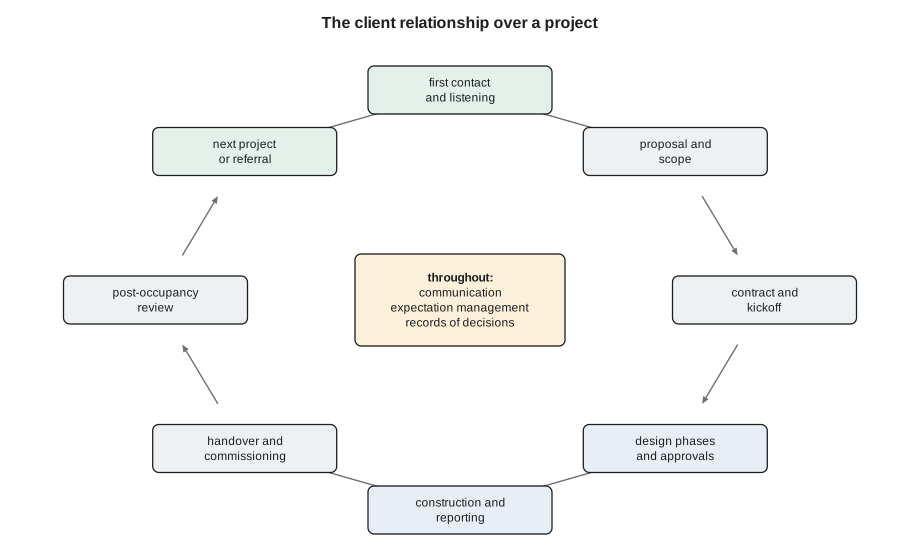
The first meeting is mostly listening. Eberle teaches the students to ask open questions and to resist the urge to sketch a solution before they understand the problem. What does the client hope the project will do for their organization? What does success look like in five years? What worries them? What have they built before, and what went wrong? Who else needs to be involved? What is the budget, and where does the money come from? The answers become the basis of the proposal and, later, of the program. Delgado says that the firm that got the Stanfield project was the only one that asked how Greenway measures the success of a building after it opens.
Communication and decisions
Clear communication prevents most problems in the relationship. Eberle Moss sends a short written update to each client every two weeks during design and every week during construction, listing what was done, what decisions are needed and by when, and any risks to cost or schedule. Meetings are followed by minutes that record decisions, actions and who is responsible, and the client is asked to correct anything wrong. When the client approves a phase of design, the approval is recorded in writing. Delgado says that she does not always read the updates carefully, but she reads the list of decisions, and she has never been able to claim that a decision was made without her knowledge.
The most difficult conversations concern cost, schedule and change. When a cost estimate comes in over budget, the architect must tell the client promptly, explain why, and offer options: reduce scope, change materials or systems, phase the work, or increase the budget. When the client asks for a change after a phase has been approved, the architect must explain its effect on fee, cost and schedule before doing the work, and must get the change approved in writing as an additional service if the contract requires it. Architects who do extra work without written approval often find, at the end of the project, that the client does not remember asking for it. Lesson 7 returns to this.
# Decision log for a client: what is pending, what is late, and its effect on the schedule.
from datetime import date
today = date(2027, 3, 1)
decisions = [
    ("D-14", "window repair or replace on the lane wall", date(2027, 2, 15), None, 10),
    ("D-15", "light court size (option A or B)", date(2027, 2, 22), date(2027, 2, 20), 15),
    ("D-16", "finish package for common areas", date(2027, 3, 8), None, 5),
    ("D-17", "rooftop addition set back distance", date(2027, 2, 26), None, 20),
]
late_days = 0
for ref, text, due, made, impact in decisions:
    if made:
        status = "made " + made.isoformat()
    elif due < today:
        overdue = (today - due).days
        status = f"LATE by {overdue} days"
        late_days = max(late_days, min(overdue, impact))
    else:
        status = "due " + due.isoformat()
    print(f"{ref}  {status:<20} {text}")
print("schedule days at risk from late decisions:", late_days)D-14 LATE by 14 days window repair or replace on the lane wall D-15 made 2027-02-20 light court size (option A or B) D-16 due 2027-03-08 finish package for common areas D-17 LATE by 3 days rooftop addition set back distance schedule days at risk from late decisions: 10
The decision log is a simple tool, but Delgado says it is the single document she values most from her architects. It shows at a glance what the architect is waiting for and what the delay costs, which helps her push her own organization to decide. In the example, two decisions are late, and the late decision on the rooftop set back puts about two weeks of the schedule at risk. The log also protects the architect: if the project runs late because the client did not decide, the record shows it.
When the relationship goes wrong
Relationships go wrong for predictable reasons: a budget that was never realistic, a client who cannot decide, a change of the client's staff halfway through, a mistake by the architect, an unpaid invoice, or simple loss of trust. Eberle's advice is to deal with problems early and directly. Raise the issue in a meeting, not only in an email; listen to the client's view; acknowledge what the firm got wrong; propose a way forward; and record what was agreed. Most disputes can be resolved this way, and the contract usually provides for negotiation and mediation before anything more formal. If a client stops paying, the contract will usually allow the architect to suspend services after notice, but Eberle says that suspending work is a last resort, because it almost always ends the relationship.
Sometimes the right thing is to end a relationship. A client who insists on something unsafe or illegal, who repeatedly refuses to pay, or who abuses staff may leave the architect no choice. The contract sets out how either party may terminate and what happens to fees, documents and copyright when they do. Ending a project well matters as much as starting one: the architect should hand over what the client is entitled to, settle accounts, notify the insurer if a claim is possible and keep complete records. A firm's reputation is shaped as much by how it leaves projects as by how it wins them.
Worked problem
Delivering bad news about cost
At the end of design development, the cost consultant's estimate for the Stanfield conversion comes in 9% over Greenway's construction budget. How should the architect handle it?
Show solution
- Review the estimate with the cost consultant to understand where the overrun comes from: the rooftop addition, the light court, window work and mechanical systems.
- Prepare three options that bring the cost back to budget, each with its effect on the design, the heritage approvals, the number of homes and the schedule.
- Meet Delgado in person within a week, present the estimate honestly and explain the causes without blaming others.
- Recommend one option, such as reducing the rooftop addition by two homes and repairing rather than replacing the lane windows, and explain why.
- Record the decision in writing, update the cost plan, and confirm any change to the fee or schedule as the contract requires.
Answer: Tell the client promptly, explain the causes, offer options and a recommendation, and record the decision.
Exercise 5: the first meeting
- Prepare ten open questions for a first meeting with a client who wants to convert an old school into a community arts building.
- Role-play the meeting with a classmate as the client, and take notes on what you learned that you did not expect.
- Write a one-page summary of the client's goals, constraints and decision-makers.
- Draft the first two-week update you would send after the meeting.
Self-check
- Do I know who the client's authorized representative is on my project?
- Can I explain how I would handle a change requested after approval?
- Do I record decisions in writing and ask the client to confirm them?
- Do I know what questions to ask before accepting a commission?
Common mistakes
MistakeTaking instructions from a stakeholder who has no authority.
InsteadName the client's authorized representative in the contract and route all instructions through them.
MistakeSketching solutions before understanding the problem.
InsteadListen first: goals, constraints, budget, decision-makers and measures of success.
MistakeDoing extra work without written approval.
InsteadExplain the effect of the change and get approval in writing before doing the work.
MistakeHiding bad news about cost or schedule.
InsteadTell the client promptly, with causes, options and a recommendation.
MistakeAccepting every commission offered.
InsteadCheck the client's authority, money, budget and schedule before accepting.
Summary and key terms
- The client is the party that engages and pays the architect; many other stakeholders have interests but cannot give binding instructions.
- Name the client's authorized representative and route decisions through them.
- Clients choose architects by referral, interview, competition or formal procurement; qualifications-based selection is common for public work.
- Regular written updates, minutes and a decision log keep expectations aligned and protect both parties.
- Problems should be raised early and directly; ending a relationship well matters as much as starting it.
- Authorized representative
- The person named by the client with authority to give instructions and approve decisions.
- Stakeholder
- A person or group with an interest in a project who is not a party to the architect's contract.
- Qualifications-based selection
- Choosing an architect on experience and approach, with the fee negotiated afterward.
- Decision log
- A record of decisions needed from the client, their due dates and their status.
- Additional service
- A service outside the agreed scope, provided only with the client's written agreement and usually for an additional fee.
Practice problems
Work each problem on paper first, then reveal the answer to check.
Why should a contract name the client's authorized representative?
Show answer
So that it is clear who can give binding instructions and approve decisions, which prevents unauthorized changes and disputes.
Name three questions to ask before accepting a commission.
Show answer
Any three of: does the client have authority and money; is the budget realistic; is the schedule possible; how did past projects go; is it good for the firm.
What should a two-week client update contain?
Show answer
Work done, decisions needed and when, and risks to cost or schedule.
What should the architect do when a client asks for a change after a phase is approved?
Show answer
Explain the effect on fee, cost and schedule, and get written approval, as an additional service if the contract requires, before doing the work.
Why is choosing an architect mainly on fee a false economy?
Show answer
The fee is a small part of a building's life cost, and a low fee can reduce the time spent on decisions that drive that cost.
Lesson quiz · 5 questions
Score 60% or more to complete this lesson.
Create a free account to save your progress, take quizzes and earn a certificate.