
ARCH-410 · Lesson 2 of 12 · 22 min
Provincial associations and the Architects Act
The second week begins with a guest. Margaret Olafson is a retired architect who served for six years on the registration and complaints committees of the Manitoba Association of Architects, and she comes to the Eberle Moss conference room with a folder of anonymized cases. She tells the students that most architects meet their regulator only three times in a career: when they enrol as interns, when they are registered, and when they renew each year. A few meet it a fourth time, when someone complains. Her aim this week is to make the association familiar, so that the students understand what it does, why it asks for what it asks, and how to stay on the right side of it.
What a provincial association does
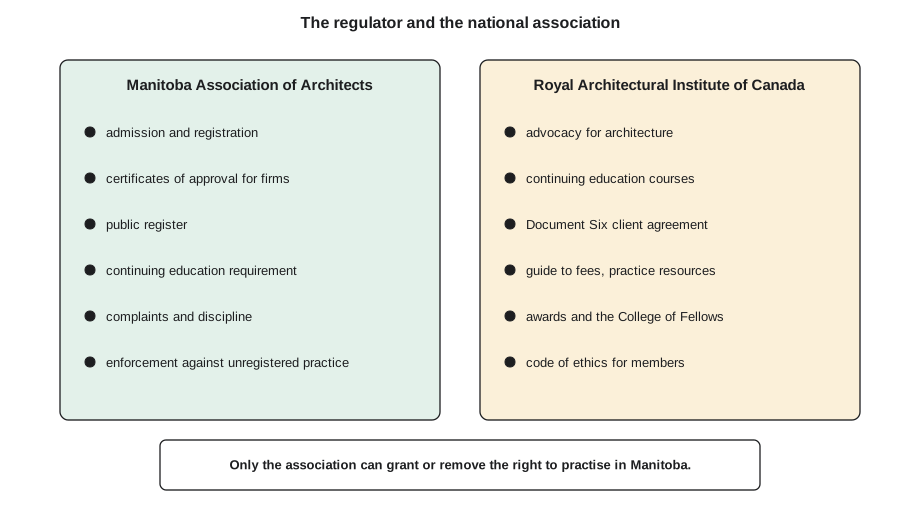
The Manitoba Association of Architects exists because The Architects Act says it does. Its objects, set out in the Act, include advancing the knowledge and skill of its members in the public interest and for the safety of the public, and setting the examinations and standards for admission. To carry out those objects it does six main things. It admits people to the profession, first as students and interns and then as registered architects. It approves firms, by issuing certificates of approval to corporations and partnerships that offer architectural services. It keeps a public register of members and firms in good standing. It sets standards of practice and conduct through its by-laws, including a mandatory continuing education program. It investigates complaints and disciplines members and firms. And it enforces the Act against people who practise without being registered.
The association is governed by a council, which the Act says must have between eight and twenty-three members, two of whom represent the public. The council makes by-laws and rules, appoints committees and hears the most serious matters. Most of the day-to-day work is done by staff and by committees of volunteer architects: a registration board that reviews interns' experience and applications, a complaints committee that screens complaints, and a discipline committee that holds hearings. Olafson says that the volunteers are the part of self-regulation that the public rarely sees. Practising architects give hundreds of hours a year to read internship records, interview applicants and review the work of colleagues, and the system depends on them doing it fairly and without favouring friends.
Registration and the annual renewal
To be registered with the MAA, the Act requires an applicant to be at least eighteen, to satisfy the council of their fitness and competence, to pass the association's examinations and to pay the fees. In practice this means completing the national internship program described in the next lesson: a professional education certified by the Canadian Architectural Certification Board, a minimum of 3,720 hours of supervised experience, and the Examination for Architects in Canada. Once registered, an architect renews every year by paying the annual fee, confirming that they have met the continuing education requirement and reporting any changes, such as a new firm. An architect who stops practising can move to a retired or non-practising category, which keeps the title in a limited form but removes the right to offer services.
Continuing education is the part of regulation that architects notice most often after they are licensed. The idea is simple: building codes, materials, technology and law change, and an architect who stopped learning on the day of licensure would soon be practising with out-of-date knowledge. The requirement is also a modest one, and Olafson admits that it can be met carelessly by sitting through lunchtime presentations from product manufacturers. She urges the students to plan their learning instead, choosing courses that close real gaps: code changes, accessibility, building science, contracts and the business of practice. A well-planned record of continuing education is also a defence if a complaint ever questions an architect's competence.
# Continuing education log for one reporting year (hours by topic).
# The MAA requirement is set in its by-laws; this sketch assumes a yearly target and a
# rule that at least part of it must be structured learning, for illustration only.
log = [
    ("2026-01-14", "building code update seminar", "structured", 3.0),
    ("2026-02-03", "manufacturer lunch talk on windows", "informal", 1.0),
    ("2026-03-20", "contracts and risk workshop", "structured", 6.0),
    ("2026-05-08", "accessibility standard course", "structured", 4.0),
    ("2026-09-15", "reading: building science journal", "informal", 2.5),
]
target, structured_min = 18.0, 9.0
total = sum(h for *_, h in log)
structured = sum(h for _, _, kind, h in log if kind == "structured")
print(f"total hours      {total:5.1f} of {target}")
print(f"structured hours {structured:5.1f} of {structured_min}")
print("status:", "complete" if total >= target and structured >= structured_min else "more hours needed")total hours 16.5 of 18.0 structured hours 13.0 of 9.0 status: more hours needed
The numbers in the Manitoba sketch are placeholders chosen for the exercise: the actual requirement, including how many hours must be structured learning, is set in the association's by-laws and changes from time to time, and the students must look it up before they rely on it. The habit the code teaches is the important part. Eberle Moss keeps a shared log for every architect and intern in the firm, and the office manager checks it each autumn so that no one discovers in December that they are short.
The national picture: CALA and mobility
Licensing is provincial in Canada, but the eleven provincial and territorial regulators coordinate their work through the Canadian Architectural Licensing Authorities, known as CALA. CALA maintains the Internship in Architecture Program that all the regulators use, oversees the Examination for Architects in Canada, and negotiates agreements for mobility between provinces and with other countries. Under the national mobility agreement an architect registered in good standing in one province can register in another without repeating the examination. Internationally, CALA administers the Canada–US mutual recognition agreement and other arrangements, and it runs a program for experienced architects educated and licensed outside Canada. The RAIC, by contrast, is the national voluntary association. It advocates for architecture with the federal government, publishes the standard client–architect contract known as Document Six and a guide to fees, runs continuing education and awards, and has its own code of ethics for members.
Olafson draws a lesson from the national structure. Because the education, experience and examination are largely the same across the country, an architect's qualifications travel with them, and mobility is easier than in many professions. But each jurisdiction still has its own law, its own rules of conduct and its own disciplinary process, and an architect who practises in several places must follow all of them. A complaint in one place can also follow an architect to another, because regulators share information about discipline.
Complaints and discipline
Olafson opens her folder. The cases are real but anonymized, and she reads three. In the first, a homeowner complained that an architect had taken a deposit for a house design, produced a few sketches and then stopped answering calls for four months. There was no written contract. The committee found that the architect had failed to define the services and had not communicated, and it required a reprimand and a course in practice management. In the second, a building official complained that an architect had sealed a set of drawings prepared by an unlicensed designer who worked for another company and whom the architect had never supervised. This is called plan stamping, and it is treated seriously because it defeats the whole purpose of licensing. The architect's registration was suspended. In the third, a contractor complained that an architect had refused to certify a payment. The committee found that the architect had acted correctly under the contract and dismissed the complaint.
The three cases show the range. Some complaints come from clients who feel badly served; some come from officials or other professionals who see a risk to the public; and some come from people who are unhappy with a decision that the architect was entitled to make. The process is designed to tell these apart. A complaint is screened first. If it falls outside the regulator's authority, such as a pure fee dispute that belongs in court, it is closed with an explanation. If it raises a question of competence or conduct, it is investigated, and the architect is asked to respond in writing. Many complaints are resolved at this stage by an undertaking, mediation or a caution. Only the most serious go to a formal hearing, where the regulator must prove its case and the architect may be represented by a lawyer.
The Act gives the association a wide range of outcomes: censure, an undertaking, conditions on practice, additional study, a fine, suspension or cancellation of registration. A complaint that concerns only the complainant and the member can be sent to mediation if both agree, and a member can appeal a disciplinary decision to the Court of Appeal within thirty days. Olafson notes that the Act also makes the architect who takes professional responsibility for a firm's work personally and jointly liable with the firm for certain misconduct, which is one reason firms take the role of the responsible architect seriously.
| Ground for discipline | Example | Typical prevention |
|---|---|---|
| Practising without a licence or outside the scope of practice | Offering services in a jurisdiction before being licensed there | Check licensing before proposing; register the firm |
| Plan stamping | Sealing drawings prepared by someone the architect did not supervise | Seal only work you directly supervised |
| Incompetence or negligence | Drawings that ignore basic code requirements for exits | Quality control, peer review, continuing education |
| Misrepresentation | Claiming credit for another firm's design in a proposal | Accurate credits and project descriptions |
| Conflict of interest | Accepting a payment from a supplier whose product the architect specifies | Disclose interests to the client; refuse gifts that influence judgement |
| Failure to communicate or to define services | No written agreement, missed deadlines, unanswered calls | Written contracts, scheduled updates, prompt replies |
Enforcement against unlicensed practice
Regulators spend a surprising share of their effort on people who are not licensed at all. A designer who advertises 'architectural services' online, a drafting company that prepares permit drawings for buildings above the exemption thresholds, or a builder who calls a staff designer an architect can all be breaking the law. Regulators usually start with a letter, and most people stop when asked. If they do not, the regulator can seek a fine or an injunction. The Architects Act sets fines of up to 10,000 dollars for a first offence and 20,000 dollars for a later one, and the association can ask the Court of King's Bench for an injunction. Olafson says that architects help by reporting what they see, and that the profession's credibility depends on enforcement being even-handed: an unlicensed designer who does good work on an exempt building is within the law, and the regulator's job is not to protect architects from competition.
Worked problem
Responding to a complaint
A former client complains to the regulator that an architect's drawings for a small office renovation missed a required exit, and that the contractor charged extra to fix it. The architect receives a letter asking for a written response within thirty days. What should the architect do?
Show solution
- Notify the professional liability insurer immediately; most policies require prompt notice of any claim or complaint and offer advice or a lawyer.
- Gather the project file: the contract, the drawings as issued, the code analysis, emails and minutes, and any change orders.
- Review the facts honestly: was the exit missing from the drawings, did the client change the layout after the drawings were issued, and was the extra cost caused by the omission?
- Write a factual, courteous response that answers the questions asked, attaches the relevant documents and avoids attacking the client.
- If the drawings were in error, say so, explain what was done to correct it and what the firm has changed in its quality control; regulators look favourably on honesty and remediation.
Answer: Notify the insurer, respond on time with facts and documents, and be candid about any error.
Exercise 2: reading the rules
- Find the MAA's by-laws and identify the continuing education requirement and the categories of membership.
- Read the summary of a published disciplinary decision and write a one-paragraph account of what went wrong and how it could have been prevented.
- Make a personal continuing education plan for your first renewal period, naming at least three topics that close real gaps in your knowledge.
Self-check
- Do I know what my regulator does, and what it does not do?
- Can I explain plan stamping and why it is treated so seriously?
- Do I know how renewal and continuing education work where I intend to practise?
- Do I know the first thing to do if I receive a complaint?
Common mistakes
MistakeIgnoring the regulator's letter or responding late.
InsteadRespond on time, factually and courteously, after notifying the insurer.
MistakeTreating continuing education as a box to tick.
InsteadPlan learning that closes real gaps, and keep records in case of an audit.
MistakeAssuming the regulator will settle a fee dispute.
InsteadFee disputes are usually civil matters for negotiation, mediation or court; regulators deal with competence and conduct.
MistakeSealing a colleague's or a consultant's work without review.
InsteadSeal only work prepared under your direct supervision, and review consultants' work within your scope.
MistakeAssuming that discipline in one jurisdiction stays there.
InsteadRegulators share disciplinary information, and action in one place can lead to action elsewhere.
Summary and key terms
- The MAA admits and registers architects, approves firms, keeps the public register, sets continuing education rules, disciplines members and enforces the Act.
- Registration requires CACB-certified education, the internship and the ExAC; renewal is annual and includes continuing education.
- CALA coordinates the provincial regulators nationally, while the RAIC is the voluntary national association.
- Complaints are screened, investigated and, if serious, heard; outcomes range from dismissal to cancellation of the licence.
- Most complaints can be prevented by written agreements, clear communication and sealing only supervised work.
- Council
- The governing body of the provincial association, including elected architects and public representatives.
- Continuing education
- Learning that a registered architect must complete to keep their registration current.
- Plan stamping
- Sealing drawings that were not prepared under the architect's direct supervision.
- CALA
- Canadian Architectural Licensing Authorities, the national body of the provincial and territorial regulators.
- Undertaking
- A written promise by a member to take or avoid certain actions, often used to resolve a complaint.
Practice problems
Work each problem on paper first, then reveal the answer to check.
Name four things the MAA does.
Show answer
Any four of: admits and registers or licenses architects; approves or registers firms; keeps the public register; sets continuing education and conduct rules; investigates complaints and disciplines; enforces the law against unlicensed practice.
Why is plan stamping treated as a serious offence?
Show answer
It allows unqualified, unsupervised people to produce work that the public relies on as the work of a licensed architect, which defeats the purpose of licensing.
What should an architect do first on receiving a complaint letter?
Show answer
Notify their professional liability insurer, then gather the project file and prepare a timely, factual response.
What is the difference between CALA and the RAIC?
Show answer
CALA is the national body of the regulators, coordinating admission and mobility; the RAIC is a voluntary association that serves architects.
Why should continuing education be planned rather than collected?
Show answer
Planned learning closes real gaps in competence, which protects clients and the public and gives the architect a credible record if competence is questioned.
Lesson quiz · 5 questions
Score 60% or more to complete this lesson.
Create a free account to save your progress, take quizzes and earn a certificate.