
ARCH-410 · Lesson 6 of 12 · 22 min
Contracts: RAIC and CCDC documents
The binder on the conference table from the first week comes open in the sixth. Eberle explains that it holds the firm's standard contracts, each one tabbed and annotated with notes from the firm's lawyer and insurer, and that every project the firm has done in thirty years began with one of them. The guest this week is Amira Sandoval, a construction lawyer who represents architects, owners and contractors at different times and who says she has seen every kind of contract go wrong. She begins by asking the students what a contract is for. Wren says it sets the fee. Callum says it protects the firm. Sandoval says both answers are right, but that the main purpose of a contract is to make sure that two parties who want the same thing agree in advance on what each will do, so that they can remember it the same way when memories differ.
Why standard forms exist
Architects in Canada rarely write contracts from scratch. They use standard forms published by the profession and the construction industry, which have been drafted and revised over decades by architects, engineers, owners, contractors and lawyers. The Royal Architectural Institute of Canada publishes the standard form for the agreement between client and architect, known as Document Six. The Canadian Construction Documents Committee, a national committee that includes representatives of owners, consultants and contractors, publishes the family of construction contracts known as CCDC documents. Sandoval says that the great advantage of standard forms is that their wording is familiar to everyone, has been tested in disputes and courts, and allocates risk in a way that the industry broadly accepts. The great danger is that people change them without understanding what the changes do.
The client–architect agreement
Document Six, the Canadian Standard Form of Contract for Architectural Services, was last revised in 2018. It has five parts: a cover and table of contents, the Agreement form that the parties fill in, the definitions, the general conditions and a set of schedules. The definitions and general conditions are meant to be used without change; any amendments belong in separate supplementary conditions, so that everyone can see what was altered. The Agreement records the parties, the project, the services, the fee and the key terms. Schedule A lists the services and shows which party is responsible for each, and alternative schedules cover narrower scopes such as predesign, building condition assessments, custom houses and interior fit-ups. The RAIC publishes a guide that explains each clause. Document Six is intended for most project types and delivery methods but not for design-build or integrated project delivery, for which the CCDC publishes separate forms.
Sandoval walks the students through the terms that matter most. The scope of services defines what the architect will do, and everything not listed is an additional service. The fee and payment terms say how much the architect is paid and when, how expenses are reimbursed and what interest applies to late payments. The client's responsibilities include providing information about the site, a budget, decisions on time and, often, surveys and geotechnical reports; the architect is entitled to rely on that information. Ownership of documents and copyright usually stays with the architect, who gives the client a licence to use the drawings for the project; this matters if the client wants to build the design again elsewhere. Termination clauses let either party end the agreement for cause or, in many forms, for convenience, with payment for work done. Dispute resolution clauses set out negotiation, mediation, arbitration or litigation.
Limiting liability and allocating risk
Two terms deserve special attention. The first is the limitation of liability. Document Six limits the architect's liability to the lesser of the insurance available when a claim is made and an amount the parties agree in the Agreement, and it limits both parties to direct damages, excluding indirect and consequential losses such as lost rent or profit. The RAIC's guide advises against supplementary conditions that make the firm's employees or principals personally liable. The second is the standard of care. The architect promises to perform with the skill and care of a reasonably competent architect in similar circumstances, not to produce a perfect building. Clients' lawyers sometimes propose clauses that promise more, such as warranties that the design is fit for purpose or guarantees of cost, and insurers generally will not cover liability that goes beyond the normal standard of care.
| Proposed change | Risk to the architect | Typical response |
|---|---|---|
| 'The architect warrants that the design is fit for the owner's purposes' | Liability beyond the standard of care, likely uninsured | Replace with the standard of care of a reasonably competent architect |
| Remove the limitation of liability | Unlimited exposure on a small fee | Negotiate a cap related to fee or insurance |
| 'The architect shall ensure the project is completed within budget' | Guarantee of matters the architect does not control | Commit to designing to the budget and to revising the design if bids exceed it |
| Architect to defend and indemnify the owner for all claims | Defence costs and liability for others' acts | Limit to losses caused by the architect's negligence, without a duty to defend |
| Payment only when the owner is paid by its funder | Cash flow and the risk of non-payment | Payment within a fixed period after invoice |
| Owner owns all documents and may reuse them anywhere | Liability for reuse without the architect | Licence for this project; reuse only with consent and release |
Sandoval says that every change has a price, and that the architect's negotiating position is usually stronger than they think. A client who insists on an uninsurable warranty is asking the architect to bet the firm on a single project, and many clients will accept a reasonable alternative once the risk is explained. Eberle Moss sends every non-standard clause to its insurer's contract review service before signing, a service most professional liability insurers offer to their policyholders. Eberle says that the review has saved the firm more than once, and that the habit of reading every clause is worth more than any single negotiation.
The construction contract and the architect's role in it
The architect is not a party to the contract between the owner and the contractor, but the standard forms give the architect, called the Consultant in CCDC documents, a central role in administering it. CCDC 2, the stipulated price contract, is the most widely used. It was revised in 2020, and the new edition introduced a completion milestone called Ready-for-Takeover, which requires the Consultant to confirm that substantial performance has been reached, that an occupancy permit has been issued, and that final cleaning, operation and maintenance documents and as-built drawings are complete. The 2020 edition also ties warranty and insurance periods to Ready-for-Takeover, adds requirements related to prompt payment and annual release of holdbacks on long projects, confirms that statutory adjudication rights are not limited, and excludes indirect and consequential damages. Other CCDC forms cover cost-plus contracts (CCDC 3), construction management (CCDC 5 and 17), design-build (CCDC 14 and 15) and integrated project delivery (CCDC 30).
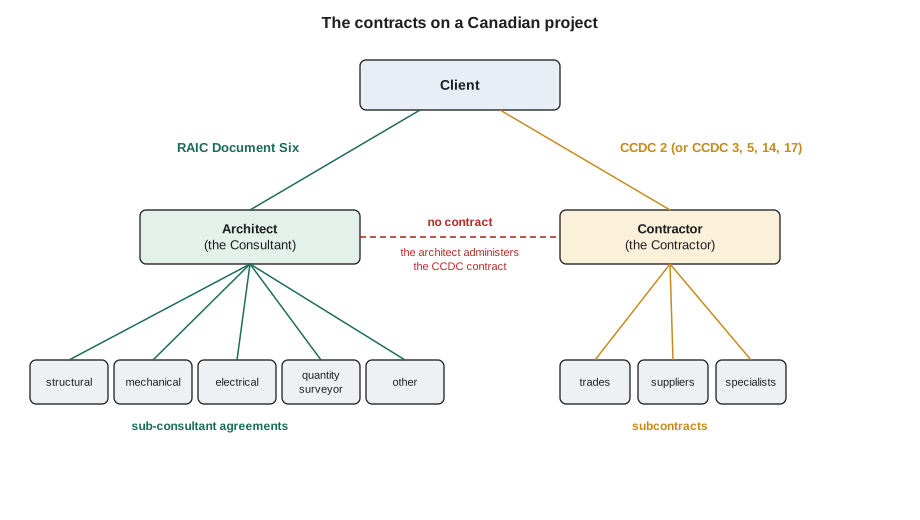
The architect's role in the construction contract is one of the hardest in practice, because the architect is paid by the owner but must interpret the contract fairly between owner and contractor. When the contractor asks for more money or time, the architect evaluates the request against the contract documents and decides, and either party can dispute the decision. When the architect certifies a payment, they confirm that the work has progressed to the point claimed, as far as they can tell from site visits; they do not guarantee its quality or check every detail. Lesson 10 and the next course on project delivery return to these duties in detail.
Agreements with consultants
Most architects engage the engineers and other consultants on their team themselves, under sub-consultant agreements. The key principle is that the terms should flow down: the consultant's scope, standard of care, insurance, schedule and limitation of liability should match the architect's agreement with the client, so that the architect is not left responsible to the client for something the consultant is not responsible to the architect for. Document Six requires the architect to ensure that consultants carry insurance. Payment terms matter too. Many sub-consultant agreements say that the architect will pay the consultant when the client pays the architect, which shares the risk of a slow client but must be written carefully to be enforceable.
# Check that key terms flow down from the client agreement to each consultant agreement.
prime = {"standard of care": "reasonable", "liability cap": 2_000_000, "insurance": 2_000_000,
         "payment days": 30, "copyright to client": False, "consequential damages waived": True}
consultants = {
    "structural": {"standard of care": "reasonable", "liability cap": 2_000_000, "insurance": 2_000_000,
                   "payment days": 30, "copyright to client": False, "consequential damages waived": True},
    "mechanical": {"standard of care": "reasonable", "liability cap": 500_000, "insurance": 1_000_000,
                   "payment days": 15, "copyright to client": False, "consequential damages waived": False},
    "landscape":  {"standard of care": "best efforts", "liability cap": 2_000_000, "insurance": 2_000_000,
                   "payment days": 30, "copyright to client": True, "consequential damages waived": True},
}
for name, terms in consultants.items():
    gaps = []
    for k, v in prime.items():
        c = terms[k]
        if isinstance(v, int) and not isinstance(v, bool):
            if k == "payment days":
                if c < v: gaps.append(f"{k}: pays in {v} but owes in {c}")
            elif c < v:
                gaps.append(f"{k}: {c:,} below {v:,}")
        elif c != v:
            gaps.append(f"{k}: {c} vs {v}")
print(f"{name:<11}", "terms match" if not gaps else "; ".join(gaps))structural terms match mechanical liability cap: 500,000 below 2,000,000; insurance: 1,000,000 below 2,000,000; payment days: pays in 30 but owes in 15; consequential damages waived: False vs True landscape standard of care: best efforts vs reasonable; copyright to client: True vs False
The check finds two problems. The mechanical engineer's liability cap and insurance are lower than the architect's commitment to the client, and the engineer expects payment in fifteen days while the client pays the architect in thirty, so the architect would carry both the liability gap and the cash flow gap. The landscape architect's agreement uses a different standard of care and gives copyright to the client, which conflicts with the prime agreement. Each gap is a conversation to have before the agreements are signed, not after something goes wrong.
Letters, emails and the contract that was never signed
Sandoval ends with the problem she sees most often: work that starts before the contract is signed. A client asks the architect to 'get going on some sketches' while the lawyers review the agreement, and months later the project is in design development with no signed contract. If the relationship sours, the parties argue about what was agreed, and the architect may find it hard to collect the fee or to rely on a limitation of liability that was never signed. Her advice is to sign the contract before starting, or at least to sign a short letter of agreement for the early services that sets out the scope, the fee, the terms that will apply and the intention to sign the full contract. Emails and meeting minutes can also form or change a contract, so architects should write them carefully.
Worked problem
Reviewing a client's amendments
Greenway Homes' lawyer returns Document Six for the Stanfield with supplementary conditions that delete the limitation of liability, add a warranty that the design will meet the funder's energy target, and require payment within sixty days of invoice. How should the architect respond?
Show solution
- List each change and identify its risk: unlimited liability, an uninsurable warranty and a long payment period.
- Send the changes to the insurer's contract review service and ask for its comments.
- Propose alternatives: a limitation of liability tied to the insurance or the fee; a commitment to design to the energy target using the standard of care, with the energy model shared with the client; payment in thirty days with interest after that.
- Explain the reasons in a meeting with Delgado and the lawyer, focusing on what serves the project.
- Record the agreed changes in the supplementary conditions or amendment, and check that consultant agreements are updated to match.
Answer: Identify the risk in each change, take advice, propose reasonable alternatives and flow agreed terms down to consultants.
Exercise 6: reading a contract
- Obtain the RAIC's guide to Document Six and read the general conditions on limitation of liability, termination and dispute resolution.
- Find three clauses that allocate risk between client and architect and explain each in one sentence.
- Draft a short letter of agreement for early design services on a small project.
Self-check
- Do I know which standard forms apply to the client–architect agreement and the construction contract where I practise?
- Can I explain the standard of care and why warranties are dangerous?
- Do I understand why consultant terms should flow down from the client agreement?
- Will I sign a contract before starting work?
Common mistakes
MistakeStarting work before a contract is signed.
InsteadSign the contract, or at least a letter of agreement for early services, before starting.
MistakeAccepting warranties or guarantees beyond the standard of care.
InsteadReplace them with the standard of care; uninsured liability can threaten the firm.
MistakeEditing the standard general conditions directly.
InsteadPut amendments in supplementary conditions or tracked amendments so that changes are visible.
MistakeSigning consultant agreements that do not match the client agreement.
InsteadFlow down scope, standard of care, insurance, limits and payment terms.
MistakeAssuming that emails have no contractual effect.
InsteadWrite emails and minutes carefully; they can form or change agreements.
Summary and key terms
- Canadian practice relies on RAIC Document Six for client–architect agreements and CCDC documents for construction contracts.
- The key terms are scope, fee and payment, client responsibilities, copyright, standard of care, limitation of liability, termination and dispute resolution.
- The standard of care is reasonable professional skill, not perfection; warranties and guarantees create uninsurable risk.
- CCDC 2 2020 introduced Ready-for-Takeover and made the Consultant responsible for confirming it.
- Consultant agreements should mirror the client agreement, and contracts should be signed before work begins.
- Standard form
- A contract drafted and published by an industry or professional body for repeated use.
- Supplementary conditions
- Written amendments to a standard form, kept separate so that changes are visible.
- Standard of care
- The level of skill and care that a reasonably competent architect would exercise in similar circumstances.
- Limitation of liability
- A clause that caps the amount a party can recover from the architect.
- Flow-down
- Carrying the terms of the prime agreement into the agreements with consultants or subcontractors.
Practice problems
Work each problem on paper first, then reveal the answer to check.
What is RAIC Document Six?
Show answer
The standard form of contract between client and architect for architectural services, last revised in 2018.
Why should architects avoid warranties that the design is fit for purpose?
Show answer
They create liability beyond the standard of care that insurers generally will not cover.
Why must consultant agreements match the client agreement?
Show answer
So that the architect is not responsible to the client for matters the consultant is not responsible to the architect for.
What did CCDC 2 2020 introduce as its completion milestone?
Show answer
Ready-for-Takeover, which requires substantial performance, an occupancy permit, final cleaning, operation and maintenance documents and as-built drawings.
What should an architect do if a client wants work to start before the contract is signed?
Show answer
Sign a short letter of agreement covering the early services, fee and terms, with the intention to sign the full contract.
Lesson quiz · 5 questions
Score 60% or more to complete this lesson.
Create a free account to save your progress, take quizzes and earn a certificate.