
ARCH-410 · Lesson 11 of 12 · 21 min
Diversity and equity in the profession
Eberle does not teach the eleventh week alone. He invites Adaeze Nwosu, an architect who leads a firm of twelve people and chairs a mentoring program for young architects from groups that are under-represented in the profession, and he says at the start that he expects to learn as much as the students. Nwosu begins with a photograph of the graduating class of an architecture school in the 1960s: forty men in suits, almost all of them white. She then shows the students' own class photograph from last year, in which more than half the graduates are women and the faces reflect the city around the school. The profession, she says, is changing from the bottom up, and the question for this generation is whether the change will reach the top.
Who becomes an architect
Canada has no single national register of architects with demographic data, so most of what is known comes from the census and from studies of particular provinces and schools. A 2023 review of the evidence in Canadian Architect found that women made up 37.9% of people employed as architects in the 2021 census, up from 28.8% in 2011 and 33% in 2016. The figures vary by province: about 48.8% in Quebec and 34.5% in the rest of the country. In the schools, women have made up more than half of the students in pre-professional bachelor's programs every year since 2003, and among architects under thirty women are now a majority of more than 60%. The review also found that the share of women falls between the bachelor's degree and the professional master's degree, and that there is little data on how many women complete the internship and become registered.
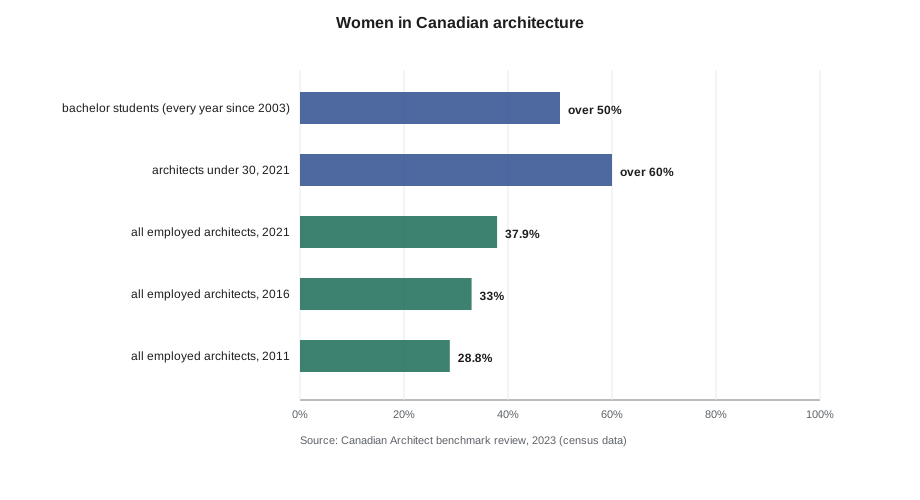
Nwosu asks the students what they see in the numbers. Joon-ho points out that the share of women and of other under-represented groups is highest at the beginning of the path and lower at the end. Ingrid notes that the figures for the whole profession lag behind those for young architects, because the profession is made up of people who entered decades ago. Nwosu agrees with both and adds a third point: averages hide the experience of particular groups. Indigenous architects remain very few in both countries, Black architects are a small share of licensed architects, and architects with disabilities are barely counted at all. The profession's own data is improving, but it still cannot say clearly where people leave the path and why.
Why it matters
There are several reasons the profession cares about who it includes, and Nwosu wants the students to distinguish them. The first is fairness: talented people should not be excluded from a profession by barriers that have nothing to do with their ability. The second is quality: buildings serve everyone, and a profession that reflects the people it serves is more likely to understand their needs, from the design of washrooms and prayer rooms to the location of housing and the meaning of public space. The third is the profession's own future: a field that loses many of the people it educates wastes their talent and its investment in them. The fourth is legitimacy: a profession that the public has trusted with self-government must show that it serves the whole public.
Nwosu also asks the students to notice that diversity and equity are different things. Diversity describes who is present. Equity asks whether people have a fair chance to succeed once they are there: whether they are paid fairly, given interesting work, promoted, mentored and heard. A firm can hire a diverse group of graduates and still lose most of them within five years if its culture, pay and expectations work against them. Inclusion is the work of making sure that people can participate fully. The three words are often used together, but each asks a different question.
Where people leave, and why
Studies in both countries point to similar reasons why people leave architecture or never become licensed. Long hours and unpaid overtime fall hardest on people with caregiving responsibilities, who are still more often women. The long and expensive path to licensure, with low salaries in the early years and fees for the examination, is a barrier for people without family wealth. Pay gaps between men and women, and between white architects and racialized architects, have been documented in salary surveys. A lack of mentors and role models makes it harder for people to see themselves as future leaders. Harassment and exclusion, on job sites and in offices, drive people away. And the culture of the studio, which often celebrates the all-night charrette, carries into practice in ways that many people find unsustainable.
Nwosu is careful not to suggest that individual firms can solve all of this. Some barriers are structural, built into the cost of education and the economics of the industry. But firms and regulators control a great deal. They set salaries, overtime policies and parental leave. They decide who gets to present to clients, who leads projects and who is promoted. Regulators decide how long the path to licensure is and how much it costs. Schools decide how studios are taught. Professional associations decide whose work is celebrated in awards and publications.
# Pay equity check for a firm: compare salaries by role and group, adjusting for experience.
# (Illustrative data for teaching; a real review uses the firm's own records and legal advice.)
staff = [  # role, years of experience, group, salary
    ("intern", 1, "A", 62_000), ("intern", 2, "B", 60_500), ("intern", 1, "B", 59_000),
    ("architect", 6, "A", 84_000), ("architect", 7, "B", 79_500), ("architect", 5, "A", 81_000),
    ("project architect", 11, "A", 101_000), ("project architect", 12, "B", 94_000), ("project architect", 10, "A", 99_000),
]
by_role = {}
for role, yrs, grp, sal in staff:
    by_role.setdefault(role, []).append((yrs, grp, sal))
for role, rows in by_role.items():
    n = len(rows)
    my = sum(y for y, _, _ in rows) / n; ms = sum(s for *_, s in rows) / n
    sxx = sum((y - my) ** 2 for y, _, _ in rows) or 1
    slope = sum((y - my) * (s - ms) for y, _, s in rows) / sxx
    gaps = {}
    for y, g, s in rows:
        gaps.setdefault(g, []).append(s - (ms + slope * (y - my)))
    a = sum(gaps.get("A", [0])) / max(1, len(gaps.get("A", [])))
    b = sum(gaps.get("B", [0])) / max(1, len(gaps.get("B", [])))
print(f"{role:<18} group B vs A, adjusted for experience: {b - a:+,.0f}")intern group B vs A, adjusted for experience: -2,250 architect group B vs A, adjusted for experience: -1,875 project architect group B vs A, adjusted for experience: -2,250
The check compares salaries within each role after allowing for years of experience, and in the illustrative data it finds that group B is paid about 1,900 to 2,300 dollars a year less than group A in every role, a gap that experience does not explain. Nwosu says that results like these are common when firms look for the first time, and that the gaps are rarely the result of anyone's intention. They come from starting salaries negotiated differently, raises that reward people who ask, and promotions that go to people who resemble the partners. The fix is to look regularly, set salary ranges for each role, explain them, and correct gaps when they are found.
What firms and the profession are doing
Canadian regulators, schools and associations have taken several steps. Several provincial regulators have studied why interns leave before registration and have changed the internship to make it more flexible. The RAIC and provincial associations have published guides on equity, diversity and inclusion, and the RAIC has created a task force and programs to support Indigenous architects and Indigenous design. Schools have expanded scholarships, outreach to high schools and partnerships with Indigenous communities. Women in architecture groups across the country run mentoring, networking and advocacy programs. Pay transparency laws in several provinces are also making salaries more visible, which helps employees and employers see gaps.
Nwosu describes what her own firm does. It posts salary ranges for every role and reviews pay every year for gaps. It pays all overtime and limits it. It offers parental leave to every parent and flexible hours to anyone who needs them. It assigns client presentations and leadership roles deliberately, so that the same few people are not always chosen. It pays for interns' examinations and gives every intern a mentor. It recruits from schools and community colleges that send few graduates to architecture firms. And it measures the results, because good intentions without data tend to fade.
| Barrier | What a firm can do |
|---|---|
| Long hours and unpaid overtime | Record all hours, pay or compensate overtime, plan and price projects realistically |
| Pay gaps | Publish salary ranges, review pay annually, correct gaps |
| Few mentors or role models | Assign mentors, create leadership roles, invite diverse critics and speakers |
| Cost of the path to licensure | Pay examination fees, give paid study time, plan a range of experience |
| Caregiving responsibilities | Parental leave, flexible hours, part-time paths to leadership |
| Harassment and exclusion | Clear policies, training, safe reporting, prompt action |
Design, community and the public
Equity is also a question about the buildings architects design and the communities they serve. Nwosu reminds the students of the courses they took last year on culture and community and on urban design. Architects have helped to build segregated neighbourhoods, highways through racialized communities, and public housing that failed its residents. They have also designed accessible buildings, community-led housing and public spaces that welcome everyone. Accessibility law, consultation requirements and community benefit agreements now shape many projects, and clients increasingly ask architects to show how their work serves people who have been excluded. A profession that includes more of the public is better placed to do that work well.
Worked problem
Responding to an inequity in the firm
A project architect at Eberle Moss notices that the two women on her team have not been asked to present to clients in a year, although both are capable and have asked to. What should she do?
Show solution
- Check the facts: review who has presented to clients on the team's projects over the past year.
- Raise it with the principal in charge, focusing on the pattern rather than on blame.
- Propose a plan: assign each of the two architects a client presentation in the next month, with preparation time and support.
- Suggest that the firm track who presents and leads meetings across all teams.
- Follow up after the presentations to make sure the change has stuck.
Answer: Check the pattern, raise it constructively, propose a specific change and measure the result.
Exercise 11: an equity review
- Find the most recent data on representation in the profession where you intend to practise and identify the stage of the path where the largest drop occurs.
- Interview an architect from a group that is under-represented in the profession about the barriers they faced and what helped.
- Draft a one-page equity policy for a small firm covering pay, overtime, leave, mentoring and leadership opportunities.
- Identify one way your studio culture at school could be changed to make practice more sustainable.
Self-check
- Can I explain the difference between diversity, equity and inclusion?
- Do I know where in the path to licensure people tend to leave?
- Do I know what firms can do about pay gaps and overtime?
- Have I thought about how the profession's makeup affects the buildings it designs?
Disability, age and other differences
Discussions of diversity in architecture often focus on gender and race, but Nwosu asks the students to think more widely. Architects with disabilities face offices, job sites and schools that were not designed for them, and software, drawing conventions and site visits that assume a particular kind of body. Older architects can be pushed out of firms that equate energy with youth, and younger ones can be kept from responsibility for too long. Architects who grew up in rural or northern communities, who came to the profession through technical colleges, or who learned English or French as a second language bring knowledge that firms often fail to use. Each of these differences can be a barrier or a strength, depending on how a firm is organized.
Nwosu points out a connection that the students should already see. The profession spends a great deal of effort designing accessible buildings for the public, following codes and standards that the students studied last year, yet many architecture offices are themselves hard to work in for someone who uses a wheelchair or has low vision. A firm that takes accessibility seriously for its clients should take it seriously for its own staff: accessible offices, adjustable equipment, documents that work with screen readers, and site visits planned so that everyone can take part. She says that the habit of asking who is left out, and why, is one of the most useful habits an architect can develop, and that it improves the design of buildings as much as the life of firms.
Common mistakes
MistakeTreating diversity as only a matter of hiring.
InsteadLook at pay, assignments, promotion, mentoring and retention as well.
MistakeAssuming that good intentions are enough.
InsteadMeasure results and correct gaps, because intentions without data fade.
MistakeTreating long hours as a sign of commitment.
InsteadRecord and limit overtime; sustainable practice keeps good people and reduces errors.
MistakeRelying on averages.
InsteadLook at the experience of particular groups, which averages can hide.
MistakeSeeing equity as separate from design.
InsteadRecognize that who designs affects whom buildings serve.
Summary and key terms
- In Canada women were 37.9% of employed architects in 2021 and are a majority of young architects, but data on internship completion is limited.
- Diversity describes who is present; equity asks whether people have a fair chance to succeed; inclusion is the work of full participation.
- People leave because of long hours, the cost and length of licensure, pay gaps, a lack of mentors and harassment.
- Firms control pay, overtime, leave, assignments, mentoring and promotion, and can measure and correct gaps.
- A profession that reflects the public is better placed to design for it.
- Diversity
- The range of people present in a group or organization.
- Equity
- Fair access to opportunity, pay and advancement once people are present.
- Inclusion
- The practices that allow people to participate fully and be heard.
- Pay equity review
- A regular comparison of salaries by role and group, adjusted for legitimate factors such as experience.
- Pay transparency
- Laws or policies that make salary ranges visible, for example in job postings.
Practice problems
Work each problem on paper first, then reveal the answer to check.
What share of employed architects in Canada were women in 2021?
Show answer
37.9%, according to the 2021 census as reviewed in Canadian Architect in 2023.
What is the difference between diversity and equity?
Show answer
Diversity is who is present; equity is whether they have a fair chance to succeed.
Name three reasons people leave the profession.
Show answer
Any three of: long hours and unpaid overtime, the cost and length of licensure, pay gaps, lack of mentors and role models, harassment and exclusion.
Why should a pay review adjust for experience?
Show answer
So that it compares like with like and identifies gaps that experience does not explain.
Name two things a firm can do to support interns from under-represented groups.
Show answer
Any two of: pay examination fees, provide paid study time, assign mentors, plan a range of experience, offer flexible hours.
Lesson quiz · 5 questions
Score 60% or more to complete this lesson.
Create a free account to save your progress, take quizzes and earn a certificate.