
ARCH-410 · Lesson 1 of 12 · 25 min
The profession and its regulation
The last term of the fourth year opens in an office rather than a studio. Professor Thomas Eberle has practised architecture for thirty-one years and is one of the two founding principals of Eberle Moss Architects, a firm of twenty-eight people with an office on the second floor of an old warehouse in Winnipeg's Exchange District. He teaches professional practice every winter, and he holds the first class in the firm's conference room so that the four students, Wren, Callum, Ingrid and Joon-ho, can hear the phones and see the plotter running. On the table are three objects: a rubber stamp, a thick binder of contracts, and an insurance policy. Eberle says that by the end of the term the students should understand why each of those things exists, who controls it and what it costs to use it carelessly.
He begins with the stamp. It reads 'Registered Architect, Province of Manitoba' and carries his name and registration number. When he presses it onto a drawing he is telling the building official, the contractor and the public that the drawing was prepared under his direct supervision and that he takes professional responsibility for it. No one else in the room may use it, and no drawing for a building of any size may be issued for a permit without a stamp like it. The stamp is the visible end of a long chain of law, education, experience and examination, and this course follows that chain from beginning to end.
What makes architecture a profession
Many occupations call themselves professions, but the word has a precise meaning in the law and in the history of work. A profession is an occupation in which practitioners apply specialized knowledge and judgement on behalf of others who cannot easily judge the quality of the work for themselves, and in which the public has granted the practitioners a measure of self-government in exchange for a duty to put the public interest first. Medicine, law, engineering and architecture share these features. A patient cannot check a diagnosis, a client cannot check a structural calculation, and a person walking into a theatre cannot check that the exits were designed for the number of people in the room. Society therefore controls who may do the work, rather than trying to check every piece of work after it is done.
Eberle lists four features that the students will meet again and again. The first is a body of specialized knowledge, taught in accredited schools and tested by examination. The second is a period of supervised experience, in which a newcomer learns to apply that knowledge on real projects under someone who is already licensed. The third is a code of conduct that puts duties to the public, clients and colleagues above the practitioner's own interest. The fourth is regulation by law, usually through a body that the government has created or recognized, with the power to admit, discipline and remove practitioners. A profession that loses the public's trust can lose its self-government, and the history of the regulated professions includes several moments when legislators took powers back after a scandal.
Architecture adds features of its own. Architects design for people who will never meet them: the occupants of a building, its neighbours and the people who will use the street in front of it for a century. Their work is public in a way that a lawyer's advice is not. They also work in a crowded field. Engineers, interior designers, technologists, contractors and design-builders all do some of the work that architects do, and the boundaries between them are drawn by law, not by custom. The students will spend part of this term learning exactly where those boundaries lie, because a firm that crosses them, or allows an unlicensed person to cross them, can face fines and the loss of its right to practise.
Why architecture is regulated
The modern regulation of architecture began in the late nineteenth and early twentieth centuries, when cities were growing quickly and fires, collapses and unhealthy housing were common. Illinois passed the first architectural licensing law in the United States in 1897, after a period in which anyone could call themselves an architect and some buildings in Chicago were designed by people with little training. In Canada the provincial associations were created by provincial statutes around the same time, beginning with Ontario in 1889 and Quebec in 1890, and Manitoba's association dates from the early twentieth century. Today every Canadian province and territory and every US state regulates architecture, though the details differ.
The core of the argument is public safety. A building that is badly designed can burn, collapse, poison its occupants or trap them in a fire. Building codes set minimum standards, but codes do not design buildings; someone has to apply them to a particular site, program and budget, and that person must know how. Licensing is the public's way of making sure that the person who designs a building of a certain size and use has been educated, has worked under supervision and has passed an examination. A second argument is consumer protection. Clients spend large sums on buildings and rely on their architect's advice about cost, schedule and contracts. A licensing body can investigate complaints and discipline architects who mislead or neglect their clients.
Regulation also has costs. It limits who may offer services, which can raise prices and exclude talented people who took unusual paths. Critics have argued for decades that licensing requirements are longer and more expensive than public safety needs, and some have argued that they have kept the profession less diverse than the population it serves. Lesson 11 returns to this question. Eberle wants the students to hold two ideas at once: licensing protects the public and gives the profession its standing, and it also deserves scrutiny, because rules that protect the public can drift into rules that protect the people who already hold the licence.
Practice acts and title acts
Laws that regulate a profession come in two kinds. A title act protects a name. Only people who meet the requirements may call themselves architects, but anyone may do the work as long as they do not use the title. A practice act goes further: it defines the practice of architecture and makes it an offence for an unlicensed person to do that work, whatever they call themselves. Most jurisdictions in North America have practice acts for architecture, with exemptions for small buildings and certain kinds of work. The difference matters to everyone in an office. A recent graduate may do almost any kind of design work under the supervision of a licensed architect, but may not offer architectural services to the public or sign drawings, and may not use the title 'architect' until licensed.
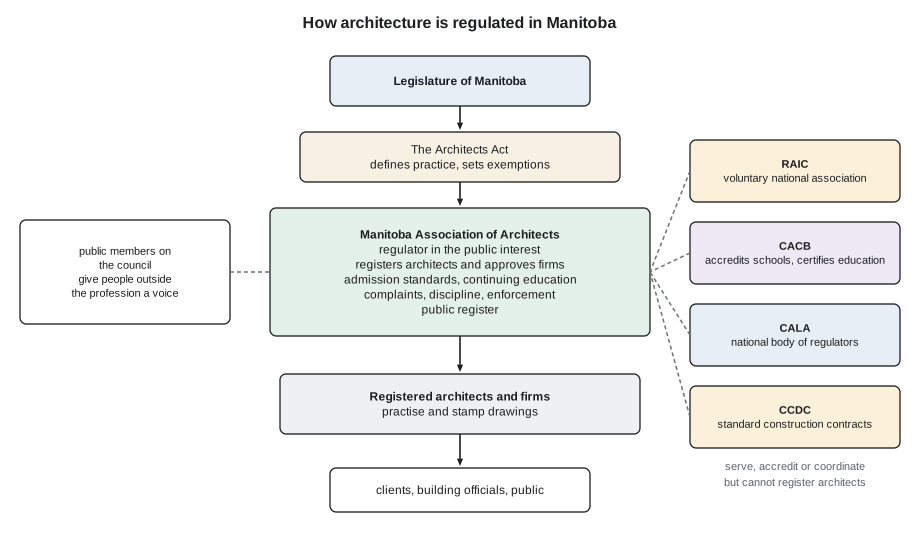
Manitoba's law is The Architects Act. It continues the Manitoba Association of Architects as the body that regulates the profession in the province, and it says that no person or firm may practise as an architect in Manitoba unless they are registered or hold a certificate of approval. The Act defines an architect as a person who, for pay, plans or reviews the construction of buildings by others. It sets fines for unlicensed practice and allows the association to seek an injunction. It also contains the exemptions that every practice act needs: draftspeople and students working under the direction of a registered architect; professional engineers doing certain kinds of work, such as many industrial buildings and farm buildings; and anyone preparing plans for smaller buildings below thresholds set out in the Act, which include residential and business buildings of up to 600 square metres and three storeys. Even an exempt person may not use the title 'architect'.
Self-regulation and public accountability
Canadian architecture is self-regulated. The Manitoba Association of Architects is both the body that licenses architects and, in a limited way, the membership organization of the province's architects, and its council is elected mostly by its members. The Act adds public representatives to the council so that people outside the profession have a voice in decisions about admission and discipline. The council may make by-laws, including a mandatory continuing education program, and it keeps a public register of members in good standing that any client can check. The arrangement depends on trust: the legislature has delegated its power to the profession on the understanding that the profession will use it for the public, not for itself. Across Canada, governments have been examining that bargain more closely in recent years, and several provinces have separated the regulatory and advocacy roles of professional bodies in other fields.
Every regulator handles complaints. A client, a building official, a contractor or a member of the public may complain that an architect acted incompetently, dishonestly or unethically. The regulator investigates, and if the complaint is serious it can hold a hearing. The outcomes range from dismissal of the complaint through a reprimand, conditions on practice, additional education and fines to suspension or cancellation of the licence. Many complaints concern things that architects think of as business matters rather than design: failing to put an agreement in writing, missing deadlines, not returning calls, stamping drawings that the architect did not supervise, or practising outside the scope of a licence. Eberle has sat on a complaints committee, and his first piece of advice is that most of the complaints he saw could have been prevented by a clear written contract and regular communication.
The regulated organizations around the profession
Students often find the alphabet of organizations confusing, so Eberle draws a table on the whiteboard. Some organizations regulate the profession and protect the public; some accredit the schools; some coordinate examinations and mobility between jurisdictions; and some are voluntary associations that serve architects. Knowing which is which tells a young architect where to go with a question and whose rules are binding.
| Organization | Kind | Role |
|---|---|---|
| Manitoba Association of Architects (MAA) | Regulator under provincial law | Registers architects and firms, sets admission standards, disciplines members, keeps the public register |
| Canadian Architectural Licensing Authorities (CALA) | National body of the provincial and territorial regulators | Coordinates admission standards, the internship program, the national examination and mobility agreements |
| Canadian Architectural Certification Board (CACB) | Accreditation and certification body | Accredits professional degree programs and certifies the education of individual applicants |
| Royal Architectural Institute of Canada (RAIC) | Voluntary national association | Advocacy, continuing education, the standard client–architect contract and practice resources |
| Canadian Construction Documents Committee (CCDC) | Industry committee | Publishes standard construction contracts used across Canada |
Eberle points out that the voluntary association and the regulator sometimes have overlapping names and members, and young architects sometimes assume that membership in the association is the same as a licence. It is not. An architect can be registered with the MAA and never join the RAIC, and a member of the association who loses a licence cannot practise even though they can still attend the association's events. The reverse also matters: an association's code of ethics applies only to its members, while the regulator's rules of conduct apply to everyone it licenses.
Practising across borders
Architects increasingly work in more than one jurisdiction. Licensing is provincial in Canada, so an architect registered in Manitoba who wins a commission in Saskatchewan must also register there. The Canadian Architectural Licensing Authorities coordinate a national agreement under which an architect registered in one province can register in another with limited additional requirements. Between Canada and the United States, a mutual recognition agreement that took effect on 1 January 2014 lets architects licensed in one country obtain a licence in a participating jurisdiction of the other. Applicants must be licensed in good standing at home, have at least 2,000 hours of experience as a licensed architect at home, and hold an NCARB Certificate; all of the Canadian licensing authorities have signed the agreement, along with many US boards. The agreement replaced an earlier one from 1994, and architects who hold a licence through a special program for broadly experienced foreign architects are not eligible.
Firms face rules too. Most jurisdictions require a firm that offers architectural services to be owned or controlled in a particular way, or to hold a permit or certificate, and to have a licensed architect who takes responsibility for the work. Manitoba allows corporations and partnerships to practise if they hold a certificate of approval, have registered architects who take professional responsibility for the work, and carry the professional liability insurance that the council requires; the responsible architect is personally and jointly liable with the firm. Lesson 9 returns to these rules when the students set up a small office of their own.
# Who may do this work in Manitoba? A simplified check of the thresholds in the Act.
# (The Act has more categories; this sketch covers a few common cases.)
def needs_architect(use, area_m2, levels):
    small_uses = {"residential", "business", "mercantile", "low-hazard industrial"}
    if use in small_uses and area_m2 <= 600 and levels <= 3:
        return False
    return True

projects = [
    ("residential", 450, 2, "two-family house"),
    ("business", 900, 2, "small office"),
    ("assembly", 300, 1, "community hall"),
    ("residential", 4400, 5, "warehouse conversion to homes"),
]
for use, area, lv, name in projects:
    who = "registered architect" if needs_architect(use, area, lv) else "anyone (exempt)"
print(f"{name:<32} {use:<12} {area:>5} m2 {lv} levels -> {who}")two-family house residential 450 m2 2 levels -> anyone (exempt) small office business 900 m2 2 levels -> registered architect community hall assembly 300 m2 1 levels -> registered architect warehouse conversion to homes residential 4400 m2 5 levels -> registered architect
The sketch reflects the shape of the Act rather than every clause, and Eberle reminds the students that the exemptions are narrow. An assembly building of any size, such as a small community hall, falls outside them because the people inside are at higher risk in a fire, and the Stanfield conversion from last term needs a registered architect several times over. When a client asks whether they really need an architect, the honest answer begins with the Act and ends with the building official, who will not issue a permit for a regulated building without a stamped set of drawings.
Worked problem
Is this practice of architecture?
A recent graduate who is not yet licensed is asked by a friend to design a two-storey addition to a small café and to prepare drawings for the building permit, for a fee. Is this allowed?
Show solution
- Identify the work: planning a building addition and preparing permit drawings for pay is the core of the legal definition of practising architecture.
- Check the exemptions: a business building under 600 square metres and three storeys may fall within the Act's exemption for small buildings, so anyone may prepare the plans.
- Check the title: even if the building is exempt, the graduate may not describe themselves or their work as architectural services or use the title 'architect'.
- Check the risk: the graduate carries no professional liability insurance and has no supervisor reviewing the work; if the addition fails or leaks, the friend has no regulated professional to turn to.
- Recommend: do the work, if at all, within the exemption, under a written agreement, without using the title, and preferably under the review of a licensed architect at the graduate's firm with the firm's agreement.
Answer: Exempt work is legal but carries real risk; the title is protected even when the work is not.
Exercise 1: mapping the profession
- Look up the public register of the Manitoba Association of Architects and find the record of an architect whose work you admire. Note what information the register shows.
- Read the definition of the practice of architecture in The Architects Act and write it out in your own words in no more than fifty words.
- List three kinds of building work that an unlicensed person may legally do in your jurisdiction, and three kinds that only a licensed architect may do.
- Draw a diagram of the organizations described in this lesson and show which ones can grant or remove the right to practise.
Self-check
- Can I explain the difference between a title act and a practice act?
- Can I explain why the public regulates architecture rather than checking each building after it is built?
- Do I know which organization licenses architects where I intend to practise?
- Can I explain why membership in the professional association is not the same as a licence?
Common mistakes
MistakeAssuming that a degree in architecture allows a person to call themselves an architect.
InsteadThe title is protected by law and belongs only to people who are licensed or registered.
MistakeConfusing the regulator with the professional association.
InsteadThe regulator licenses and disciplines; the association serves members and advocates for the profession.
MistakeBelieving that exempt work carries no responsibility.
InsteadExempt work is still subject to building codes, contracts and the law of negligence, without the protection of insurance or supervision.
MistakeStamping drawings that were not prepared under one's direct supervision.
InsteadSeal only work you have supervised and are prepared to take responsibility for; plan stamping is a common ground for discipline.
MistakeAssuming that a licence in one jurisdiction allows practice in another.
InsteadObtain a licence in each jurisdiction before offering services there, using mobility agreements where they apply.
Summary and key terms
- Architecture is a profession: specialized knowledge, supervised experience, a code of conduct and regulation by law in the public interest.
- Regulation exists mainly to protect public health and safety, and also to protect clients; it also has costs and deserves scrutiny.
- Practice acts define the work and restrict it to licensed people, with exemptions for small buildings and supervised employees; title acts protect the name.
- In Manitoba the MAA regulates the profession under The Architects Act, while the RAIC, CACB and CALA play national roles.
- Mobility agreements and certificates allow architects to practise in other jurisdictions, but a licence is still required in each one.
- Practice act
- A law that defines the practice of a profession and restricts it to licensed people.
- Title act
- A law that protects the use of a professional title without restricting the work itself.
- Registered architect
- An architect admitted to practise by the provincial regulator and entitled to use the title and the seal.
- Certificate of approval
- The authorization that allows a corporation or partnership to offer architectural services in Manitoba.
- Mutual recognition agreement
- An agreement between regulators that allows professionals licensed in one jurisdiction to obtain a licence in another with limited additional requirements.
Practice problems
Work each problem on paper first, then reveal the answer to check.
What are the four features of a profession described in this lesson?
Show answer
Specialized knowledge, supervised experience, a code of conduct and regulation by law in the public interest.
Why do practice acts include exemptions for small buildings?
Show answer
The public risk of small, simple buildings is lower, and requiring an architect for every shed or house would be costly and impractical; the exemptions focus regulation where risk is greatest.
What is the main difference between a regulator and a professional association?
Show answer
The regulator has legal power to license and discipline in the public interest; the association is a voluntary organization that serves and advocates for its members.
What must an architect hold to use the Canada–US mutual recognition agreement?
Show answer
A licence in good standing at home, at least 2,000 hours of experience as a licensed architect at home and an NCARB Certificate.
Give two common causes of complaints against architects.
Show answer
Any two of: no written agreement, missed deadlines or poor communication, stamping work not supervised, practising outside the scope of the licence, incompetent or negligent work.
Lesson quiz · 5 questions
Score 60% or more to complete this lesson.
Create a free account to save your progress, take quizzes and earn a certificate.