
APT-340 · Lesson 9 of 12 · 24 min
Review: heavy and industrial parts
▶ Video coming soon A video version of this lesson is on the way.
For the eighth session, Imani borrowed the ring binder that Hamish Corrigall, parts manager at Linmore Truck and Equipment, had lent Talia earlier in the month: his collection of fall cases from the heavy truck, equipment and farm counter. She handed it to Teodor with a warning. "You've never sold a hydraulic hose," she said, "but the Red Seal exam is the same for every sector. A parts technician at a tractor dealer writes the same exam you do. Some of its questions will come from their world."
The Red Seal occupational standard describes parts technicians working in automotive and heavy-duty dealerships, farm equipment, marine, mining, manufacturing, warehousing and tool cribs. Questions about identifying, sourcing and handling heavy and industrial parts fall under parts acquisition and warehousing and inventory. APT-320 covered this world.
Parts beyond the passenger car
The core skills of the trade don't change from sector to sector: identify the part, source it, sell it, handle it and track it. What changes is the equipment, the customer and the cost of a mistake. A car with a wrong part waits in the service bay. A harvester with a wrong part can cost a farm its crop, and an excavator waiting for a pump can stop a whole construction site.
Heavy and industrial counters also identify parts differently. Equipment is identified by model and serial number from the machine's plate rather than a VIN, and component suppliers' numbers on engines, axles and transmissions often matter more than the machine maker's. Many general parts, such as bearings, belts, chains, hose and fittings, are identified by industry-standard numbers and measurements rather than by machine.
Heavy truck parts and fleet customers
Heavy trucks use air brakes. A compressor fills reservoirs with air; pressing the brake pedal sends air to brake chambers at each wheel, which push a pushrod that turns a slack adjuster and rotates an S-cam to spread the brake shoes against the drum. Spring brakes, in the rear section of the chamber, apply when air pressure is released, for parking and emergencies. Automatic slack adjusters have been required on new trucks since the mid-1990s, and anti-lock brakes are required on air-braked trucks and trailers under FMVSS 121 and CMVSS 121.
- Brake chambers are identified by type, the effective area in square inches, such as type 30, and by stroke: long-stroke chambers must not be mixed with standard-stroke chambers on the same axle.
- Brake shoes and drums use industry numbers, such as the 4707 shoe size for a 16.5 × 7 in drum.
- Diesel exhaust fluid (DEF), used by selective catalytic reduction systems to reduce nitrogen oxide emissions, is a 32.5 percent urea solution made to ISO 22241. It freezes at about −11 °C and is not regulated as a dangerous good.
Fleet customers buy on schedules. APT-320's fleet example was Ridgeholt Freight, whose maintenance manager, Ines Kowalczyk, planned preventive maintenance kits for 48 tractors a year in advance.
Worked problem
Forecasting preventive maintenance kits
Ridgeholt's 48 tractors each run about 180,000 km a year, with an oil change and filter kit every 60,000 km. How many kits will they need in a year?
Show solution
- Services per tractor = 180,000 ÷ 60,000 = 3.
- Kits = 48 × 3 = 144.
Answer: 144 kits a year, about 12 a month, which can be stocked on a schedule rather than ordered by emergency.
Construction, mining and farm equipment
Construction and mining equipment wears its parts quickly. The largest wear item on a tracked machine is the undercarriage: track chains, rollers, idlers, sprockets and shoes, which are measured and sold by percentage of wear. Ground engaging tools, such as bucket teeth, adapters and cutting edges, are replaced often and are identified by system and size. Joelle Strand's undercarriage measurement for Pellmore Excavating in September found the chain about three-quarters worn, which shaped the repair choice.
Farm equipment parts are seasonal. Planting, spraying and harvest each bring their own rush, and a farm's machines can't wait. APT-320's farm customer, Dunmarrow Farms, ran two combines, grain carts, tractors and a grain dryer through a harvest week in October in which the counter handled feederhouse slats, dryer belts, a flange bearing, a grain cart hose, a combine main belt from another dealer at night, and trailer brake parts. Farms also place early orders in the off-season for the next year's rebuilds, often with a discount and delayed payment terms.
Hydraulic hoses, fittings and components
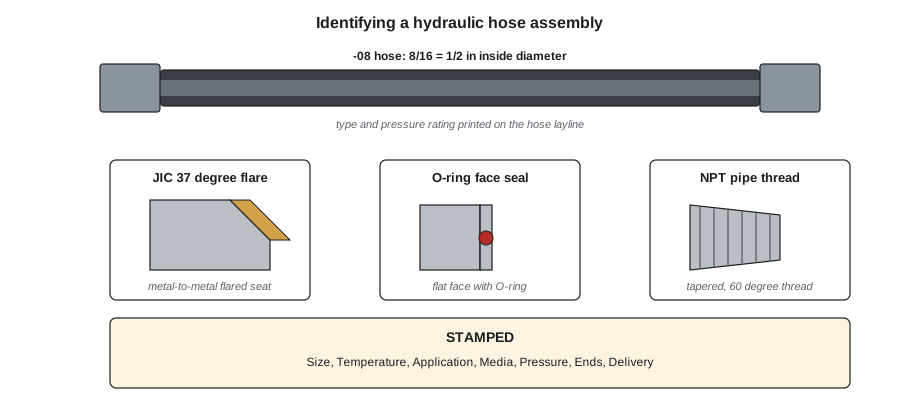
Hydraulic hose is one of the most common industrial counter sales, and one of the most safety-critical. A hose assembly is identified by:
- Size: the inside diameter in sixteenths of an inch, called the dash size. A −08 hose is 8/16 = 1/2 in inside diameter.
- Type and pressure rating: by the SAE J517 hose types or the ISO 18752 pressure classes, chosen for at least the system's maximum working pressure.
- Fittings: the ends on each side. Common types are JIC 37° flare (SAE J514), O-ring face seal (ORFS, SAE J1453), NPT tapered pipe threads with a 60° thread angle, and BSP threads with a 55° angle. Fittings that look alike can be incompatible.
- Length and orientation: overall length and, on fittings with bends, the angle between them.
The counter uses the memory aid STAMPED: size, temperature, application, media, pressure, ends and delivery. Hose assemblies are built on a hose bench, cut square, cleaned, and crimped to the hose and fitting maker's specification.
The most important safety rule is that pressurized hydraulic fluid can be injected through the skin by a pinhole leak. A suspected injection injury is a medical emergency even if it looks small. Nobody checks for leaks with a hand; technicians use cardboard or wood.
Bearings and seals in industry
Industrial bearings use the same numbering as automotive ones, with more suffixes. A 6310-2RS C3 is a deep groove ball bearing, series 63, bore code 10 (50 mm), with rubber seals on both sides and C3 internal clearance, looser than normal, used where heat makes the inner ring expand. Tapered roller bearings are sold as a cone (inner ring and rollers) and a cup (outer ring), and the two must be replaced together. Mounted bearings combine an insert bearing and a housing, such as a pillow block.
APT-320's case at Quellmont Packaging showed why the suffix matters: washdown failures on 6310-2RS C3 bearings came from water getting past ordinary seals. Seals are chosen for the conditions, not only the size.
Power transmission: belts, chains and couplings
Belts, chains and couplings carry power from motors and engines to machines.
- V-belts come in classical sections (A, B, C), narrow sections (3V, 5V, 8V) and metric sections. A B75 is a B-section belt about 75 in long on its inside; a 5V1000 is a 5V belt with an effective length of 100 in.
- Roller chain is numbered by the ANSI standard: the first digits give the pitch in eighths of an inch. A number 60 chain has a 6/8 = 3/4 in pitch. A chain is usually replaced at about 3 percent elongation.
- Couplings join two shafts, allow for small misalignment and are sized by bore and torque.
Worked problem
Measuring chain wear
A number 60 chain has a 3/4 in (19.05 mm) pitch. Twenty pitches should measure 381 mm. Bram Vandersluis measures 388.6 mm over 20 pitches on the grain leg chain. How much has it stretched?
Show solution
- Elongation = (388.6 − 381) ÷ 381 = 7.6 ÷ 381 = 0.020.
- 0.020 = 2 percent.
Answer: About 2 percent, below the usual 3 percent replacement point but worth watching. The sprockets should be checked too, because a worn chain wears its sprockets.
Industrial maintenance and MRO supply
MRO (maintenance, repair and operations) supply covers the parts and consumables a plant uses to keep running: bearings, belts, filters, lubricants, fasteners, safety supplies and tools. Many MRO customers want vendor-managed inventory (VMI), where the supplier stocks and refills a cabinet at the customer's site. Linmore Truck and Equipment's VMI agreement with Quellmont Packaging, signed on November 2, covers 140 part numbers with weekly Tuesday visits, while critical spares are held at the branch.
Recreational and marine parts
Recreational and marine parts follow special rules. Electrical parts fitted in the engine or fuel tank compartments of gasoline-powered boats must be ignition protected, so they can't ignite fuel vapours.
In Canada, the Small Vessel Regulations require ignition protection certified to SAE J1171 or UL 1500. An automotive starter or alternator must never be sold for a gasoline inboard engine. Marine fuel hose follows SAE J1527.
APT-320's case at the aftermarket store was Yusuf Halloran refusing to sell an automotive starter for a boat, a correct refusal that an exam would reward.
Large and heavy part handling
Heavy parts, such as final drives, buckets, engines and transmissions, need lifting equipment and planning. The key calculation is the tension in each leg of a sling, which rises as the sling angle flattens:
Worked problem
Sling tension
A loader bucket weighing 1,100 kg is lifted with a two-leg sling, each leg at 60° from the horizontal. What is the tension in each leg?
Show solution
- sin 60° = 0.866.
- Tension = 1,100 ÷ (2 × 0.866) = 1,100 ÷ 1.732 = 635 kg.
Answer: About 635 kg per leg, more than half the load. At a flatter angle the tension climbs quickly, which is why slings are rated by angle.
Loads on trucks and trailers are secured with tie-downs whose total working load limit is at least half the weight of the cargo, under the cargo securement rules that apply in each country.
Machine-down orders and emergency service
A machine-down order is the most urgent request a heavy counter handles. APT-320's example was Pellmore Excavating's main hydraulic pump on November 12: the call came at 7:10 a.m., a remanufactured pump came by dedicated courier at 9:40 p.m., and the machine was digging again before noon the next day. The steps are the same every time: confirm the part exactly, check every source, give the customer the real arrival time and the cost of each option, and follow up until the machine runs.
Supplying a farm at harvest
APT-320's capstone was Dunmarrow Farms' harvest week, and it showed how a heavy counter prepares for a customer's busiest time. Before harvest, Joelle Strand walked the farm's machines with the owners and built a list of likely wear parts: belts, bearings, slats, sickle sections, hoses and filters for each combine, cart and dryer. The branch stocked the most likely items and arranged emergency sources for the rest, including another dealer's after-hours counter. During harvest, the branch kept an on-call person every evening and weekend. After harvest, the farm reviewed the account: 39 of 41 parts lines filled when needed, 95 percent, and the two misses explained.
The same pattern applies to any seasonal or critical customer: plan ahead from the customer's equipment and history, stock for the season, set up emergency sources and on-call cover, and review afterwards. Exam questions about seasonal customers usually reward the answer that plans ahead rather than the one that reacts.
Industrial customers and their own part numbers
Plants and fleets often have their own internal part numbers and stores systems. A parts technician supplying them keeps a cross-reference between the customer's numbers and the supplier's, and quotes on both. When a plant's maintenance planner orders a "spare for pump 12", the counter that knows pump 12's bearing and seal numbers keeps the account. Linmore Truck and Equipment's VMI agreement with Quellmont Packaging depends on exactly that cross-reference for its 140 part numbers.
Heavy and industrial customers also expect technical knowledge of lubricants: grease grades such as NLGI 2, hydraulic oil viscosity grades, gear oils and the compatibility of different greases. Mixing incompatible greases can cause a bearing failure, so the counter asks what the equipment uses before selling a substitute.
Heavy parts in a dealership counter
Even a car dealership sees some of this world. Linmore's own counter sells trailer wiring and brake parts, light truck parts for fleets such as Orland Courier, and bearings, belts and fasteners by description. Teodor realized during the session that he had been selling general industrial parts for years without calling them that, and that the numbering systems he used without thinking were the same ones the heavy counter used every day.
Imani's last question of the session was a test of sector-neutral thinking: a mining customer needs a bearing the branch has never sold. What does the parts technician do? Teodor's answer covered it: decode the number, confirm the dimensions and suffixes against the old part, check the standard interchange, source it, and give the customer the real arrival time. "Same as a Vela," he said. "Different bearing."
Common mistakes
MistakeConfusing a −08 hose with an 8 mm hose.
InsteadDash sizes are sixteenths of an inch: −08 is 1/2 in inside diameter.
MistakeMixing JIC and ORFS fittings because they look similar.
InsteadIdentify the fitting type and thread before building an assembly.
MistakeChecking a hydraulic leak by hand.
InsteadUse cardboard or wood; an injection injury is a medical emergency.
MistakeSelling an automotive starter for a gasoline boat engine.
InsteadSell only ignition-protected marine parts for gasoline engine compartments.
MistakeMixing long-stroke and standard-stroke brake chambers on one axle.
InsteadMatch chamber type and stroke on each axle.
Summary and key terms
- The core skills are the same in every sector; identification often uses model and serial number and industry part numbers.
- Heavy trucks use air brakes with brake chambers, slack adjusters and spring brakes; ABS is required.
- Hose assemblies are identified by dash size, type, pressure, fittings and length, using STAMPED.
- Bearing suffixes such as 2RS and C3 matter; tapered cones and cups are replaced together.
- Sling tension per leg = W ÷ (2 sin θ); machine-down orders need every source and honest arrival times.
- Dash size
- Hose inside diameter in sixteenths of an inch.
- JIC 37° flare
- A common hydraulic fitting with a 37° flared seat (SAE J514).
- C3 clearance
- Bearing internal clearance looser than normal, for high temperatures.
- Vendor-managed inventory (VMI)
- Stock kept and refilled by the supplier at the customer's site.
- Ignition protection
- Design of electrical parts so they cannot ignite fuel vapours.
- Machine-down order
- An urgent order for a part that has stopped a machine.
Practice problems
Work each problem on paper first, then reveal the answer to check.
What is the inside diameter of a −12 hose?
Show answer
12/16 = 3/4 in.
What is the pitch of a number 80 roller chain?
Show answer
8/8 = 1 in.
What is the bore of a 6312 bearing?
Show answer
12 × 5 = 60 mm.
Tension in each leg of a two-leg sling at 45°, load 800 kg?
Show answer
800 ÷ (2 × 0.707) = 566 kg.
A fleet of 20 trucks runs 150,000 km a year each with service every 50,000 km. How many kits a year?
Show answer
20 × 3 = 60 kits.
Lesson quiz · 5 questions
Score 60% or more to complete this lesson.
Create a free account to save your progress, take quizzes and earn a certificate.