
APT-340 · Lesson 4 of 12 · 27 min
Review: customer service and sales
▶ Video coming soon A video version of this lesson is on the way.
The third session was the one Teodor expected to enjoy, because customer service was his strongest area. Imani surprised him by making him play the customer. She took the counter role herself, deliberately made four mistakes in a ten-minute conversation, and asked him and Talia to name them. Talia caught three: Imani hadn't asked for the VIN, hadn't offered the related parts, and had quoted a price without saying when the part would arrive. Teodor caught the fourth, the one an exam would ask about: she had told the customer the part was "probably" covered by warranty without checking the invoice date.
Customer service is major work activity B, 22 percent of the Red Seal exam or about 26 questions, covering retail, wholesale and internal customers and general customer support. Promoting products and services, from related sales to displays and promotions, is the first task of major work activity E, business practices. APT-130 covered both.
The counter and its customers
A parts counter serves three kinds of customer, and each expects something different:
- Retail customers are individuals buying parts for their own vehicles. They need explanation, patience and honest advice, because they may not know exactly what they need.
- Wholesale customers are repair shops, fleets and other businesses buying on account, usually at a discount from list. They need speed, accuracy and reliable delivery. At Linmore, wholesale is about 147,000 dollars of the 412,000 dollars of monthly counter sales.
- Internal customers are the dealership's own service technicians and other departments. They are the largest group, 188,000 dollars a month at Linmore, and every minute they wait at the counter is a minute the shop can't bill.
An exam question often names the customer type in the first sentence, because the right answer depends on it. A retail customer asking about brakes needs an explanation of the options. A technician needs the right part now and a note on the repair order. A wholesale account needs the price at its level and the delivery time.
Listening and asking the right questions
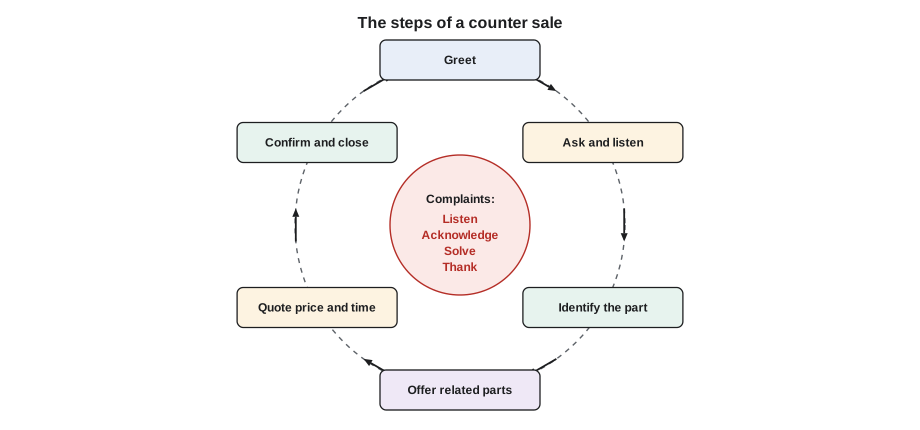
Every good sale starts by finding out what the customer actually needs. APT-130 taught the department's method:
- Open questions get the customer talking: "What's the vehicle doing?" or "What repair are you planning?"
- Closed questions pin down the facts: year, model, engine, VIN, side, quantity.
- Active listening means repeating back what you heard, so mistakes are caught before the lookup.
- Confirming the order before it is rung up: the part, the price, the quantity and when it will be ready.
When things go wrong, Linmore uses the same four steps as many counters, which APT-130 called LAST: listen to the whole complaint without interrupting, acknowledge the problem and the customer's frustration, solve it or explain what will happen next, and thank the customer for raising it. Exam questions about difficult customers almost always reward the answer that listens and solves calmly, and penalize the answer that argues, blames someone else or quotes policy before understanding the problem.
Related sales and upselling
A related sale is a part the customer will need to finish the job: the hardware kit with brake pads, the gasket with a water pump, the thermostat seal with the thermostat, the coolant to refill the system. Offering it is not pushy. It saves the customer a second trip and prevents a comeback. Upselling means offering a better grade of part, such as ceramic pads in place of economy pads or a premium battery with a longer warranty. It is fair when it matches the customer's needs and is explained honestly, and it becomes a problem when it pushes something the customer doesn't need.
APT-130 suggested thinking in features and benefits. A feature is a fact about the part: a longer warranty, a coated rotor, a higher cold cranking rating. A benefit is what it means to the customer: one less trip if it fails, no rust showing through the wheel, an easier start on a cold morning. Customers buy benefits.
Worked problem
What else does the job need?
A retail customer is replacing the front pads and rotors on a 2017 Vela. What related items should the parts technician offer?
Show solution
- Brake hardware kit (clips and shims) for the new pads.
- Caliper slide pin grease and, if the boots are torn, a slide pin kit.
- Brake cleaner for the new rotors.
- Brake fluid, if the customer plans to flush or the fluid is old.
- A reminder to check the pad wear sensor or the parking brake, depending on the model.
Answer: The hardware kit, grease and cleaner are almost always needed; fluid and sensors depend on the vehicle and the job. Offering them as questions ("Do you have brake cleaner?") works better than adding them to the bill.
Displays and promotions, part of promoting products and services, follow the same logic: put related items together, put seasonal items where customers see them, and keep displays full, priced and clean. Linmore's wiper display moves to the front counter in early October, when the season starts.
Quoting price and availability
A quote has two parts, and customers care about both: the price and when the part will be in their hands. APT-130's rule was never to give one without the other. A part that is cheaper but three days away may be the wrong choice for a technician with a car on the hoist, and the right choice for a retail customer planning a weekend job.
Prices depend on the customer. Retail customers pay list or the department's retail price. Wholesale accounts get a discount from list at their price level, such as Bramhall Auto Service's list less 25 percent on terms of net 30. Internal customers pay the internal price set with the service department. Lesson 10 reviews how those prices are built.
Worked problem
Quoting a wholesale price
A water pump lists at 148.00 dollars. Bramhall's price level is list less 25 percent. What is Bramhall's price for two?
Show solution
- Discount = 148.00 × 0.25 = 37.00 dollars.
- Net price = 148.00 − 37.00 = 111.00 dollars each.
- Two pumps = 222.00 dollars, before tax.
Answer: 222.00 dollars for two, on account. The quote should also give the delivery time: on the next van run if the pumps are in stock.
Phone, online and technician orders
Phone orders need the same questions as counter orders, without the customer's old part to look at, so the VIN matters even more. Repeat the order back, give a reference number, and confirm the price, delivery time and payment. Online orders arrive with whatever the customer typed, so the department checks fitment before shipping and contacts the customer if anything is unclear.
Technician orders are the counter's most frequent and most time-critical requests. APT-130 listed the department's standards: work from the repair order, look up by VIN, record every part on the repair order so it is billed, and tell the technician immediately if a part isn't in stock, with the expected time. Linmore's morning pre-pick, pulling parts for the day's scheduled jobs before the shop opens, cut technician wait time noticeably in the autumn.
Returns, cores and warranty
Returns are part of customer service, and the rules need to be clear and applied consistently:
- Normal returns: unused, in saleable packaging, within the return period, with proof of purchase. Linmore refunds stock parts in full.
- Special-order returns: often accepted with a restocking fee, a sample 20 percent at Linmore, because the part may have to go back to the supplier at a cost.
- Electrical parts: opened static-shielding packaging, installed, programmed or VIN-ordered parts aren't returnable; a defect goes through warranty with a diagnosis.
- Cores: the old part returned for a core charge refund must be the same type, complete, and not broken or cracked. A cracked starter case or a missing pulley can mean the core is rejected.
- Warranty claims: check the invoice date and the warranty terms, inspect the failed part, record the reason and process the claim with the supplier or maker. Never promise coverage before checking.
Worked problem
A special-order return
A retail customer returns a special-order lamp assembly bought for 145.00 dollars, unopened, because he sold the vehicle. The restocking fee is 20 percent. What does he get back?
Show solution
- Restocking fee = 145.00 × 0.20 = 29.00 dollars.
- Refund = 145.00 − 29.00 = 116.00 dollars, plus the matching tax.
Answer: 116.00 dollars plus tax. Explaining the fee calmly, and that it was on his order slip, is the customer service part of the answer.
Payment, credit and invoicing
Every sale ends with an invoice and payment. A parts technician should know the payment types (cash, debit, credit card, account), how to make change and close a cash drawer, and what to do when an account customer is over its limit or past due. At Linmore, the drawer starts with a float of 200 dollars, and a drawer that comes up short or over is investigated the same day. Talia's first drawer close was 10 dollars short, traced to a refund for a clip that hadn't been recorded.
Taxes appear on most retail invoices. In Ontario, HST of 13 percent applies to parts sold to retail customers.
Worked problem
A retail invoice
A retail customer buys a thermostat housing for 64.00 dollars. What is the total with tax?
Show solution
- HST = 64.00 × 0.13 = 8.32 dollars.
- Total = 64.00 + 8.32 = 72.32 dollars.
Answer: 72.32 dollars.
Customer information is protected under PIPEDA, the federal privacy law for businesses: collect only what is needed, keep it secure, and use it only for the purpose it was collected for. Ontario's Consumer Protection Act covers internet agreements and repair warranties, and Linmore's electronic messages to customers follow CASL, the anti-spam law, which requires consent.
Commercial and fleet accounts
Accounts bring regular business and their own expectations: agreed prices, delivery schedules, a named contact and accurate monthly statements. APT-130's example was Orland Courier, a fleet of 34 vans run by Ewan Tullis, set up in October with a fleet price level. Accounts also need credit control. When Orland's September invoice passed 60 days in mid-November, the account went on credit hold and the next order was paid by card. A credit hold isn't a punishment; it protects both sides from a debt that grows too large.
Teodor's verdict at the end of the session was that the exam questions in this area weren't about being friendly. "They're about being right and being clear," he said. "The right part, the right price, the right time, and telling the customer the truth."
Serving shop technicians well
Internal customers are the largest group at most dealership counters, and they have the least time. APT-130 set out what technicians value most: a part that is right the first time, a quick answer when it isn't in stock, and a counter that knows the job. The department measures technician wait time, the minutes technicians spend at the counter waiting for parts, because every one of those minutes is labour the shop can't bill. Linmore's wait time fell from about 12 minutes per technician a day in October to about 8 by mid-November after the morning pre-pick and a parts runner from 7:30 to 9:30 were introduced.
Technicians also need honesty. If a part will be late, say so at once, with the expected time, so the shop can move the car or start another job. If the technician has asked for the wrong part, say so politely and show why, using the catalogue. Most technicians respect a parts counter that catches their mistakes, and they remember the one that sold them the wrong part without a question.
Telephone manners and written messages
Phone calls are still a large part of counter work, especially from wholesale accounts. The basic manners are worth reviewing because they come up on exams as best-answer questions: answer promptly with the department's name and your own, give the caller your full attention, put a caller on hold only after asking and come back within a minute, take messages with the name, number, vehicle, question and time, and call back when you said you would. Emails and texts to customers should be short, clear, and checked for the right part number and price before they are sent, because a written quote is a commitment.
Imani closed the session by asking Teodor to name the single habit that prevented most counter mistakes. He thought for a moment and said, "Repeat it back." Repeating the vehicle, the part and the quantity back to the customer before looking anything up catches misheard details, and repeating the price and the time back at the end catches misunderstood quotes. It takes ten seconds and saves a return.
Talia added one of her own from APT-130: write it down. A part number, a price or a promised time that lives only in memory is the one that gets lost when the counter gets busy.
Common mistakes
MistakeQuoting price without availability.
InsteadAlways give both: the price and when the part will be ready.
MistakePromising warranty coverage before checking.
InsteadCheck the invoice date, the terms and the part before making any promise.
MistakeArguing with an angry customer about policy.
InsteadListen, acknowledge, solve and thank; explain policy after understanding the problem.
MistakeTreating related sales as pushy.
InsteadOffer the parts needed to finish the job; it prevents a second trip and a comeback.
MistakeAccepting a cracked core for a full refund.
InsteadInspect cores; broken or incomplete cores can be rejected under the core policy.
Summary and key terms
- Retail, wholesale and internal customers have different needs and prices.
- Open questions find the need, closed questions pin down the facts, and confirming prevents errors.
- LAST (listen, acknowledge, solve, thank) handles complaints.
- Related sales finish the job; upselling is fair when it fits the customer's need.
- Returns, cores and warranty claims follow written policy applied consistently.
- Related sale
- A part needed to finish the job the customer is doing.
- Upselling
- Offering a better grade of part that fits the customer's need.
- Restocking fee
- A charge on returned special-order parts to cover return costs.
- Credit hold
- A stop on account purchases until an overdue balance is paid.
- Features and benefits
- Facts about a product, and what those facts mean to the customer.
- Price level
- An account's agreed discount or pricing basis.
Practice problems
Work each problem on paper first, then reveal the answer to check.
A part lists at 80.00 dollars. A shop's price level is list less 20 percent. What is the shop's price?
Show answer
80.00 × 0.80 = 64.00 dollars.
A special-order part bought for 210.00 dollars is returned with a 20 percent restocking fee. What is the refund before tax?
Show answer
210.00 − 42.00 = 168.00 dollars.
Name two related items for a water pump replacement.
Show answer
Gasket or seal, coolant, and on many engines a thermostat or timing belt kit.
What do the letters of LAST stand for?
Show answer
Listen, acknowledge, solve, thank.
What is the HST on a 120.00 dollar retail sale in Ontario?
Show answer
120.00 × 0.13 = 15.60 dollars.
Lesson quiz · 5 questions
Score 60% or more to complete this lesson.
Create a free account to save your progress, take quizzes and earn a certificate.