
APT-340 · Lesson 11 of 12 · 20 min
A full practice exam and debrief
▶ Video coming soon A video version of this lesson is on the way.
Imani spent three evenings in late October writing a full-length practice exam: 120 original questions, four options each, weighted exactly like the real one. She didn't copy questions from anywhere. She wrote them from the occupational standard's tasks and the situations the department had faced that autumn, and she had Rolf check the answers. On Sunday, November 8, Teodor sat it at his kitchen table with a timer set for four hours, no phone, and nothing on the table but a pencil, a calculator and scrap paper.
The debrief was at the Tuesday session on November 10. Talia arrived twenty minutes late, after her first drawer close of the day had come up 10 dollars short and she had stayed to trace it. Imani waited for her. "This is the most useful session of the whole course," she said. "A practice exam isn't for the score. It's for finding out what to study next."
The results
Teodor scored 89 out of 120, or 74.2 percent, above the 70 percent pass mark but not by enough for Imani's liking. She had a rule: aim for at least 80 percent on practice exams, so that a bad day or a few unfamiliar questions on the real one still leave a pass.
| Major work activity | Questions | Correct | Score |
|---|---|---|---|
| A: Common occupational skills | 19 | 15 | 79 percent |
| B: Customer service | 26 | 22 | 85 percent |
| C: Parts acquisition | 29 | 22 | 76 percent |
| D: Warehousing and inventory | 30 | 19 | 63 percent |
| E: Business practices | 16 | 11 | 69 percent |
| Total | 120 | 89 | 74.2 percent |
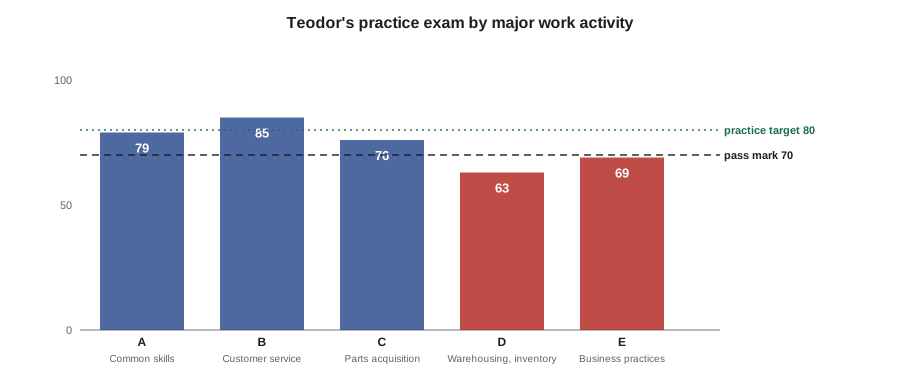
The pattern matched Imani's prediction from the first session. Customer service was strong. Warehousing and inventory, the largest area, was the weakest, and business practices was close behind. Those two areas together had cost him 16 of his 31 wrong answers.
Why each question was wrong
Imani didn't let Teodor stop at the score. She made him go through every wrong answer and sort it into one of three groups, because each needs a different fix:
- Knowledge gaps: he didn't know the fact or the method. The fix is study.
- Misreadings: he knew the answer but misread the question, missed a word such as first, not or best, or chose an option before reading all four. The fix is reading technique.
- Calculation errors: he knew the method but made an arithmetic or units mistake. The fix is checking.
Of his 31 wrong answers, 17 were knowledge gaps, 8 were misreadings and 6 were calculation errors.
Worked problem
What a perfect fix would be worth
If Teodor fixed every misreading and calculation error, and nothing else, what would his score have been?
Show solution
- Errors fixed: 8 + 6 = 14.
- New score: 89 + 14 = 103 out of 120.
- 103 ÷ 120 = 0.858, or 85.8 percent.
Answer: Above Imani's 80 percent target without learning a single new fact. Reading carefully and checking calculations are the cheapest marks on any exam.
The misreadings had a clear pattern. Three were questions with not or except in them ("Which of the following is not a related sale for a timing belt?"), where Teodor had picked the first true statement he saw. Two were best-answer questions where he had chosen a correct action that wasn't the first one. The others were questions he had answered before reading the last option. Imani's fix was simple: circle the key word in the question, and read all four options every time, even when the first one looks right.
The calculation errors had a pattern too. Two used markup where the question asked for margin. Two used monthly figures in an annual formula. One divided a dimensional weight by the wrong divisor, and one forgot to round a reorder point up. Imani asked him to write the formula in words at the top of the scrap paper before every calculation question.
Working through sample questions
Imani then went through a selection of the practice questions, one or two from each area, and asked Teodor to explain his reasoning aloud, right or wrong. These are some of them, in her wording.
- **A technician needs a front wheel bearing for a vehicle whose catalogue lists two bearings, one for vehicles with an anti-lock brake sensor ring built into the bearing. What should the parts technician do first?** Answer: check the VIN or build data for the brake system. Teodor had chosen "ask the technician to look at the old bearing", which works but is slower and isn't the first step.
- Which document gives the transport information for a product being shipped? Answer: section 14 of the safety data sheet, together with the TDG regulations. Teodor got it right.
- A part costs 22.00 dollars and the matrix multiplier for its cost band is 1.80. What is the margin? Answer: 44.4 percent. Teodor had chosen 80 percent, the markup, which was one of the distractors written exactly for that mistake.
- A shipment arrives with one carton visibly crushed. Which action comes first? Answer: note the damage on the delivery receipt before signing. Teodor had chosen "photograph the carton", a good action but not the first.
- **Which of the following is not usually replaced with a timing belt on an engine whose water pump is driven by the belt: tensioner, idler pulley, water pump or spark plugs?** Answer: spark plugs. Teodor had picked the tensioner, reading the question as "which is replaced".
- A customer returns an electronic module in an opened static-shielding bag, unused. What is the policy? Answer: not returnable unless it was defective on arrival and a test confirms it. Teodor got it right.
- Cost of sales is 2,160,000 dollars a year and average inventory is 360,000 dollars at cost. What are the turns? Answer: 6.0. Teodor got it right after catching himself using the monthly figure first.
- A customer asks for an LED bulb for a halogen headlamp. What should the parts technician do? Answer: explain that it isn't a legal replacement and sell the correct halogen bulb. Teodor got it right.
- An apprentice asks how many hours of in-school training the Ontario parts technician apprenticeship has. Answer: about 540, in two levels. Teodor had guessed 720.
- A hydraulic hose is marked −10. What is its inside diameter? Answer: 10/16 = 5/8 in. Teodor got it right.
Talia, who had never sat a practice exam, answered seven of the ten correctly from what she had learned since September. Imani pointed out that every one of her wrong answers was a knowledge gap, not a misreading, which was the better kind of mistake to have two years before an exam.
Timing
Teodor finished his first pass in 2 hours 35 minutes, slower than the 2.5 hours Imani had suggested, with 23 questions flagged. He reached the end of the second pass with 15 minutes left and used them to check his calculations. He hadn't left any blanks. Imani's advice was to speed up the first pass by not working calculations on it at all: mark a guess, flag it and move on.
The plan for the last weeks
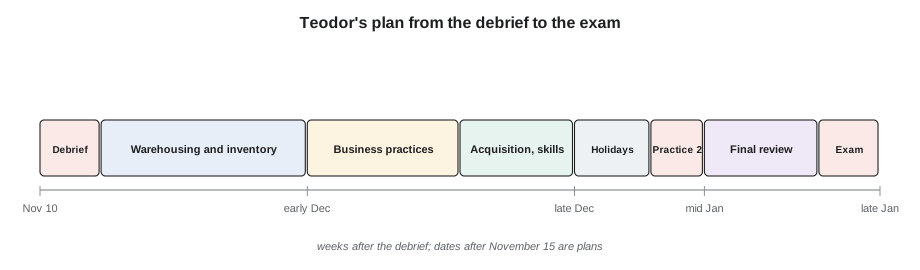
With the exam booked for late January, Imani and Teodor built a targeted study plan for the remaining weeks:
- Weeks 1 to 3 (from November 16): warehousing and inventory: receiving exceptions, dangerous goods, inventory formulas and cycle counts, with Sasha taking him through a full receiving day.
- Weeks 4 and 5: business practices: pricing formulas, margin and markup, transactions and credit memos, using the department's own tickets.
- Weeks 6 and 7: parts acquisition and common occupational skills, with emphasis on supersessions and sourcing.
- Early January: a second full practice exam, written fresh by Imani, then a final review of whatever it shows.
- The last week: light review only, sleep, and no new material.
Managing nerves
Teodor admitted that the hardest part of the practice exam had been the first twenty minutes, when every question seemed to be about something he hadn't reviewed yet. Imani's advice came from her own experience. Expect that feeling and don't trust it: the first questions always seem harder. Answer what you know and keep moving, because confidence returns as the easy questions pile up. Breathe slowly when a question feels impossible, flag it and come back. And remember that a practice exam you passed on the first try is good evidence that the real one is within reach.
Rolf joined the end of the session to hear the result. When Imani showed him the 74, he said it was the best news he had heard all week, which made Talia laugh, given her drawer. "You passed it before you've studied your weakest area," Rolf told Teodor. "That's a man who is going to pass in January."
How Imani wrote the practice exam
Talia asked how Imani had written so many questions. Imani explained her method, which anyone can use to make practice questions for themselves or for an apprentice. Start with a task from the standard. Write a short situation from real work that needs that task. Ask one clear question about it. Write the correct answer first. Then write three distractors, each based on a real mistake: the right answer to a different situation, the result of a common calculation error, or an action that is good but not the best or the first. Finally, check that only one option is defensible, and that the question can't be answered from the wording alone.
She warned against two kinds of weak question. The first gives the answer away, for example when only one option is a complete sentence or when the correct answer is much longer than the others. The second is a trick question that tests reading rather than knowledge. Real certification questions are written and reviewed by panels of tradespeople precisely to avoid both, and a good practice exam should try to do the same.
Reading a question carefully
Imani's reading routine, which she asked Teodor to use on every question of the second practice exam, had five steps:
- Read the last sentence first, so you know what is being asked.
- Read the whole question, and circle key words: first, best, most likely, not, except, always, never.
- Predict the answer before looking at the options.
- Read all four options, even if the first one matches your prediction.
- Eliminate options that are wrong, then choose the best of what remains.
Eliminating is useful even when you don't know the answer. Removing two options that are clearly wrong turns a one-in-four guess into a one-in-two guess. On a 120-question exam, a few of those can be the difference between a pass and a rewrite.
Using results from more than one practice exam
A single practice exam is a snapshot, and small areas are too small to judge from one attempt. Imani planned to compare the second practice exam with the first area by area, and to look for two things: whether the weak areas had improved after targeted study, and whether any new weakness had appeared. A score that improves overall but falls in one area usually means that area was neglected while the others were studied, and the plan for the final weeks is adjusted to match.
What Talia took from it
Talia asked whether she should start practice exams now. Imani said no, not full ones. For an apprentice two months in, the better habit was to answer a few practice questions on each course as she finished it, and to keep the chart of tasks up to date. Full practice exams belong in the last months before the real one, when there is enough knowledge to measure. Rolf agreed, and added that he would rather Talia spend the time on the counter, where every day was a practice exam of its own.
Practising with the real format
Imani's last point was to practise in the real format before the day. The Red Seal website offers sample questions and a self-assessment tool, and Skilled Trades Ontario's exam preparation guide explains what to expect on the day. Teodor planned to try the sample questions in December, after his targeted study, so that the format, the screen or paper and the pace would all feel familiar.
Teodor took the marked practice exam home and pinned the results table beside his task chart. He said that seeing the 63 beside warehousing and inventory every morning would do more for his studying than any amount of good intentions, and Imani agreed that a number on the wall was a fine reason to open the books.
Common mistakes
MistakeLooking only at the total score.
InsteadBreak results down by area and by type of error.
MistakeChoosing the first true statement in a not or except question.
InsteadCircle the key word and find the one option that doesn't fit.
MistakeWorking calculations on the first pass.
InsteadMark a guess, flag the question and come back to it.
MistakeStudying everything equally after a practice exam.
InsteadTarget the weakest high-weight areas first.
MistakeCramming new material the night before.
InsteadKeep the last week for light review and rest.
Summary and key terms
- Teodor's first practice exam scored 89 of 120 (74.2 percent), with warehousing and inventory weakest.
- Wrong answers are sorted into knowledge gaps, misreadings and calculation errors, each with its own fix.
- Fixing misreadings and calculation errors alone would have lifted the score above 85 percent.
- Key words such as first, not, except and best decide the correct option.
- A targeted plan, a second practice exam and a light last week finish the preparation.
- Practice target
- A practice score above the pass mark, such as 80 percent, that leaves a margin for the real exam.
- Knowledge gap
- A wrong answer caused by not knowing the fact or method.
- Misreading
- A wrong answer caused by reading the question or options carelessly.
- Except question
- A question asking for the one option that does not fit.
- Flagging
- Marking a question to return to on a later pass.
- Targeted study
- Study aimed at the areas a practice exam shows are weakest.
Practice problems
Work each problem on paper first, then reveal the answer to check.
Teodor's second practice exam gives 26 of 30 in warehousing and inventory. What is his score in that area?
Show answer
26 ÷ 30 = 86.7 percent.
How many questions must he answer correctly for 80 percent on a 120-question practice exam?
Show answer
120 × 0.80 = 96.
He has 20 wrong answers: 9 knowledge gaps, 7 misreadings and 4 calculation errors. What share are misreadings?
Show answer
7 ÷ 20 = 35 percent.
He finishes the first pass at 2 hours 20 minutes. How much time is left of the four hours?
Show answer
1 hour 40 minutes, or 100 minutes.
Which word in a question signals that you are looking for the one option that doesn't fit?
Show answer
Not or except.
Lesson quiz · 5 questions
Score 60% or more to complete this lesson.
Create a free account to save your progress, take quizzes and earn a certificate.