
APT-340 · Lesson 5 of 12 · 24 min
Review: inventory control
▶ Video coming soon A video version of this lesson is on the way.
Imani called the fourth session "the numbers night". She had warned Teodor in the first session that warehousing and inventory was the largest single area of the exam, and that inventory control was the half of it he had seen least. For fifteen years, the parts system had suggested the stock order and Rolf had approved it. Teodor had never had to work out a reorder point by hand. On the exam, he would.
Inventory control is one of three tasks in major work activity D, warehousing and inventory, which carries 25 percent of the exam, about 30 questions. The other two, handling parts and shipping and receiving, are reviewed in lessons 2 and 6. APT-210 covered inventory control in full.
Why inventory control matters
A parts department's inventory is money on shelves. Linmore Tessaro's parts inventory averages 640,000 dollars at cost, and every part on the shelf costs money to hold even when it doesn't sell. The aim of inventory control is to have the parts customers want, when they want them, without tying up more money than necessary. Two measures pull in opposite directions:
- Fill rate, the share of requests filled from stock, measures service. Linmore's is 371 of 412 requests in a sample week, 90 percent, against a target of 92.
- Turns, how many times a year the inventory sells and is replaced, measures how hard the money is working. Linmore's is 6.0, against a target of 6.5.
More stock raises fill rate and lowers turns. Less stock does the opposite. The skill is stocking the right parts in the right quantities, so both measures improve together.
Bin locations and stock layout
Every stocked part has a bin location recorded in the parts system, so anyone can find it. Linmore's codes read aisle, section, shelf and position: C-07-2-14 is aisle C, the seventh section along it, the second shelf from the floor and the fourteenth bin from the left. Fast-moving parts are stored nearest the counter and at waist height, heavy parts low, and small parts in drawers or bins. A part in the wrong location is as good as out of stock, which is why put-away accuracy matters as much as picking accuracy.
Stock levels, reorder points and lead times
Inventory software decides when to reorder from a few numbers that every parts technician should be able to work out:
- Demand: average sales per day, week or month, taken from the sales history.
- Lead time: the time from when stock is ordered until it is on the shelf.
- Safety stock: extra stock to cover demand above average or a late delivery.
- Reorder point: the stock level at which a part is ordered.
- Minimum and maximum: the levels the system orders between, usually a minimum at the reorder point and a maximum one order cycle above it.
Worked problem
The Vela oil filter
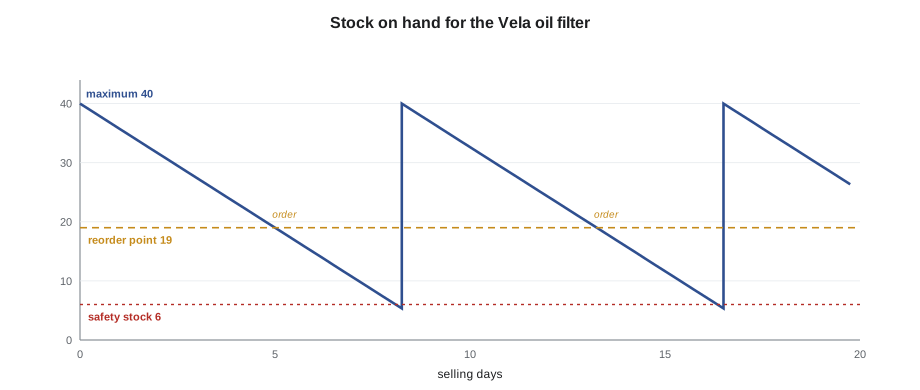
The Vela oil filter sells an average of 4.2 a day. The lead time is 3 days and Rolf wants 6 filters of safety stock. The department orders weekly, and a week is 5 selling days. What are the reorder point and the maximum?
Show solution
- Demand during the lead time: 4.2 × 3 = 12.6.
- Reorder point: 12.6 + 6 = 18.6, rounded up to 19.
- One week's demand: 4.2 × 5 = 21.
- Maximum: 19 + 21 = 40.
Answer: A reorder point (minimum) of 19 and a maximum of 40. Round reorder points up, so the safety cushion isn't lost.
The exam may also ask about economic order quantity (EOQ), a formula that balances the cost of placing orders against the cost of holding stock. Most dealers order daily and weekly from the maker, so EOQ matters more for parts with high ordering costs, such as freight from a distant supplier.
Ordering: stock orders and emergency orders
Dealers order from the maker in two main ways. The stock order, placed on a schedule (Linmore's is weekly, on Wednesdays), restocks the shelves and usually earns a discount or better return terms. The emergency or daily order brings in a part needed for a specific job, usually faster but at a higher cost or without the stock order's benefits. APT-210 showed Rolf reviewing a stock order: the system suggested 152 lines, and he sent 140 after removing parts with a planned supersession and adjusting seasonal items.
Aftermarket parts come from distributors, often with several deliveries a day. Special orders are ordered for one customer, with a deposit and a follow-up schedule: Linmore calls the customer at 7, 14 and 30 days if a special order isn't collected.
Turns, GMROI and carrying cost
The three measures APT-210 used to judge inventory are worth knowing by heart:
Worked problem
Linmore's inventory measures
Linmore's annual parts sales are 4,944,000 dollars, cost of sales 3,840,000 dollars and average inventory 640,000 dollars at cost. Carrying cost is estimated at 25 percent of the inventory value a year. Work out turns, GMROI, months of supply and the annual carrying cost.
Show solution
- Turns = 3,840,000 ÷ 640,000 = 6.0.
- Gross profit = 4,944,000 − 3,840,000 = 1,104,000 dollars.
- GMROI = 1,104,000 ÷ 640,000 = 1.725, so each dollar of inventory earns about 1.73 dollars of gross profit a year.
- Months of supply = 12 ÷ 6.0 = 2.0 months.
- Carrying cost = 640,000 × 0.25 = 160,000 dollars a year.
Answer: Turns of 6.0, GMROI of 1.725, two months of supply and a carrying cost of 160,000 dollars a year. The carrying cost covers the money tied up, storage space, insurance, handling, damage and obsolescence.
A common exam trap is to work out turns from sales at selling price instead of cost of sales. Both numbers in the turns formula must be at cost, or the answer is too high.
Obsolete stock and returns
Parts that haven't sold for a long time are non-moving or obsolete stock. At Linmore, parts with no sale in more than 12 months are worth 38,400 dollars, about 6 percent of the inventory. Each part has a few possible exits, in order of preference:
- Return it to the supplier under a return program. Linmore's sample Tessaro program lets the dealer return up to 4 percent of the previous year's stock order purchases twice a year, with a handling charge of 10 percent.
- Transfer it to a sister store or another dealer that sells it.
- List it on the maker's dealer locator so other dealers can buy it.
- Sell it at a discount, or write it off as a last resort.
Sasha and Talia's review of aisle G in November found 214 non-moving parts: 131 went back to the supplier, 23 were transferred, 41 were listed and 19 written off.
Worked problem
A return program
Tessaro stock order purchases last year were 2,950,000 dollars. The program allows returns of up to 4 percent, with a 10 percent handling charge. What is the most the department can return in one window, and what credit would a return of 31,200 dollars earn?
Show solution
- Allowance = 2,950,000 × 0.04 = 118,000 dollars.
- Handling charge on 31,200 = 31,200 × 0.10 = 3,120 dollars.
- Credit = 31,200 − 3,120 = 28,080 dollars.
Answer: The allowance is 118,000 dollars, and the 31,200 dollar return earns a credit of 28,080 dollars. The program values and terms are teaching samples.
Cycle counts, physical inventory and shrinkage
The parts system's quantities are only useful if they are right. Departments check them in two ways:
- Cycle counts check a few locations every day, so the whole inventory is counted over the year. Linmore counts its 9,800 stock part numbers by ABC class: the 1,960 A parts (fastest and most valuable) four times a year, the 2,940 B parts twice, and the 4,900 C parts once, 18,620 counts a year or about 75 a working day.
- Physical inventory, a full count of everything, usually at year-end, values the stock for the financial statements.
Inventory accuracy is the share of counted locations whose quantity matches the system. Linmore's is 186 of 200, 93 percent, against a target of 95. Shrinkage is the loss found when the counted value is less than the book value: Linmore's last year-end count found 636,100 dollars against a book value of 640,000, a shrinkage of 3,900 dollars, which fell to 1,850 the following year after better controls on returns and internal charges.
Counts should be blind: the counter writes down what is on the shelf without seeing the system quantity first, so the count isn't influenced by what the system expects. Differences are recounted before the system is adjusted, and every adjustment is approved.
Seasonal and special-order parts
Some parts sell mostly in one season, and their stock levels must follow the season. Linmore sells about 1,400 wiper blades a year, 70 percent of them from October to February. That is 980 blades in five months, about 196 a month in season, compared with about 60 a month in the rest of the year. A reorder point based on the annual average would leave the shelf empty in November and overstocked in July. Winter tires, batteries, coolant and block heaters follow the same pattern in winter, and air conditioning parts in summer.
Special-order parts aren't stocked at all, but they still need control: a deposit (half the price at Linmore), a named customer, a location in the special-order area and the follow-up calls at 7, 14 and 30 days.
Calculating inventory metrics on the exam
Imani finished the session with her checklist for calculation questions:
- Write down the formula before putting numbers in.
- Check whether the numbers are at cost or at selling price.
- Check the time period: a monthly figure in an annual formula must be multiplied by 12.
- Estimate the answer before calculating, so a decimal error stands out.
- Compare your answer with the options; a distractor is often the answer to a mistake, such as using sales instead of cost.
Teodor worked eight practice calculations before the end of the evening and got seven right. The one he missed used monthly cost of sales in the turns formula. "That one," Imani said, "is on every exam I've ever seen."
Shrinkage and loss prevention
Shrinkage has many causes, and most of them aren't theft. APT-210 listed the common ones: parts used by the shop and never charged to a repair order, returns refunded without the part coming back to stock, receiving errors that put the wrong quantity into the system, damaged parts thrown away without being written off, and parts sold under the wrong number. Theft by staff or customers does happen, and the controls against it are the same as for errors: parts charged on every repair order, returns checked in by someone other than the person refunding them, blind counts, and approval for every adjustment.
The department's shop supply cabinet is a good example of a control that fixes a common cause. Small items such as clips, fuses and bulbs that technicians used to take from the shelves without a repair order are now kept in a cabinet that is charged to the shop each month, agreed between Rolf and the service manager.
Inventory reports
The parts system produces reports that a parts technician should be able to read: the stock status report for each part (on hand, on order, sales history, reorder point and location), the suggested order, the lost sales report of requests the department couldn't fill, the non-moving or aged inventory report, and cycle count results. An exam question might describe a report line and ask what it shows. A part with sales every month and frequent lost sales needs a higher stock level; a part with no sales for 18 months and stock on hand is a candidate for return.
Carrying cost and the cost of running out
Every inventory decision weighs two costs. Holding too much costs the carrying rate, about 25 percent of the stock's value a year at Linmore. Holding too little costs lost sales, emergency freight and waiting technicians. An exam question that asks whether to stock a part usually gives enough information to compare the two: how often it sells, what it costs, how long it takes to get, and what happens if it isn't there.
Common mistakes
MistakeCalculating turns from sales at selling price.
InsteadUse cost of sales and average inventory, both at cost.
MistakeRounding a reorder point down.
InsteadRound reorder points up so safety stock isn't lost.
MistakeUsing the annual average for seasonal parts.
InsteadSet stock levels by season for wipers, batteries, tires and similar parts.
MistakeLooking at the system quantity before counting.
InsteadCount blind and recount differences before adjusting.
MistakeWriting off old stock first.
InsteadReturn, transfer or list non-moving parts first; write off as a last resort.
Summary and key terms
- Inventory control balances fill rate (service) against turns (use of money).
- Reorder point = daily demand × lead time + safety stock; the maximum adds one order cycle of demand.
- Turns = cost of sales ÷ average inventory at cost; GMROI = gross profit ÷ average inventory at cost.
- Non-moving stock is returned, transferred, listed, discounted or written off, in that order of preference.
- Cycle counts by ABC class keep quantities accurate; shrinkage is the counted value short of the book value.
- Fill rate
- The share of requests filled from stock.
- Turns
- Cost of sales for a year divided by average inventory at cost.
- GMROI
- Gross margin return on inventory investment: gross profit divided by average inventory at cost.
- Reorder point
- The stock level at which a part is ordered.
- Safety stock
- Extra stock held to cover above-average demand or late deliveries.
- Cycle count
- A count of a few locations each day, covering the inventory over a year.
- Shrinkage
- Inventory lost to theft, damage or error, found when counts fall short of the records.
Practice problems
Work each problem on paper first, then reveal the answer to check.
A part sells 3 a day, the lead time is 4 days and safety stock is 5. What is the reorder point?
Show answer
3 × 4 + 5 = 17.
Cost of sales is 1,800,000 dollars and average inventory 400,000 dollars at cost. What are the turns?
Show answer
1,800,000 ÷ 400,000 = 4.5.
Gross profit is 500,000 dollars and average inventory 400,000 dollars at cost. What is the GMROI?
Show answer
500,000 ÷ 400,000 = 1.25.
A department has 8,000 part numbers: 1,600 A counted 4 times, 2,400 B twice and 4,000 C once a year. How many counts is that?
Show answer
6,400 + 4,800 + 4,000 = 15,200.
Book value is 500,000 dollars and the count finds 496,500. What is the shrinkage, and what share of book value is it?
Show answer
3,500 dollars; 3,500 ÷ 500,000 = 0.7 percent.
Lesson quiz · 5 questions
Score 60% or more to complete this lesson.
Create a free account to save your progress, take quizzes and earn a certificate.