
APT-340 · Lesson 1 of 12 · 23 min
How the certification exam works
▶ Video coming soon A video version of this lesson is on the way.
Teodor Vasko had sold parts at the Rymal Road counter for about fifteen years when he decided, in September, that it was time to get the certificate. He had never done an apprenticeship. When he started, the parts counter was a job you learned by doing, and nobody had asked him for a certificate since. What changed his mind was Rolf's staff review in late September, when Rolf asked each person where they wanted to be in three years. Teodor said he wanted to train the next generation of counter staff, and he wanted the paper on the wall that said he knew the trade.
Rolf agreed to pay the fees and asked Imani Grantham to coach him. Imani had written her own Red Seal exam ten years earlier, at the end of her apprenticeship, and she still had her study notes. She suggested a weekly study session on Tuesday evenings after the counter closed at six, in the training room behind the parts office, from the first week of October. Rolf added one condition: Talia Brankovic would sit in. Talia's own exam was years away, at the end of her apprenticeship, but Rolf wanted her to see the whole trade laid out early, and he thought explaining things to an apprentice would sharpen Teodor's own understanding.
This course follows those sessions. Each lesson reviews one part of the trade as the earlier courses in this program taught it, points out what the exam is likely to test, and ends with practice. The first session, though, was about the exam itself. "Before you study," Imani told them, "you need to know what you are studying for."
The Red Seal Parts Technician exam
In Canada, the parts technician trade is part of the Red Seal Program, which sets one interprovincial standard for the trade. The exam is built from the trade's Red Seal Occupational Standard (RSOS), a national description of the work that tradespeople, employers and instructors agree on. The current Parts Technician RSOS dates from 2020, when the trade's national name changed from Partsperson to Parts Technician.
The exam has 120 multiple-choice questions, each with four possible answers, and a candidate needs 70 percent to pass. In Ontario, Skilled Trades Ontario runs the certifying exams. Candidates have up to four hours, the exam may be on paper or on a computer, and the confirmation email says which. Results are posted to the candidate's online account, usually within about three weeks.
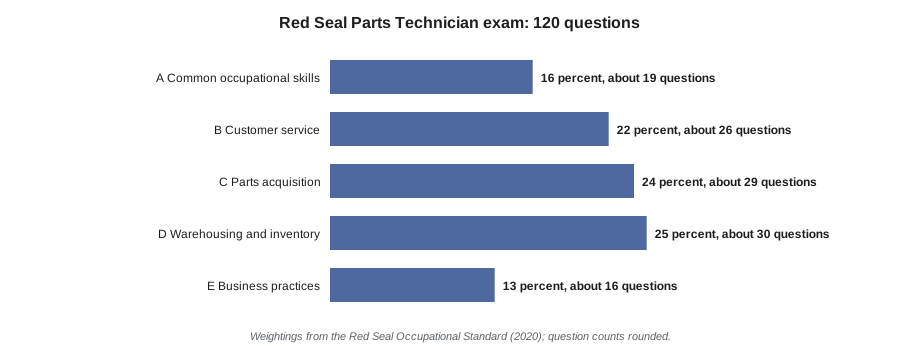
| Major work activity | Weighting | About how many questions |
|---|---|---|
| A: Performs common occupational skills | 16 percent | 19 |
| B: Performs customer service | 22 percent | 26 |
| C: Performs parts acquisition | 24 percent | 29 |
| D: Performs warehousing and inventory | 25 percent | 30 |
| E: Applies business practices | 13 percent | 16 |
| Total | 100 percent | 120 |
Imani pointed at the bottom two rows. Warehousing and inventory together with parts acquisition make up almost half the exam, about 59 of the 120 questions. Business practices, the area most people think of last, still carries about 16 questions, more than enough to fail on if it is ignored.
Who can write the exam
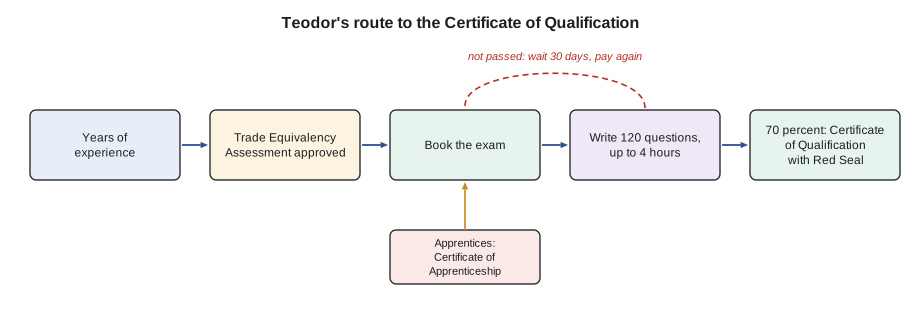
There are two routes to the exam in Ontario. An apprentice completes the training agreement, about 5,460 hours on the job and 540 hours in school over two levels, receives a Certificate of Apprenticeship and then writes the exam. That is Talia's route. An experienced worker who never did an apprenticeship can apply for a Trade Equivalency Assessment (TEA) from Skilled Trades Ontario. The worker has to show experience at least equal to the full apprenticeship, both the on-the-job and in-school hours, and competence in the skills of the trade's training standard, with evidence such as employer letters, pay records and course certificates. If the assessment is approved, the worker may challenge the exam. Because the trade is voluntary in Ontario, nobody needs the certificate to work, which is why Teodor had worked for fifteen years without it.
Teodor applied for his assessment in September with a letter from Walter Bisset listing his years and duties, pay statements from two previous employers, and the certificates from his WHMIS, dangerous goods and forklift training. The initial assessment fee was 235 dollars plus HST. The approval arrived in late October, and he booked his exam for late January 2027, after the holiday rush and the winter tire season.
If a candidate fails, Ontario requires a wait of 30 days before rewriting, and the exam fee is paid again. Passing earns a Certificate of Qualification with the Red Seal endorsement, recognized in every province and territory. Because the trade is voluntary, the certificate doesn't need renewing.
How the questions are written
Imani explained that a certification exam is not a quiz on a textbook. Every question is tied to a task in the trade's published standard, and most are written by working tradespeople. They follow patterns that can be learned.
- Knowledge questions ask for a fact: what a code means, which document a supplier issues, what a term describes. They are quick if you know the fact and impossible to work out if you don't.
- Application questions describe a situation at the counter and ask what to do, or which part or document is needed. Most questions are like this.
- Calculation questions ask for a price, a margin, an inventory measure or a measurement. They usually include the numbers you need, and the wrong answers are often the results of common mistakes.
- Best-answer questions have more than one answer that sounds possible. The word best, first or most likely in the question means the examiner wants the answer a careful professional would choose, usually the one that is safe, correct and in the customer's interest.
Every question has four options and only one correct answer. The other three, called distractors, are written to catch people who half know the material. A distractor is often true in some other situation, or is the answer you get by making a common mistake, or uses a word that sounds right.
Worked problem
Reading a best-answer question
A technician asks for a brake caliper for a 2026 Vela and gives only the model and year. The lookup shows two calipers, one for vehicles with the larger brake option. What should the parts technician do **first**?
Show solution
- Option A: sell the more common caliper. Possible, but a guess.
- Option B: ask for the VIN and check the build data or option codes. This identifies the right part.
- Option C: give both calipers and ask for the wrong one back. It solves the problem but ties up stock and invites a return.
- Option D: ask the technician to measure the rotor. It can help, but it is slower and less certain than the VIN.
Answer: B. The word first points to the step a professional takes before anything else. Lesson 3 reviews why the VIN is the starting point for identification.
Building a study plan
Imani's plan for Teodor started from the weightings. She gave each area study time in proportion to its questions and then adjusted for his strengths. Fifteen years at the counter made customer service his strongest area. He had never run receiving, so warehousing and inventory needed the most work, and business practices meant learning formulas he had only ever seen the computer apply.
Her plan had four parts. First, a self-assessment against the RSOS, using the self-assessment tool and sample questions on the Red Seal website, to rate each task from confident to unfamiliar. Second, ten weekly sessions of review, one area or theme a week, following this course. Third, a timed practice exam in early November, at full length, to measure progress and practise pacing. Fourth, eight weeks of targeted study from mid-November to the exam, on the areas the practice exam showed were weakest.
Imani was firm about one thing: study from more than one source. The exam is based on the standard, not on any single textbook. Teodor's study materials were the occupational standard, his notes from these sessions, the dealership's own manuals and procedures, and the reference material he used every day at the counter.
Managing time on the day
Four hours for 120 questions is two minutes a question, which sounds generous. It is not, if a candidate spends ten minutes on a calculation and then panics. Imani taught a three-pass method:
- First pass: answer every question you know at once. Flag any question that needs a calculation or more thought, choose your best guess, and move on.
- Second pass: return to the flagged questions and work them properly.
- Final check: make sure every question has an answer. There is no penalty for a wrong answer, so a blank is always a lost mark.
Worked problem
A time budget for the exam
Plan the first pass at an average of 1.25 minutes per question. How much time does that leave for the second pass and the final check?
Show solution
- First pass: 120 questions × 1.25 minutes = 150 minutes.
- Time available: 4 hours = 240 minutes.
- Remaining: 240 − 150 = 90 minutes for flagged questions and the final check.
Answer: About 90 minutes. Imani suggested 60 minutes for the second pass and 30 for checking, with a glance at the clock every 30 questions.
On the day
Imani gave Teodor the practical list she wished someone had given her. Bring government-issued photo identification. Leave the phone, watch, wallet and anything with a screen outside the room, because none of it is allowed in. Arrive early. Read the confirmation email for whether the exam is on paper or on screen. Eat beforehand. Read every question to the end, including all four options, before choosing.
Talia asked how Imani had felt when she sat hers. "Nervous for the first ten questions," Imani said. "Then I realized they were asking about things I did every day. That's the point of a trade exam. If you've done the work and you've reviewed it properly, you already know most of the answers."
What the exam is not
Teodor asked whether he would need to memorize part numbers. Imani laughed. No certification exam asks for a maker's part number, because the exam is written for the whole trade, not for one brand. What it does ask about are the systems every parts department uses: how part numbers, supersessions and interchange work, how a catalogue is organized, how prices are built from cost, how stock levels are set, how a shipment is received. A question might show a supersession note and ask what can be sold, but it won't ask what Tessaro's caliper number is.
The exam also doesn't test speed at the parts system. It can't watch a candidate work a lookup. What it tests instead is judgment: the order of steps, the safe choice, the correct calculation, the rule that applies. That is why fifteen years at the counter don't guarantee a pass. Experience gives the judgment, but it also builds habits, some of them shortcuts that work in one store and would be marked wrong on an exam written to the standard.
Using the standard as a checklist
Imani's most practical tip was to print the task matrix from the occupational standard and keep it on the wall beside the study desk. The matrix lists every task and sub-task in the trade on two pages. As Teodor reviewed each one, he marked it green if he could explain it to Talia without notes, yellow if he needed his notes and red if it was new. By the end of the first session, the matrix showed 41 green, 23 yellow and 9 red sub-tasks, and the red ones were mostly in shipping and receiving and in pricing. The colour of the matrix, Imani said, should change week by week. If it doesn't, the study method isn't working.
Talia made her own copy. Her chart was mostly red and yellow, which Imani said was exactly right for someone two months into the trade. She suggested Talia update it every few months as a record of what she was learning, so that by the time her own exam came, the chart would be the study plan.
Studying with other people
Imani explained why she had set the sessions up as a group, even a group of three. Explaining a topic to someone else is one of the best ways to find out whether you really understand it. Hearing another person's wrong answer shows you a mistake you might have made yourself. And a weekly session with a time and a place keeps study going when work gets busy. She asked each of them to bring one question to every session that they couldn't answer from their notes, and to leave with the answer.
Common mistakes
MistakeStudying only the areas you enjoy.
InsteadDivide study time by the published weightings and then add time for your weakest areas.
MistakeLeaving a question blank to come back to later.
InsteadMark a best guess on the first pass and flag it; there is no penalty for a wrong answer.
MistakeChoosing the first option that sounds right.
InsteadRead all four options; distractors are often true in another situation.
MistakeStudying from a single textbook.
InsteadUse the published standard, sample questions and several references.
MistakeAssuming you can work without the certificate, so it doesn't matter.
InsteadThe trade is voluntary, but the certificate is recognized across Canada and is often required for senior roles.
Summary and key terms
- The Red Seal Parts Technician exam has 120 four-option questions based on the 2020 RSOS; 70 percent is a pass.
- Its five major work activities are weighted 16, 22, 24, 25 and 13 percent.
- Apprentices write after completing their training; experienced workers can be approved through a Trade Equivalency Assessment.
- In Ontario candidates have up to four hours and must wait 30 days to rewrite after a fail.
- A three-pass method and a time budget keep pacing under control.
- Red Seal Occupational Standard (RSOS)
- The national description of a trade on which the Red Seal exam is based.
- Major work activity
- One of the five main parts of the trade in the RSOS, each with an exam weighting.
- Trade Equivalency Assessment (TEA)
- A Skilled Trades Ontario review that lets an experienced worker without an apprenticeship challenge the certifying exam.
- Certificate of Qualification
- The certificate issued to a person who passes the certifying exam.
- Distractor
- A wrong option written to look plausible.
- Best-answer question
- A question where more than one option sounds possible and the most professional choice is correct.
Practice problems
Work each problem on paper first, then reveal the answer to check.
How many Red Seal questions are needed to pass at 70 percent?
Show answer
120 × 0.70 = 84 correct answers.
About how many questions come from warehousing and inventory?
Show answer
25 percent of 120 = 30.
Teodor plans 1.5 minutes per question on the first pass. How much of the four hours is left?
Show answer
240 − 120 × 1.5 = 60 minutes.
What must an experienced worker show for a Trade Equivalency Assessment?
Show answer
Experience at least equal to the full apprenticeship, on the job and in school, and competence in the trade's skills, with verifiable evidence.
How long must a candidate wait to rewrite after failing in Ontario?
Show answer
30 days.
Lesson quiz · 5 questions
Score 60% or more to complete this lesson.
Create a free account to save your progress, take quizzes and earn a certificate.