
APT-340 · Lesson 3 of 12 · 25 min
Review: parts identification and lookup
▶ Video coming soon A video version of this lesson is on the way.
For the second session, Imani brought a stack of twenty repair orders and counter tickets from the past month, with the part numbers blacked out, and asked Teodor to identify each part again from the information on the ticket. He got eighteen right in twenty-five minutes. The two he missed were both supersession questions: he had looked up the right part, but sold the old number from the shelf to a vehicle it no longer fitted. "You know the lookup," Imani said. "The exam will test whether you know the rules around it."
Identifying and sourcing parts is major work activity C, parts acquisition, about 24 percent of the Red Seal exam or 29 questions. It covers two tasks: identifying parts, from the vehicle or equipment and the customer's description through catalogues and illustrations to the part number, and sourcing them, from stock, other stores, suppliers and special orders. APT-120 covered this whole area.
Why the right part matters
A wrong part costs more than the part. The technician loses time, the vehicle stays in the bay, the customer waits, the part comes back as a return, and the shelf now holds a part that has been opened. APT-120 measured this as first-time fill: the share of requests filled correctly the first time. Linmore's first-time fill was 1,612 of 1,780 requests, about 91 percent, and most of the misses were identification errors rather than parts out of stock.
That is why identification questions usually have one right answer and three that are each a common mistake: the right part for a different model year, the right part without the option that changes it, the old number that has been superseded, or the right part for the wrong side of the vehicle.
The vehicle identification number
The VIN is the starting point for nearly every lookup. Every road vehicle sold in North America since the 1981 model year has a 17-character VIN in a standard format:
| Positions | Section | What it tells you |
|---|---|---|
| 1 to 3 | World manufacturer identifier (WMI) | The maker and country, such as the invented 1TS for Tessaro vehicles built in the United States |
| 4 to 8 | Vehicle descriptor section | Model, body, engine, restraint system and other features, coded by the maker |
| 9 | Check digit | A number or X calculated from the other 16 characters, to catch errors |
| 10 | Model year | A letter or number; T is 2026 |
| 11 | Plant | The assembly plant |
| 12 to 17 | Serial number | The production sequence |
The letters I, O and Q are never used, because they are too easily confused with 1 and 0. The model year code skips them too, along with U, Z and the digit 0. On an exam, the most tested positions are the 10th (model year) and the 9th (check digit).
Worked problem
Checking a VIN
A technician reads out VIN 1TSVL4B29TK104829 for a Vela. Using the standard transliteration values and weights, the weighted sum of the 16 characters other than position 9 is 240. Is the VIN valid?
Show solution
- Divide the weighted sum by 11: 240 ÷ 11 = 21, remainder 9.
- The check digit should be 9 (a remainder of 10 would be written X).
- Position 9 of the VIN is 9, so the check digit matches.
Answer: The VIN is valid. If the remainder didn't match position 9, the most likely cause would be a misread character, and the parts technician should ask for the VIN again before looking anything up.
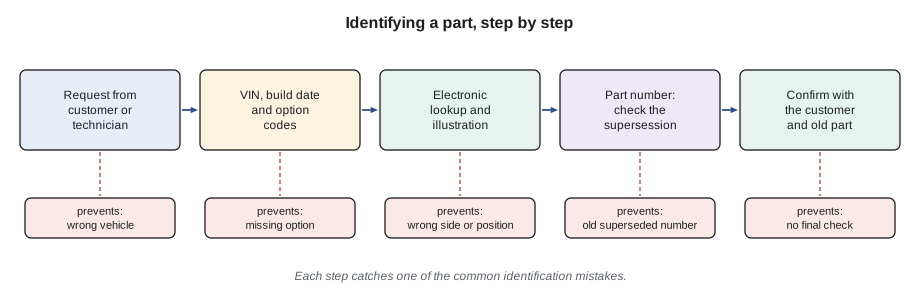
The VIN isn't the only identification on the vehicle. The certification label on the driver's door frame gives the month and year of manufacture, which matters when a part changed partway through a model year, along with the weight ratings and often the paint and trim codes. Some makers also print option codes or a build data label, and the electronic catalogue can decode a full VIN into the vehicle's build data. On the Vela, the option code JL4 marks the larger brakes, and nothing in the model name tells you whether a particular car has them.
Catalogues, illustrations and part numbers
Most lookups today are done in an electronic parts catalogue: the maker's catalogue for original parts, and aftermarket catalogues that use industry standards to say which vehicles a part fits. APT-120 reviewed how to use them:
- Start from the VIN so the catalogue filters out parts that don't fit.
- Use the illustration (the exploded view) to find the part's position and callout number, and read the notes for sides, options and production dates.
- Check quantity per vehicle and whether the part is sold individually, in pairs, as a kit or only as part of an assembly.
- Read the footnotes: they hold most of the information that turns a near miss into the right part.
Aftermarket catalogues rely on shared data standards so that every store's catalogue agrees on fitment. ACES describes which vehicles a part fits, using a standard vehicle database, and PIES describes the product itself: dimensions, weight, packaging, images and other attributes. A parts technician doesn't need to know the standards in detail, but should know that a fitment error in the data can send the wrong part to the counter, and that a part's attributes, such as its dimensions, are a way to check.
Supersession and interchange
Makers change parts during a model's life, and the catalogue records it as a supersession: an old part number replaced by a new one. The supersession note says which way the replacement works.
- Two-way: the old and new parts are interchangeable, so old stock can still be sold for any vehicle the new part fits.
- One-way: the new part fits everything the old part did, but the old part doesn't fit everything the new one does. Old stock can be sold only for the vehicles it was originally listed for.
Linmore's example from APT-120 was the chain TS-21380-VL05, superseded two-way by VL07, then one-way by VL09 for vehicles built from April 2026. A VL07 on the shelf can still go on an older Vela, but not on one built after the change. Teodor's two misses in the drill were exactly this case.
Worked problem
Reading a supersession chain
The catalogue shows TS-21380-VL05 replaced by VL07 (two-way), then VL07 replaced by VL09 (one-way, from 04/26 production). The shelf has two VL05s and one VL07. A technician needs the part for a Vela built in 06/26. What can be sold?
Show solution
- The vehicle was built after the one-way change, so it needs VL09.
- VL05 and VL07 fit only vehicles built before 04/26.
- Order VL09 or source it from another store.
Answer: Only VL09. The old stock can be kept for older vehicles, which is why the department doesn't return it all at once.
Interchange is the broader idea that different part numbers can do the same job: an original part and an aftermarket equivalent, or a part used on several models. Aftermarket catalogues publish interchange lists, and a parts technician uses them to offer an alternative. The rule is that interchange is a starting point, not a guarantee. The safe answer on an exam is to confirm interchange with the catalogue data, the old part or measurements.
Original, aftermarket and remanufactured parts
A parts technician has to explain the choices to customers:
- Original equipment (OE) parts from the vehicle maker, usually sold through dealers, match the part that came on the vehicle and carry the maker's warranty.
- Aftermarket parts are made by other companies to fit and perform like the original. Quality ranges from premium brands that supply makers directly to economy lines.
- Remanufactured parts, such as starters, alternators, calipers and steering racks, are used parts that have been disassembled, cleaned, inspected, rebuilt with new wear parts and tested. They are usually sold with a core charge returned when the old part comes back.
- Used or salvage parts come from wrecked vehicles. They can be useful for discontinued parts, but some electronic modules are tied to the original vehicle's VIN and can't be reused without programming.
Linmore sells Tessaro original parts and two invented aftermarket lines, Corvane and Torvale, through the wholesale counter. An exam question that asks which part to recommend usually wants the one that meets the customer's needs and the vehicle's requirements, explained honestly, not simply the most expensive.
Fasteners, bearings, seals and other general parts
Not every part comes from a vehicle catalogue. APT-120 reviewed the general parts that a counter sells by description and measurement:
- Fasteners: metric bolts are described by diameter, pitch and length (M10 × 1.5 × 30) and graded by property class (8.8, 10.9); inch bolts by diameter, threads per inch and length (3/8-16 × 1-1/4) and graded by head marks (radial lines: three for grade 5, six for grade 8).
- Bearings: a standard ball bearing number such as 6205 gives the series (62) and a bore code (05, which times 5 gives a 25 mm bore). Suffixes describe seals and shields, such as 2RS for two rubber seals and 2Z for two metal shields.
- Seals and O-rings are identified by inside diameter, outside diameter, width and material.
- Belts, hoses and filters are identified by catalogue number but checked by measurement: belt length and rib count, hose inside diameter, filter thread and gasket size.
Measuring tools come up here. A parts technician should be able to read a vernier or dial caliper, an outside micrometer, a thread pitch gauge and a tape, and should measure the old part rather than trust a worn label.
Worked problem
Decoding a bearing number
A customer brings in a bearing marked 6205-2RS. What size is it and how is it sealed?
Show solution
- Series 62: a light series deep groove ball bearing.
- Bore code 05: 05 × 5 = 25 mm bore.
- A 6205 is 25 mm bore, 52 mm outside diameter and 15 mm wide.
- 2RS: rubber seals on both sides.
Answer: A sealed deep groove ball bearing, 25 × 52 × 15 mm.
Sourcing a part
The second task of parts acquisition is sourcing. When the part isn't on the shelf, the parts technician works through the options in order of speed and cost:
- Check stock again: overflow locations, the receiving area, parts on hold and returns not yet put away.
- Sister stores and dealer locator: Linmore can transfer from Brantford on the weekly run, and the maker's dealer locator shows other dealers' stock.
- Supplier orders: the daily or emergency order to the maker's warehouse, or an aftermarket distributor.
- Special orders: parts not normally stocked, often with a deposit (Linmore takes half) and a restocking fee if returned.
- Discontinued parts (no longer available): interchange, aftermarket, remanufactured or salvage sources, or a specialist supplier.
Each choice is a trade-off between time, cost and certainty, and the customer needs to know the answer before agreeing. APT-120's final drill, ten customer requests in a row, showed that a good parts technician answers three questions every time: what is the right part, where can it come from, and when will it be here.
Researching hard-to-find parts
The hardest identification questions on an exam, and at the counter, involve parts that the normal catalogue doesn't show: parts for older or rare vehicles, parts with no visible number, or parts that have been discontinued. APT-120 taught a research routine for these. Start with whatever is on the part: casting numbers, stamped numbers, supplier logos and labels. Measure it carefully and photograph it from several angles. Search the maker's catalogue by illustration rather than number, and check technical service bulletins, which sometimes replace a failing part with a redesigned one. Ask other dealers, specialist suppliers and the maker's parts support line. Record what was found, so the next request takes minutes instead of hours.
Linmore's example was a voltage regulator for an old Marlo hatchback, a model that had ended production years before. The original part was listed as no longer available. The research found an aftermarket regulator with the same connector and mounting, confirmed by comparing measurements and photographs with the old part, and the customer's car was running two days later.
Exploded views and callout numbers
Exam questions sometimes describe an illustration and ask what a callout means, or which part is shown as a separate item rather than part of an assembly. The rules are consistent across catalogues: each callout number points to a part in the parts list beside the illustration; a bracket around several callouts shows a sub-assembly that can be sold as a unit; and notes in the list give quantity, side and application. A part that appears in the illustration but has no part number in the list is usually available only as part of a larger assembly.
Imani's last advice on identification was to treat the customer's old part as a witness. Even when the VIN and the catalogue agree, putting the new part beside the old one before the customer leaves, and comparing the connectors, mounting points and dimensions, catches the errors that data alone can't.
Common mistakes
MistakeLooking up a part by model and year only.
InsteadStart from the VIN, the build date and any option codes.
MistakeSelling old superseded stock to any vehicle.
InsteadCheck whether the supersession is one-way or two-way before selling old stock.
MistakeTreating an interchange list as a guarantee.
InsteadConfirm with catalogue data, measurements or the old part.
MistakeReading the 9th VIN character as the model year.
InsteadThe 9th is the check digit; the 10th is the model year.
MistakeIgnoring catalogue footnotes.
InsteadRead the notes for sides, options and production dates.
Summary and key terms
- A 17-character VIN gives the maker, vehicle description, check digit, model year, plant and serial number.
- Build dates and option codes refine a lookup where a part changed during production or with options.
- Two-way supersession means old and new interchange; one-way means old stock fits only its original vehicles.
- Original, aftermarket, remanufactured and salvage parts each have their place, explained honestly to the customer.
- Sourcing runs from stock, sister stores and suppliers to special orders and discontinued-part searches.
- VIN
- The 17-character vehicle identification number.
- Check digit
- The 9th VIN character, calculated from the others to catch errors.
- Supersession
- The replacement of one part number by another.
- One-way supersession
- A replacement where the new part fits all applications but the old part does not.
- Interchange
- Different part numbers that can do the same job.
- Core charge
- A deposit on a remanufactured part, refunded when the old part is returned.
Practice problems
Work each problem on paper first, then reveal the answer to check.
What model year is a VIN whose 10th character is T?
Show answer
2026.
A weighted VIN sum is 251. What should the check digit be?
Show answer
251 ÷ 11 = 22 remainder 9, so the check digit is 9.
What is the bore of a 6206 bearing?
Show answer
06 × 5 = 30 mm.
Part A is superseded by part B, two-way. Can part A be sold for a vehicle B is listed for?
Show answer
Yes; a two-way supersession means the parts interchange.
Which label gives the month and year a vehicle was built?
Show answer
The certification label on the driver's door frame.
Lesson quiz · 5 questions
Score 60% or more to complete this lesson.
Create a free account to save your progress, take quizzes and earn a certificate.