
APT-340 · Lesson 7 of 12 · 27 min
Review: mechanical systems
▶ Video coming soon A video version of this lesson is on the way.
For the sixth session, Imani brought a cardboard box of failed parts from the warranty shelf and the core pallet: a cracked thermostat housing, a stretched timing belt, a scored rotor, a leaking strut, a worn clutch disc and a fuel injector. She held each one up and asked two questions. What is it, and what else will the technician need to finish the job? Teodor answered every first question instantly. On the second, he gave three or four items each time, and Imani pushed him for one more. "The exam doesn't ask you to fix cars," she said. "It asks you to know what a repair needs."
Mechanical knowledge isn't a major work activity of its own on the Red Seal exam, but it runs through parts acquisition (identifying parts) and customer service (advising customers and technicians). APT-230 covered the systems a parts technician needs to understand.
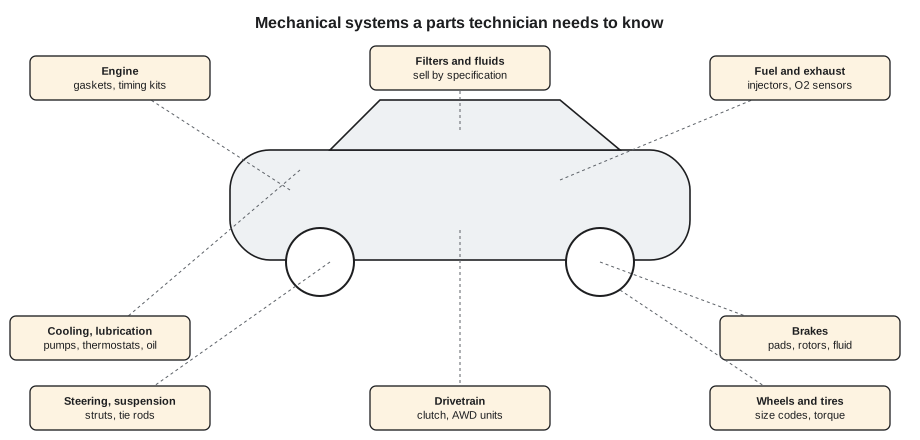
Engine parts and gaskets
An engine converts fuel into motion through the four strokes of intake, compression, power and exhaust. The parts counter sells the parts that wear or leak: gaskets and seals, timing components, sensors, mounts, belts and the parts of the top end. Three ideas come up again and again on exams.
- Timing belts and chains. A timing belt has a replacement interval in the maintenance schedule; a chain usually lasts the life of the engine but can stretch. On an interference engine, such as the 2017 Arden's 1.8-litre, a broken belt lets the valves hit the pistons and can destroy the engine, so the belt is replaced on schedule, at 160,000 km or 8 years for that engine.
- Kits. A timing belt job usually uses a kit with the belt, tensioner and idlers, and often the water pump, because the pump is driven by the belt and the labour to reach it is already done.
- Gaskets and seals. A gasket seals two flat surfaces, a seal seals around a moving shaft. Replacing one often means replacing the bolts too, when the maker calls for single-use torque-to-yield bolts, as many head bolts are.
Worked problem
What does a timing belt job need?
A shop is replacing the timing belt on a 2017 Arden 1.8 at its scheduled interval. What should the parts technician offer?
Show solution
- The timing belt kit: belt, tensioner and idler pulleys.
- The water pump and its gasket, because the belt drives it.
- Coolant to refill the system after the pump is replaced.
- Camshaft and crankshaft seals if they are leaking, since they sit behind the belt.
- Any accessory drive belt that has to come off for access.
Answer: The kit with water pump and coolant is the standard answer; seals and accessory belts depend on what the technician finds.
Cooling and lubrication
The cooling system carries heat from the engine to the radiator. Its parts are the radiator, water pump, thermostat, hoses, pressure cap, fans and coolant. The lubrication system keeps oil between moving parts: the pump, filter, pan, pressure sensor and the oil itself.
- Oil is specified by viscosity grade (SAE J300, such as 0W-20, where the W number describes cold performance and the second number hot viscosity) and by performance standards such as API SQ and ILSAC GF-7, plus any maker specification. The Vela 2.0-litre turbo uses 0W-20 meeting Tessaro's specification, 5.4 L (5.7 qt) with the filter.
- Coolant comes in chemical families: inorganic additive (older green), organic acid technology (OAT) and hybrids. Mixing types can shorten coolant life and cause deposits. Tessaro specifies its long-life OAT coolant.
- Thermostats control engine temperature; a thermostat stuck open gives slow warm-up and poor heat, stuck closed gives overheating.
APT-230's warning case was a retail customer who topped up his 2019 Arden with the wrong coolant and came back with a leak. The lesson for the counter is to sell coolant by the vehicle's specification, not by colour.
Fuel, exhaust and emissions
Fuel systems on modern engines are either port injection, with injectors in the intake ports, or direct injection (DI), with high-pressure injectors in the combustion chamber. DI engines, such as the Vela and the Arden 2.0, use injector seal kits that must be replaced whenever an injector is removed. Other fuel parts include the pump module, filters, pressure sensors and evaporative emission parts.
Exhaust and emissions parts include the manifold, oxygen sensors (the upstream sensor before the catalytic converter controls the fuel mixture; the downstream sensor monitors the converter), the catalytic converter, the muffler and pipes, and the gaskets and hangers between them. A sensor always needs its gasket or seal and often an anti-seize compound on the threads, unless the new sensor comes pre-coated.
Replacement catalytic converters must be the right type for the vehicle and installed according to the rules that apply; a parts technician sells by the catalogue's fitment and the maker's information, never a converter listed for a different engine.
Brakes
Brakes are among the most frequent and most safety-critical parts sold, and exam questions here are common.
- Disc brakes: pads, rotors, calipers, hardware, slide pins and hoses. A rotor below its minimum thickness (stamped on the rotor, such as 26.0 mm on the Vela front) must be replaced, not machined.
- Drum brakes: shoes, drums, wheel cylinders, springs and hardware.
- Hydraulics: master cylinder, lines, hoses and brake fluid. Glycol-based DOT 3, DOT 4 and DOT 5.1 fluids absorb water and can be mixed in an emergency; silicone-based DOT 5 must never be mixed with them.
- Electronic parts: wheel speed sensors for anti-lock brakes and stability control, pad wear sensors, and electronic parking brake actuators.
Worked problem
Machine or replace?
A customer's Vela front rotor measures 26.4 mm, and the minimum thickness is 26.0 mm. Machining will remove about 0.3 mm per side. Can the rotor be machined?
Show solution
- Thickness after machining: 26.4 − 2 × 0.3 = 25.8 mm.
- 25.8 mm is below the 26.0 mm minimum.
Answer: No. The rotor would end up below minimum thickness, so it must be replaced. Rotors are usually replaced in pairs on an axle.
Steering, suspension and drivetrain
Steering parts include the rack or gearbox, tie rod ends, inner tie rods, and on electric power steering systems the motor and sensors built into the rack. Suspension parts include struts and shocks, springs, control arms, ball joints, bushings, stabilizer links and wheel bearings. Most suspension and steering repairs need a wheel alignment afterwards, which is worth mentioning to a retail customer doing the work at home.
A complete strut assembly (strut, spring, mount and boot, ready to install) saves the technician the time and risk of compressing the spring; APT-230's example was Bramhall's 2018 Arden front struts.
Drivetrain layouts are front-wheel drive, rear-wheel drive and all-wheel or four-wheel drive. The Vela's AWD system is front-wheel-drive based, with a power transfer unit at the transaxle and a rear drive unit with an electronically controlled coupling, each with its own fluid. Transmissions are manual, automatic or continuously variable (CVT), and each type has its own fluid specification. A clutch job on a manual car usually needs the clutch kit (disc, pressure plate and release bearing), and on many cars a dual-mass flywheel, which wears and is often replaced with the clutch, as on the 2016 Arden 2.0.
Wheels, tires and bearings
Tire sizes follow a standard code. On 225/55R18 98V, 225 is the section width in millimetres, 55 the aspect ratio (sidewall height as a percentage of width), R radial construction, 18 the rim diameter in inches, 98 the load index and V the speed rating.
Worked problem
Reading a tire size
What is the sidewall height and overall diameter of a 225/55R18 tire, and what do 98 and V mean?
Show solution
- Sidewall height = 225 × 0.55 = 123.75 mm.
- Rim diameter = 18 × 25.4 = 457.2 mm.
- Overall diameter = 457.2 + 2 × 123.75 = 704.7 mm, about 27.7 in.
- Load index 98 = 750 kg (1,653 lb) per tire; speed rating V = 240 km/h (149 mph).
Answer: About 705 mm (27.7 in) tall, rated for 750 kg (1,653 lb) at speeds up to 240 km/h (149 mph). A replacement tire should match or exceed the original load index and speed rating.
Wheels are fitted by bolt pattern (the Vela's is 5 × 114.3: five studs on a circle of 114.3 mm), centre bore, offset and the size and seat type of the lug nuts. Lug nuts are torqued to the maker's figure, 135 N·m (100 lb·ft) on the Vela. A tire's DOT code ends with a four-digit date: 2324 means the 23rd week of 2024.
Filters, fluids and specifications
Filters and fluids are the counter's most frequent sales. The rule is always to sell by specification: the oil grade and standard, the coolant type, the transmission fluid the maker requires, the brake fluid grade. Air, cabin, fuel and oil filters are identified by catalogue, but a quick check of the old filter (thread size, gasket diameter, and on oil filters the anti-drainback valve) prevents mistakes. APT-230's fleet example was an oil filter sold without the anti-drainback valve the van engines needed.
Heavy trucks and small engines
Heavy truck parts, reviewed in lesson 9, use air brakes: compressed air applies the service brakes through brake chambers and slack adjusters, and spring brakes apply the parking brake when air pressure is released. Small engines in lawn and landscape equipment are often two-stroke engines lubricated by oil mixed into the fuel at a set ratio, and they are easily damaged by stale fuel or fuel with too much ethanol.
Worked problem
Mixing two-stroke fuel
A landscaper needs a 50:1 mix for a blower. How much two-stroke oil goes into 5 L of fuel?
Show solution
- 5 L = 5,000 mL.
- Oil = 5,000 ÷ 50 = 100 mL.
Answer: 100 mL of oil. Fresh fuel, ideally without ethanol or with no more than the maker allows, prevents most small-engine fuel problems.
Ignition, heating and air conditioning
Two more systems often come up. The ignition system's counter parts are spark plugs (sold by heat range, thread, reach and gap, and on many engines with iridium or platinum tips), ignition coils (usually one per cylinder on modern engines) and the sensors that time the spark. Heating and air conditioning parts include the compressor, condenser, evaporator, expansion valve or orifice tube, receiver-drier or accumulator, blower motor, cabin filter and refrigerant.
Most newer vehicles use R-1234yf refrigerant and older ones R-134a, and the two have different service fittings and must never be mixed. Handling refrigerants is regulated, and technicians who service vehicle air conditioning need the required certification.
Matching parts to repair orders
APT-230 ended with six repair orders: 22 parts lines, 19 filled right the first time (86 percent), and a 23rd line that nobody had written down, an oxygen sensor gasket. The habit it taught is the one Imani wanted on the exam: read the job, picture the repair, and list everything it needs.
Suspension and alignment parts by symptom
Customers and technicians often describe a problem by its symptom, and exam questions do too. A clunk over bumps usually points to worn stabilizer links, bushings or strut mounts. A vehicle that pulls to one side may need an alignment, or may have a sticking brake caliper or a tire problem. Steering wheel vibration at highway speed often comes from wheel balance or a bent wheel; vibration when braking usually comes from rotors with uneven thickness. A humming noise that changes with speed, and with turning, is often a wheel bearing. A parts technician doesn't diagnose, but knowing the usual causes helps ask the right questions and suggest what the technician might need.
Fluids by specification
Fluids are where the counter most often sells the wrong product because two bottles look alike. The specifications to check are the maker's own fluid numbers and the industry standards behind them: engine oil grade and standard, coolant type, automatic transmission fluid specification, CVT fluid (never a conventional automatic fluid), manual transmission and differential gear oil grade, brake fluid DOT grade and power steering fluid. Many multi-vehicle fluids list the specifications they meet on the label, and the parts technician should check that the vehicle's specification is actually listed, not just that the bottle says "universal".
Teodor's best answers in the session came from experience: he remembered which Arden repairs always needed a second part, and which Vela jobs technicians forgot to order seals for. Imani told him to write those down, because they were exactly the related-parts knowledge the exam rewards and the department's newer staff needed.
Imani added that the exam's mechanical questions often name a symptom or a repair and offer four parts, only one of which belongs to that system. Knowing which system each part belongs to, even without knowing its exact function, is often enough to eliminate two options.
Common mistakes
MistakeSelling coolant by colour.
InsteadSell coolant by the maker's specification; colours are not standard.
MistakeMachining a rotor that will end up below minimum thickness.
InsteadCheck minimum thickness against the measurement after machining, and replace if it would be below.
MistakeMixing DOT 5 silicone fluid with glycol fluids.
InsteadNever mix DOT 5 with DOT 3, 4 or 5.1.
MistakeSelling a timing belt without the tensioner and idlers.
InsteadOffer the kit, and the water pump if the belt drives it.
MistakeChoosing a replacement tire with a lower load index.
InsteadMatch or exceed the original load index and speed rating.
Summary and key terms
- Interference engines need timing belts replaced on schedule; kits include tensioner, idlers and often the water pump.
- Oil and coolant are sold by specification, not by colour or habit.
- Rotors below minimum thickness are replaced; glycol and silicone brake fluids never mix.
- Tire codes give width, aspect ratio, construction, rim diameter, load index and speed rating.
- Every repair order needs its related parts: gaskets, seals, hardware, fluids and kits.
- Interference engine
- An engine in which valves and pistons can collide if the timing belt or chain fails.
- Minimum thickness
- The thinnest a brake rotor may be in service.
- Load index
- A number on the tire giving its maximum load.
- Speed rating
- A letter on the tire giving its maximum sustained speed.
- Dual-mass flywheel
- A two-piece flywheel with springs that damp vibration; it wears and is often replaced with the clutch.
- Upstream oxygen sensor
- The sensor before the catalytic converter that the engine uses to control the fuel mixture.
Practice problems
Work each problem on paper first, then reveal the answer to check.
What is the sidewall height of a 205/60R16 tire?
Show answer
205 × 0.60 = 123 mm.
How much oil is needed for 2 L of fuel at 40:1?
Show answer
2,000 ÷ 40 = 50 mL.
Which brake fluid must never be mixed with DOT 4?
Show answer
DOT 5, which is silicone-based.
A DOT code ends 0726. When was the tire made?
Show answer
The 7th week of 2026.
Name three parts often sold with a clutch kit on a car with a dual-mass flywheel.
Show answer
The dual-mass flywheel, new flywheel bolts and the pilot bearing, plus transmission fluid if the gearbox is drained.
Lesson quiz · 5 questions
Score 60% or more to complete this lesson.
Create a free account to save your progress, take quizzes and earn a certificate.