
APT-340 · Lesson 12 of 12 · 25 min
Capstone: a day running the parts counter
▶ Video coming soon A video version of this lesson is on the way.
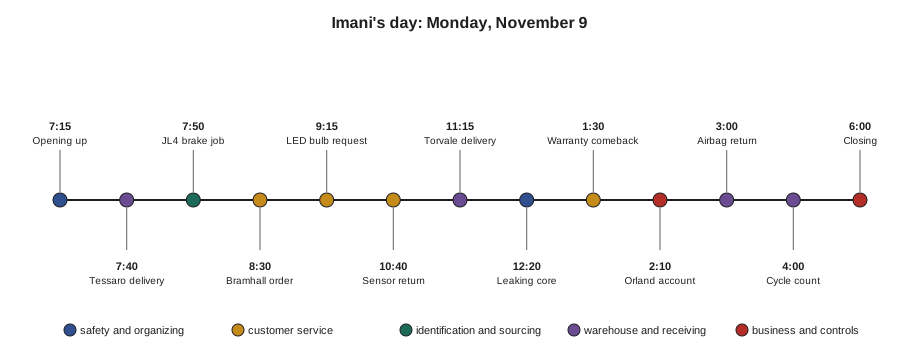
On Monday, November 9, Rolf drove to Linmore Tessaro Brantford with Talia to look at the sister store's parts department, and left Imani in charge of the Rymal Road counter for the day. It was the first full day she had run on her own since Walter had asked Rolf to prepare her as assistant parts manager. At the Tuesday study session the next evening, after the practice exam debrief, Imani walked Teodor and Talia through the day from her notes, event by event, and asked them to say which part of the exam each one belonged to. "An exam tests the trade one question at a time," she said. "A day at the counter tests it all at once."
This lesson follows that day. Teodor was on the front counter, Maribel Quist on the back counter serving the shop, Sasha Esparza in the warehouse, and Gideon Achebe on the van. Each section ends with the question Imani asked: what would the exam want here?
7:15 a.m.: opening up
Imani opened at 7:15. She switched off the alarm, counted the two cash drawers' 200 dollar floats, checked the department's email and the parts system's overnight messages, and read the note Rolf had left: the Tessaro daily delivery, two jobs waiting on back-ordered parts, and a reminder that Orland Courier's September invoice was getting old. She then walked the department: aisles clear, the battery charging station switched on and ventilated, the eyewash station unobstructed, the forklift's pre-use inspection sheet ready for Sasha.
Maribel arrived at 7:20 and started the morning pre-pick: parts for the shop's nine scheduled jobs, pulled into labelled totes before the technicians arrived at 7:30. Teodor opened the front counter at 7:30.
- Exam link: common occupational skills, organizing work and safety-related functions (lesson 2).
7:40 a.m.: the Tessaro delivery
The Tessaro daily delivery arrived at 7:40: 31 cartons on two pallets. Sasha counted the pieces against the delivery receipt before signing, found no visible damage and signed it clean. At 8:20, opening the cartons, she found a headlamp assembly cracked inside an undamaged box. She photographed it, kept the packaging, and filed a concealed damage report through Tessaro's dealer portal the same morning, as the maker's procedure requires.
- Exam link: warehousing and inventory, shipping and receiving: count and inspect before signing, and report concealed damage at once with photographs and packaging (lesson 6).
7:50 a.m.: a brake job and an option code
Wen Okafor-Lund came to the back counter with a repair order for front pads and rotors on a 2026 Vela. Maribel decoded the VIN: the car had option JL4, the larger brakes. The department had one JL4 rotor in stock and the matching pads. The second rotor could come from the Tessaro emergency order the next morning, or a Torvale aftermarket equivalent could arrive on the distributor's 11:00 delivery.
Maribel didn't choose for the customer. She gave the service advisor both options, with prices and times, and the advisor called the owner, who preferred original parts and accepted a loaner car until the next morning. Maribel ordered the second Tessaro rotor, put the pads and the first rotor on hold under the repair order, and added the hardware kit and brake cleaner, which Wen had forgotten.
- Exam link: parts acquisition (identify by VIN and option code; source from stock, supplier or aftermarket) and customer service to internal customers (lessons 3 and 4).
8:30 a.m.: a wholesale phone order
Corinne Ferraby at Bramhall Auto Service phoned in an order for two 2017 Arden 1.8 timing belt jobs. Teodor asked for both VINs, confirmed the engines, and offered the kit with the water pump, because the pump on that engine is driven by the belt. Corinne also took coolant.
Worked problem
Pricing the Bramhall order
Each timing belt kit with water pump lists at 289.00 dollars, and the coolant lists at 32.00 dollars a jug. Bramhall's price level is list less 25 percent. What is the order total for two kits and four jugs, before tax?
Show solution
- Kit: 289.00 × 0.75 = 216.75 dollars; two kits = 433.50 dollars.
- Coolant: 32.00 × 0.75 = 24.00 dollars; four jugs = 96.00 dollars.
- Total = 433.50 + 96.00 = 529.50 dollars.
Answer: 529.50 dollars on Bramhall's account, net 30. Teodor confirmed the delivery on the 10 a.m. van, which meant picking and packing by the 9:30 cut-off.
- Exam link: customer service to wholesale customers and business practices, implementing the pricing formula (lessons 4 and 10).
9:15 a.m.: the LED bulb request
A retail customer, Hollis Pennock, asked Teodor for LED bulbs to replace the halogen low beams on his 2015 Arden, because a friend's car "looked so much brighter". Teodor explained that the Arden's headlamps were designed and certified around a halogen bulb, that an LED bulb in them scatters light into oncoming drivers' eyes and isn't a legal replacement, and offered a premium H11 halogen bulb with a whiter light. He also suggested having the headlamp aim checked, which is often the real cause of poor lighting. Mr. Pennock bought the halogen bulbs and booked an aim check.
- Exam link: customer service to retail customers and parts acquisition: honest advice, legal parts, a better alternative (lessons 4 and 8).
10:40 a.m.: a difficult return
Celeste Ashcombe came back with an engine sensor she had bought on Saturday for her Vela. It was the wrong part: she had given the model and year but not the VIN, and her car had the other engine variant. The static-shielding bag was open, though the part was unused. She was upset and said she had been sold the wrong part.
Imani took over the conversation and used LAST. She listened to the whole story without interrupting. She acknowledged that it was frustrating to make a second trip. Then she solved what she could: she looked up the correct sensor from the VIN, had it on the counter in two minutes, and explained honestly why the opened sensor couldn't go back on the shelf, because a static discharge can damage it without leaving a mark and the next customer would have no way to know. She thanked Ms. Ashcombe for coming in rather than fitting the wrong part. Ms. Ashcombe wasn't happy about the policy, but she accepted it, and Imani recorded the case in the complaint log with a note to Rolf: Saturday staff should ask for the VIN on every engine sensor.
- Exam link: customer service (handling a complaint, returns policy) and parts acquisition (identify by VIN) (lessons 3, 4 and 8).
11:15 a.m.: a short shipment that wasn't
The Torvale distributor's delivery arrived with the expected rotor and a carton of filters. The packing slip listed six oil filters for the Orland Courier vans; the carton held four. Sasha checked the slip before calling the distributor and found the note she was looking for: two filters back-ordered, shipping Wednesday. There was nothing to claim. She received the four, updated the back order in the system, and told Teodor so he could warn Ewan Tullis.
- Exam link: warehousing and inventory: check back orders and separate shipments before claiming a shortage (lesson 6).
12:20 p.m.: a leaking core
Gideon came back from the 10 a.m. run with a problem. One of the cores he had collected, a battery from a repair shop, had been cracked, and acid had leaked onto the van's floor mat. He had already put on gloves and eye protection from the van's kit. Imani and Sasha neutralized the spill with the spill kit, bagged the battery in an acid-resistant container, cleaned the mat and recorded the incident. Imani, a member of the joint health and safety committee, added it to the committee's next agenda.
The core also had a business side. A cracked core would be rejected by the supplier, so the shop's core refund was on hold until Rolf spoke to them. Imani reminded Gideon of the rule APT-220 had set: inspect every core at pickup, and don't accept a cracked battery as a core without bagging it and noting it on the paperwork.
- Exam link: common occupational skills (safety, spill response), handling hazardous parts, and cores and reverse logistics (lessons 2 and 6).
1:30 p.m.: a warranty comeback
Priyanka Rautela, the service manager, came to the back counter with a comeback: a remanufactured alternator fitted five weeks earlier had failed. Maribel checked the original repair order and invoice, confirmed it was within the warranty period, supplied a replacement from stock and opened a warranty claim. The failed alternator was tagged with the claim number and the repair order number and placed in the warranty area, where it would stay until the supplier said whether it wanted the part back.
- Exam link: customer service to internal customers and processing warranty claims (lessons 4 and 8).
2:10 p.m.: an account getting old
Ewan Tullis phoned to add four more filter kits for the Orland Courier vans. Before entering the order, Teodor checked the account and showed Imani the aging report: Orland's September invoice was 56 days old. The account was still within its credit limit and Imani approved the order, but she emailed Ruth Brennagh in accounts receivable and copied Rolf, noting that the invoice would pass 60 days at the end of the week. (When it did, on Saturday, November 14, the account went on credit hold, and the next order was paid by card.)
- Exam link: business practices, processing financial transactions and credit (lesson 10).
3:00 p.m.: a hazardous return
Tessaro had asked for an airbag module removed under a warranty repair to be returned for analysis. Sasha, who holds a current TDG training certificate, packed it in the replacement part's original packaging, applied the UN3268 marks and labels the return instructions required, completed the shipping document and booked the pickup. Nobody without a training certificate touched the shipment.
- Exam link: warehousing and inventory, shipping dangerous goods (lesson 6).
4:00 p.m.: the daily cycle count
Maribel did the day's cycle count while the shop was quiet: 75 locations from the system's list, counted blind. Seventy-one matched. Of the four that didn't, two were found on recount to be parts in the wrong bin, which she moved. The other two were real differences, a missing gasket worth 14.20 dollars and an extra wiper blade. Imani didn't approve the adjustments herself; she held them for Rolf, because the department's control is that inventory adjustments need the parts manager's approval.
Worked problem
The day's count accuracy
Seventy-five locations were counted and 71 matched the system. What was the accuracy before recounts, and after the two misplaced parts were found?
Show solution
- Before recounts: 71 ÷ 75 = 0.947, or 94.7 percent.
- After recounts: 73 ÷ 75 = 0.973, or 97.3 percent.
Answer: 94.7 percent on the first count and 97.3 percent after recounts, both near the department's target of 95. Recounting before adjusting is what keeps a misplaced part from becoming a false loss.
- Exam link: warehousing and inventory, performing inventory control (lesson 5).
6:00 p.m.: closing
The last hour brought the usual after-work retail rush. At six, Teodor and Imani closed both drawers. Both balanced. Imani ran the end-of-day report and wrote Rolf a short email:
- Counter sales 19,840 dollars on 238 tickets.
- Requests filled from stock: 211 of 229.
- One concealed damage report (headlamp), one back order confirmed (Orland filters), one warranty claim (alternator), one airbag return shipped.
- One complaint logged (sensor return), with a suggestion about Saturday VIN checks.
- One spill incident in the van, cleaned up, recorded and on the committee's agenda; the cracked core is on hold.
- Two cycle count adjustments waiting for approval; Orland's September invoice flagged to Ruth.
Worked problem
The day's fill rate
211 of 229 requests were filled from stock. What was the fill rate, and how does it compare with the department's target of 92 percent?
Show solution
- Fill rate = 211 ÷ 229 = 0.921, or 92.1 percent.
Answer: 92.1 percent, just above target, on a day when the department was two people short.
What the day showed
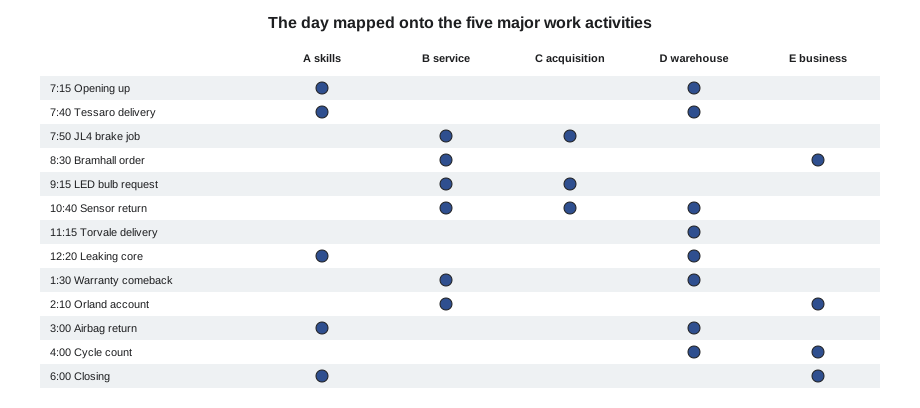
Teodor and Talia mapped every event to the exam areas, and Imani asked what they noticed. Talia noticed that almost every event touched more than one area: the sensor return was customer service, parts identification and electronic returns all at once. Teodor noticed something else. "None of it was hard," he said. "But every one of those things could have gone wrong if someone skipped a step: signing for the delivery without counting, guessing the brake option, selling the LED bulbs, claiming the filters short, approving my own count adjustments."
Imani agreed. That, she said, is what a certification exam is really measuring: not whether you can find a part, but whether you take the right steps in the right order every time, including when you're busy, short-staffed and dealing with an upset customer. The exam's questions are the trade broken into pieces. A day like Monday is the trade put back together.
Rolf read Imani's email on the drive back from Brantford and replied with one line: "Sounds like a normal Monday. That's the best thing I can say about it." At the end of the Tuesday session, Imani told Teodor that if he could run that day, he could pass the exam. His study plan ran from the following week to his exam in late January, and Talia's own exam was still a few years away. But Imani suggested to Rolf, and he agreed, that from the new year Teodor would take a turn running the counter on the days Rolf and Imani were both away. The best preparation for the exam, and for the trade after it, was more days like that one.
Common mistakes
MistakeSigning a delivery receipt clean without counting the pieces.
InsteadCount and inspect before signing; report concealed damage with photographs and packaging.
MistakeChoosing between OE and aftermarket for the customer.
InsteadGive the customer or service advisor both options with price and time.
MistakeClaiming a shortage without checking the packing slip notes.
InsteadCheck for back orders and separate shipments first.
MistakeAccepting a cracked core without bagging or noting it.
InsteadInspect cores at pickup, bag leaking batteries and record the condition.
MistakeApproving your own inventory adjustments.
InsteadRecount differences and send adjustments for the manager's approval.
Summary and key terms
- A day at the counter combines every area of the exam, often several in one event.
- Opening and closing routines cover safety, cash floats, messages and the end-of-day report.
- Receiving, back orders, cores and hazardous returns each follow their own procedure.
- Identification by VIN and option code, honest advice and clear options keep customers and technicians served.
- Controls such as blind counts, recounts, manager approval and credit monitoring protect the department.
- Morning pre-pick
- Pulling parts for the day's scheduled jobs before the technicians start.
- Concealed damage report
- A report of damage found after a delivery was signed for clean.
- Back order
- A part on an order that the supplier will ship later.
- Aging report
- A list of account balances by how long they have been unpaid.
- Inventory adjustment
- A change to the system quantity after a count, approved by the manager.
- End-of-day report
- A summary of the day's sales, fill rate and open issues.
Practice problems
Work each problem on paper first, then reveal the answer to check.
A wholesale account pays list less 25 percent. What is its price on a part listing at 64.00 dollars?
Show answer
64.00 × 0.75 = 48.00 dollars.
Eighty locations are counted and 76 match. What is the accuracy?
Show answer
76 ÷ 80 = 95 percent.
On a day with 240 requests, 218 are filled from stock. What is the fill rate?
Show answer
218 ÷ 240 = 90.8 percent.
What should a driver do with a leaking battery core at pickup?
Show answer
Wear protective equipment, bag it in an acid-resistant container, note it on the paperwork and report it.
Who should prepare an airbag module return for shipment?
Show answer
Only a person with a current TDG training certificate.
Lesson quiz · 5 questions
Score 60% or more to complete this lesson.
Create a free account to save your progress, take quizzes and earn a certificate.