
APT-340 · Lesson 10 of 12 · 26 min
Review: management and business
▶ Video coming soon A video version of this lesson is on the way.
Rolf asked to teach the ninth session himself. Business practices was the smallest major work activity on the exam, but he had seen good counter people fail it because they had never had to think about where a price came from. He brought the department's price matrix, a page of last month's counter tickets and a calculator, and set Teodor a challenge: price twelve tickets by hand, then check them against what the system had charged.
Major work activity E, applies business practices, carries 13 percent of the Red Seal exam, about 16 questions, in three tasks: promoting products and services (reviewed in lesson 4), implementing the pricing formula, and processing financial transactions. APT-330 covered the management side of the department, which helps make sense of all three.
Cost, list, margin and markup
Every price starts with the department's cost, what it pays the supplier. The supplier usually also publishes a list price, a suggested selling price. The department's selling price is set from one or the other, and the difference between price and cost is the gross profit. Two percentages describe it, and the exam tests the difference between them constantly:
Markup is gross profit as a share of cost; margin is gross profit as a share of price. For the same sale, the markup is always the larger number. A 50 percent markup is only a 33.3 percent margin.
Worked problem
Converting between markup and margin
A part costs 40.00 dollars and sells for 60.00 dollars. What are the markup and the margin? What markup gives a 30 percent margin?
Show solution
- Gross profit = 60.00 − 40.00 = 20.00 dollars.
- Markup = 20.00 ÷ 40.00 = 0.50, or 50 percent.
- Margin = 20.00 ÷ 60.00 = 0.333, or 33.3 percent.
- For a 30 percent margin: markup = 0.30 ÷ (1 − 0.30) = 0.30 ÷ 0.70 = 0.429, or 42.9 percent.
Answer: A 50 percent markup and a 33.3 percent margin. A 30 percent margin needs a markup of about 42.9 percent.
The pricing formula
Most parts departments price from a price matrix: a table of multipliers applied to cost, with higher multipliers on cheaper parts, where handling costs are a larger share of the price, and lower multipliers on expensive parts. Linmore's retail matrix from APT-130 is:
| Cost band (dollars) | Multiplier | Markup | Margin |
|---|---|---|---|
| Up to 5.00 | 2.50 | 150 percent | 60.0 percent |
| 5.01 to 25.00 | 1.80 | 80 percent | 44.4 percent |
| 25.01 to 100.00 | 1.55 | 55 percent | 35.5 percent |
| 100.01 to 500.00 | 1.35 | 35 percent | 25.9 percent |
| Over 500.00 | 1.20 | 20 percent | 16.7 percent |
Worked problem
Pricing from the matrix
A sensor costs 18.40 dollars. What is its retail price, gross profit and margin?
Show solution
- Cost band 5.01 to 25.00: multiplier 1.80.
- Price = 18.40 × 1.80 = 33.12 dollars.
- Gross profit = 33.12 − 18.40 = 14.72 dollars.
- Margin = 14.72 ÷ 33.12 = 0.444, or 44.4 percent.
Answer: 33.12 dollars, a gross profit of 14.72 dollars and a 44.4 percent margin, which matches the margin for a 1.80 multiplier: 1 − 1 ÷ 1.80 = 0.444.
Other customers are priced from list. A wholesale account may pay list less a discount (Bramhall's is list less 25 percent), and a fleet account list less 15 percent. Internal service work is priced by the agreement between parts and service; warranty parts by the maker's policy. Teodor's twelve tickets turned up one difference from the system: a part whose cost had gone up was still being sold at the old price, because its cost band hadn't been updated. Rolf fixed it the next morning.
Discounts and the volume they need
A discount feels small to the customer and large to the department, because it comes straight out of gross profit. The exam may ask how much extra volume a discount needs to keep the same gross profit.
Worked problem
What a 10 percent discount costs
A part sells for 100.00 dollars at a 30 percent margin. The department offers 10 percent off. How many more units must it sell to earn the same gross profit?
Show solution
- Cost = 100.00 × 0.70 = 70.00 dollars.
- Gross profit before: 100.00 − 70.00 = 30.00 dollars a unit.
- Price after discount: 90.00 dollars; gross profit 90.00 − 70.00 = 20.00 dollars a unit.
- Units needed for the same gross profit: 30.00 ÷ 20.00 = 1.5 times as many.
Answer: Fifty percent more units. A 10 percent price cut took a third of the gross profit on each part.
Pricing must also be honest. Canada's Competition Act prohibits false or misleading representations, including advertising a price that leaves out fixed fees the customer must pay, a practice called drip pricing.
Processing financial transactions
Every sale and return creates a financial record, and the parts technician is responsible for getting it right:
- Invoices record the parts, quantities, prices, taxes, core charges and payment method. Account sales go on the customer's account and appear on the monthly statement.
- Credit memos reverse all or part of an invoice for a return, a core refund or a price correction, referring to the original invoice.
- Cash, debit and credit card payments are taken at the counter; cheques are rare now and may need approval.
- Deposits on special orders are recorded and applied when the part is collected.
- Drawer reconciliation at the end of the day compares the cash in the drawer with the system's expected total.
Worked problem
Balancing the drawer
The drawer started with a float of 200.00 dollars. The system shows cash sales of 1,245.60 dollars and cash refunds of 32.40 dollars. The count is 1,413.20 dollars. Does the drawer balance?
Show solution
- Expected = float + cash sales − cash refunds.
- Expected = 200.00 + 1,245.60 − 32.40 = 1,413.20 dollars.
- Count = 1,413.20 dollars.
Answer: It balances. If it didn't, the first step is to recount and check every refund and paid-out against its slip, as Talia did with her first drawer close.
Accounts need credit control. Linmore's parts receivables at the end of October were 210,000 dollars against credit sales of about 147,000 dollars a month, a days sales outstanding of about 43.5 days on terms of net 30.
The department as a business
APT-330 looked at the department through the manager's eyes, and a few of its ideas are worth carrying into the exam because they explain the rules at the counter.
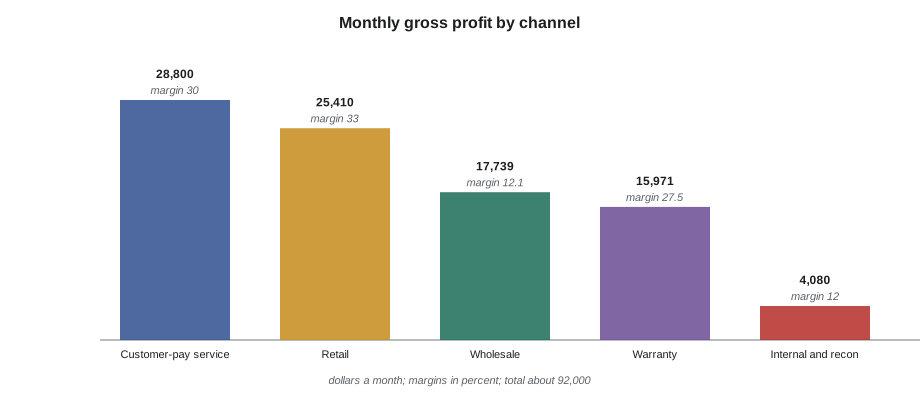
- Gross profit by channel. Retail earns the highest margin and wholesale the lowest. Linmore's monthly gross profit was about 92,000 dollars: retail 25,410, customer-pay service 28,800, warranty 15,971, internal and reconditioning 4,080 and wholesale 17,739.
- Expenses against gross profit. Departments judge expenses as a share of gross profit, the money they actually earn. Linmore's personnel costs were half its gross profit, and its net departmental profit was 238,000 dollars a year.
- Fixed absorption. The share of the dealership's overhead covered by service and parts gross profit: (1,104,000 + 1,690,000) ÷ 3,900,000 = 71.6 percent at Linmore.
- Break-even for a new cost. Divide the cost by the margin on the sales it must bring in. A second van costing 3,000 dollars a month at a 12 percent wholesale margin needs 3,000 ÷ 0.12 = 25,000 dollars a month of extra wholesale sales.
Suppliers, staff and policies
The rest of APT-330 covered how the department is run, and exam questions sometimes describe these situations:
- Supplier programs: stock order discounts, return allowances, rebates for volume, and co-op funds for advertising. Each has terms that the department must meet to earn the benefit.
- Staff: employment standards for hours, overtime and breaks; a safe and respectful workplace; and training, including apprentices registered with the ministry and their training plans.
- Controls: separating duties so the same person doesn't sell, refund and count; approving overrides, credits and write-offs; blind counts; and audits by the maker.
- Customer satisfaction: surveys, the Net Promoter Score (the share of promoters minus the share of detractors; Linmore's was 47 in the third quarter) and a complaint log reviewed every month.
Rolf ended the session by showing Teodor the department's numbers for October and asking what he would change first if he ran it. Teodor said the overrides: forty-six price overrides in a month, worth 1,380 dollars of gross profit, was too many. Rolf agreed, and told him that answer would have earned the mark on any exam.
Promotions and the profit they need
Promotions follow the same arithmetic as discounts. A supplier's spring brake promotion might offer the department a lower cost, a rebate or co-op money for advertising, but the department still has to decide what price to sell at and whether the extra volume will cover the lower margin. Rolf's rule was to work out three numbers before running any promotion: the gross profit per unit before and during the promotion, the extra units needed to make the same gross profit, and a realistic estimate of the extra units it will bring. If the estimate is smaller than the need, the promotion makes the department busier and poorer.
Promotions also have rules of their own. Advertised prices must be available as advertised, stock must be available in reasonable quantities or the limits stated, and conditions such as a mail-in rebate must be clear before the customer buys. Displays and point-of-sale material come from the supplier's program and must be taken down when the promotion ends.
Supplier invoices and credits
Financial transactions run the other way too. Every supplier invoice is matched against the purchase order and the receiving record before it is paid, a step called three-way matching. A shortage or damage found at receiving must be reflected in a credit from the supplier, or the department pays for parts it never received. Return credits, core credits and warranty credits are tracked until they appear on the supplier's statement, because a credit that is promised but never posted is money lost. APT-330's controls lesson made the point that the parts manager is responsible for these receivables just as much as for the customer accounts.
Key ratios to remember
Imani's summary card for business practices held six formulas, and she suggested Teodor write them from memory every week until the exam:
- Gross profit = price − cost; margin = gross profit ÷ price; markup = gross profit ÷ cost.
- Price from a matrix = cost × multiplier; price from list less a discount = list × (1 − discount).
- Volume needed after a discount = old gross profit per unit ÷ new gross profit per unit.
- Turns = cost of sales ÷ average inventory; GMROI = gross profit ÷ average inventory.
- Days sales outstanding = receivables ÷ annual credit sales × 365.
- Break-even sales for a new cost = cost ÷ margin.
Talia copied the card too. Teodor noted that most of the formulas were divisions of one number by another, and that the trick in every case was knowing which number went on top. "Exactly," Imani said. "Margin divides by price. Markup divides by cost. Turns divide by inventory. If you remember what each measure is about, the formula writes itself."
Ethics at the counter
Business practices also include honesty. A parts technician never charges a customer for a part that wasn't supplied, never sells a used part as new, never applies a discount to friends that the department hasn't approved, and never accepts gifts from suppliers that could influence which parts are recommended. Price overrides are recorded with a reason, and refunds are made to the original payment method. These rules protect the customer, the department and the parts technician, and exam questions that offer a shortcut against one of them always want the honest answer.
Staff and training as business decisions
APT-330 also showed that staffing and training are business decisions with numbers behind them. Personnel costs were half of Linmore's gross profit, so every hire had to be justified by the work it would cover or the gross profit it would bring. Training had a return too: a second trained person on electrical parts meant fewer wrong modules and fewer returns, and a certified technician meant a counter customers trusted. Rolf counted Teodor's exam fees as part of that investment, and Teodor said that was the first time anyone had called him an investment.
Teodor priced the twelve tickets in 25 minutes and matched the system on eleven. The twelfth was the out-of-date cost band, which meant that his hand calculation, not the computer, had the right answer. Rolf said that was the whole reason a parts technician needs to understand pricing: the system is only as good as the numbers someone put into it.
Common mistakes
MistakeTreating markup and margin as the same.
InsteadMarkup is profit over cost; margin is profit over price. A 50 percent markup is a 33.3 percent margin.
MistakeAdding a markup percentage to the margin target.
InsteadConvert with margin = markup ÷ (1 + markup).
MistakeOffering discounts as if they cost nothing.
InsteadWork out the extra volume needed to keep the same gross profit.
MistakeRecording a return as a new negative sale with no reference.
InsteadIssue a credit memo that refers to the original invoice.
MistakeRecounting the drawer last when it doesn't balance.
InsteadRecount first, then check every refund and paid-out against its slip.
Summary and key terms
- Markup = gross profit ÷ cost; margin = gross profit ÷ price; margin = markup ÷ (1 + markup).
- A price matrix applies higher multipliers to cheaper parts; accounts pay list less their discount.
- A discount needs extra volume: gross profit per unit before ÷ after.
- Invoices, credit memos, deposits and drawer reconciliation keep transactions accurate.
- Departments judge expenses against gross profit and measure fixed absorption, DSO and customer satisfaction.
- Markup
- Gross profit as a share of cost.
- Margin
- Gross profit as a share of selling price.
- Price matrix
- A table of multipliers applied to cost by cost band.
- Credit memo
- A document that reverses all or part of an invoice.
- Fixed absorption
- The share of a dealership's overhead covered by service and parts gross profit.
- Net Promoter Score
- The share of customers who are promoters minus the share who are detractors.
Practice problems
Work each problem on paper first, then reveal the answer to check.
A part costs 30.00 dollars and sells for 45.00 dollars. What are the markup and margin?
Show answer
Markup 15 ÷ 30 = 50 percent; margin 15 ÷ 45 = 33.3 percent.
Using Linmore's matrix, what is the retail price of a part costing 3.60 dollars?
Show answer
3.60 × 2.50 = 9.00 dollars.
What markup gives a 25 percent margin?
Show answer
0.25 ÷ 0.75 = 33.3 percent.
A drawer starts at 200.00 dollars with cash sales of 860.25 and refunds of 15.00. What should it hold?
Show answer
200.00 + 860.25 − 15.00 = 1,045.25 dollars.
A new cost of 1,800 dollars a month must be covered by sales at a 20 percent margin. What sales are needed?
Show answer
1,800 ÷ 0.20 = 9,000 dollars a month.
Lesson quiz · 5 questions
Score 60% or more to complete this lesson.
Create a free account to save your progress, take quizzes and earn a certificate.