
APT-220 · Lesson 7 of 12 · 21 min
Shipping dangerous goods under TDG
▶ Video coming soon A video version of this lesson is on the way.
On Saturday, October 3, Talia and Gideon spent the morning in the parts office with Lucan Breckin of Cairnmore Safety Training. Lucan taught transportation of dangerous goods courses to dealerships and distributors across the region, and Rolf had booked him to train the two newest people who would be preparing shipments. Lucan started by putting three things on the table: an airbag module in its warranty return box, a carton of twelve aerosol cans of brake cleaner, and a photograph of a pallet of used car batteries. "Every one of these is dangerous goods," he said. "Every one can be shipped legally. And every one can get the person who ships it wrong into serious trouble, because a parts department ships these things every week."
This lesson introduces the Canadian rules for shipping dangerous goods by road: the Transportation of Dangerous Goods Act and the Transportation of Dangerous Goods Regulations, usually called TDG. It covers what counts as dangerous goods, who is responsible, training, classification, the main exemptions a parts department uses, and the marks, labels and documents that go with a shipment. It is an introduction, not a substitute for TDG training: anyone who handles, offers for transport or transports dangerous goods must be trained and certified for the work they do.
What counts as dangerous goods
Dangerous goods are products and substances that can harm people, property or the environment while they are being transported. TDG sorts them into nine classes, which follow the United Nations system used around the world:
| Class | What it covers | Examples in a parts department |
|---|---|---|
| 1 | Explosives | Some airbag inflators and seat belt pretensioners, if not classed as Class 9 safety devices |
| 2 | Gases | Aerosol cans, refrigerant cylinders, tire inflators |
| 3 | Flammable liquids | Fuel additives, some cleaners, paints and thinners |
| 4 | Flammable solids and similar | Rare in parts departments |
| 5 | Oxidizers and organic peroxides | Some body filler hardeners |
| 6 | Toxic and infectious substances | Rare in parts departments |
| 7 | Radioactive materials | Not normally present |
| 8 | Corrosives | Wet lead-acid batteries, battery acid |
| 9 | Miscellaneous | Lithium batteries, airbag modules and pretensioners classed as safety devices |
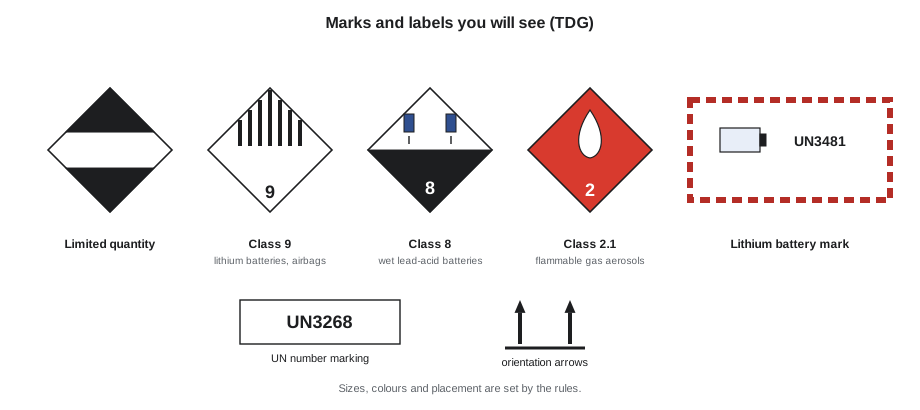
A product's transport classification is not always obvious. A can of brake cleaner and a can of spray paint are both aerosols in Class 2, but the paint may also be flammable. A new airbag module is usually classed as a safety device in Class 9, with the UN number UN3268, but only when the manufacturer has had it classified that way. Lithium batteries fall under several UN numbers depending on their chemistry and whether they are packed alone, packed with equipment or contained in equipment, such as UN3480 for lithium ion batteries on their own and UN3481 for lithium ion batteries packed with or contained in equipment. Wet lead-acid batteries are Class 8, UN2794.
The best source for a product's classification is section 14 of its safety data sheet (SDS), which gives the transport information: the UN number, the shipping name, the class and, for many products, the packing group, a measure of how dangerous the product is within its class, from I (high danger) to III (lower danger). The manufacturer's shipping instructions for warranty returns, such as airbag modules, also give the classification and the packaging to use.
Who is responsible
TDG places duties on everyone involved, but the person who prepares and offers the shipment, called the consignor, carries most of them. The consignor must classify the goods, choose the right packaging, mark and label it, and prepare the shipping document. The carrier must check the documents, carry them, and display placards when they are needed. When a parts department ships a battery, an aerosol or an airbag module, the dealership is the consignor.
The most dangerous shipment is the one nobody declared. Lucan was firm about this. "Never hide dangerous goods in a shipment, never describe them as something else, and never leave them out of the paperwork to get a lower rate or to use a service that won't take them. If the carrier won't take a product, ship it another way or don't ship it. Undeclared dangerous goods start fires in trucks and planes, and the penalties fall on the shipper."
Training
Under TDG, a person who handles, offers for transport or transports dangerous goods must be adequately trained and hold a training certificate, or work under the direct supervision of someone who does. The certificate is issued by the employer, not by the trainer, and states the person's name, the employer, the aspects of handling or transport the person is trained in, and the expiry date. For road transport, a certificate is valid for 36 months. The worker must show it to an inspector on request, and the employer keeps a copy.
Training covers only the aspects the person actually does. A counter person who sells aerosol cans across the counter to the public does not need TDG training for that sale. A person who packs aerosols for courier shipment does. Talia and Gideon were trained in classifying, packing, marking and documenting the products the department ships, and in the special provisions for batteries and limited quantities. Rolf issued their certificates on Monday, valid until October 2029, and put a reminder in the department calendar to book refresher training before then.
Limited quantities
Many dangerous goods that a parts department ships are small consumer-sized packages: aerosol cans, small bottles of fluid, tubes of adhesive. TDG allows these to be shipped as limited quantities, with far fewer requirements, if each inner package is no larger than the limit set for that product in the regulations' schedule and the package as a whole is within the gross mass limit, generally 30 kg. For aerosols, the inner limit is generally 1 L per can.
A limited quantity package needs strong outer packaging and the limited quantity mark: a square set on its point, with the top and bottom sections black and the middle white. The mark goes on the side of the package. For road transport in Canada, a limited quantity shipment generally does not need a shipping document, dangerous goods labels or placards. Shipping by air is different: air carriers follow the international air rules, which are much stricter, and a package acceptable by road may not be acceptable by air.
Worked problem
Checking an aerosol carton
A carton holds 12 cans of brake cleaner, each a 500 mL aerosol weighing 0.55 kg, in an outer carton weighing 0.4 kg. Is it within the limited quantity limits for road?
Show solution
- Each can:
- 500 mL is under the 1 L inner limit for aerosols
- Gross mass:
- \[12 \times 0.55 + 0.4 = 7.0 \text{ kg}\]
- Compare:
- 7.0 kg is under the 30 kg limit
Answer: Yes. The carton can go by road as a limited quantity with the limited quantity mark, if the cans are protected so their valves cannot be pressed and the carton is strong enough. The weights are samples; always check the product's own SDS and the current rules.
Batteries
Lead-acid batteries are the dangerous goods a dealership handles most. New batteries come in from the supplier, and used batteries go back to the supplier or a recycler, often on pallets carried by the battery supplier's own trucks or a recycler's truck. Damaged, leaking batteries are a special hazard, because the acid is corrosive and can burn skin and eyes and damage other parts.
TDG contains special provisions for lead-acid batteries carried by road that relieve the consignor of many requirements when the batteries are protected against short circuits, secured upright, and protected from damage and from sliding. The exact conditions are in the regulations, and Lucan showed Talia and Gideon where to find them and how to check a pallet against them: terminals protected or covered, batteries upright, no leaks, layers separated, the pallet wrapped and stable. Leaking or damaged batteries are packed in a leak-proof container with absorbent material and handled as the supplier or recycler directs.
Lithium batteries are a growing part of the work: key fob batteries, batteries in tire pressure sensors, telematics units and, increasingly, high-voltage batteries and modules for hybrid and electric vehicles. Small lithium batteries packed with or in equipment often qualify for simpler rules. Large lithium batteries, and any lithium battery that is damaged, defective or recalled, have much stricter rules, and damaged lithium batteries are forbidden on aircraft. High-voltage traction batteries are shipped only by people trained for them and following the manufacturer's instructions, usually through the manufacturer's own return logistics.
Airbag modules and other safety devices
Airbag modules, seat belt pretensioners and similar devices contain a small explosive or gas-generating charge. New ones are usually classed as Class 9 safety devices, UN3268, which allows them to be shipped in their approved packaging with relatively simple rules. The classification depends on the device being in its approved condition and packaging. A dealership most often ships them as warranty returns to the manufacturer, and the manufacturer provides the packaging, labels and instructions. Those instructions must be followed exactly.
Deployed airbags, where the charge has gone off, are generally no longer dangerous goods for transport, though they may still be hazardous waste under other rules. Undeployed modules that are damaged are a different matter: they may no longer meet the conditions of their classification, and they must not be shipped as ordinary Class 9 goods. The manufacturer or a trained specialist should be asked how to handle them.
Marks, labels and documents
For dangerous goods that are not in limited quantities or otherwise exempt, the main requirements are:
- UN number on the package, in the size the rules require.
- Shipping name on the package, for many products.
- Class labels, the diamond-shaped labels that show the class by colour and symbol.
- Orientation arrows for liquids, showing which way is up.
- A shipping document that lists the consignor, consignee, UN number, shipping name, class, packing group, quantity and number of packages, and a 24-hour emergency telephone number. It travels with the shipment, within the driver's reach.
Larger quantities also need placards on the vehicle: large diamonds on each side and each end. For most classes, placards are generally required when the gross mass of dangerous goods on the vehicle is more than 500 kg, though some goods need them at any quantity. Placarding is mainly the carrier's job, but the consignor must offer the placards if the carrier does not have them.
Couriers and freight carriers often set their own rules on top of the regulations. Many couriers accept dangerous goods only from shippers with a special account and trained staff, and some do not accept certain classes at all. Air services are the strictest. The parts department should know which of its carriers accept which goods before an order is promised to a customer.
The rules change
TDG is amended from time to time, as the United Nations recommendations are updated and as Transport Canada reviews the rules. Amendments published in 2026, for example, changed some marking requirements. Training providers update their courses, and the training certificate's expiry date makes sure every worker is retrained within three years. In between, the parts manager should keep the current regulations and each carrier's current dangerous goods guide at hand.
The three items on the table
By the end of the morning, Talia and Gideon could explain how to ship each of Lucan's three items:
- The airbag module: a Class 9 safety device returned in the manufacturer's warranty packaging, with the manufacturer's labels and documents, by the carrier the manufacturer names.
- The brake cleaner: a limited quantity of aerosols, checked against the inner and gross limits, with valves protected, in a strong carton with the limited quantity mark, by road.
- The used batteries: a pallet checked against the battery provisions, terminals protected, upright, wrapped, collected by the battery supplier's truck with the supplier's paperwork.
"Most of what you'll ship is one of these three," Lucan said. "Anything else, you look it up before you pack it. And if you're not sure, you ask before it leaves the building, not after."
When something goes wrong in transport
If a dangerous goods package leaks, is damaged or is involved in an accident, the first priority is people's safety: keep people away, avoid contact with the product, and follow the emergency information on the SDS and shipping document. TDG requires certain incidents, called dangerous goods releases and similar occurrences, to be reported, some of them immediately. The dealership's procedure should say who makes the report and how, and the trainer's course covers the details.
A leaking package that arrives at the dock is handled the same way: keep people back, use the spill kit as the SDS directs, isolate the package, and report it to the carrier and the shipper. It is not signed for as a clean delivery.
Common mistakes
MistakeDescribing dangerous goods as ordinary parts to get a lower rate.
InsteadAlways declare them; if a carrier will not take them, choose another way.
MistakeAssuming a product is safe to ship because it is sold over the counter.
InsteadCheck the SDS transport section.
MistakeShipping a damaged airbag module as a normal Class 9 return.
InsteadAsk the manufacturer or a specialist how to handle it.
MistakeSending a road-acceptable package by air.
InsteadAir rules are stricter; check before choosing the service.
MistakeLetting a TDG certificate expire.
InsteadBook refresher training before the certificate expires.
Summary and key terms
- TDG governs the transport of dangerous goods in Canada; the consignor classifies, packs, marks, labels and documents.
- There are nine classes; parts departments mostly ship Class 2 aerosols, Class 8 batteries and Class 9 lithium batteries and safety devices.
- Workers need a training certificate, valid for 36 months for road transport.
- Limited quantities and the battery provisions simplify many shipments, but only when every condition is met.
- Never undeclare dangerous goods; check the SDS, the rules and the carrier's own rules before shipping.
- UN number
- A four-digit number that identifies a dangerous product or group of products in transport.
- Packing group
- A rating of danger within a class, from I (high) to III (lower).
- Limited quantity
- Small inner packages of dangerous goods shipped under simplified rules within set limits.
- Safety device
- An airbag module, pretensioner or similar item classed as Class 9, UN3268, in its approved form.
- Placard
- A large diamond sign on a vehicle showing the class of dangerous goods it carries.
- Consignor
- The person who prepares and offers dangerous goods for transport.
Practice problems
Work each problem on paper first, then reveal the answer to check.
Where is a product's transport classification usually found?
Show answer
In section 14 of its safety data sheet.
Which class are wet lead-acid batteries?
Show answer
Class 8, corrosive, UN2794.
A carton holds 24 aerosol cans of 0.4 kg each in a 0.6 kg carton. What is the gross mass, and is it under 30 kg?
Show answer
24 × 0.4 + 0.6 = 10.2 kg, under 30 kg.
What should you do if a carrier will not accept a product?
Show answer
Ship it another way that accepts it, or do not ship it; never undeclare it.
Why are damaged lithium batteries a special case?
Show answer
They can overheat or catch fire, have stricter rules and are forbidden on aircraft.
Lesson quiz · 5 questions
Score 60% or more to complete this lesson.
Create a free account to save your progress, take quizzes and earn a certificate.