
APT-220 · Lesson 12 of 12 · 21 min
Running a receiving dock for a day
▶ Video coming soon A video version of this lesson is on the way.
This last lesson follows one full day on the Linmore Tessaro dock: Wednesday, October 21, stock order day. The day had all the ordinary work of a receiving dock, and one event nobody on the dock knew was coming. Sasha Esparza ran the dock, with Talia working beside her. The lesson tells the day in order, then looks at what went well, what went wrong and what changed afterwards. Each part points back to the earlier lessons in this course.
The day's stock order had been built the afternoon before. On Tuesday, October 20, Rolf and Talia had reviewed the system's suggested order of 152 lines and sent 140 to Tessaro's regional parts depot (APT-210). Sasha looked at the purchase order before she went home: 140 lines, several boxes of winter wiper blades for the seasonal display, two windshields, a bumper cover and the usual pads, rotors and filters. She expected seven or eight pallets.
7:30 a.m.: opening the dock
Sasha's first job each morning was the opening check. She walked the dock: the receiving area clear, as it had been left the night before; the pallet jack charged; the scanner and label printer working; the vehicle restraint and dock leveller tested; the yellow chain across the truck door. She noted that the pallet of returned cores, waiting for the remanufacturer, stood on the dock near the side exit door. It had grown over the past two weeks. She made a mental note to move it after the truck had been unloaded.
At 7:35 the overnight emergency parts arrived by courier: two cartons, ordered by 3 p.m. the day before for cars in the service shop. Sasha checked the piece count against the courier's handheld, signed, and Talia opened and checked them at once: a water pump and a set of brake hoses, both for repair orders in progress. They were received in the system and on the back counter by 7:50, before the technicians had finished their first coffee.
Sasha's rule for the morning order of work was simple: parts for waiting cars first, then the stock order, then everything else (lesson 2).
8:40 a.m.: the depot truck
The depot truck backed onto the dock at 8:40. Sasha confirmed the restraint had engaged, lowered the leveller and took the paperwork: seven pallets and nine loose cartons. She and Talia counted as the driver brought them off: seven and nine. Talia looked at every piece. One pallet's wrap was torn at one corner, but the cartons under it were sound. Sasha opened the corner anyway with the driver watching, found nothing damaged, and signed the receipt with a note: "Pallet 4 wrap torn, contents checked, no damage seen." The truck left at 9:05.
"Why write it if nothing was damaged?" Talia asked. "Because if we find something cracked inside later, I want the record to show the wrap was torn when it arrived," Sasha said (lesson 3).
9:05 a.m.: checking and the first put-away
Checking began with the cartons marked for special orders and back orders, which the DMS had flagged when Sasha opened the purchase order: a bumper cover for the body shop, two sets of pads for a fleet customer and a sensor that a customer was waiting for at the front counter. Those went to the counters first. Then the regular stock lines, pallet by pallet, checked against the packing slips. Lines over 200 dollars were counted blind.
By 9:30, the van wave was due. Gideon had already picked most of the 10 a.m. orders, and Talia stopped checking for fifteen minutes to help him pack the last three. The van left on time at 10:00 (lesson 5).
Put-away of the checked lines began at 9:50. Talia took the first cart of 34 lines, sorted by location. The winter wiper blades went up to their overflow locations on the mezzanine, where they would wait until the seasonal display at the front counter needed restocking.
10:12 a.m.: the alarm
At 10:12 the fire alarm sounded. Talia was halfway up the mezzanine stairs with a tote of wiper blades. She set the tote down on the landing, out of the way, walked down and out through the nearest exit beside the receiving dock, and joined the parts staff at the assembly point at the far corner of the back lot, where Rolf was counting heads. Sasha left the dock by the same exit, and found she had to squeeze past the pallet of cores to reach it. It took the whole dealership four minutes and ten seconds to get out.
It was a planned drill (APT-110). When the all-clear came and everyone was back inside, Rolf held a short debrief at the back counter. It found two problems: the pallet of returned cores had been left partly blocking the dock exit, and one of the newer counter staff had gone back for her phone. "Next time it might not be a drill," Rolf said.
The core pallet was the dock's problem, and Sasha took it personally. It had been the item she meant to move "after the truck," and the truck had come and gone without her moving it. She moved it to a marked area well away from the exit before she did anything else, and asked Rolf to make the reverse flow a fixed job with a fixed pickup day (lesson 8).
10:40 a.m.: back to work
Work resumed at about 10:40. A courier had left a parcel inside the van door during the drill, without a signature. Sasha counted it against the courier's tracking record online, opened it at once and checked it, and emailed the courier to note that it had been left unsigned. Talia went back up the mezzanine for the tote she had left on the landing.
Checking found two problem lines. One carton labelled for a cabin air filter held filters for a different model, a supplier labelling error. One line of brake hoses was short by two pieces in a sealed carton, a supplier packing error. Talia tagged both, put them on the problem shelf, photographed the labels and the opened carton, and entered both in the claims log. Sasha emailed the depot's dealer support desk with the purchase order number, the packing slip lines and the photographs. The DMS showed both lines as short received, so the invoice would not be paid for parts that had not arrived in good order (lessons 2 and 3).
At 11:30 Linmore Parts Supply dropped off three aftermarket parts ordered the day before. Talia received them against their purchase order and scanned their barcodes; one Corvane box would not scan, and she found its part number on the inner label and typed it, noting it for the cross-reference list she was building (lesson 10).
Midday: the second wave and the afternoon flow
Lunch was staggered so the dock was never empty. At 1:00, the picking wave for the 2 p.m. van began; by the 1:30 cut-off, 38 lines were picked, and Gideon packed them at the bench and loaded the van in reverse stop order. He brought back two cores and a return from the morning run, each with its paperwork, and set them in the new core area (lesson 11).
At 2:30 Sasha checked progress against her own target: every stock line put away by the end of the day.
Worked problem
Put-away progress at 2:30
Of the 140 stock order lines, 131 were in their bins at 2:30 p.m. What fraction was put away, and how many lines were left?
Show solution
- Fraction put away:
- \[131 \div 140 \approx 0.936\]
- Lines left:
- \[140 - 131 = 9\]
Answer: About 94 in 100 lines were away at 2:30, with 9 to go: the 2 problem lines, 4 lines that were new to stock and needed locations, and 3 lines of wiper blades that needed a second overflow location. The drill had cost about half an hour, and the day was still on track.
Talia assigned locations to the four new parts, following the rules in lesson 4: right size, near similar parts, fast movers low and close. Sasha checked them before the labels were printed. The extra wiper blades went to a second overflow location, entered in the system before they left the cart.
3:00 to 4:30 p.m.: shipping out
At 3:00, Imani placed the day's emergency order for parts needed tomorrow morning. At the same time, Sasha and Talia prepared the afternoon's outgoing courier shipments:
- Two online orders for customers out of the van's area, packed with cushioning and H-taped, labels printed with tracking numbers sent to the customers by email (lessons 5 and 6).
- A return to an aftermarket supplier with its return authorization number written on the carton (lesson 3).
- A warranty airbag module going back to Tessaro, packed in the manufacturer's approved return packaging with its labels and documents. Talia, trained and certified under TDG earlier in the month, prepared it, and Sasha checked it (lesson 7).
Everything was packed and labelled by 4:00, the cut-off for the courier's 4:30 pickup. The driver scanned each package, and Sasha kept the pickup receipt with the day's paperwork.
4:45 p.m.: closing the dock
The close-down checklist took fifteen minutes. The receiving floor was clear: every stock line was in its bin except the two problem lines, which were tagged on the problem shelf with their claims log entries. The staging lanes were empty. The truck door was closed and chained, the leveller stowed, the pallet jack on charge. The returns, cores and warranty areas were tidy and labelled. And, added that day, two new checklist items from Rolf: walk every exit route, and confirm nothing is stored within 1 m (3 ft) of any exit door.
| Measure | Result on October 21 | Target |
|---|---|---|
| Emergency parts to the shop | 20 minutes after arrival | Before the first job needs them |
| Stock lines checked clean | 138 of 140 (about 98.6 in 100) | At least 98 in 100 |
| Stock lines put away by close | 138 of 138 good lines | All good lines the same day |
| Van runs on time | 2 of 2 | All |
| Courier cut-off met | Yes | Every day |
| Problem lines logged and reported | 2 of 2, same day | All, same day |
| Exits clear | No: core pallet found in the drill, fixed the same morning | Always |
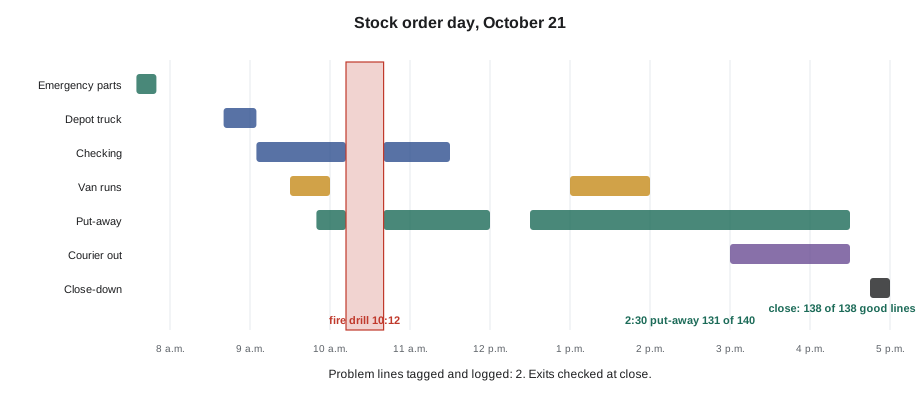
Looking back on the day
Sasha and Rolf talked the day over the next morning. Most of it had gone well, and for reasons that were not luck:
- Preparation. Sasha had read the purchase order the day before, so she knew the order's size and its special items.
- Priorities. Parts for waiting cars and waiting customers went first, every time.
- Evidence. The torn wrap was noted, the problem lines were photographed and logged, and the invoice was protected by receiving only what arrived in good order.
- Records moving with parts. Every receipt, put-away, location and shipment was in the system when it happened.
- Safety habits. Talia set down her load and left at once in the alarm, and the dock rules were followed for the truck.
And one thing had gone wrong in a way that could have been serious. The core pallet by the exit was not a receiving problem; it was a reverse flow problem that had been allowed to sit on the dock because the dock was where it would eventually leave. Sasha had seen it at 7:30 and put it off. "That's the lesson I'm keeping," she told Talia. "The thing you mean to move after the truck is the thing that's in the way when the alarm goes."
The changes that followed are told in earlier lessons: the core pallet's marked area and fixed pickup day, and the new packing rule for cores (lesson 8); the packing bench moved to the van lane on October 31 (lesson 9); and the cross-references for Corvane and Torvale barcodes (lesson 10).
What a dock lead plans
Running a dock well is mostly planning. A good dock lead thinks about each day before it starts:
- What is coming: the purchase orders and advance shipping notices due, their size and anything that needs special handling.
- What is going: van runs, courier cut-offs, returns and cores due out, and any dangerous goods shipments.
- Who is available: who is on the dock, who can help at the busiest times, and who is trained for forklifts and dangerous goods.
- What could go wrong: a late truck, a damaged pallet, a full bin, a missing location, a drill, and what will be done about each.
- What must be finished: the receiving floor clear, the staging lanes empty, the exits clear, the claims log up to date.
Talia wrote these five headings on the inside cover of her notebook. Over the next weeks, Sasha began handing her the planning for an ordinary weekday: the courier parcels, the van waves and the returns. Stock order days stayed with Sasha a while longer.
Common mistakes
MistakePutting off a small hazard until after the busy part of the day.
InsteadFix it when you see it, especially anything near an exit.
MistakeTreating a drill as a break from work.
InsteadLeave at once, set down loads safely, and never go back for belongings.
MistakeLetting a drill or delay push problem lines to tomorrow.
InsteadTag, photograph and log problems the same day.
MistakeStarting the stock order before the shop's emergency parts.
InsteadParts for waiting cars go first.
MistakeClosing the dock without the checklist.
InsteadUse the close-down checklist every day, including the exits.
Summary and key terms
- A dock day follows a rhythm: emergency parts first, then the stock order, van waves, courier cut-offs and close-down.
- Count, inspect and note exceptions at the truck; check every line; receive only what arrived in good order.
- Records move with parts at every step, so the system matches the shelves.
- Problems are tagged, photographed, logged and reported the same day.
- The reverse flow needs its own space and schedule; a pallet by an exit is a hazard, whatever is on it.
- Opening check
- The dock lead's first walk-through of the day: area clear, equipment working, door and restraint checked.
- Close-down checklist
- The routine that ends each day: floor clear, lanes empty, doors closed, exits clear, logs up to date.
- Wave
- A group of orders picked and packed for one shipping deadline, such as a van run.
- Problem shelf
- The marked shelf where tagged problem lines wait for a decision.
- Cut-off
- The latest time an order can be placed or packed to make a particular run or pickup.
Practice problems
Work each problem on paper first, then reveal the answer to check.
Why did Sasha note the torn wrap even though nothing was damaged?
Show answer
So the record would show the wrap was torn on arrival if concealed damage turned up later.
Of 150 lines, 141 are away by 2:30. What fraction is that?
Show answer
141 ÷ 150 = 0.94, or 94 in 100.
What were the two problems found in the fire drill debrief?
Show answer
The core pallet partly blocking the dock exit, and a worker going back for her phone.
Which parts went first on October 21, and why?
Show answer
The emergency parts for cars in the shop, because technicians were waiting.
Name the five things a dock lead plans for each day.
Show answer
What is coming, what is going, who is available, what could go wrong, what must be finished.
Lesson quiz · 5 questions
Score 60% or more to complete this lesson.
Create a free account to save your progress, take quizzes and earn a certificate.