
APT-220 · Lesson 11 of 12 · 23 min
Delivery drivers and routes
▶ Video coming soon A video version of this lesson is on the way.
On Monday, October 26, Talia rode along on Gideon Achebe's 10 a.m. run. Before he started the van, Gideon walked around it, checking the tires, lights, mirrors and the back doors, and looked at the load through the side door: boxes stacked by stop, heaviest at the bottom and forward against the partition, nothing loose. He set the navigation for the first stop, put his phone in its holder, and only then put the van in gear. "Everything I need to touch is done before we move," he said. "After that, my hands are for driving."
The run had nine stops: independent shops, a body shop, the Orland Courier depot and a fleet garage. By the time they were back at the dock at ten past twelve, Talia had seen what the job involved: driving, but also checking, loading, counting, collecting returns and cores, solving small problems at the customer's door and representing the dealership to the people who bought the most parts from it. This lesson covers the delivery driver's role, the van and its load, route planning, the delivery routine and safe driving.
The driver's role
For many wholesale customers, the delivery driver is the person from the parts department they see most often. A good driver is reliable, polite and careful, and brings back useful information as well as returns. Gideon's job included:
- Loading the van in stop order, checking the box count for each stop against the delivery list.
- Driving the route safely and on time.
- Delivering: handing over the parts, confirming the count with the customer and getting a signature.
- Collecting returns, cores and warranty parts, with the right paperwork, and bringing them back to the dock.
- Communicating: telling the counter about delays, problems and customer requests, and passing on questions to the right person.
- Looking after the van: daily checks, keeping it clean and loaded safely, and reporting faults.
Customers notice small things: a driver who takes the boxes inside rather than leaving them by the door, who knows which technician ordered the urgent part, who remembers to ask whether there are any cores to go back. Many wholesale customers choose their supplier partly on delivery service, and a good driver keeps accounts that a cheaper competitor might otherwise win.
The van and the rules that apply
Linmore Tessaro's delivery van was a large cargo van with a gross vehicle weight rating (GVWR) of 4,350 kg. In Ontario, trucks and similar commercial vehicles with a registered or actual gross weight over 4,500 kg generally need a Commercial Vehicle Operator's Registration (CVOR) and are subject to further rules, such as daily inspections and hours of service. The van was under that weight, so it did not need a CVOR, and Gideon could drive it on an ordinary car licence. The Highway Traffic Act's rules of the road, including those on distracted driving, speed, seat belts and securing loads, applied as they do to every driver.
Even when a vehicle is below the weight where the heavier rules apply, many businesses follow some of them anyway as good practice. Linmore Tessaro required a daily walk-around check, kept a log of mileage and fuel, and limited the van driver's driving day.
A van must also stay within its own limits. The GVWR is the maximum the vehicle may weigh fully loaded, including the vehicle itself, the driver, passengers, fuel and cargo. The difference between the GVWR and the vehicle's weight with driver and fuel is its payload: the most cargo it can carry. Parts are heavier than they look. A load of brake rotors, drums and batteries can reach a van's payload long before the van looks full.
Worked problem
Checking the payload
The van weighs 2,500 kg with fuel. Gideon weighs about 90 kg. The day's heaviest load, with rotors, batteries and two transmissions for a fleet customer, is about 1,050 kg. The GVWR is 4,350 kg. Is the van within its rating, and how much margin is left?
Show solution
- Loaded weight:
- \[2{,}500 + 90 + 1{,}050 = 3{,}640 \text{ kg}\]
- Margin:
- \[4{,}350 - 3{,}640 = 710 \text{ kg}\]
Answer: The van is within its rating with about 710 kg to spare. Each axle also has its own rating, so heavy items should be spread along the floor rather than piled at the back. The values are samples; the van's own label gives its ratings.
Loading and securing
A load that shifts can injure the driver in a sudden stop, damage the parts and make the van harder to control. The rules for a van load are simple:
- Heavy items low and forward, against the partition behind the seats, and spread across the floor.
- Nothing loose. Use the van's tie-down points, straps, load bars or shelving with lips or nets.
- A solid partition between the cargo area and the cab, so nothing can slide forward into the driver.
- Batteries upright and secured, terminals protected, in a tray or box that would hold a leak.
- Hazardous products loaded as lesson 7 requires, kept apart from food or drink and secured.
- Long items such as exhaust pipes secured along the side, not left to slide.
- Stops in order: the first stop's boxes loaded last, nearest the side or rear door.
Gideon's van had shelving along one side with lipped shelves and cargo nets, a clear floor area with tie-down rails for heavy items and pallets of batteries, and a steel partition behind the seats. He used the shelving for small boxes by stop and the floor for anything heavy.
Planning the route
A route is the order of stops for a run. Good route planning cuts driving time and distance, gets urgent parts to their customers first and lets the driver keep the promised delivery times. The things to consider are:
- Which stops are on the run: set by the orders picked before the cut-off.
- Geography: stops grouped by area, avoiding crossing back and forth.
- Priorities: a car waiting on a hoist at a shop may need to be the first stop, even if it is not the nearest.
- Customer hours and access: a shop that opens at 8 is no problem for a 10 a.m. run, but a body shop that closes for lunch at noon must be reached before then; some stops have narrow lanes or no place to park.
- Traffic and road work at the times of the run.
- Returns and pickups: stops with cores or returns waiting.
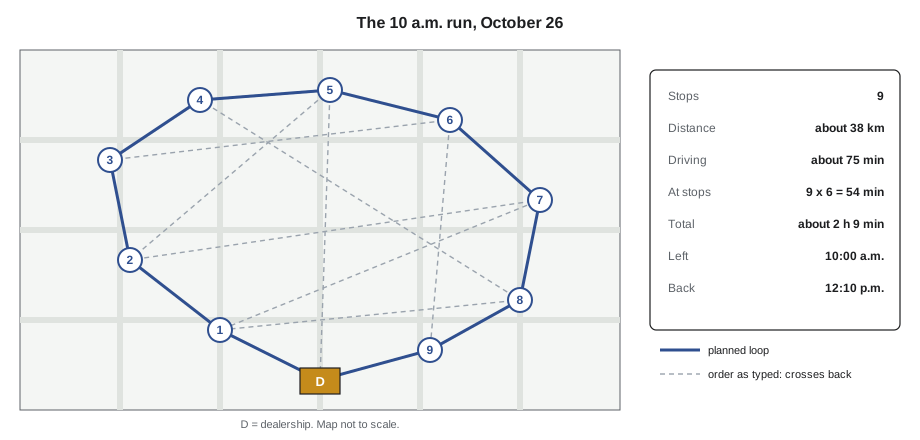
Many departments use routing software or a navigation app that can put several stops in an efficient order. Gideon used one, but he also adjusted the order himself: he knew which lanes were blocked at certain times, which customers needed parts urgently and which ones had cores to collect.
Worked problem
Planning the run time
The October 26 run had 9 stops and covered about 38 km. Gideon planned about 75 minutes of driving and about 6 minutes at each stop. How long should the run take, and what was the average distance per stop?
Show solution
- Time at stops:
- \[9 \times 6 = 54 \text{ min}\]
- Total time:
- \[54 + 75 = 129 \text{ min} \approx 2 \text{ h } 9 \text{ min}\]
- Distance per stop:
- \[38 \div 9 \approx 4.2 \text{ km}\]
Answer: Leaving at 10:00, the van should be back at about 12:09, well before the 1:30 cut-off for the 2 p.m. run. In fact they were back at ten past twelve. The values are samples.
Route planning also shows when the van runs are getting too full. If the run regularly takes longer than the time between runs, or customers at the end of the route regularly get their parts late, the department may need to change the cut-offs, add a run, split the area or use a courier for distant stops. Rolf reviewed the van logs each month for exactly this.
The delivery routine
At each stop, Gideon followed the same steps:
- Park safely and legally, out of the way of the customer's traffic and with the hazard lights on if needed. Back in only when necessary, and walk around first.
- Take the right boxes for the stop, checking the stop number and customer name.
- Hand them to a person, not just leave them at the door, unless the customer has agreed to a drop-off spot.
- Confirm the count: scan each box, or count them with the customer, and get a signature on the phone app or the delivery list.
- Ask about returns and cores, and take them only with a return slip or a tag showing the customer, the part and the original invoice.
- Pass on messages, such as a question about a back order, to the counter by phone when parked, or in person on return.
At the fifth stop, a shop owner said he had been sent only two of three boxes for a brake job. Gideon showed him the app: three boxes scanned at the dock, three scanned at his door and signed for by his technician twenty minutes earlier. The third box was on a bench at the back of the shop. Proof of delivery saved a phone call, a second trip and an argument.
Collecting returns needs as much care as delivering. A core or return without paperwork arriving at the dock is an orphan: nobody knows whose it is, what credit is owed, or whether it was ever sold. Gideon would not take a return without a slip; if the customer had none, he wrote one on the spot with the customer's name, the part number and the invoice number if known, and the customer signed it.
Driving safely
Driving is the most dangerous part of most delivery jobs. The main risks and their controls:
- Distracted driving. Ontario law bans holding or using a handheld phone or other device while driving, including while stopped in traffic or at a red light, except to call 911 in an emergency. Penalties include large fines, demerit points and, even for a first conviction, a licence suspension. Gideon set the navigation before moving, kept the phone in a holder, and made calls only when parked.
- Speed and following distance. A loaded van stops more slowly than a car. Leave more space, especially in rain and snow.
- Backing up. Many van collisions happen while reversing at low speed. Avoid backing where possible by choosing parking spots you can pull out of; if you must back, walk around first, use the mirrors and camera, and use a spotter if one is available.
- Seat belts, always, for the driver and any passenger.
- Fatigue and time pressure. A driver who is rushing to make up time takes risks. The route plan should allow realistic times, and the counter should not promise delivery times the route cannot keep.
- Weather. Winter driving needs good tires, cleared windows and lights, and more time. In bad conditions, a late delivery is better than a collision.
- Lifting and carrying at the customer's door: use the van's hand truck for heavy or awkward boxes.
If there is a collision, the driver stops, makes the scene safe, checks for injuries and calls for help if anyone is hurt, follows the law on reporting, exchanges information, takes photographs and calls the dealership. The dealership's procedure, kept in the van with the insurance and registration documents, sets out the details.
What Talia took back
Back at the dock, Talia unloaded two cores, a return and a warranty part for the service department, each with its slip, and handed the signed delivery records to the counter. On the way back, Gideon had mentioned that the body shop at stop seven had asked twice about a back-ordered bumper. Talia passed the question to Imani, who found that the bumper had arrived on Friday and was on the problem shelf with a damaged corner. A replacement was ordered that afternoon, and Imani phoned the body shop to explain. "Half of what I do," Gideon said, "is carrying information. The boxes are the easy part."
The van log
Gideon kept a simple log for every run: the date, the run, the start and end times, the odometer readings, the number of stops, fuel bought and any problems, from a late customer to a warning light on the dashboard. The log took a minute a run to fill in and served several purposes. It showed Rolf how long runs were taking and whether they were growing. It gave the service department the van's mileage for maintenance. It gave the accountant a record of business use. And when a customer said a delivery had been late, the log showed when the van had actually arrived. The van itself was serviced on the dealership's own schedule, and any fault found on the walk-around check, such as a lamp out or a tire low, was fixed before the next run, not at the end of the week.
Common mistakes
MistakeTouching the phone while the van is moving.
InsteadSet the navigation and make calls before moving or when parked.
MistakeJudging the load by how full the van looks.
InsteadCheck the weight against the van's payload and GVWR.
MistakeLeaving boxes loose in the cargo area.
InsteadSecure everything; heavy items low and forward against the partition.
MistakeTaking a return with no paperwork.
InsteadTake returns only with a signed slip or tag.
MistakeBacking into a lane without looking first.
InsteadAvoid backing where possible; walk around first and use a spotter.
Summary and key terms
- The delivery driver drives, loads, delivers, collects and communicates; for many customers the driver is the dealership.
- A van under 4,500 kg does not need a CVOR, but every rule of the road still applies.
- Stay within the GVWR and payload, and secure every load with heavy items low and forward.
- Plan routes by geography, priority, customer hours and returns; review run times as volume grows.
- Confirm counts with a signature, collect returns only with paperwork, and drive without distraction.
- GVWR
- Gross vehicle weight rating: the most a vehicle may weigh fully loaded.
- Payload
- The most cargo a vehicle can carry: GVWR minus the vehicle's weight with driver and fuel.
- Route
- The order of stops for a delivery run.
- Proof of delivery
- A signature, scan or photo showing a shipment was delivered.
- Circle check
- A walk-around inspection of a vehicle before driving.
- CVOR
- Commercial Vehicle Operator's Registration, required in Ontario for most trucks over 4,500 kg.
Practice problems
Work each problem on paper first, then reveal the answer to check.
A van with a GVWR of 4,200 kg weighs 2,450 kg with fuel and an 80 kg driver. What payload is left?
Show answer
4,200 − 2,450 − 80 = 1,670 kg.
A run has 7 stops at 5 minutes each and 60 minutes of driving. How long should it take?
Show answer
7 × 5 + 60 = 95 minutes.
Why is the first stop's freight loaded last?
Show answer
So it is nearest the door and comes out first.
Name two controls for backing collisions.
Show answer
Avoid backing by choosing pull-through spots, walk around first, use mirrors and camera, use a spotter.
What should a driver do if a customer has a core but no paperwork?
Show answer
Write a slip with the customer, part and invoice number and have the customer sign it.
Lesson quiz · 5 questions
Score 60% or more to complete this lesson.
Create a free account to save your progress, take quizzes and earn a certificate.