
APT-220 · Lesson 5 of 12 · 23 min
Picking and packing orders
▶ Video coming soon A video version of this lesson is on the way.
At 8 a.m. on Tuesday, September 29, Gideon Achebe handed Talia a stack of pick tickets. "Ten o'clock run," he said. "Nine customers, forty-six lines. Cut-off was last night for most of these, and Bramhall will phone in a couple more before nine-thirty. Everything picked, packed and on the van by a quarter to ten." Talia picked with a cart and a scanner while Gideon packed. At 8:50 her scanner beeped at a Corvane oxygen sensor: she had taken the upstream sensor from the bin next to the downstream one she needed. The two boxes looked almost the same. She put it back, took the right one, and by 9:15 all 46 lines were packed. The two late calls from Bramhall Auto Service came in at 9:20 and went on the van too.
This lesson covers picking and packing: how orders become pick lists, the main ways to pick, how to prevent picking errors, and how to pack parts so they arrive safely and are easy to identify.
Where orders come from
A dealership parts department picks parts for several kinds of customers, each with its own timing and paperwork:
- The service department. Technicians need parts for repair orders, often within minutes. Back counter picks are small and urgent.
- Counter customers. Retail and trade customers at the front counter, usually picked while they wait.
- Wholesale customers. Independent shops, fleets and body shops that order by phone or online for delivery on the van runs. These are picked in batches before each cut-off.
- Online and shipped orders. Parts sold online or to distant customers, picked and packed for a courier.
- Transfers. Parts sent to another dealership in the group, such as the sister store.
Each order produces a pick ticket or pick list: a document or screen that shows each part number, quantity, bin location and description, and the order or customer it is for. A good pick list is printed in location order, so that the picker walks the warehouse once in a sensible path rather than in the order the parts were typed.
Ways to pick
Warehouses use several picking methods, and many use more than one.
- Single-order picking (also called discrete picking): one person picks one order at a time, start to finish. It is simple and makes errors easy to trace, but the picker may walk the same aisles many times in a morning. Back counter and front counter picks are nearly always single-order.
- Batch picking: one person picks several orders at once, walking the aisles once and sorting parts into separate totes or bins on the cart by order. It saves walking but needs care in sorting.
- Zone picking: each picker works one area of the warehouse, such as the mezzanine or the large-parts racking, and orders pass from zone to zone or are brought together at the end. It suits larger warehouses.
- Wave picking: orders are released in groups timed to a shipping deadline, such as a van run or the courier pickup. All the orders for the 10 a.m. van are picked as one wave.
Linmore Tessaro used single-order picking at the counters and batch picking in waves for the van runs. Talia's cart had nine totes, one per customer, each with the customer's pick ticket clipped to it. She picked in location order and dropped each part into the right tote.
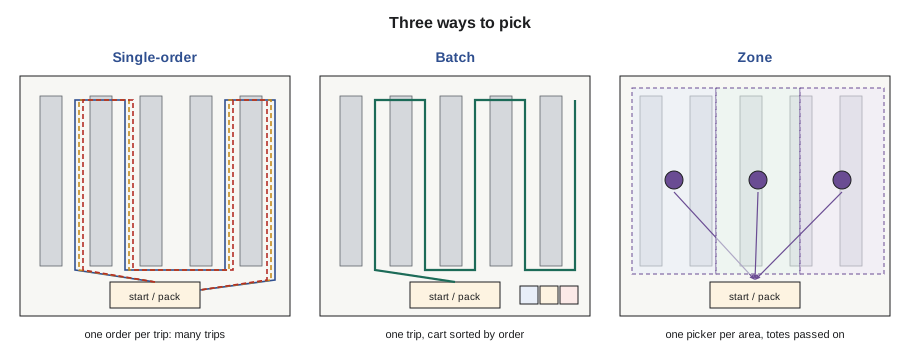
The pick path
Most picking time is spent walking, not picking. A well-planned pick path cuts walking by visiting locations in order along a route that passes each aisle once. A common route is the serpentine or S-shaped path: up one aisle, down the next. Locations are numbered so that the pick list sorted by location follows that path. Lesson 9 shows how slotting fast movers near the start of the path cuts walking further.
Talia's pick list for the wave began in aisle A near the back counter, wound through the aisles to G, then went up the mezzanine stairs for three light parts and back down to the drawer cabinets for clips. Sasha had planned the location numbers years earlier so the path worked that way. Picking the same list in the order it was typed would have doubled the walking.
Preventing picking errors
A picking error sends the wrong part, the wrong quantity, or the right part to the wrong customer. Each one costs a return trip, a frustrated technician and sometimes a car that cannot leave the shop. Most picking errors come from a few causes:
- Look-alike parts in neighbouring bins, such as upstream and downstream sensors, left and right parts, or parts for two engine sizes.
- Wrong bin: a part put away in the wrong location, so the picker takes the right bin but the wrong part.
- Wrong quantity, especially with package quantities: one box of ten clips, or ten boxes.
- Mixing orders in batch picking: the right part dropped in the wrong tote.
- Reading the bin label but not the part label.
The controls follow the causes. Scan to confirm: scanning both the bin and the part catches most wrong-part errors before the part leaves the shelf, as Talia's scanner did. Read the part label every time, even when the bin is right. Count twice for small parts. Separate look-alike parts where possible, or mark their bins clearly, for example with a coloured label reading LEFT or RIGHT. Check at packing: the packer compares each part with the pick ticket again before it goes in the box. This second check catches many errors the picker missed.
Short picks and empty bins
Sometimes the picker reaches the bin and the part is not there, or there are fewer than the system shows. This is a short pick. It means either the part is in the wrong place, or the system's count is wrong. The picker should not simply skip the line. The routine is:
- Look for the part in its overflow location and in the bins on either side.
- Tell the counter or the person responsible for the order, so the customer can be told and the part sourced elsewhere if needed.
- Record the short pick, so the bin is counted (APT-210) and the system corrected.
If a part is genuinely out of stock, the line becomes a back order or a lost sale, which feeds back into the stocking decisions covered in APT-210.
Packing: protect, identify, seal
Packing has three jobs: protect the part, identify the shipment and seal it securely. Parts going to the service shop may need only a bag and a label with the repair order number. Parts on the van need sturdy packing because they will be loaded, unloaded and handled several times. Parts going by courier need the most protection, because they will be sorted by machine, stacked and dropped along the way.
The basic rules:
- Choose the right box. A box should be strong enough for the weight and only a little larger than the contents. Too big, and the parts slide and the box crushes; too small, and the parts press against the walls.
- Leave room for cushioning on every side, typically at least 5 cm (2 in) for fragile parts, filled with paper, foam or air pillows.
- Heavy parts at the bottom, light parts on top, and nothing heavy on top of anything fragile.
- Keep parts in their original packaging where possible. The manufacturer's box protects the part and carries its label.
- Bag liquids upright in a sealed bag with absorbent material, and mark the box with orientation arrows.
- Seal with good tape using the H method: along the centre seam and across both edges, top and bottom.
- Remove or cover old labels on reused boxes, so the box cannot be sent to the wrong address.
- Put the packing slip inside and the shipping label on the largest flat surface, not across a seam.
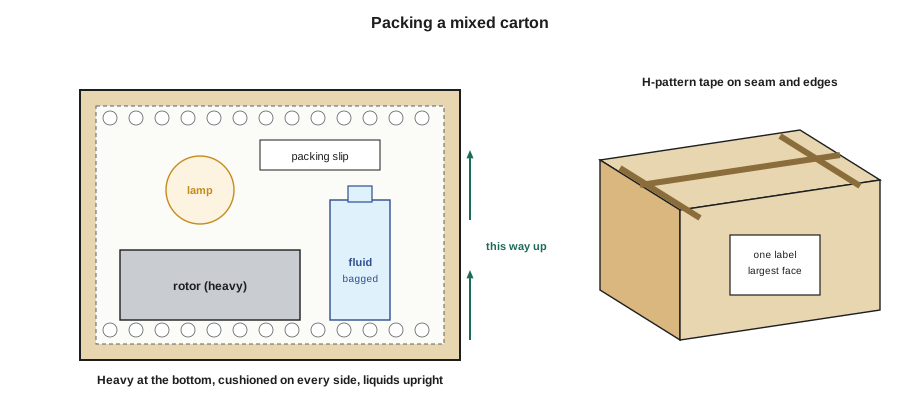
Some parts need special packing. Glass and lamps need padding on every face. Electronic modules stay in their protective bags. Long parts such as exhaust pipes and mouldings go in long cartons or are bundled and protected at the ends. Batteries, aerosols, fuel system parts with fuel residue and airbag modules are dangerous goods and are packed under the rules in lesson 7. Cores going back to a remanufacturer often go in the new part's box, which is designed to protect them (lesson 8).
Staging and loading
Packed orders go to the staging area for their shipping method: the van lane, the courier shelf or the counter pick-up shelf. In the van lane, Gideon staged orders by stop, in the reverse of his delivery order, so the first stop's boxes were loaded last and came out first. Each box carried the customer's name and the stop number in large writing, so he could find it in the van without reading small labels.
Before loading, Gideon checked the number of boxes for each stop against the delivery list, and the customer signed for that number on delivery (lesson 11). A box count is the simplest proof that a shipment was complete when it left.
Measuring picking and packing
Two measures matter most. Order accuracy is how many orders, or lines, are picked and shipped correctly. Pick rate is how many lines a picker picks in an hour. Rate without accuracy is useless: a fast picker who sends wrong parts costs more than a slower one who is always right.
Worked problem
Pick rate for the 10 a.m. wave
Talia picked 46 lines between 8:00 and 9:15. What was her pick rate in lines per hour?
Show solution
- Time taken:
- 1 hour 15 minutes = 1.25 hours
- Rate:
- \[46 \div 1.25 = 36.8\]
Answer: About 37 lines an hour, a reasonable rate for a new picker on a mixed wave that includes stairs and drawer cabinets. Rates depend on the warehouse and the kind of parts.
Worked problem
Wholesale order accuracy
In September, Linmore Tessaro shipped 380 wholesale orders. Customers reported 2 with a wrong part. What was the order accuracy?
Show solution
- Correct orders:
- \[380 - 2 = 378\]
- Accuracy:
- \[378 \div 380 \approx 0.995\]
Answer: About 99.5 in 100. Rolf's target was at least 99.5 in 100, so September just met it. Every error was still looked at to find its cause.
When Rolf looked at the two errors from September, one was a left and right mix-up and the other a box of ten clips sent where one clip was ordered. He moved the left and right parts to separate bins with coloured labels, and added a line to the pick ticket for any part with a package quantity: "Sold as box of 10."
Picking for the service shop
Picks for the service department have their own rhythm. A technician who needs a part stands at the back counter or sends a request from the shop, and every minute the part takes is a minute the car is on the hoist and the technician is not earning. Back counter picks are therefore single-order and immediate, and the parts go out in a bag or tote labelled with the repair order number, the technician's name and the bay, so they reach the right car.
Many departments also pre-pick for booked work. Each afternoon, the service department's schedule for the next day shows which cars are booked for maintenance and repairs, and which parts each job will need. The parts department picks those parts the afternoon before, bags each job's parts together as a kit, labels it with the repair order and puts it on a shelf by the back counter. In the morning, the technician collects the whole kit at once.
At Linmore Tessaro, Priyanka Rautela's service advisors printed the next day's booked jobs at 2 p.m., and the counter staff picked the kits between the 2 p.m. van run and the end of the day. Pre-picking showed up shortages a day early, when there was still time to order a part for the morning, instead of at 8 a.m. with the car already on the hoist. It also spread the picking work into a quieter part of the day.
Kits need care. A kit for a job that is cancelled or rescheduled must be returned to stock, or it ties up parts the system thinks are sold. The kits shelf was checked each evening against the next day's schedule, and any kit for a cancelled job was unpacked and put away before close.
Packing for the van and the counter
Packing for the van is lighter than packing for a courier, because the parts are handled fewer times and travel only a short way. Even so, every van package needs a customer name and stop number, parts protected from each other, and liquids upright. Small parts for several jobs for one customer can share a bag, each with its own label, inside one carton. Counter orders usually need only a bag and the invoice. In every case, the person packing checks each part against the pick ticket one last time, because a wrong part caught at the bench costs a few seconds, and a wrong part caught at the customer's door costs a trip.
Common mistakes
MistakePicking in the order the parts were typed.
InsteadSort the pick list by location and follow the pick path.
MistakeReading the bin label only.
InsteadRead or scan the part label too.
MistakeSkipping a short pick without telling anyone.
InsteadSearch nearby, tell the counter and record it for a count.
MistakeUsing a box much bigger than the parts.
InsteadUse a box just larger than the contents, with cushioning.
MistakeLeaving old labels on a reused box.
InsteadRemove or cover them.
Summary and key terms
- Pick tickets list part, quantity, location and order, and should be printed in location order.
- Single-order, batch, zone and wave picking each suit different work; van runs suit batch picking in waves.
- Most picking errors come from look-alike parts, wrong bins, package quantities and mixed orders; scanning and a second check at packing catch most.
- Pack to protect, identify and seal: right box, cushioning, heavy at the bottom, H-tape, one clear label.
- Measure order accuracy first and pick rate second.
- Pick ticket
- A document or screen listing the parts to pick for an order, with quantities and locations.
- Batch picking
- Picking several orders in one trip and sorting them by order on the cart.
- Wave picking
- Releasing orders in groups timed to a shipping deadline.
- Pick path
- The route a picker follows through the warehouse, usually in location order.
- Short pick
- A pick where the bin holds fewer parts than the system shows.
- Order accuracy
- The share of orders or lines picked and shipped correctly.
Practice problems
Work each problem on paper first, then reveal the answer to check.
Why is a pick list printed in location order?
Show answer
So the picker walks the warehouse once along the pick path.
Name two controls for look-alike parts.
Show answer
Scan to confirm, separate the bins, or mark bins clearly with coloured labels.
A picker picks 60 lines in 1.5 hours. What is the pick rate?
Show answer
60 ÷ 1.5 = 40 lines an hour.
Which goes at the bottom of a mixed carton?
Show answer
The heaviest part.
Why stage van orders in the reverse of the delivery order?
Show answer
So the first stop's boxes are loaded last and come out first.
Lesson quiz · 5 questions
Score 60% or more to complete this lesson.
Create a free account to save your progress, take quizzes and earn a certificate.