
APT-220 · Lesson 4 of 12 · 22 min
Put-away and storage methods
▶ Video coming soon A video version of this lesson is on the way.
By eleven o'clock on stock order day, the checked parts stood in neat groups on the receiving floor. Sasha handed Talia a scanner and a cart. "Put-away is where a good receiving job gets wasted," she said. "You can count every part perfectly, and if one goes in the wrong bin, it's lost. The system says we have it, the counter can't find it, and someone orders another one."
Talia's first cart held 38 lines. Most went straight to their bins. Three bins were too full for the new stock, and Sasha showed her how to use overflow locations. One part had no location at all, because it was new to stock. And one part, a cabin air filter, turned out to have two bins: its main location in aisle C and an old location on the mezzanine that still held five filters nobody had sold in months, because the counter always went to aisle C. By the end of the morning Talia understood why Sasha said put-away was a job for someone careful rather than someone fast.
This lesson covers how parts are put away and the main ways they are stored: the kinds of storage equipment, fixed and random locations, overflow, stock rotation and how to protect parts while they wait to be sold.
The put-away routine
Put-away moves checked parts from the receiving area to their storage locations and records the move. A good routine is the same every time:
- Sort the cart by route. Group parts by aisle and section, so the cart follows one path through the warehouse rather than crossing back and forth.
- Go to the location shown in the system, not the one you remember. Locations change when the warehouse is re-slotted (lesson 9).
- Scan or read the bin label and the part label before placing the part, and confirm they match.
- Place the new stock behind or under the old stock so that older stock is sold first.
- Record the put-away. In many systems scanning the bin confirms it; in others the receiver marks the line put away.
- Report problems at once: a bin too full, a bin label missing, a part found in the wrong bin, or a part with no location.
Sasha's rule for a part found in the wrong bin was simple: move it to the right bin, tell her, and do not guess. A part in the wrong place is a hidden stock error. The system says it is in one place, the shelf shows it in another, and until someone notices, the part is both in stock and lost.
Fixed locations and random locations
There are two main ways to decide where a part is stored.
With fixed locations, each part number has its own permanent bin. The cabin filter always lives in C-07-2-14; when new stock arrives, it goes there. Fixed locations are easy for people to learn. Experienced staff often know where a fast mover lives without looking it up, and an empty bin is easy to spot. The disadvantage is wasted space: each bin must be big enough for the part's maximum stock, even though it is usually only half full.
With random locations, also called dynamic or floating locations, a part can go into any empty location that fits it, and the system records where it went. Random locations use space much better, because a location emptied by one part can be filled by another the same day. But they depend completely on the system. Nobody can find a part without looking it up, and a single put-away error is very hard to find. Random locations are common in large distribution centres with scanners on every step; they are less common in dealerships.
Most dealerships use a mix: fixed primary locations for every stock part, and a smaller area of overflow locations used randomly for extra stock that does not fit, for large deliveries such as seasonal orders, and for bulky parts. The system records both. When the primary bin runs low, stock is moved from overflow to the primary bin, a step called replenishment.
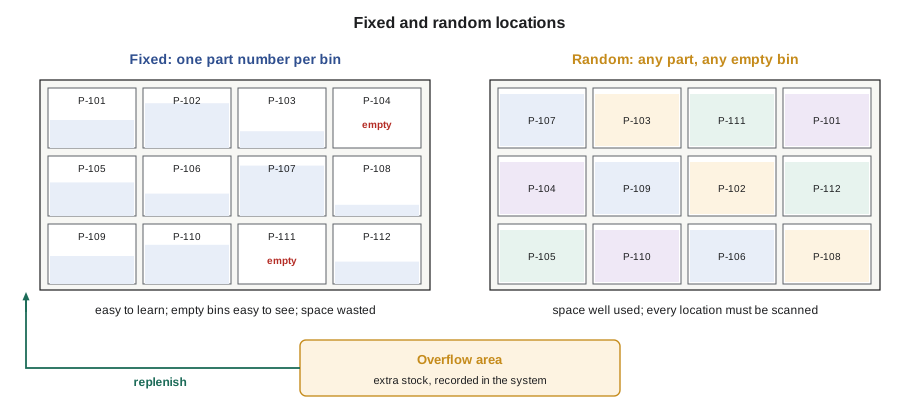
Overflow has one danger: forgotten stock. The cabin filters on the mezzanine had been put there as overflow two years earlier, before the department moved to a new DMS, and the overflow location was never carried over. The system showed all seven filters in aisle C, where only two were. Rolf's rule after that was that every overflow location must be in the system, and every overflow location is checked in the cycle count (APT-210).
Assigning a location to a new part
When a part becomes a stock part for the first time, it needs a location. The choice should follow a few rules:
- Fit the part to the space. Choose a bin, shelf or rack position that holds the part's maximum stock without crushing it or leaving most of the space empty.
- Put fast movers where they are easy to reach, close to the counter and at waist to shoulder height. Slow movers can go higher, lower or farther away. Lesson 9 covers this as slotting.
- Keep like parts together where it helps: all filters in one area, all wiper blades in another. This helps people find parts and helps cycle counts.
- Keep heavy parts low and light parts high.
- Keep hazardous products in their designated storage, whatever the slotting rules say (lesson 7).
- Print and attach the bin label before the part goes on the shelf.
Storage equipment
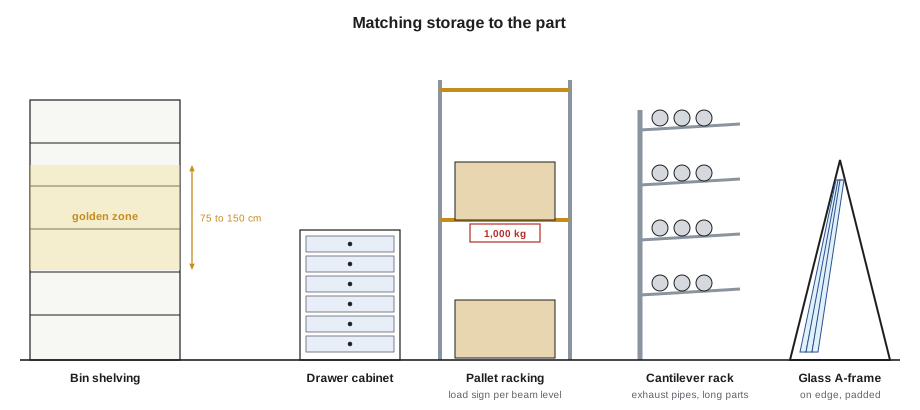
A dealership warehouse holds an odd mix of parts: thousands of small clips and bolts, boxes of filters and brake pads, heavy rotors and drums, long exhaust pipes and trim pieces, bulky bumpers and hoods, fragile glass and lamps, tires, batteries and fluids. No single kind of storage suits them all.
| Equipment | Typical parts | Notes |
|---|---|---|
| Steel shelving with bin boxes | Filters, pads, sensors, gaskets, small boxed parts | The main storage in most parts departments; adjustable shelves |
| Modular drawer cabinets | Clips, bolts, nuts, bulbs, fuses, small electrical parts | Dense storage for very small parts; drawers divided into compartments |
| Pallet racking | Bulk fluids, batteries in their cases, large boxed parts, seasonal stock | Load signs give the capacity per beam level; loaded with a forklift |
| Cantilever or long-part racks | Exhaust pipes, mouldings, wiper refills in long cartons, door seals | Arms with no front uprights so long parts slide in |
| Tire racks | Tires | Tires stored standing on their treads, rotated so they do not flatten |
| Sheet metal racks | Hoods, fenders, doors, bumper covers | Panels stored on edge with padding between them |
| Glass racks (A-frames) | Windshields, door glass | Glass stored on edge, never flat, with padding |
| Mezzanine shelving | Light, slow-moving parts | No heavy parts; load limit posted |
Loading racking safely
Pallet racking and heavy shelving have a rated capacity, usually posted on a load sign at the end of each run. The sign gives the maximum load for each beam level and for the whole bay, usually assuming the load is spread evenly. APT-110 covered the safety rules: never exceed the posted load, report damaged uprights and beams at once, keep loads square on the beams, and never climb racking. Put-away is where those rules are tested, because it is the moment when weight is added.
Worked problem
Checking a beam level before put-away
Sasha wants to put 24 cartons of rotors, each weighing 18 kg, on one pallet rack beam level. The load sign says 1,000 kg per beam level, evenly distributed. Can the level take them?
Show solution
- Total weight:
- \[24 \times 18 = 432 \text{ kg}\]
- Compare with the sign:
- 432 kg is less than 1,000 kg
Answer: Yes, with room to spare, as long as the level is empty and the cartons are spread evenly on a pallet across both beams. The values are samples; always use the rack's own load sign.
Shelving follows the same rule on a smaller scale. A steel shelf that holds bins of filters easily may bend under a row of brake drums. Heavy parts go on the lowest shelves, both because the shelf is strongest there and because nobody should be lifting a heavy rotor down from above shoulder height.
Stock rotation: first in, first out
Most parts do not spoil, but many do change with time. Rubber hoses and belts harden. Batteries lose charge. Some fluids, adhesives and sealants have a shelf life printed on the package. Packaging fades and gets dusty, and a customer who receives a part in a faded, torn box assumes it is old or used, even if it is not. And sometimes a part is updated by the manufacturer, and the old version should be sold first or returned.
The usual rule is first in, first out (FIFO): the oldest stock is sold first. In practice this means putting new stock behind or under the old, so the person picking takes the older part without thinking about it. For parts with a printed date, the date should face out, and the picker should take the earliest date. Batteries are a special case. Many battery suppliers ask that stock be checked and charged on a schedule, and that the oldest date code be sold first, because a battery that sits too long can be damaged by self-discharge.
FIFO matters for supersessions too. When a part number is replaced, the old stock is usually sold first, as long as the old part is interchangeable with the new (APT-120). If the two are kept in different bins, the old bin should be emptied first and then removed from the system, so the department does not end up with two locations for one part.
Protecting stored parts
Storage is not only about finding parts; it is also about keeping them sellable. Common risks and their controls:
- Crushing. Do not stack heavy cartons on light ones. Do not overfill bins so that parts are jammed in.
- Moisture and rust. Keep parts off the floor and away from the dock doors. Keep bare steel parts such as rotors in their packaging.
- Sunlight and heat. Keep rubber and plastic parts out of direct sunlight, which hardens and cracks them.
- Static electricity. Leave electronic modules in their protective bags until they are installed. Handle them by the case, not the connector.
- Dust and handling damage. Keep parts in their packaging and close drawers and bin covers. Painted parts and chrome trim need padding.
- Mixing and loss. One part number per bin, labelled; small parts in bags or compartments, never loose in a drawer with other numbers.
Sheet metal and glass need extra care. Body panels are stored on edge, padded, with nothing leaning against their painted or primed surfaces. Glass is always stored on edge on an A-frame or in a rack, never flat, and carried with two people and suction cups for large pieces. A dropped windshield is a lost part and a serious cut risk.
Measuring storage
Two simple measures help a manager judge storage. Space utilization is how much of the available storage is actually used. A warehouse that is nearly full has no room for large deliveries or seasonal stock; one that is half empty is paying for space it does not need. Location accuracy is how often a part is in the location the system shows. It is checked in cycle counts (APT-210), and it is one of the best signs of how good put-away is. At Linmore Tessaro, Rolf's target was at least 98 in 100 locations correct on every count.
After the morning with Talia, Sasha added one item to the put-away routine: when a primary bin is full, the overflow location is entered in the system before the part leaves the cart. The forgotten mezzanine location was emptied, its five filters moved to aisle C, and the old location deleted.
Parts on hold
Not every received part goes to a stock bin. Special-order parts, parts for booked repair orders and parts a customer has paid for but not collected need a hold area: a set of shelves near the counters, labelled by date or by customer, where each part waits with a tag showing the customer or repair order, the date received, the person who ordered it and the phone number to call. At Linmore Tessaro the hold shelves sat behind the front counter, with one section for the service department and one for retail and wholesale customers.
A hold area needs the same care as stock. Every part on hold is recorded in the system against its order, so the counter can find it from the customer's name. The hold shelves are reviewed every week: a part that has waited more than a set time, such as 14 days, prompts a reminder call, and a part abandoned past the time in the special-order terms is dealt with under those terms (APT-130). Without a weekly review, hold shelves fill with forgotten parts that have been paid for by nobody and can be sold to nobody.
Hold parts must never be used to fill another order without the counter's agreement, however convenient that would be. A technician who finds the exact part he needs on the hold shelf and takes it leaves another customer without the part they were promised.
Common mistakes
MistakePutting a part in the bin you remember.
InsteadGo to the location the system shows, and scan or read both labels.
MistakePutting new stock in front of old.
InsteadPut new stock behind or under, so the oldest sells first.
MistakeUsing an overflow location that is not in the system.
InsteadRecord every overflow location before the part leaves the cart.
MistakeStoring heavy parts on high shelves.
InsteadKeep heavy parts low, where shelves are strongest and lifting is safest.
MistakeStoring glass or body panels flat.
InsteadStore them on edge, padded, in their racks.
Summary and key terms
- Put-away moves checked parts to their locations and records the move; one wrong bin creates a hidden stock error.
- Fixed locations are easy to learn; random locations use space better but depend on the system.
- Most dealerships combine fixed primary bins with overflow locations, and replenish primary bins from overflow.
- Match storage equipment to the part, and never exceed a rack's posted load.
- Rotate stock first in, first out, and protect parts from crushing, moisture, sunlight, static and damage.
- Fixed location
- A permanent storage location for one part number.
- Random location
- A location that any part can use, with the system recording where each part is; also called a dynamic or floating location.
- Overflow location
- A location for extra stock that does not fit in the primary bin.
- Replenishment
- Moving stock from overflow or reserve storage into the primary bin.
- FIFO
- First in, first out: selling the oldest stock first.
- Location accuracy
- How often parts are in the locations the system shows.
Practice problems
Work each problem on paper first, then reveal the answer to check.
Why is a part in the wrong bin called a hidden stock error?
Show answer
The system shows it in stock, but nobody can find it where the system says.
Give one advantage of fixed locations and one of random locations.
Show answer
Fixed: easy for people to learn. Random: better use of space.
A shelf is rated 150 kg. How many 18 kg drums can it hold?
Show answer
150 ÷ 18 ≈ 8.3, so 8 drums.
How should new stock be placed in a bin with old stock?
Show answer
Behind or under the old stock, so the oldest sells first.
How should a windshield be stored?
Show answer
On edge in a glass rack or A-frame, padded, never flat.
Lesson quiz · 5 questions
Score 60% or more to complete this lesson.
Create a free account to save your progress, take quizzes and earn a certificate.