
APT-220 · Lesson 6 of 12 · 21 min
Shipping methods and carriers
▶ Video coming soon A video version of this lesson is on the way.
One afternoon in early November, an online order came in for a front bumper cover for a 2024 Arden. The customer lived about 400 km (250 miles) away. Sasha pulled the part and measured the carton: long, wide and light. "This is the kind of box that teaches you about dimensional weight," she told Talia. The courier would charge it not by what it weighed, but by how much space it took up. She priced it with Brackenly Express, the courier the department used for parcels, then with a freight carrier on a small pallet, and chose the courier after adding the charge for delivery to a home. The customer had paid for shipping at checkout, and Sasha wanted to be sure the price on the website still covered the real cost.
This lesson covers the ways parts leave the building, how carriers charge, how to choose a method, and the paperwork each one needs. Dangerous goods have their own rules, covered in lesson 7.
The main shipping methods
A dealership parts department uses a handful of shipping methods, each suited to different parts, distances and deadlines:
- Customer pickup. The customer collects the part at the counter. No shipping cost, but the customer must come in.
- The dealership's own delivery van. Regular runs to wholesale customers in the local area, such as Gideon's 10 a.m. and 2 p.m. runs. The cost is the van, the fuel and the driver's time, spread over all the deliveries (lesson 11).
- Courier or parcel service. Small packages, usually up to about 30 to 70 kg (70 to 150 lb) per piece depending on the service, delivered next day or in a few days. Charged by weight or dimensional weight, distance and speed.
- Less-than-truckload (LTL) freight. Shipments on pallets or in crates that are too large or heavy for a courier but do not fill a truck. The carrier combines shipments from many shippers on one trailer and moves them through its terminals.
- Full truckload. A whole trailer for one shipment. Rare for a dealership, except for large moves such as stocking a new store.
- Same-day or expedited service. A dedicated driver or a priority service for a part needed urgently, at a high price.
- Transfers within the group. Parts moved between stores of the same dealer group, by the group's own vehicles or a regular courier run.
Most outgoing shipments at Linmore Tessaro went on the van. Couriers carried online orders and parts for customers outside the van's area. LTL freight was used for large items such as a complete exhaust system or a pallet of returns to a supplier, and for returns of non-moving stock to Tessaro under the return program (APT-210).
How couriers charge
Couriers and parcel services price each package by several factors: its weight or dimensional weight, the distance or zone, the speed of service, and any extra charges. Most also add a fuel surcharge, an extra charge, set as a share of the base charge, that changes with fuel prices.
Dimensional weight (also called volumetric weight or dim weight) is a weight calculated from the size of the package. Couriers use it because a large, light box takes up space in a truck or plane that could carry heavier, paying packages. The courier compares the actual weight with the dimensional weight and charges for whichever is greater, called the billable weight.
Dimensional weight is the volume of the box divided by a dim divisor set by the courier. A divisor commonly used for courier shipments in Canada is 5,000 cubic centimetres per kilogram; some services use other divisors, so the courier's current rate guide is the source.
Most couriers measure each dimension at its longest point, round each up to the next whole unit, and round the result up to the next whole unit of weight.
Worked problem
The bumper cover carton
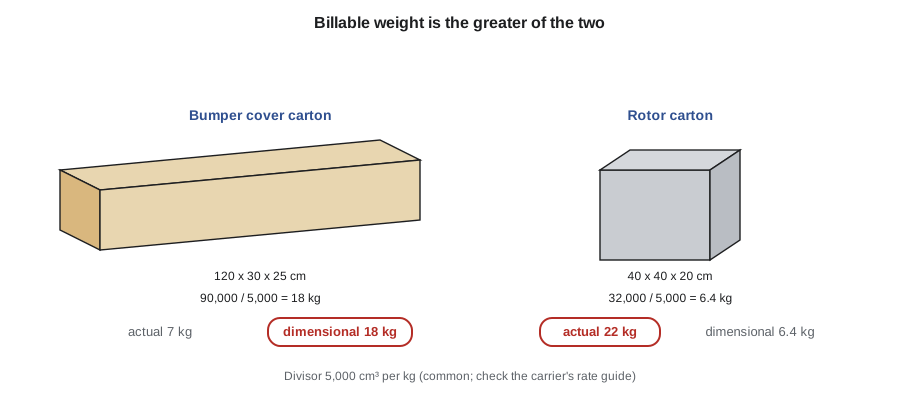
The bumper cover's carton measures 120 cm by 30 cm by 25 cm and weighs 7 kg. Using a dim divisor of 5,000, what is the billable weight?
Show solution
- Volume:
- \[120 \times 30 \times 25 = 90{,}000 \text{ cm}^3\]
- Dimensional weight:
- \[90{,}000 \div 5{,}000 = 18 \text{ kg}\]
- Compare with actual weight:
- 18 kg is greater than 7 kg
Answer: The billable weight is 18 kg, more than two and a half times the actual weight. A smaller carton, if the part can be packed safely in one, would cost less to ship.
Common extra charges, also called accessorial charges, include delivery to a home rather than a business, oversized or long packages, packages that need special handling, signature on delivery, extra declared value, delivery to remote areas, and address corrections. On a long, light bumper cover going to a home, the extras can cost more than the base charge.
How freight carriers charge
LTL freight is priced from the shipment's weight, its size and how much trailer space it takes, the origin and destination, and the carrier's rates for that lane, plus a fuel surcharge and any extras. Many Canadian LTL carriers price by weight with a minimum charge, and some apply a density or cube rule to light, bulky freight, much as couriers use dimensional weight. Extras include a liftgate for delivery to a location with no dock, inside delivery, appointment delivery and residential delivery.
Freight is a better choice than a courier for anything on a pallet, anything very heavy, and long or bulky items that would carry large courier surcharges. It is usually slower than a courier, and delivery dates are less exact.
Choosing a method
Choosing how to ship is a balance of cost, speed, safety and service. The questions Sasha asked, roughly in this order, were:
- Is it dangerous goods? If so, only methods and carriers that accept it, under the rules in lesson 7.
- When does it need to arrive? Emergency parts may justify same-day service; stock transfers can go by the cheapest method.
- What are its size, weight and shape? A small, heavy box suits a courier; a pallet suits freight; a long, light carton may cost less by freight than by courier once surcharges are added.
- What is it worth? A valuable module needs a service that tracks it closely and covers its value.
- Where is it going? A business with a dock, a home with no liftgate access, or a remote area each change the price and the choice.
- Who is paying? The customer, the dealership or the supplier, under the terms of the sale or the return.
| Shipment | Usual method | Why |
|---|---|---|
| Filters and pads for a local shop | Own van | On the regular run; no extra cost |
| Sensor for a customer out of town | Courier, next day | Small, light, needs tracking |
| Bumper cover to a home far away | Courier or LTL, compare | Dimensional weight and residential charges |
| Pallet of non-moving stock to the manufacturer | LTL freight | Heavy, palletized, not urgent |
| Module needed today across the city | Same-day courier | Urgency justifies the cost |
| Parts for the sister store | Group transfer run | Regular, cheap, predictable |
Shipping documents
Every method has its paperwork, and accurate paperwork is what lets a shipment arrive, be tracked and be claimed for if something goes wrong.
- Courier shipments need a shipping label, usually printed from the courier's software or website. The label carries the sender, the receiver, the service, the weight and a tracking barcode. The sender keeps a record of the tracking number.
- LTL shipments need a bill of lading, the contract between the shipper and the carrier. It lists the shipper and consignee, the number of pieces, the weight, a description of the goods, any declared value, and special instructions such as a liftgate or an appointment. Every pallet should also carry a label with the consignee's address and the piece number, such as "1 of 2."
- Dangerous goods need extra documents and marks (lesson 7).
- Cross-border shipments need customs documents, such as a commercial invoice, and are often handled by a customs broker. They are outside the scope of this lesson.
Describing the goods correctly matters. A bill of lading that says "auto parts" when the shipment contains a battery hides dangerous goods from the carrier, which is illegal and dangerous. A wrong weight can cause a re-weigh and a correction charge. A missing piece count makes a shortage claim hard to prove.
Declared value and coverage
As lesson 3 explained, carriers limit their liability unless a higher value is declared. For courier services, the standard coverage is often small, commonly about 100 dollars per package, and more can be bought by declaring a higher value. For freight, the limit is often set per unit of weight. Before shipping a valuable part, the shipper should decide whether the standard coverage is enough. A body control module worth 900 dollars and weighing under a kilogram is poorly protected by a weight-based limit.
Declared value is not the same as insurance in every case, and the courier's terms set out exactly what is covered and what is not. Some shippers buy separate cargo insurance for valuable shipments. For a dealership, the simple rule is to declare the real value on anything worth more than the standard coverage, and to pack it well enough that a claim is unlikely.
Pickups, cut-offs and tracking
Couriers and freight carriers pick up on a schedule. Linmore Tessaro had a daily courier pickup at about 4:30 p.m., and orders had to be packed and labelled by 4:00 to make it. LTL pickups were booked a day ahead. A shipment that misses its pickup loses a day, so cut-off times are part of every promise made to a customer: an online order received at 3:55 p.m. can ship today; one received at 4:15 cannot.
Tracking lets the shipper and the customer see where a package is. Sasha sent tracking numbers to customers by email as soon as the label was printed, and checked the courier's exception report each morning for packages delayed or undeliverable. A package returned for a bad address costs a second shipping charge and a disappointed customer, so the address is confirmed before the label is printed.
Transfers to the sister store
Rolf's plan for the sister store, Linmore Tessaro Brantford, included moving slow parts between the two stores so that each could sell what the other could not. The two stores were about 40 km apart. Until then, transfers had gone by courier when someone remembered. After Rolf's visit on November 9, he and Fergus Amberley, the Brantford parts manager, agreed to start a weekly transfer run on Thursdays by the group's own van, with a transfer list printed from each store's system, a box count signed on each end and the transfers received like any other shipment. Talia asked why they needed to be received at all if they were coming from their own group. "Because the system has to know," Sasha said. "A transfer that leaves one store and never arrives in the other is just a loss with better paperwork."
The bumper cover went by Brackenly Express. Sasha repacked it in a slightly smaller carton the supplier had used for a similar part, which cut the dimensional weight, and the cost came in under what the customer had paid. She also asked Rolf to raise the website's shipping price for oversized parts, because the next one might not fit a smaller carton.
Who pays the freight
Every shipment raises a question that has nothing to do with boxes: who pays? Freight can be prepaid by the shipper, sent collect so the receiver pays the carrier on delivery, or billed to a third party, such as a supplier that has agreed to pay for a return. For a sale, the dealership either absorbs the shipping cost, charges it to the customer at cost, or charges a set amount, such as the shipping price on its website.
Charging a set amount works only if the set amount covers the real cost on average. Large, light parts can break that rule, as the bumper cover nearly did. Sasha kept a short table of the real cost of the most common online shipments and compared it with the website's prices every few months. When a part's real cost was regularly higher than the price charged, she asked Rolf either to raise the shipping price for that kind of part or to offer it for pickup or van delivery only.
Returns raise the same question. A return caused by the supplier's error, such as a wrong part, should go back at the supplier's cost, usually on a prepaid label or a collect account the supplier provides. A return caused by the dealership's own mistake is usually at the dealership's cost. The return authorization should say which.
Common mistakes
MistakePricing a large, light box by its actual weight.
InsteadCalculate the dimensional weight and use the greater of the two.
MistakeDescribing a shipment as "auto parts" when it holds dangerous goods.
InsteadDescribe the goods correctly, and follow the dangerous goods rules.
MistakeShipping a valuable module with standard coverage only.
InsteadDeclare the real value when it exceeds the standard coverage.
MistakeMissing the pickup cut-off.
InsteadBuild cut-off times into every promise to a customer.
MistakeSending transfers without receiving them at the other store.
InsteadReceive transfers like any other shipment, with a box count.
Summary and key terms
- Parts leave by pickup, the store's van, courier, LTL freight, truckload, expedited service or group transfer.
- Couriers charge by billable weight, the greater of actual and dimensional weight, plus zone, speed and extra charges.
- LTL freight is priced by weight, size or class, lane and extras; it suits pallets and heavy or bulky items.
- Choose a method by dangerous goods status, urgency, size, value, destination and who pays.
- Accurate labels and bills of lading, declared value and tracking protect every shipment.
- Dimensional weight
- A weight calculated from a package's size, used by carriers to charge for space.
- Billable weight
- The greater of a package's actual weight and dimensional weight.
- Dim divisor
- The number a carrier divides a package's volume by to get its dimensional weight.
- LTL freight
- Less-than-truckload: shipments too large for a courier but too small to fill a trailer.
- Accessorial charge
- An extra charge for a service such as residential delivery, a liftgate or signature.
- Declared value
- The value a shipper states for a shipment, which can raise the carrier's liability.
Practice problems
Work each problem on paper first, then reveal the answer to check.
A carton is 60 cm × 40 cm × 40 cm and weighs 9 kg. With a divisor of 5,000, what is the billable weight?
Show answer
96,000 ÷ 5,000 = 19.2 kg, rounded up to 20 kg, which is more than 9 kg, so 20 kg.
A carton of rotors is 40 cm × 40 cm × 20 cm and weighs 22 kg. What is the billable weight?
Show answer
32,000 ÷ 5,000 = 6.4 kg, so the actual 22 kg is billable.
Why do couriers use dimensional weight?
Show answer
Large, light boxes take up space that could carry heavier, paying packages.
Name two accessorial charges.
Show answer
Residential delivery, liftgate, signature, oversized package, address correction.
When is LTL usually better than a courier?
Show answer
For pallets, very heavy shipments and long or bulky items with large courier surcharges.
Lesson quiz · 5 questions
Score 60% or more to complete this lesson.
Create a free account to save your progress, take quizzes and earn a certificate.