
APP-220 · Lesson 8 of 12 · 24 min
Gas dryers: burners, igniters and valves
▶ Video coming soon A video version of this lesson is on the way.
On Wednesday evening, November 4, Hiro Nakashima took over the second laundry night. He had brought a 2013 gas dryer's burner assembly in a plastic tote: the gas valve with its two coils, the burner tube, the glow-bar igniter and the round flame sensor on its bracket. "The drum, the belt, the blower and the thermostats on a gas dryer are the same as on an electric one," he told Kiran. "The difference is in here. And in Ontario, the difference is also who is allowed to touch it." Hiro holds a TSSA G.2 gas technician certificate, and at Penfold every repair to the gas side of a dryer goes to him.
This lesson covers the gas dryer's burner system: the gas valve and its coils, the igniter, the flame sensor, and the sequence in which they work together to light the burner safely. It covers testing those parts, the gas supply and conversion between natural gas and propane, and the venting and safety points that make gas dryers different. It also sets out who may do gas work on a dryer. Everything in lesson 7 about airflow, thermostats, fuses, the motor and the drum applies to gas dryers too.
Who may work on the gas side
In Ontario, work on a gas appliance, including installing, servicing, adjusting, converting or repairing its gas components, is regulated by TSSA under the Technical Standards and Safety Act and its fuels regulations. It must be done by a person holding the right gas technician certificate for the appliance, or under that person's supervision as the regulation allows. A household gas dryer is well within the range of a G.2 certificate holder such as Hiro. An appliance service technician without a gas certificate can work on the dryer's electrical parts and mechanical parts that are not part of the gas system, such as the belt, rollers and motor, but must not open, adjust or replace the gas valve, burner, orifice or gas connection. Kiran will learn the gas parts and how they work, but on a Penfold call he hands the gas side to Hiro.
That division matters because the gas side is where a mistake can cause a fire, an explosion or carbon monoxide in a home. The electrical tests in this lesson are done with the dryer unplugged and the gas supply valve closed. Opening the gas train, re-lighting after a repair, leak testing and adjusting pressure are the gas technician's tasks.
The burner system
A household gas dryer has a single tube burner in a combustion chamber, usually at the lower front or lower right of the cabinet, firing into a heat duct that leads to the back of the drum. Gas enters through a manual shut-off valve behind the dryer and a flexible connector, passes through the dryer's gas valve and out through a fixed orifice into the burner tube, where it mixes with air drawn in at the burner's open end. The igniter sits at the burner's outlet, and the flame sensor is mounted on the side of the combustion chamber where it can see the igniter and the flame. The blower, the same as on an electric dryer, pulls the hot combustion products and heated air through the drum and pushes them out the vent.
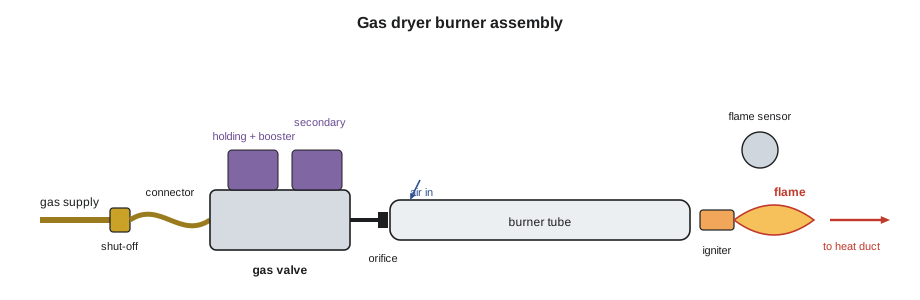
Typical household gas dryers have an input of about 6 kW (20,000 to 22,000 Btu/h), given on the rating plate. That is similar to the 5,400 W of an electric heater, which is why gas and electric dryers dry in similar times. The rating plate also gives the gas type the dryer is set up for and the manifold pressure the maker specifies.
Worked problem
How much gas does a dryer burn?
A gas dryer's rating plate gives an input of 22,000 Btu/h. Convert this to kilowatts, and work out how much natural gas it burns in an hour of heating if the gas supplies about 10.4 kWh per cubic metre (a typical value; the utility's figure varies).
Show solution
- Kilowatts: 22,000 ÷ 3,412 = 6.45 kW.
- Gas per hour of heating: 6.45 ÷ 10.4 = 0.62 m³.
- The burner cycles on and off with the thermostat, so a 50-minute load uses less than this.
Answer: About 6.45 kW, burning about 0.62 m³ of natural gas for each hour the burner is on.
The igniter
Most household gas dryers use a hot surface igniter, commonly called a glow bar: a small bar of silicon carbide, or in some newer designs silicon nitride, that glows bright orange when 120 V passes through it and is hot enough to light the gas. A silicon carbide igniter is fragile; touching its element with fingers can leave oil that causes a hot spot and an early failure, and any knock can crack it. Its resistance cold is typically somewhere in the range of about 50 to 400 Ω, depending on the design; the tech sheet gives the value, and an open igniter reads OL. Older dryers used a spark igniter or a standing pilot, but these are now uncommon.
The flame sensor
The flame sensor on most North American gas dryers is a radiant sensor: a bimetal switch in a round metal case that is normally closed when cold and opens when it is heated by radiant heat from the igniter and then the flame. It has no connection to the flame itself, unlike the flame rod in a furnace that GAS-220 described. Testing it is simple: with the dryer unplugged, it should read continuity at room temperature. If it reads open cold, it has failed and the igniter will never get current. If it stays closed when hot, the gas valve's second coil never opens, as the sequence below shows.
The gas valve and its coils
The gas valve on most household dryers has two valve seats in series, so gas can flow only when both are open, and two removable coils on top that open them. The coils have three electrical jobs between them. A holding coil holds the first valve open once it is open. A booster coil, connected through the flame sensor, gives the extra pull needed to open the first valve. A secondary coil opens the second valve. On the common design, the booster and holding windings share one coil body with three terminals, and the secondary coil is the other body with two terminals.
| Coil | Job | Typical resistance on one common design |
|---|---|---|
| Holding coil | Holds the first valve open once it has opened | About 1,000 to 1,400 Ω |
| Booster coil | Helps the holding coil open the first valve; switched off when the flame sensor opens | A few hundred ohms |
| Secondary coil | Opens the second valve when the flame sensor opens | About 1,000 to 1,400 Ω |
Coils fail with age, especially from the heat of the combustion chamber. A coil that reads open on the meter is clearly failed. A coil that reads within specification cold can still fail when it warms up: it opens the valve at first, but as it heats its winding opens or weakens and the valve closes. This gives the classic symptom of a dryer that heats for a few minutes, stops, and then tries again. Because the coils age together, makers usually sell them as a set, and gas technicians replace both together.
The sequence of operation
When the timer or board calls for heat, and the motor's centrifugal switch, the cycling thermostat and the high limit are all closed, 120 V reaches the burner circuit. On the common design, the cold flame sensor is closed, so current flows through it to the igniter and the booster coil, and also to the holding coil; the first valve opens, but the second valve is still shut because the secondary coil is shorted out by the closed flame sensor. No gas flows yet. The igniter heats up over about 30 to 90 seconds. Its radiant heat warms the flame sensor, which opens. With the sensor open, current now flows through the secondary coil, which opens the second valve, and gas flows to the burner and lights on the glowing igniter. The booster coil has dropped out, the holding coil keeps the first valve open, and the igniter, now in series with the secondary coil, cools down. The flame keeps the sensor open. When the cycling thermostat opens, all the coils lose power, both valves close and the flame goes out. When it closes again, the sequence repeats.
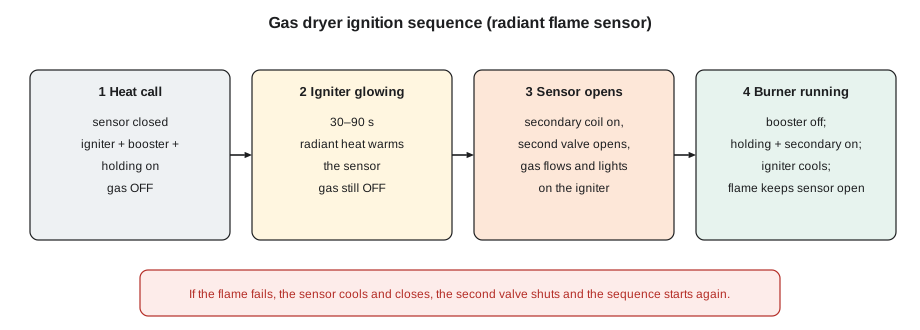
If the flame does not light, or goes out, the sensor cools and closes again, the secondary valve closes, the igniter is powered again and the sequence restarts. That is also why the sequence is a good diagnostic tool: watching the burner through the inspection hole, which most dryers have in the front panel or the burner cover, tells the technician which stage fails.
| What you see | Likely cause |
|---|---|
| Igniter never glows | Open igniter, open flame sensor, or no power to the burner circuit (thermal fuse, high limit, cycling thermostat, motor switch) |
| Igniter glows, goes out, no flame, repeats | Secondary or booster coil failed, or no gas reaching the valve |
| Flame lights, then goes out after minutes, repeats | Coils failing as they warm; sometimes a weak holding coil |
| Igniter glows continuously, no flame | Flame sensor stuck closed, or no gas (supply valve closed) |
| Flame lights, burns, but drying is slow | Airflow restriction or venting; see lesson 9 |
Worked problem
Hiro's case: an igniter that glowed and gave up
On Thursday, October 8, Hiro went to Ludmila Dobrescu's 2014 gas dryer in Rosedale, Hamilton, which ran but gave no heat. Through the inspection hole he watched the igniter glow for about 45 seconds, go dark, and glow again two minutes later, with no flame each time. The supply valve was open and he confirmed gas at the dryer's inlet. With the dryer unplugged and the gas closed, he read the coils: the three-terminal coil read 1,350 Ω on its holding winding and 560 Ω on its booster winding, and the two-terminal secondary coil read OL. What was the fault?
Show solution
- The igniter glowed, so it, the flame sensor and the heat circuit were working.
- The igniter going dark means the flame sensor opened, as it should.
- At that moment the secondary coil should open the second valve; with that coil open, no gas reaches the burner.
- The sensor then cools and closes, and the sequence repeats.
Answer: An open secondary coil. Hiro replaced both coils as a set, as the maker recommends, opened the gas, leak-tested the valve connections with a bubble solution, watched three ignition cycles light normally and checked the vent at the outside hood.
Gas supply, connection and conversion
A gas dryer is connected through an accessible manual shut-off valve and an approved flexible appliance connector, as the installation instructions and the gas code require. Connectors must not be kinked, reused after removal on many makers' instructions, or run through walls. A gas technician leak-tests every joint disturbed during a repair with a bubble solution or an electronic detector, never with a flame. Supply and manifold pressures are checked with a manometer at the test points the maker gives. A typical natural gas manifold pressure for a household dryer is about 0.87 kPa (3.5 in w.c.), and for propane about 2.5 kPa (10 in w.c.), but the rating plate gives the value for each model.
Propane needs a smaller orifice than natural gas and a different pressure setting, so a dryer set up for one gas cannot simply be connected to the other. Converting a dryer means fitting the maker's conversion kit, usually a new orifice and a change to the valve's regulator or a regulator spring, then checking pressure and flame and fixing the conversion label to the dryer. Conversion is gas work and is done only by the gas technician. A dryer running on the wrong gas burns too rich or too lean, producing soot, a yellow lazy flame, delayed ignition or carbon monoxide.
Venting and safety on gas dryers
A gas dryer's exhaust carries combustion products, including water vapour, carbon dioxide and potentially carbon monoxide, as well as lint. It must always be vented to the outdoors through a rigid or approved metal duct, as lesson 9 describes; a gas dryer must never be vented indoors, into a chimney or into a lint box, even though some customers ask for an indoor lint trap on an electric dryer to keep heat in the house. Restricted venting on a gas dryer also reduces combustion air movement and can raise the carbon monoxide in the exhaust.
A working carbon monoxide alarm in the home, which Ontario law requires near sleeping areas in homes with fuel-burning appliances, is worth checking on every gas appliance call.
The burner also needs air to burn. A dryer in a small, closed laundry closet must have the openings or louvred door the installation instructions call for. The combustion chamber must be kept free of lint: lint around the burner can ignite, and many lint fires in gas dryers start in a burner area that has not been cleaned in years. Cleaning the burner area, the cabinet base and the drum seals is part of every gas dryer service.
Common mistakes
MistakeDoing gas work without the required certificate or authorization.
InsteadHand the gas valve, burner, orifice and gas connection to the gas technician.
MistakeReplacing only the coil that reads open.
InsteadReplace the valve coils as a set.
MistakeCondemning coils that read good cold without watching the burner.
InsteadWatch the sequence; coils can fail only when hot.
MistakeTouching a glow-bar igniter's element.
InsteadHandle it by its base; oil and knocks shorten its life.
MistakeLeak-testing with a flame.
InsteadUse a bubble solution or an electronic detector.
MistakeConnecting a natural gas dryer to propane.
InsteadOnly the gas technician converts it, with the maker's kit and a label.
Summary and key terms
- Gas work on a dryer is for a certified or authorized gas technician; appliance technicians handle the rest.
- Gas flows through a shut-off valve, a connector, a two-seat gas valve and an orifice into a tube burner.
- A glow-bar igniter heats to ignition temperature; it is fragile and reads open when failed.
- The radiant flame sensor is closed cold and opens when heated by the igniter and the flame.
- Holding, booster and secondary coils open the valve seats in sequence; they fail with heat and are replaced as a set.
- Watching the burner through the inspection hole tells you which stage of the sequence fails.
- Conversion between natural gas and propane needs the maker's kit and a gas technician.
- Gas dryers must always vent outdoors; keep the burner area free of lint and check for a CO alarm.
- Glow-bar igniter
- A silicon carbide or silicon nitride hot surface igniter that glows to light the gas.
- Radiant flame sensor
- A bimetal switch, closed when cold, that opens when heated by the igniter and flame.
- Holding coil
- The gas valve coil that holds the first valve seat open.
- Booster coil
- The gas valve coil that helps open the first valve seat, switched off by the flame sensor.
- Secondary coil
- The gas valve coil that opens the second valve seat.
- Orifice
- The fixed opening that meters gas into the burner, sized for the type of gas.
- Conversion kit
- The maker's parts for changing an appliance between natural gas and propane.
- Manifold pressure
- The gas pressure at the burner side of the valve, set by the valve regulator.
Practice problems
Work each problem on paper first, then reveal the answer to check.
An igniter glows, goes out and glows again with no flame. Which parts are likely at fault?
Show answer
The secondary or booster coil, or no gas at the valve.
How should a radiant flame sensor read at room temperature?
Show answer
Closed, with continuity.
A dryer heats for a few minutes, stops and then relights repeatedly. What is the usual cause?
Show answer
Valve coils that fail as they warm up.
Why must a gas dryer never be vented indoors?
Show answer
Its exhaust carries combustion products, including possible carbon monoxide.
Who converts a dryer from natural gas to propane?
Show answer
The certified or authorized gas technician, using the maker's kit.
Lesson quiz · 5 questions
Score 60% or more to complete this lesson.
Create a free account to save your progress, take quizzes and earn a certificate.