
APP-220 · Lesson 2 of 12 · 23 min
Top-load washers and their drives
▶ Video coming soon A video version of this lesson is on the way.
After the break on October 28, Harriet tipped the 2009 top-load washer onto its back on a moving blanket and took off the front panel and the base cover. "This is a belt-drive machine with a transmission," she said. "Thirty years ago almost every top-loader looked like this underneath. Then came direct drive, and now the HE machines with a motor bolted to the bottom of the tub and a shift actuator. You will see all three for years yet, because people keep top-loaders a long time." She handed Kiran a flashlight and the tech sheet she had found tucked behind the console.
This lesson covers top-load washers: how the basket, tub and agitator or impeller fit together, how the three common drive arrangements turn one motor into both a slow back-and-forth wash and a fast one-way spin, what a lid lock does and why it is required, and how to diagnose the commonest top-load complaints. Lesson 5 covers the motors themselves in more detail, and lesson 6 the controls.
The parts of a top-load washer
A top-load washer has two containers, one inside the other. The outer tub is fixed to the cabinet through a suspension and holds the water. The inner basket, perforated with small holes, holds the clothes and turns inside the tub. In the centre of the basket is either a tall agitator or a low impeller, driven separately from the basket. Under the tub sits the drive: a motor and either a belt and transmission, a direct-drive gearcase or a gearcase with a shift actuator. A pump drains the tub. The suspension, usually four springs or rods with dampers hanging from the corners of the cabinet on older and HE machines, lets the tub swing so that the vibration of an uneven spin is absorbed instead of shaking the floor.
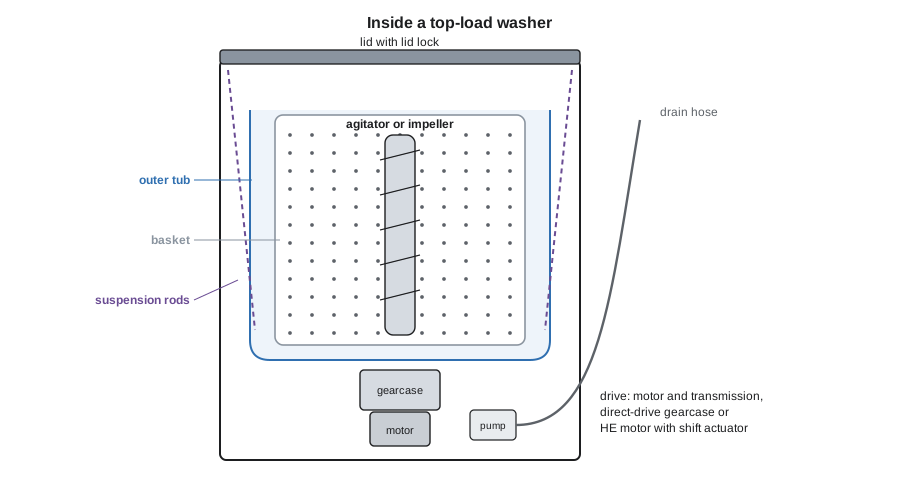
The tub must hold water, so where the drive shaft passes through its bottom there is a seal, and around it a bearing for the basket. A leaking tub seal shows as water dripping from under the tub; a failed basket bearing shows as a rumble during spin and, often, rust stains on the floor under the machine. On many top-loaders the tub seal and bearing are part of a hub or gearcase assembly that is replaced as a unit.
Belt drive with a transmission
The oldest common arrangement uses a single-speed or two-speed motor and a belt to a transmission under the tub. The transmission is a gearbox that turns the motor's one-way rotation into the back-and-forth twist of the agitator. A clutch or brake controls the basket. In the wash, the motor turns one way, the transmission oscillates the agitator, and a brake holds the basket still. In the spin, the motor turns the other way, the brake releases and the transmission turns the basket and agitator together. On some designs a solenoid or the direction of the motor selects wash or spin.
Belt drives have a few predictable faults: a worn or loose belt that slips, squeals and gives a slow spin; a worn brake or clutch, which gives a slow spin or a basket that turns during agitation; and a worn transmission, which leaks oil or makes a grinding noise. The belt tension and the condition of the pulleys are the first things to check on a slow spin.
Worked problem
Spin speed from the pulleys
A belt-drive top-loader has a motor that runs at 1,725 rpm, a 100 mm motor pulley and a 270 mm transmission pulley, and the transmission turns the basket at the same speed as its pulley in spin. What is the basket speed, and what would it be if the belt slipped 5 in 100?
Show solution
- Pulley ratio: 100 ÷ 270 = 0.370.
- Basket speed: 1,725 × 0.370 = 639 rpm.
- With 5 in 100 slip: 639 × 0.95 = 607 rpm.
Answer: About 640 rpm with a good belt and about 607 rpm with 5 in 100 slip. Because the spin force goes with the square of speed, that slip costs about 10 in 100 of the force, and the clothes come out wetter.
Direct drive
Many top-loaders built from the 1980s to the 2010s use a direct drive. The motor is mounted directly under the gearcase and drives it through a small rubber or plastic coupling, sometimes called a motor coupler. There is no belt. The motor reverses to switch between agitation and spin, and the gearcase uses internal clutches to agitate in one direction and spin in the other. Direct-drive machines are simple and reliable; their most common fault by far is a broken motor coupling, which lets the motor run with nothing turning. The customer hears the motor hum or run and reports that the washer fills and drains but does not agitate or spin. The coupling is designed to fail before the motor or gearcase is damaged by an overload, such as an overloaded basket or a jammed agitator.
Other direct-drive faults include worn agitator dogs, the small ratchet pieces that let the upper part of a two-piece agitator turn one way; a worn clutch that gives a slow spin; and a lid switch fault that stops the spin. Lid switches are covered below.
HE top-loaders: impellers, motors under the tub and shift actuators
Most current top-loaders are HE machines with an impeller or a low agitator, and their drive is quite different. A motor, often a brushless DC or a variable-speed induction motor, is mounted under the tub and drives the gearcase either directly or through a short belt. The control board can run it at many speeds and in either direction, so it can rock the load gently, roll it vigorously or spin it fast. To switch between wash and spin, the board uses a shift actuator: a small motor or solenoid that moves a shifter in the gearcase so that the motor drives either the impeller alone or the impeller and basket together. A position switch in the actuator tells the board which mode the gearcase is in.
When an HE top-loader will not agitate, will not spin or stops with a shift error code, the shift actuator is a frequent cause. It may have failed electrically, the shifter may be stuck, or the position switch may report the wrong state. The tech sheet's service mode usually lets the technician command a shift and read whether the board saw it complete. The motor itself and its control board, on brushless machines, are covered in lesson 5 and in APP-320.
| Drive | How wash and spin are selected | Commonest faults |
|---|---|---|
| Belt drive with transmission | Motor direction and a brake or clutch | Belt slip, worn brake, transmission leak or noise |
| Direct drive | Motor direction; clutches in the gearcase | Broken motor coupling, worn agitator dogs, worn clutch |
| HE with motor under tub | Shift actuator moves the gearcase between modes | Shift actuator faults, hall sensor or board faults, bearing noise |
The lid lock and lid switch
A top-load washer's basket spins fast enough to injure a hand or arm that reaches in, so the lid must stop the spin. Older top-loaders used a lid switch: an electrical switch that the lid closed, which allowed the spin only while the lid was shut and stopped the motor when it was lifted, with a brake to bring the basket to a stop quickly. Current washer safety standards require that the user cannot reach a basket spinning at speed, and current top-loaders meet that requirement with a lid lock, so the lid cannot be opened at all until the basket has slowed. The lid lock is a solenoid or wax motor that drives a bolt into a catch on the lid, with a switch that tells the board the lid is locked. The washer will not spin until it has seen the lid lock confirm.
Lid lock faults are among the commonest top-load complaints. A broken plastic strike on the lid, a lock that does not engage, a switch that does not report locked or a damaged wire through the hinge all give the same symptom: the washer fills, agitates and drains, then stops before spinning, often with a lid code. A customer may also report a lid that stays locked after the cycle. Test the lock as the tech sheet describes: check for the lock voltage when the board commands it, and check that the switch changes state when the lock engages.
Never bypass a lid lock or lid switch, even briefly to test the spin. Bypassing it removes the one protection against someone reaching into a spinning basket. The CSA and UL washer safety standards require this protection for good reason, and a technician who leaves a washer with its lock bypassed has created a hazard for the household and a liability for the company.
Worked problem
A lid lock that will not lock
On Thursday, September 24, Dee had a call from Petronella Vesey: her 2019 HE top-loader filled and washed, then stopped with water drained and the clothes soaking, showing a lid code. In service mode Dee commanded the lid lock. She measured 120 V AC across the lock solenoid terminals for the two seconds the board energized it, heard no click, and with the washer unplugged read the solenoid at OL. The tech sheet said about 70 to 100 Ω. What was wrong?
Show solution
- The board sent the lock its voltage, so the board and wiring to the lock were working.
- The solenoid did not click and read open, against a specified 70 to 100 Ω.
- An open solenoid cannot move the bolt, so the lock never engaged and the switch never reported locked.
- Without that report, the board would not allow the spin.
Answer: The lid lock solenoid had failed open. Dee replaced the lid lock assembly, ran a drain and spin to confirm the lock engaged and the spin reached full speed, and showed Ms. Vesey that the lid now locked during the spin.
Suspension and the out-of-balance load
A top-load tub hangs from the cabinet corners on four suspension rods with springs and damping cups on many current machines, or sits on a spring-and-snubber base on older ones. The suspension lets the tub move so that an uneven load does not slam the cabinet. When suspension rods wear, the tub drops, bangs against the cabinet during spin and walks the washer across the floor. A tub that sits visibly lower on one corner, or that bounces several times when pushed down, has worn suspension. The rods are usually replaced as a set of four.
An HE top-loader is more sensitive to load balance than an old agitator machine, because its basket spins faster and the load is not floating in deep water. The control checks the balance before spinning, as lesson 6 describes, and may stop, add water to redistribute the load or reduce the spin speed. A customer who washes single bulky items, such as a comforter, may get repeated out-of-balance codes; the use and care guide usually names a bulky cycle for those items.
Diagnosing common top-load complaints
Most top-load drive complaints come down to three symptoms. "It will not agitate": check whether the motor runs. If it runs with nothing turning, suspect the motor coupling on a direct drive, the belt on a belt drive, or the shift actuator on an HE machine. If the motor does not run, check the lid, the motor and its control. "It will not spin": check whether the lid locks and the board reports it locked, whether the tub has drained, because most washers will not spin with water above a certain level, and whether the load is balanced. Then check the drive. "It makes a noise": a rumble that rises with spin speed points to a bearing; a grinding during agitation points to the transmission or gearcase; a bang during spin points to an unbalanced load or worn suspension; a squeal points to a belt.
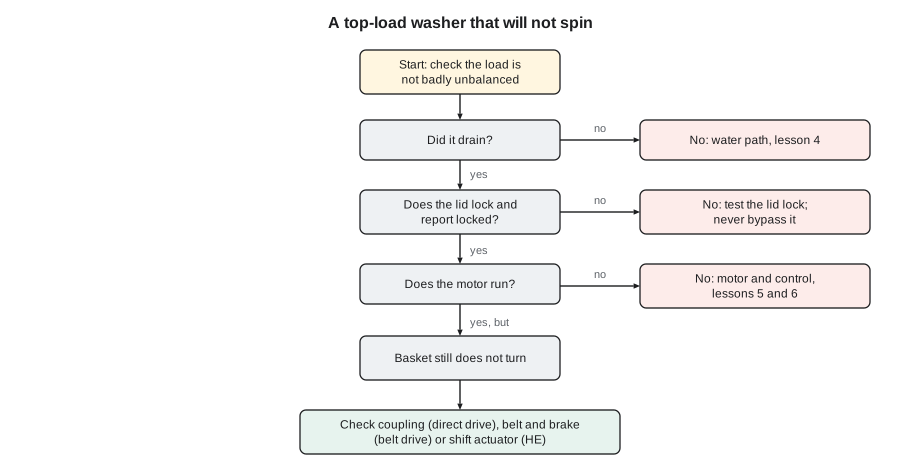
Before taking the washer apart, listen and watch through a cycle, with the lid closed and the board's service mode or test cycle if the tech sheet gives one. A washer that is not spinning because it cannot drain, or because the lid is not locking, gives itself away in the first few minutes of a drain and spin test, and saves an hour of disassembly.
Common mistakes
MistakeBypassing the lid lock to test the spin.
InsteadTest the lock and its switch as the tech sheet describes; never bypass it.
MistakeReplacing the motor when a direct-drive washer hums but nothing turns.
InsteadCheck the motor coupling first; it is designed to break before the motor.
MistakeDiagnosing a no-spin without checking the drain.
InsteadMost washers will not spin with water in the tub.
MistakeReplacing one suspension rod.
InsteadReplace the set so the tub hangs level.
MistakeIgnoring the shift actuator on an HE top-loader that will not agitate or spin.
InsteadUse service mode to command a shift and check its position report.
Summary and key terms
- A top-loader has a fixed outer tub and a perforated inner basket with an agitator or impeller.
- Belt drives use a transmission and brake; slipping belts and worn brakes give slow spins.
- Direct drives reverse the motor; a broken motor coupling is the commonest fault.
- HE top-loaders use a motor under the tub and a shift actuator to select wash or spin.
- Lid locks are required on top-loaders; never bypass one.
- Worn suspension lets the tub bang and the washer walk; replace the rods as a set.
- Sort complaints into no agitation, no spin and noise, and check the drain and lid before the drive.
- Outer tub
- The fixed container in a washer that holds the water.
- Basket
- The perforated inner container in a top-loader that holds the clothes and spins.
- Transmission
- The gearbox in a belt-drive top-loader that turns motor rotation into agitation and spin.
- Motor coupling
- The small coupling between motor and gearcase on a direct-drive top-loader, designed to break under overload.
- Shift actuator
- The device on an HE top-loader that moves the gearcase between wash and spin modes.
- Lid lock
- A device that locks the lid during spin and reports to the control that it is locked.
- Suspension rod
- One of the spring-and-damper rods from which a top-load tub hangs.
- Agitator dogs
- Small ratchet pieces in a two-piece agitator that let the top section turn one way.
Practice problems
Work each problem on paper first, then reveal the answer to check.
A direct-drive washer fills and drains, and the motor runs, but nothing agitates or spins. What is the likeliest fault?
Show answer
A broken motor coupling.
Why must a lid lock never be bypassed?
Show answer
It is the only protection against someone reaching into a spinning basket.
A top-loader bangs during spin and has moved across the floor. What should you check?
Show answer
The load balance and the suspension rods.
A belt-drive washer spins slowly and squeals. What is the first thing to check?
Show answer
The belt tension and condition, and the pulleys.
What tells an HE top-loader's board that the gearcase has shifted to spin?
Show answer
The shift actuator's position switch.
Lesson quiz · 5 questions
Score 60% or more to complete this lesson.
Create a free account to save your progress, take quizzes and earn a certificate.