
APP-220 · Lesson 6 of 12 · 24 min
Washer controls and fault codes
▶ Video coming soon A video version of this lesson is on the way.
Kiran's first look at a washer control board came from one of Dee's case files. She had printed it for him with the tech sheet page clipped to it: a 2019 front-loader that had shown a long-drain code three times in a week, a drain pump that tested perfectly, a clean drain filter, and a fault that turned out to be somewhere else entirely. "The code told me where the board saw the problem," Dee wrote across the top. "It did not tell me what the problem was. Read the whole thing before you read the answer."
This lesson covers how washers are controlled, from cam timers to electronic boards, the sensors a modern control reads, how a washer detects an unbalanced load, how to use service modes and fault codes, and how to decide whether a board has really failed. It finishes with Dee's case. APP-320 covers board electronics, communication between boards and manufacturer diagnostic tools in more depth.
Electromechanical timers
Older washers, and some current basic models, are controlled by an electromechanical timer: a small synchronous motor that turns a shaft carrying a stack of cams, each of which opens and closes a set of contacts as it turns. The cams are shaped so that, as the timer advances, the contacts switch the inlet valves, the motor, the pump and the motor direction in the right order for each part of the cycle. The customer selects a cycle by turning the knob, which sets the starting point on the cams. A timer chart in the tech sheet shows which contacts are closed at each increment of the timer's rotation.
Timers fail by burning their contacts, by wear in the cam stack or by failure of the timer motor. A washer that stops at the same point every cycle, or that skips a stage, often has a worn timer contact. The timer motor can be tested for continuity and is usually around a couple of thousand ohms; if it is open, the timer never advances. Testing timer contacts means unplugging the washer, setting the knob to the increment on the timer chart and reading continuity between the terminals the chart lists.
Electronic controls
Most current washers have an electronic main control board, usually with a separate user interface board behind the console. The main board reads the sensors and switches the loads: relays for the inlet valves, pump, door or lid lock and heater, and either triacs for a universal motor or a data link to an inverter board for a brushless motor. The user interface board handles the buttons, knob, display and sometimes the Wi-Fi module. The two communicate over a cable, and on many washers the main board also talks to the inverter.
A washer's control reads many inputs. The door or lid lock switch tells it the door is safe. The pressure sensor gives the water level. A thermistor gives the water temperature. The tachometer or hall sensors give the drum speed. Some washers have an accelerometer, a vibration sensor that measures how much the tub moves, and some measure the motor's current. From these, the board decides when to fill, how long to wash, whether it is safe to spin and how fast.
| Input | What the board learns |
|---|---|
| Door or lid lock switch | That the door or lid is closed and locked |
| Pressure sensor or switch | The water level in the tub, and signs of foam or leaks |
| Water temperature thermistor | The temperature of the water in the tub or valve |
| Tachometer or hall sensors | The actual speed and position of the drum or motor |
| Motor current or speed ripple | How heavy the load is and whether it is unbalanced |
| Accelerometer (some models) | How much the tub is moving during spin |
| Flow meter (some models) | How much water has entered |
Detecting an unbalanced load
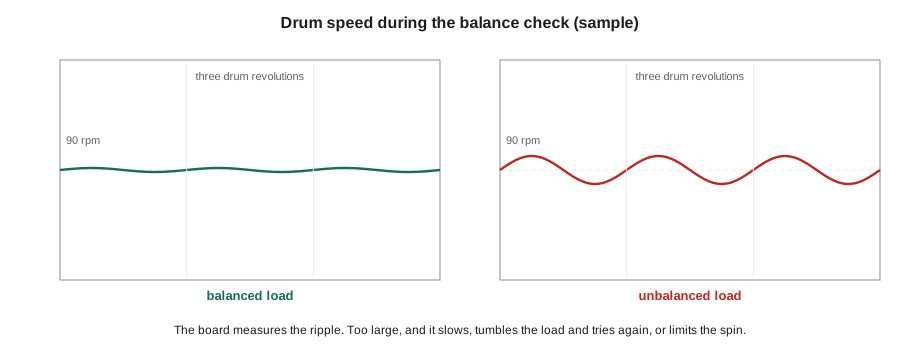
Before a washer spins fast, it checks the balance of the load, because an unbalanced load at full speed puts a huge force on the bearings, suspension and cabinet. The commonest method is to spin the drum at a moderate speed and watch how steadily it turns. An evenly spread load turns at a steady speed; an unbalanced one makes the drum speed up and slow down slightly on each revolution, as the heavy side rises and falls, and the motor's current or speed shows a ripple that the board measures. Washers with an accelerometer also measure the tub's movement directly.
If the board finds an unbalance, it tries to fix it. It slows the drum to let the load fall and redistribute, tumbles it, and tries again. On a top-loader it may add water to float the load. After several tries, it either spins at a reduced speed or stops with an unbalance code, leaving the clothes wetter than normal. That is a protective behaviour, not a fault, and the usual cause is the load: a single heavy item, a few large towels bunched together, or a bulky item on the wrong cycle. Worn suspension, a washer that is not level and a drum bearing with play can also make a normal load look unbalanced.
Worked problem
How large is the force from an unbalanced load?
A bunched wet towel puts 0.5 kg of extra mass on one side of a front-load drum with a 0.25 m radius. What outward force does it make at 1,200 rpm, where the drum wall feels about 403 g?
Show solution
- Force in kilograms of force: 0.5 × 403 = 201.5 kgf.
- In newtons: 201.5 × 9.81 = 1,977 N.
- That is about the weight of three adults, swinging round once every 0.05 s.
Answer: About 2,000 N, or 450 lbf. That is why the washer refuses to spin fast until the load is balanced.
Service modes and fault codes
Almost every electronic washer has a service or diagnostic mode, entered by a button sequence printed on the tech sheet, which is usually tucked inside the console or behind the front panel. In service mode, the technician can read stored fault codes, see the live readings of the sensors, such as water level, water temperature and drum speed, and run each load on command: each inlet coil, the pump, the door lock, the motor at various speeds and the heater. Many service modes also run an automatic test that steps through every load in turn. The service mode is the most useful diagnostic tool on any modern washer.
A fault code tells you where the board saw a problem. A long-drain code means the board commanded a drain and the water level did not fall to empty in the time allowed. That can be a blocked filter, a failed pump, a kinked drain hose, a drain hose set too high, a house drain that is blocked, a pressure sensor that cannot see the level fall, or a board that is not powering the pump. The code narrows the search; measurements find the cause. The same logic applies to fill codes, which can be closed taps, clogged screens, low pressure, a failed valve, a pressure sensor fault or a siphoning drain, and to motor codes, which can be the motor, the tachometer or hall sensor, the inverter, the wiring or a drum that cannot turn.
| Sample code | Meaning (sample Northwind table) | First checks |
|---|---|---|
| F10 | Long fill: level not reached in 8 minutes | Taps, screens, supply pressure, valve voltage and coil, siphoning |
| F21 | Long drain: level not empty in 8 minutes | Drain filter, pump hum and coil, hose kinks, standpipe, pressure hose and air trap |
| F33 | Water temperature sensor out of range | Thermistor resistance against table, connector |
| F45 | Door lock did not confirm | Strike and lock, lock voltage, lock switch |
| F51 | Motor did not reach commanded speed | Drum turns freely, belt, brushes or hall sensor, inverter |
| F60 | Communication lost between boards | Harness and connectors between main, interface and inverter boards |
| SUD | Excess suds detected | Detergent type and dose; not a part failure |
Most boards store a history of recent fault codes, which is valuable on intermittent complaints. A washer that showed a door code twice last week and is working now has still told you where to look. Clear the history after the repair, as the tech sheet describes, so that the next technician does not chase a fault that has been fixed. Some current washers can also report fault codes to the maker through a Wi-Fi app, and some can have their software updated over the air; APP-320 covers connected appliances.
Reading a sensor in service mode
Live sensor readings let the technician compare what the board sees with what is really happening. If the service mode shows water in the tub when the tub is visibly empty, the board is seeing a false level, and the cause is in the pressure hose, the air trap or the sensor. If it shows a water temperature far from what a thermometer reads in the drum, the thermistor or its wiring is suspect. If it shows the drum turning at 40 rpm while the drum is clearly still, the speed sensor is giving a false signal.
Worked problem
A false water level
The Northwind tech sheet gives the pressure sensor output as about 25.6 kHz with the tub empty, falling to about 24.4 kHz at the normal wash level. In service mode, with the tub drained and the drum visibly empty, the board reads 24.9 kHz. What level does the board think the tub is at, and what should be checked?
Show solution
- The full span from empty to wash level is 25.6 − 24.4 = 1.2 kHz.
- The reading has fallen 25.6 − 24.9 = 0.7 kHz from empty.
- Fraction of the wash level: 0.7 ÷ 1.2 = 0.58, so the board thinks the tub is more than half full.
- With the tub empty, the sensor is seeing pressure that is not there: water or sludge in the air trap or hose, or a failed sensor.
Answer: The board believes the tub is about 58 in 100 of the way to wash level. Check the pressure hose and air trap for water or sludge before replacing the sensor.
Dee's case: a long-drain code that was not a drain fault
On Friday, October 2, Dee went to Beatriz Oyarzun's 2019 front-load washer in Westcliffe. It had stopped three times that week with the long-drain code, always with the drum looking empty. In service mode the pump ran with a steady hum and its coil read within specification; the drain filter was clean; the drain hose was straight and the standpipe drained freely. A commanded drain emptied the drum in under a minute. But the level reading in service mode never returned to the empty value: it stopped at 24.9 kHz.
Dee took off the top panel and followed the pressure hose down to the air trap on the side of the tub. The hose was full of grey sludge: detergent residue and lint that had been pushed up into it. Because the sludge blocked the hose, the sensor saw a constant pressure, as if the tub still held water, and the board decided the drain had failed. She removed the hose, flushed it and the air trap with warm water, refitted it with a steady upward run, and the empty reading came back to 25.6 kHz. A full test cycle finished without a code.
The repair took twenty minutes and no parts. The cause behind it was Ms. Oyarzun's detergent dose: she used two pods per load in a softened home, and the excess residue had worked its way into the air trap. Dee explained the dose, showed her the tub-clean cycle and noted on the invoice that the washer had a clean drain path. Without the service mode reading, the obvious repair, a new drain pump, would have cost the customer over 200 dollars and left the fault exactly where it was.
Deciding that a board has failed
Boards do fail, but they are blamed far more often than they deserve. Before replacing a board, confirm that it has its supply voltage, that its low-voltage outputs are present where the tech sheet gives test points, that the sensors it reads are correct at its connector, and that it is not putting out the output it should when commanded in service mode. If all of that points to the board, look for what killed it: a shorted heater, a seized pump, a motor drawing too much current, water dripping from a leaking dispenser onto the board, or a power surge. Replace the cause along with the board, or the new board will fail too.
Handle boards as APP-210 described for refrigerators: unplug the appliance before connecting or disconnecting anything, handle the board by its edges, keep it in its anti-static bag until it is fitted and follow any setup steps that come with the replacement, such as entering a model code. Many replacement washer boards must be configured for the exact model, or they run the wrong cycles, fill to the wrong levels or refuse to run.
Common mistakes
MistakeReplacing the part a fault code names without testing it.
InsteadUse the code to narrow the search and measurements to find the cause.
MistakeTreating an unbalance code as a fault.
InsteadCheck the load, the level and the suspension; the washer is protecting itself.
MistakeIgnoring live sensor readings in service mode.
InsteadCompare what the board sees with what is really happening.
MistakeReplacing a board without finding what damaged it.
InsteadCheck for shorted loads, seized parts and water on the board.
MistakeLeaving old fault codes in the history.
InsteadClear the history after the repair, as the tech sheet describes.
MistakeSkipping the setup on a replacement board.
InsteadConfigure it for the model before running a cycle.
Summary and key terms
- Older washers use cam timers whose contacts switch the loads in sequence; a timer chart shows the contacts.
- Electronic washers have a main board, an interface board and often an inverter board that communicate by cable.
- The board reads lock switches, level, temperature, speed and sometimes vibration and flow.
- Washers detect unbalance from speed or current ripple and redistribute, slow down or stop to protect themselves.
- Service modes show stored codes and live readings and run each load on command.
- A fault code says where the board saw a problem, not what the problem is.
- Confirm a board failure by measurement and find what damaged it before replacing it.
- Cam timer
- An electromechanical control whose motor-driven cams switch contacts through the cycle.
- Timer chart
- The tech sheet chart showing which timer contacts are closed at each step.
- Main control board
- The board that reads a washer's sensors and switches its loads.
- Service mode
- A diagnostic mode for reading codes and live values and running loads on command.
- Fault code
- A code stored or displayed when the board detects a problem.
- Unbalance detection
- The washer's check of how evenly the load is spread before a fast spin.
- Accelerometer
- A sensor that measures movement or vibration of the tub.
- Fault history
- The list of recent codes stored by a board.
Practice problems
Work each problem on paper first, then reveal the answer to check.
What does a long-drain code tell you?
Show answer
The level did not fall to empty in time; the cause could be anywhere in the drain or level-sensing path.
How does a washer usually detect an unbalanced load?
Show answer
From ripple in the drum speed or motor current as it spins at moderate speed.
The service mode shows water in an empty tub. Where do you look?
Show answer
The pressure hose and air trap, then the sensor.
What should you find before replacing a washer board?
Show answer
What damaged it, such as a shorted load, a seized part or water.
Why clear the fault history after a repair?
Show answer
So that later technicians do not chase a fault that has already been fixed.
Lesson quiz · 5 questions
Score 60% or more to complete this lesson.
Create a free account to save your progress, take quizzes and earn a certificate.