
APP-220 · Lesson 12 of 12 · 26 min
Laundry service case studies
▶ Video coming soon A video version of this lesson is on the way.
On Saturday, November 7, Kiran rode with Dee on Penfold's Saturday on-call van. Fenna had booked three laundry calls before she closed the office on Friday, and her notes were short: a washer that "fills and fills," a dryer that "takes three cycles," and a brand-new stacked pair that was "shaking the whole condo." Dee had one instruction for the day. "You run all three. Listen first, look second, measure third, and do not touch a part until you can say why it has failed. I will stop you if you are about to do something unsafe."
As you read each case, notice the order of the work, which is the same order lessons 1 to 11 have used throughout: hear the complaint and ask which stage of the cycle it happens in, look at the installation before the machine, measure before replacing anything, and find the cause behind the symptom. Watch too for the fact that none of the three calls needed a new part inside the appliance. Laundry calls are often like that, and the skill is in knowing it before the panels come off.
Call 1: a washer that fills and fills
The first call, at 8:30, was Garrick Ashdown's 2021 HE top-load washer in Binbrook. Mr. Ashdown said it ran for ages, seemed to keep adding water, sometimes stopped with a fill code, and that the clothes were not getting clean. The washer was in a basement laundry room with a standpipe beside it. Kiran asked when the problem had started. About a month earlier, Mr. Ashdown said, after he had taped the drain hose into the standpipe, because water had splashed out of the pipe during a drain and he did not want it on the floor.
Kiran looked before he measured. The drain hose went about 600 mm down into the standpipe and was wrapped with duct tape where it entered. He started a normal cycle and watched with a flashlight down the standpipe. As the washer filled, water ran steadily out of the end of the drain hose, although the pump was not running. In service mode, the inlet valve was open and the level reading rose only slowly.
Worked problem
How much water was the washer losing?
The washer's inlet valve passes about 8 L/min on this supply. During a 4-minute fill, the board's level reading rose to the equivalent of 14 L in the tub. How much water ran out through the drain while the washer filled?
Show solution
- Water in: 8 × 4 = 32 L.
- Water held in the tub: 14 L.
- Water lost down the drain: 32 − 14 = 18 L, more than half of what came in.
Answer: More than half the fill water was siphoning away. The washer kept filling to make up for it, ran out of fill time on some cycles and washed with diluted detergent.
The tape had sealed the hose into the pipe, and the hose went so deep that its end sat well below the water level in the tub. That made a siphon: once water started down the hose, it kept running out by gravity. Kiran removed the tape, pulled the hose up to the depth the installation instructions gave for that model, about 110 mm into the standpipe, and fastened it with the hose's own clip and a strap so that it could not jump out or slide down. A fill with the hose loose in the pipe held level, and a full cycle finished normally in 58 minutes.
That left Mr. Ashdown's original problem: the splashing. Kiran ran a drain and watched the standpipe. Water rose close to the top before it ran away, so the house drain below was slow. That was a plumbing matter, and Kiran said so: a plumber should clear or check the drain line, and until then the washer would be fine as long as the hose was loose and secured. He also noticed the washer used two detergent pods a load in a home with a softener and explained the dose. Dee nodded. The washer had not had a fault at all.
The invoice was the 95 dollar service call, or 95 × 1.13 = 107.35 dollars with HST. Kiran's notes recorded the siphon, the corrected hose depth and the slow house drain, with a recommendation for a plumber.
Call 2: a dryer that takes three cycles
At 10:30 they reached Mireille Quennell's house in Corktown. Her 2017 electric dryer had been taking two or three cycles to dry a load of towels for about six weeks, and the laundry room got hot. The dryer had been bought used, she said, and the vent had worked before, though she had put a screen over the outside cap in September because a bird had nested in it the spring before.
Kiran asked which cycle she used and how she cleaned the lint filter. She used the sensor cycle and cleaned the filter after every load, and the filter was clean. He ran the dryer on high heat with a load of damp towels from her washer and, with Dee, went outside to the wall cap. Barely any air came out. The screen across the cap's opening was thick with felted lint, and the cap's flap was held almost shut by it. Inside, the semi-rigid transition behind the dryer had been crushed against the wall when the dryer was pushed back.
Back inside, he watched the heat circuit. With a clamp meter on the heater lead, the heater cycled on for about forty seconds and off for about two minutes, over and over: the dryer was overheating its air and cycling on its thermostats. He checked the high-limit thermostat and thermal fuse with the dryer unplugged; both were closed. They had not yet opened for good, but the dryer was running in exactly the conditions that lesson 9 described as the start of a lint fire.
Worked problem
Airflow before and after
Before any work, Kiran measured 3.4 m/s at the 100 mm cap. After removing the screen, cleaning the 4.9 m rigid run with a brush kit, replacing the crushed transition with a listed semi-rigid duct and fitting a new cap with a backdraft damper and no screen, he measured 9.8 m/s. What were the airflows, and how much did they change?
Show solution
- Duct area: 0.00785 m², as in lesson 9.
- Before: 3.4 × 0.00785 = 0.0267 m³/s, or 1.60 m³/min.
- After: 9.8 × 0.00785 = 0.0769 m³/s, or 4.62 m³/min.
- Ratio: 4.62 ÷ 1.60 = 2.9 times as much air.
Answer: The airflow almost tripled, from about 1.6 to 4.6 m³/min, or 58 to 168 cfm. With the vent clear, the heater ran steadily instead of in short bursts, and a load of towels dried on the sensor cycle in 54 minutes.
Kiran explained to Ms. Quennell why a screen cannot be used on a dryer cap, and that the new cap's damper would close by itself when the dryer stopped, which keeps birds out without trapping lint. He recommended having the vent cleaned once a year and showed her how to check the cap's flap while the dryer runs. He also mentioned that the dryer's high limit and fuse had been working hard, and that if the dryer ever stopped heating suddenly, she should call before replacing anything herself, because a blown fuse would mean the vent needed attention again.
The invoice was the 95 dollar service call, 85 dollars for vent cleaning, 25 dollars for the transition duct and 45 dollars for the cap: 250 dollars before tax, or 250 × 1.13 = 282.50 dollars with HST.
Call 3: a new stacked pair shaking the condo
The last call, at 1:15, was Saul Kettridge's condominium in Ancaster. His nephew had installed a new front-load washer and a matching dryer, stacked, in the hall laundry closet on Thursday. On every spin the washer banged so loudly that the downstairs neighbour had knocked on his door, and on Friday the stack had moved almost 5 cm (2 in) out of the closet.
Kiran had a strong suspicion before he took a tool out of the van, and he checked it first. With the water off and both units unplugged, he and Dee pulled the stack carefully out of the closet, one on each side. On the back of the washer, three of the four shipping bolts were still in place, with their plastic spacers; only the fourth had been removed. With the tub held rigid, the washer had no suspension at all, so every bit of out-of-balance force from the spin went straight into the cabinet, the floor and the dryer on top.
He removed the three bolts and their spacers and fitted the hole caps from the installation kit, then turned the drum by hand and pushed down on the tub to check it now moved freely on its springs and dampers. He checked the stacking kit, which was the maker's own and properly fastened, levelled the washer with a spirit level on its top before re-stacking, tightened the foot lock nuts, and checked that the dryer vent and the hoses behind the stack were not crushed when the pair went back into the closet. A spin at 1,200 rpm with a test load of towels ran smoothly, and the stack stayed put.
Worked problem
Why three bolts made such a difference
Lesson 6 worked out that a 0.5 kg unbalance at the drum wall pushes outward with about 2,000 N at 1,200 rpm. With its suspension working, a tub of about 55 kg moves on its springs and dampers and its counterweights soak up much of that force. With the shipping bolts in, where does that force go?
Show solution
- With the tub bolted to the cabinet, the tub cannot move independently.
- The whole out-of-balance force goes into the cabinet once per revolution, 20 times a second at 1,200 rpm.
- The cabinet hammers the floor and the stacked dryer, and the stack walks.
- The bearings, tub and spider also take loads they were never designed for.
Answer: Straight into the cabinet, the floor and the dryer. That is why a washer run with its shipping bolts in can be damaged in a single cycle.
Dee asked Kiran to check one more thing: whether the first spins had damaged the washer. The drum had no play at its rim, the bearings were quiet on a slow spin and there was no water on the floor or rust anywhere, so the machine seemed to have escaped harm. Kiran recorded the bolt problem and his checks in his notes, so that if a fault appeared later under warranty, the record would show what had happened and that the washer was undamaged when he left. He gave the three bolts and spacers to Mr. Kettridge, taped together with a note, in case the washer was ever moved.
The invoice was the 95 dollar service call, or 107.35 dollars with HST. They were back at the shop at 3:30.
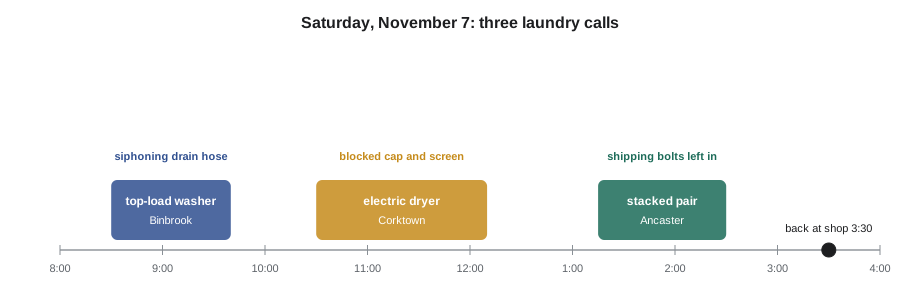
What the day showed
On the drive back, Dee asked Kiran what the three calls had in common. He thought for a minute. "None of them was broken," he said. "The washer was installed wrong, the dryer was vented wrong and the stacked pair was set up wrong. If I had gone straight to the parts, I would have replaced a valve, a heater or a fuse and a set of dampers, and none of it would have helped." Dee agreed, and added the other common thread: each call had a safety side. The siphoning washer was running too long and wasting water, the dryer was on its way to a lint fire, and the stacked pair could have walked the dryer off the washer onto someone.
That is the pattern of laundry service. A great many laundry calls are about installation, use and venting rather than failed parts, and those calls are won by careful looking, a few simple measurements and clear explanations. When a part has failed, the same habits find it quickly: the drain pump that hums against a clogged filter, the lid lock that reads open, the coil that fails when hot, the brush worn past its limit. In each case, the technician asks what the machine was trying to do at the stage it went wrong, checks the installation and the airflow or water path, measures the part, and fixes the cause, not only the symptom.
| Call | Complaint | Cause found | Lesson |
|---|---|---|---|
| 1 | Washer fills and fills | Drain hose sealed deep in the standpipe, siphoning; slow house drain | 4 |
| 2 | Dryer takes three cycles | Screen and lint on the outside cap; crushed transition duct | 9 |
| 3 | New stacked pair shakes | Three shipping bolts left in the washer | 11 |
Dee's last piece of advice came as they pulled into Penfold's lot. "Write down what you found, not just what you did," she said. "Next time someone opens that washer or that vent, your note tells them where to start." Kiran's three sets of notes were filed in the customers' records before he went home.
Common mistakes
MistakeReplacing an inlet valve on a washer that is siphoning.
InsteadWatch the drain during a fill and check the hose depth first.
MistakeTreating a slow house drain as a washer problem.
InsteadWatch the standpipe during a drain and refer a plumber when it backs up.
MistakeReplacing a dryer's thermal fuse or heater on a blocked vent.
InsteadMeasure airflow at the cap and fix the vent.
MistakeLeaving a screen on a dryer cap.
InsteadUse a cap with a backdraft damper and no screen.
MistakeReplacing dampers or bearings on a new washer that shakes.
InsteadCheck for shipping bolts before anything else.
MistakeRecording only the work done.
InsteadRecord what was found as well, so the next technician knows where to start.
Summary and key terms
- Hear the complaint, check the installation, measure, then fix the cause.
- A drain hose sealed deep into a standpipe siphons water out during the fill.
- Water backing up in the standpipe is a house drain problem for a plumber.
- A screened or blocked dryer cap and a crushed transition can cut airflow by two-thirds.
- Restricted dryer airflow makes the heater cycle in short bursts and leads toward a lint fire.
- A front-loader with shipping bolts left in has no suspension and can damage itself in one cycle.
- Many laundry calls need no internal parts; clear explanations and good notes are the repair.
- Siphon
- Flow of water out of a container by gravity through a hose whose outlet is below the water level.
- Standpipe
- The vertical drain pipe that a washer drain hose discharges into.
- Hose clip
- The bracket that holds a washer drain hose at the right height in a standpipe.
- Vent brush kit
- Flexible rods and brushes used to clean lint from a dryer duct.
- Wall cap
- The fitting where a dryer vent ends on an outside wall.
- Shipping bolt spacer
- The plastic sleeve that comes out with each shipping bolt.
- Service record
- The notes kept for a customer showing what was found and done.
- Spirit level
- A level used to check that a washer sits flat before stacking.
Practice problems
Work each problem on paper first, then reveal the answer to check.
How did Kiran confirm the washer was siphoning?
Show answer
He watched water run out of the drain hose during the fill while the pump was off.
Why did the dryer heater cycle in short bursts?
Show answer
The blocked vent overheated the air, so the thermostats kept opening.
Why must shipping bolts be removed before a front-loader is used?
Show answer
They hold the tub rigid, so the suspension cannot absorb the spin forces.
What did all three calls have in common?
Show answer
None was a failed part; each was an installation or venting problem with a safety side.
Why record what was found and not only what was done?
Show answer
So the next technician knows the history and where to start.
Lesson quiz · 5 questions
Score 60% or more to complete this lesson.
Create a free account to save your progress, take quizzes and earn a certificate.