
APP-220 · Lesson 10 of 12 · 23 min
Moisture sensing and cycle control
▶ Video coming soon A video version of this lesson is on the way.
Harriet's last topic on November 11 was how a dryer knows when to stop. She passed Kiran the front bulkhead of the 2015 dryer, turned over so he could see two curved stainless steel strips mounted side by side just below the lint filter opening. "Those two bars are how this dryer decides your clothes are dry," she said. "Wet clothes touch both bars and conduct a little current between them. Dry clothes do not. Most of the complaints that a dryer stops too early or runs forever start with those two strips of metal."
This lesson covers how dryers end their cycles: timed drying, the older thermostat-based automatic dry, electronic moisture sensing with sensor bars, and drying controlled by exhaust temperature. It covers cool-down and wrinkle prevention, how much energy drying really takes and how to diagnose dryers that stop too early or run too long. It finishes with one of Dee's case files.
Timed drying
The simplest dryer control is a timer: the customer chooses a time and the dryer runs, heating on its cycling thermostat, until the time is up, then cools down and stops. Timed drying is predictable but wastes energy, because the dryer keeps heating after the clothes are dry, and it over-dries and shrinks clothes if the time chosen is too long. On an electromechanical timer, the timer motor runs continuously in a timed cycle. A timed-dry fault is usually the timer motor or a timer contact, tested as lesson 6 described for washer timers.
Automatic dry on a mechanical timer
Many older and basic dryers with a mechanical timer have an automatic dry setting that works without any moisture sensor. In that part of the timer, the timer motor is wired so that it runs only while the cycling thermostat is open, that is, while the heater is off. When the clothes are wet, evaporation keeps the exhaust air cool, the cycling thermostat stays closed, the heater runs almost continuously and the timer barely advances. As the clothes dry, the exhaust air warms up, the thermostat opens more often and for longer, and the timer advances during each off period until it reaches the end of the drying section and moves to cool-down.
This clever arrangement means a restricted vent, which makes the thermostat cycle early, makes an automatic cycle end too soon with damp clothes. It also means that a cycling thermostat stuck closed makes an automatic cycle run forever, because the timer never gets an off period to advance in. Both faults show up as cycle-length complaints, not as heat faults.
Electronic moisture sensing
Most current dryers sense moisture directly with sensor bars: two metal strips, or sometimes a set of strips on the drum baffles, that tumbling clothes brush against. The board applies a small, safe voltage across the bars. Wet fabric conducts between them, and the board sees a low resistance; dry fabric does not, and the board sees an open circuit. The board counts how often and how long it sees wet contacts as the load tumbles. As the clothes dry, the wet contacts become fewer and shorter, and when they fall below the threshold for the dryness level the customer chose, the board ends the drying part of the cycle, often after a short extra period to finish damp seams and pockets.
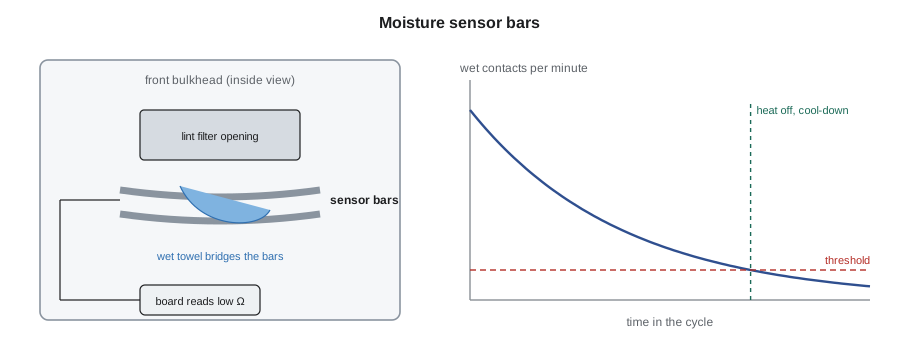
Many dryers combine the sensor bars with an exhaust thermistor, using both the moisture contacts and the exhaust temperature to judge when the load is dry. Some, especially many heat pump and some European-designed dryers, use humidity or temperature sensing alone. The tech sheet says which method a model uses, and the service mode usually displays the moisture sensor's reading, often as a count or a wet or dry indication, as the load tumbles.
Moisture sensing saves energy and is gentler on clothes, but it depends on the clothes touching the bars. A very small load may not touch them often enough, so the dryer thinks it is dry and stops early. Use and care guides often recommend a timed cycle for one or two items. A load of all synthetic fabrics, which hold little water and conduct poorly, can also end early.
When sensor bars fail
Sensor bar faults come in two kinds. Bars coated with an insulating film read dry even when touched by wet fabric. The commonest coating is residue from dryer sheets and liquid fabric softener, along with mineral deposits in hard-water homes. The dryer stops after a short time with damp clothes. The fix is to clean the bars with a cloth and rubbing alcohol or a mild abrasive pad as the maker recommends, and to advise the customer about softener use. Bars that are shorted, by a coin or metal object lodged between them, a pinched sensor wire, or a wire chafed through to the cabinet, read wet all the time, and the dryer runs until its maximum time limit and then stops. Many boards set an error code after a maximum drying time.
Testing the bars is straightforward. With the dryer unplugged, disconnect the sensor harness at the board and measure between its two wires: open, OL, with the drum empty. Then bridge the two bars with a damp cloth: the reading should fall, typically to a value in the tens or hundreds of kilohms, depending on how wet the cloth is. A reading of low resistance with the bars dry and clean means a short in the bars or wiring. Many service modes let the technician watch the moisture reading change while touching the bars with a damp cloth, which tests the whole path, including the board's input.
| Complaint | Likely cause | Check |
|---|---|---|
| Stops early, clothes damp | Coated sensor bars; restricted vent on auto dry; small load | Clean bars; check vent; check load size |
| Runs too long or to maximum time | Shorted sensor bars or wiring; failed exhaust thermistor; weak heat | Resistance of bars dry and clean; thermistor table; heat circuit |
| Over-dries, shrinks clothes | Dryness level set high; timed cycle too long | Settings; explain sensor cycles |
| Auto dry on a timer never ends | Cycling thermostat stuck closed; timer motor open | Thermostat opening; timer motor resistance |
| Auto dry on a timer ends early | Restricted airflow makes the thermostat cycle early | Vent and lint filter |
Worked problem
Dee's case: a dryer that stopped after twenty minutes
On Tuesday, October 13, Dee went to Dashiell Ferrier's 2019 electric dryer in Ainslie Wood. On its sensor cycle it stopped after about 20 minutes with the towels still damp. Timed cycles dried normally, and the vent airflow was good. In service mode the moisture reading showed dry with a soaking towel pressed against the bars. The bars were dull and slightly tacky. After she cleaned them with rubbing alcohol, the same wet towel gave a wet reading and the reading showed dry only when the cloth was removed. What was the fault, and what caused it?
Show solution
- Timed cycles dried normally, so the heat and airflow were good.
- The sensor read dry against a soaking towel, so it could not see the moisture.
- Cleaning the bars restored normal readings, so the bars, wiring and board were good.
- The tacky film was residue from the dryer sheets the household used in every load.
Answer: The sensor bars were coated with fabric softener residue. Dee cleaned them, showed Mr. Ferrier how to clean them every month or two, suggested using fewer dryer sheets or wool dryer balls, and washed the lint filter, which had a softener film too. A sensor cycle then dried a load of towels in 52 minutes.
How much energy drying takes
Drying is an energy-hungry job, because evaporating water takes a great deal of heat: about 2,260 kJ for every kilogram, as lesson 1 noted. A dryer has to supply that heat, plus the heat to warm the clothes, the drum and the air, plus what is lost out of the vent with warm air that is not fully saturated with moisture. A conventional vented dryer typically turns roughly half of its heat into evaporation. That is one reason faster washer spins, clean vents, correct dryness settings and sensor drying all save so much energy.
Worked problem
How efficient is this dryer?
A load leaves the washer weighing 6.2 kg and the same load weighs 4.0 kg when dry. The dryer, a 5,400 W electric model, dries it in 45 minutes with its heater on for about 70 in 100 of that time. What share of the heater's energy went into evaporating the water?
Show solution
- Water removed: 6.2 − 4.0 = 2.2 kg.
- Energy to evaporate it: 2.2 × 2,260 = 4,972 kJ, or 4,972 ÷ 3,600 = 1.38 kWh.
- Heater energy: 5.4 kW × 0.75 h × 0.70 = 2.84 kWh.
- Share used for evaporation: 1.38 ÷ 2.84 = 0.49, or about 49 in 100.
Answer: About half the heater's energy went into evaporating water, which is typical of a conventional vented dryer. The rest warmed the clothes, drum and air and went out of the vent.
Heat pump dryers, which lesson 11 and APP-330 cover, recover much of that lost heat by condensing the moisture and reusing the warm air, and they use far less energy, at the cost of longer drying times. Energy labels on dryers in both countries reflect these differences: ENERGY STAR in Canada and the United States lists qualifying dryers, and Natural Resources Canada and the U.S. Department of Energy set minimum efficiency standards. The U.S. standards for washers and dryers adopted in 2024, with compliance dates in 2028, were postponed in 2025 and are under review, so check the current status before quoting them to a customer.
Cool-down, wrinkle prevention and end of cycle
At the end of drying, the dryer turns off the heat and keeps tumbling with room air for a few minutes. This cool-down lowers the temperature of the clothes so they are safe to handle, reduces wrinkles set by heat, and lowers the temperature inside the drum, which reduces the fire risk from hot lint and from oily items that can heat themselves when piled up warm. Many dryers then offer a wrinkle-prevention option that tumbles the load briefly every few minutes, without heat, for an hour or more if the door is not opened. A dryer that seems to start again by itself after the cycle ends is almost always doing this.
Use and care guides warn against stopping a dryer before the cool-down is complete and leaving a hot load piled in the drum or a basket, especially items that have been stained with oils, because the heat can build up and ignite them. Customers who use the stop button to grab clothes early should be reminded of this.
Steam and special cycles
Some dryers have steam cycles that spray a small amount of water into the drum to relax wrinkles or freshen clothes. They need a water supply, usually from a cold-water tap through a fill hose and a small inlet valve, and they have a nozzle that can clog with hard-water scale. A steam dryer that shows a water supply code may have its tap closed, a kinked hose or a clogged valve screen, tested like a washer inlet valve. Sanitize, bulky, delicate and air-fluff cycles are combinations of temperature, time and sensing; the use and care guide says what each does.
Explaining sensor drying to customers
Customers who move from a timed dryer to a sensor dryer often think the new dryer is faulty, because it stops at different times for different loads, shows a time remaining that changes as it runs, and leaves some items, such as thick jeans waistbands or towel hems, slightly cool and damp when the rest of the load is dry. Those are all normal. The board estimates the time remaining from the moisture readings and updates it as the load dries. Cool, slightly damp seams usually mean the dryness level is set to normal or less dry, and the more dry setting or an extra few minutes on a timed cycle finishes them.
Mixed loads dry unevenly because light synthetics dry long before heavy cottons. Drying heavy and light items separately gives better results and saves energy. When explaining this, Penfold technicians show the customer the dryness level control and the cycle chart in the use and care guide, so the customer can see that the dryer is doing what it was designed to do.
Common mistakes
MistakeReplacing a board when a sensor cycle ends early.
InsteadCheck and clean the sensor bars and check the vent first.
MistakeTesting sensor bars with the harness still connected.
InsteadDisconnect at the board and read the bars dry, then with a damp cloth.
MistakeTreating a small load that ends early as a fault.
InsteadExplain that one or two items should be dried on a timed cycle.
MistakeIgnoring the vent on an auto-dry timer complaint.
InsteadRestricted airflow makes the thermostat cycle early and the timer advance early.
MistakeCalling a dryer that tumbles after the cycle faulty.
InsteadCheck whether a wrinkle-prevention option is on.
MistakeTelling customers it is fine to stop the dryer before cool-down.
InsteadExplain the heat build-up risk in a hot, piled load.
Summary and key terms
- Timed drying is simple but over-dries; automatic dry on a timer advances only while the heater is off.
- Sensor bars detect wet fabric by conduction; the board ends drying when wet contacts fall below a threshold.
- Coated bars read dry and end cycles early; shorted bars read wet and run to maximum time.
- Test bars disconnected, dry and with a damp cloth, or watch the reading in service mode.
- A vented dryer turns only about half its heat into evaporation; clean vents and good spins save energy.
- Efficiency standards and ENERGY STAR labels cover dryers; check current U.S. standards before quoting them.
- Cool-down reduces wrinkles and the fire risk of hot piled loads; wrinkle-prevention tumbling is normal.
- Timed dry
- A cycle that runs for a set time regardless of how dry the load is.
- Automatic dry (timer)
- A timer cycle whose motor advances only while the heater is off.
- Sensor bars
- Metal strips in the drum that detect wet fabric by electrical conduction.
- Dryness level
- The customer's setting that sets how dry the sensor must report the load before stopping.
- Exhaust thermistor
- A temperature sensor in the exhaust air used to control heat and judge dryness.
- Cool-down
- The final part of a cycle when the drum tumbles without heat.
- Wrinkle prevention
- An option that tumbles the load briefly without heat after the cycle ends.
- Heat pump dryer
- A ventless dryer that heats and dehumidifies its air with a refrigeration system.
Practice problems
Work each problem on paper first, then reveal the answer to check.
How does an automatic dry setting work on a mechanical timer?
Show answer
The timer motor runs only while the cycling thermostat is open and the heater off.
A sensor cycle stops after 20 minutes with damp clothes, but timed cycles are fine. What do you check first?
Show answer
The sensor bars for softener or mineral coating.
What do shorted sensor bars do to the cycle?
Show answer
They read wet all the time, so the dryer runs to its maximum time.
Why does a vented dryer use so much energy?
Show answer
Evaporation takes a lot of heat, and about half the heat leaves without doing that work.
Why should a dryer be allowed to finish its cool-down?
Show answer
To reduce wrinkles and the heat build-up that can ignite a hot, piled load.
Lesson quiz · 5 questions
Score 60% or more to complete this lesson.
Create a free account to save your progress, take quizzes and earn a certificate.