
APP-220 · Lesson 1 of 12 · 30 min
How washing machines clean
▶ Video coming soon A video version of this lesson is on the way.
On Wednesday evening, October 28, Harriet Penfold opened the shop's back bay for the first of three laundry nights. Two machines stood on the floor, both collected that week from customers who had bought new ones: a 2009 top-load washer with a tall agitator and a 2017 front-load washer with a cracked door boot. Quarrington Metal Recovery would take them on Monday, so for one week they were Penfold's to take apart. Harriet had been a technician for twenty years before she took over the company from her father, and she still liked to teach the laundry part of the trade herself. "Most laundry calls are not about a broken part," she told Kiran. "They are about clothes that came out dirty, wet, wrinkled, smelly or torn. If you do not know how a washer is supposed to clean, you cannot tell a fault from a habit."
This lesson explains what actually removes soil from fabric and how a washing machine supplies it. It sets out the four factors every wash depends on, explains how water hardness, detergent and load size change the result, compares top-load and front-load washing in general terms and walks through a complete wash cycle. The rest of the course takes the machine apart: lesson 2 covers top-load drives, lesson 3 front-load tubs and suspensions, lesson 4 the water path, lesson 5 motors and lesson 6 controls. Lessons 7 to 11 cover dryers, and lesson 12 follows a day of laundry calls.
The four factors of washing
Every way of washing clothes, from a river stone to a connected front-load washer, depends on the same four things: time, temperature, chemistry and mechanical action. Textile chemists often draw them as four slices of a circle that always adds up to a whole wash. If one slice shrinks, another has to grow to get the same result. A cold wash needs more time, more mechanical action or a detergent made for cold water. A short cycle needs more chemistry or more agitation. A gentle cycle for delicates, with very little mechanical action, makes up for it with time and a soak. Understanding this trade-off answers a large share of the cleaning complaints a technician hears.
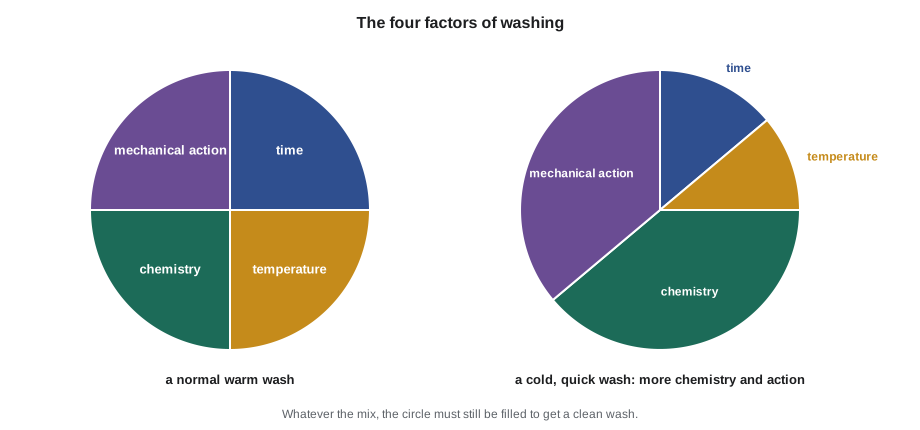
Time is how long the water and detergent are in contact with the soil. Many soils need minutes to loosen: protein stains swell and lift slowly, and oily soils need time for the detergent to work its way into them. A soak before the main wash, or a longer main wash, gives the chemistry time to act. Modern washers often lengthen their cycles to save water and energy, which surprises customers who remember shorter cycles on older machines. A 75-minute normal cycle on a new high-efficiency washer is not a fault.
Temperature speeds up chemical reactions, softens greasy soils and helps enzymes and detergent work. Warm water dissolves powdered detergent more easily, and hot water helps with heavily soiled work clothes, towels and bedding. But hot water also sets some stains, especially protein stains such as blood, fades some dyes and shrinks some fabrics. Most current detergents are designed to work in cool water, and heating water is the largest energy use of a wash, so modern machines default to cold or warm. Many front-load washers have an internal heater that raises the water in the tub to the selected temperature instead of relying on the household water heater.
Chemistry is the detergent and anything added with it: bleach, oxygen boosters, fabric softener and water conditioners. Detergent does several jobs at once. Its surfactants lower the surface tension of the water so that it wets fabric quickly, surround oily soil so it can be lifted away and keep loosened soil suspended so it does not settle back on the clothes. Enzymes break down particular soils, such as proteins, starches and fats. Builders soften the water so the surfactants can work. Optical brighteners make white fabric look whiter. Too little detergent leaves soil behind; too much, especially in a high-efficiency washer, leaves residue in the clothes and the machine and makes so much foam that the washer cannot tumble or spin properly.
Mechanical action is the physical work that flexes the fabric and forces water and detergent through it. In a top-load washer with an agitator, a post in the centre twists back and forth and drives the clothes around and down. In a top-load washer with an impeller, a low plate in the bottom of the basket pushes the clothes against each other in a rolling motion. In a front-load washer, the drum lifts the clothes on its baffles and drops them into the water at the bottom: a tumbling action. All three work. They differ in how gently they treat the fabric, how much water they need and how much space they leave for the load.
| Factor | What it does | Example of making up for less of it |
|---|---|---|
| Time | Gives detergent and water time to loosen soil | A soak or longer cycle on a cold wash |
| Temperature | Speeds up chemistry, softens grease | An enzyme detergent made for cold water |
| Chemistry | Wets fabric, lifts and suspends soil, softens water | More agitation or a warmer wash for heavy soil |
| Mechanical action | Flexes fabric and drives water through it | A longer soak on a delicates cycle |
Water hardness
Hard water contains dissolved calcium and magnesium. These minerals react with the surfactants in detergent and take them out of action, so in hard water more detergent is needed for the same result. They also form scale on heater elements and leave a grey or stiff feel in towels. Southern Ontario has moderately hard to hard water from limestone aquifers and the Great Lakes, so many customers in Penfold's area have water softeners, and a softened home needs noticeably less detergent than an unsoftened one. Detergent dosing charts on the package usually give amounts for soft, medium and hard water. A customer who complains of grey, stiff laundry in a hard-water home may simply be under-dosing. A customer with a softener who uses the hard-water dose will get too much foam.
Hardness is often given in grains per gallon in the United States and in milligrams per litre on water reports. One grain per gallon is about 17.1 mg/L. Water above about 120 mg/L, or 7 grains per gallon, is generally called hard; above about 180 mg/L, or 10.5 grains per gallon, very hard. Municipal water reports for a customer's town give the figure, and test strips give a quick reading at the tap.
Worked problem
Converting a hardness reading
A customer's water report lists hardness as 136 mg/L as calcium carbonate. Her detergent's package gives doses for soft water (under 3 grains per gallon), medium water (3 to 9) and hard water (over 9). Which dose should she use?
Show solution
- Convert: 136 ÷ 17.1 = 7.95 grains per gallon.
- That is between 3 and 9, so it is medium water on this package.
- She should use the medium dose, not the hard-water dose she has been using.
Answer: About 8 grains per gallon: medium hardness, so the medium dose. Too much detergent, not too little, is the likelier problem in her case.
High-efficiency washers and detergent
Most washers sold in Canada and the United States today are high-efficiency, or HE, machines. That includes all front-load washers and most top-load washers with an impeller or a low-profile agitator. An HE washer uses much less water than an older top-loader: it senses the load and adds only enough water to wet and move the clothes, then relies on longer tumbling or rolling to do the work. Because there is less water, the detergent is more concentrated in it, and ordinary detergent makes too much foam. HE detergents are formulated for low suds. The HE symbol on the bottle means the detergent is made for these machines.
Too much foam is one of the commonest causes of laundry complaints on HE washers. Foam cushions the clothes so they do not tumble properly, it holds soil that redeposits on the load, and in a front-load washer it can make the drum slow down or stop during spin, because the motor works against the foam. Many washers sense excess suds, either from the motor load or from the pressure sensor, and add extra rinses or pause the spin, which makes the cycle longer. Some display a suds code. The fix is to use less detergent, an HE detergent, and to run a cleaning cycle to clear residue. A technician who replaces a pump or a motor on a washer that was simply full of foam has not fixed anything.
Single-dose pods and pre-measured packs are popular because they remove the guesswork of measuring, but they contain a fixed amount sized for a large load in medium or hard water. In a softened home or with small loads, one pod can still be too much. Fabric softener adds its own residue, which builds up on the dispenser, the tub and, in a dryer, on the moisture sensor bars, as lesson 10 explains.
Load size and loading
A washer can only clean clothes that can move. An overloaded washer leaves clothes packed so tightly that water and detergent cannot circulate and the mechanical action cannot reach them. A top-load washer that is jammed full often leaves the clothes at the top barely wet. A front-load washer filled to the door glass cannot lift and drop the load, so the clothes just rotate with the drum. Manufacturers usually say a front-load drum should be filled loosely, with room for a hand above the load, and a top-load basket should not be packed above the top of the agitator or the fill line.
Underloading causes problems too. A single heavy item, such as a bath mat or a pair of jeans, cannot be balanced in the drum, and the washer may refuse to spin at full speed or may spin with a lot of vibration. Lesson 6 explains how washers detect an unbalanced load. Mixing a few heavy towels with light items gives the drum something to spread out. Large waterproof items, such as mattress covers, rain jackets and some pet beds, can trap water or air and throw a load badly off balance; many manuals warn against spinning them at all.
Capacity is given in cubic feet in North America on both sides of the border, and sometimes in litres or in kilograms of dry clothes in European-made machines. A typical full-size front-load washer is about 4.5 to 5 cubic feet, or 127 to 142 L. Kilogram ratings are maximum dry loads for a cotton cycle, not loads to aim for every time.
Top-load and front-load washing compared
A traditional top-load washer with a tall agitator fills the basket with enough water to float the clothes, then twists the agitator back and forth, then drains and spins. It uses the most water but has a short cycle and is forgiving of overloading and ordinary detergent. An HE top-load washer with an impeller or a low agitator uses less water, senses the load, wets the clothes with a spray or a shallow fill and moves them in a rolling pattern. It treats clothes more gently and holds more, but it is more sensitive to overloading and suds, and it can leave clothes tangled. A front-load washer tumbles the load through a small pool of water in the bottom of the drum. It uses the least water, is gentlest on clothes and spins fastest, so it leaves the clothes driest. Its cycles are longer and it needs care to prevent odour, which lesson 3 covers.
| Type | Water use (typical) | Action | Highest spin speed (typical) | Common complaints |
|---|---|---|---|---|
| Top-load, agitator (traditional) | Most | Agitator twists the load | About 600–800 rpm | Worn clothes, high water use |
| Top-load HE, impeller | Low | Impeller rolls the load | About 700–850 rpm | Tangling, top of load dry, suds |
| Front-load HE | Least | Drum lifts and drops the load | About 1,000–1,400 rpm | Odour, door boot mould, long cycles |
Spin speed and moisture left in the load
The final spin throws water out of the clothes by centrifugal force. The faster the spin, the less water is left in the load, and every kilogram of water left in the clothes is water the dryer has to evaporate, which takes much more energy than spinning it out. That is why front-load washers, with their high spin speeds, save dryer energy as well as water. The force on the load depends on the square of the spin speed and on the drum radius. Technicians often describe it as a number of g, the multiple of the force of gravity the clothes feel.
Worked problem
How hard does a front-load drum spin?
A front-load drum has an inside diameter of 500 mm. How many g does a load against the drum wall feel at a final spin of 1,200 rpm?
Show solution
- Radius: r = 500 ÷ 2 = 250 mm = 0.25 m.
- Angular speed at 1,200 rpm: ω = 1,200 × 2π ÷ 60 = 125.7 rad/s.
- Acceleration: a = ω² × r = 125.7² × 0.25 = 15,800 × 0.25 = 3,950 m/s².
- In multiples of gravity: 3,950 ÷ 9.81 = about 403 g.
Answer: About 400 g at 1,200 rpm. At 600 rpm the force is a quarter as large, about 100 g, because it depends on the square of the speed.
That force is why an unbalanced load or a worn bearing matters so much at high speed. A wet towel of 1 kg (2.2 lb) bunched on one side of the drum pushes outward with about 400 times its weight. Washers therefore check the balance before spinning fast and limit the speed if the load is uneven. It is also why the shipping bolts that hold the tub still in transit must be removed before a front-load washer is first used, a point lesson 11 returns to.
Worked problem
Water left in the load
A 4 kg (8.8 lb) dry cotton load leaves a washer that spins at 800 rpm holding about 2.2 kg (4.9 lb) of water. The same load spun at 1,200 rpm holds about 1.8 kg (4.0 lb). The latent heat needed to evaporate water is about 2,260 kJ per kilogram. How much less energy does the dryer need, at the very least?
Show solution
- Water removed by the faster spin: 2.2 − 1.8 = 0.4 kg.
- Energy to evaporate it: 0.4 × 2,260 = 904 kJ.
- In kilowatt-hours: 904 ÷ 3,600 = 0.25 kWh.
- A real dryer is far from perfect, so the saving at the meter is larger, often around twice this figure.
Answer: At least about a quarter of a kilowatt-hour per load, and in practice more. The fastest spin the fabric allows saves dryer energy on every load.
A complete wash cycle
Whatever the machine, a normal cycle goes through the same stages. The washer first senses the load, on most HE machines by turning the drum or basket and measuring how hard the motor works or how quickly the drum coasts. It fills, either to a level set by a pressure sensor or by a volume measured by a flow meter, and dispenses the detergent from the drawer or cup by routing the incoming water through it. The wash stage moves the load for a set time, heating the water if the machine has a heater. The washer drains, spins to remove the dirty water, then fills again for one or more rinses, dispensing fabric softener in the last one. Each rinse ends with a drain and a spin, and the cycle ends with a final high-speed spin. Lessons 4 to 6 cover the parts that do each of these jobs.
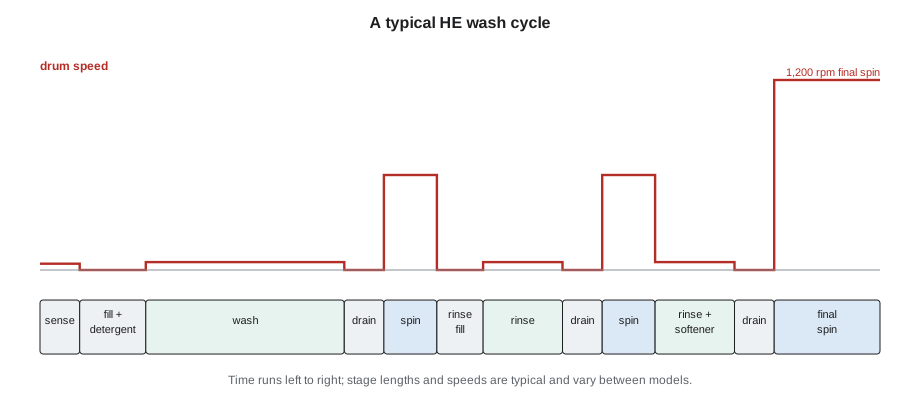
Knowing the stages makes a customer's description useful. "It stops with water in it" points to a drain problem or a lid lock problem. "The clothes come out soaking" points to a spin that did not happen, which may be an unbalanced load, too much foam, a drain problem or a drive problem. "It takes forever" may be normal for the cycle chosen, or the washer adding rinses because of suds, or the washer trying again and again to balance a load. Asking which stage the problem happens in narrows the search before any panel comes off.
Cleaning complaints that are not faults
Harriet ended the first half of the evening with a list she had kept for years: the complaints that bring a technician out and that no part will fix. Grey or dingy whites usually mean too little detergent for the water hardness or for heavily soiled loads, or washing everything in cold water. Residue or white streaks on dark clothes mean too much detergent, undissolved powder or overloading. Lint on clothes means mixed loads of towels and synthetics, tissue left in a pocket or an overloaded drum. Stains that come out after drying were often set by heat in the dryer before they were removed in the wash. Musty smells are covered in lesson 3. In each case, the technician's job is to check the machine is working properly and then explain, politely and without blame, what will help.
That last part matters for the business as well as for the customer. Penfold charges a service call for a visit that finds no fault, and a customer who is told only "nothing is wrong" is not happy to pay it. A customer who is shown the detergent dose for their water hardness, the fill line in the basket and the cleaning cycle on the control panel usually is, and often becomes a regular customer.
Common mistakes
MistakeReplacing parts on a washer that was simply full of foam.
InsteadCheck for excess suds and the detergent used before suspecting the pump or motor.
MistakeTelling a customer a long HE cycle is a fault.
InsteadCheck the cycle time in the use and care guide; long cycles are normal on HE washers.
MistakeIgnoring water hardness when a customer complains of grey laundry.
InsteadFind the hardness and match the detergent dose to it.
MistakeTreating overloading as a machine problem.
InsteadShow the customer how full the drum or basket should be.
MistakeRecommending hot water for every stain.
InsteadHot water can set protein stains; follow the care label and stain advice.
MistakeSaying only that nothing is wrong.
InsteadExplain what will improve the result, so the visit is useful.
Summary and key terms
- Washing depends on time, temperature, chemistry and mechanical action; less of one needs more of another.
- Detergent wets the fabric, lifts and suspends soil, and softens water; too much is as bad as too little in an HE washer.
- Hard water uses up detergent; match the dose to the water hardness.
- HE washers use little water and need low-suds HE detergent; excess foam stops tumbling and spin.
- Clothes must be able to move; overloading and single heavy items both cause poor results.
- Spin force rises with the square of the speed; faster spins leave less water for the dryer.
- A cycle senses, fills, dispenses, washes, drains, spins and rinses; ask which stage a problem occurs in.
- Many cleaning complaints are about use, not faults; explain clearly and politely.
- High-efficiency (HE) washer
- A washer that senses the load and uses a low water level with longer action to clean.
- Surfactant
- The part of a detergent that lowers surface tension and lifts and suspends oily soil.
- Enzyme
- A detergent ingredient that breaks down a particular type of soil, such as protein or starch.
- Water hardness
- The amount of dissolved calcium and magnesium in water, which uses up detergent.
- Agitator
- The post in the centre of a traditional top-load basket that twists the load back and forth.
- Impeller
- The low plate in the bottom of an HE top-load basket that rolls the load.
- Tumbling
- The front-load wash action, in which the drum lifts the clothes and drops them into the water.
- Suds lock
- A washer's response to excess foam: pausing or slowing the spin and adding rinses.
Practice problems
Work each problem on paper first, then reveal the answer to check.
What are the four factors of washing?
Show answer
Time, temperature, chemistry and mechanical action.
Why does an HE washer need HE detergent?
Show answer
It uses little water, so ordinary detergent makes too much foam.
A customer in a softened home uses the hard-water dose. What will she see?
Show answer
Excess foam, residue and possibly long cycles or poor spins.
Spin speed doubles from 600 to 1,200 rpm. What happens to the force on the clothes?
Show answer
It becomes four times as large, because it depends on the square of the speed.
A customer says the clothes come out soaking. Which stage should you think about first?
Show answer
The spin, and what stopped it: balance, foam, draining or the drive.
Lesson quiz · 5 questions
Score 60% or more to complete this lesson.
Create a free account to save your progress, take quizzes and earn a certificate.