
APP-220 · Lesson 11 of 12 · 25 min
Stacked and combination units
▶ Video coming soon A video version of this lesson is on the way.
Not every laundry room has space for a washer and dryer side by side. Penfold's service area includes condominium towers along the waterfront, older houses with laundry in a closet and new townhouses with a laundry cupboard off the upstairs hall, and in many of them the laundry is stacked, compact or all in one machine. Dee keeps a folder of case files on these units, and one of them, from Friday, September 25, was the first thing she handed Kiran when they talked about them: an all-in-one washer-dryer that was taking four hours to dry a load. "These are not harder to fix," she said. "They are harder to get at, and they behave differently. Customers who are new to them need more explaining than fixing."
This lesson covers the laundry appliances that save space: stacked washer and dryer pairs, single-unit laundry centres, compact washers and dryers, ventless condenser and heat pump dryers, and combination washer-dryers that wash and dry in one drum. It covers installing them safely, why shipping bolts matter, how ventless drying works and how to service these units without injury. APP-330 covers heat pump dryers' refrigeration systems in more depth.
Stacked pairs and laundry centres
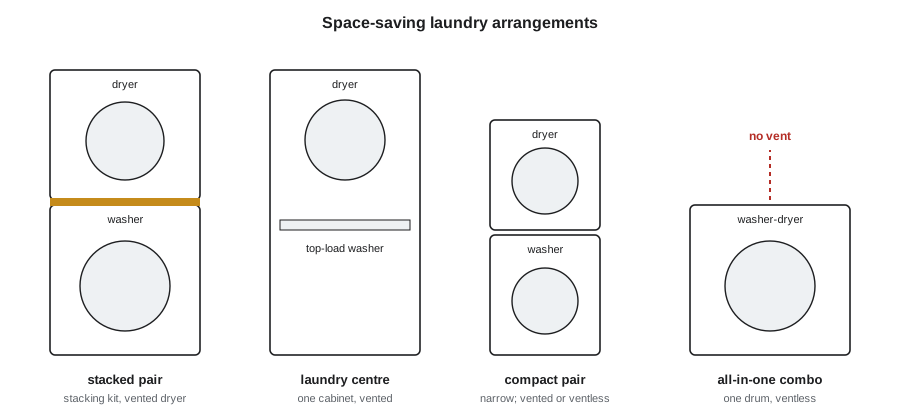
Most front-load washers and their matching dryers can be stacked, with the dryer on top, using a stacking kit from the maker. The kit holds the dryer to the washer so that the washer's vibration cannot walk the dryer off. Only the kit made for that pair should be used; dryers from a different maker or series may not fit securely, and a dryer falling from on top of a washer can cause serious injury. Top-load washers cannot be stacked. The washer must be level and stable before the dryer goes on, because any rocking of the washer is magnified at the top of the stack. The dryer's controls end up near or above head height, so many makers offer dryers with controls that can be reached from the front.
A laundry centre is a single appliance with a washer, usually a top-loader, in the bottom and a dryer in the top, sharing one cabinet. They are common in apartments and condominiums. Their parts are mostly like those of separate machines, but access is tighter: the dryer section is serviced from the front with the top panel off, and many washer repairs mean pulling the whole unit out from the wall, which needs two people and care with the dryer vent and the water hoses behind it.
Compact washers and dryers
Compact washers and dryers are about 60 cm (24 in) wide instead of the usual 69 cm (27 in). They are popular in condominiums and small homes and are often stacked. Compact washers hold less, typically around 60 to 70 L (2.2 to 2.5 cu ft), and many have an internal heater because they are often installed where hot water is not available. Compact dryers come in vented and ventless versions; vented compacts may run on 240 V or on 120 V with a smaller heater, which dries more slowly. A 120 V compact dryer with a heater of about 1,500 to 2,000 W takes much longer than a full-size 5,400 W dryer, and customers sometimes report that as a fault.
Ventless condenser dryers
A ventless condenser dryer does not blow its moist air outside. Instead it recirculates the air in a closed loop: the heater warms it, it passes through the clothes and picks up moisture, and then it passes through a condenser, an air-to-air heat exchanger cooled by a second fan drawing room air across it. The moisture condenses into water, which collects in a tank the customer empties or is pumped to a drain. The dried air returns to the heater. Because the cooling air goes back into the room, the room gets warm during drying. Condenser dryers use about as much energy as vented dryers, sometimes more, but they can go anywhere there is power and, for pumped models, a drain.
The condenser collects lint that gets past the filter, and on most models it must be removed and rinsed regularly. A clogged condenser reduces both the drying and the cooling, so drying times grow longer and longer. Many condenser dryers have a second lint filter in front of the condenser; customers often do not know it is there. Water left in the drum or on the floor points to a full tank, a kinked drain hose or a blocked condensate pump.
Heat pump dryers
A heat pump dryer also recirculates its air, but it uses a small refrigeration system instead of a heater and an air-to-air condenser. The refrigerant's evaporator cools the moist air leaving the drum below its dew point, so the moisture condenses out; the refrigerant's condenser then heats the dry air before it goes back into the drum. The same heat is used over and over, so a heat pump dryer uses far less energy than a vented dryer, often half or less. It dries at lower temperatures, which is gentler on clothes but takes longer, commonly 1.5 to 2 times as long. It runs on a standard 120 V or 240 V circuit depending on the model and needs no vent, only a drain or a water tank.
Heat pump dryers need their lint filters and their heat exchanger coils kept clean. Most have a primary filter in the door and a secondary filter or foam pad in front of the evaporator coil, and many clean the coil automatically with condensate water; others need the coil brushed or rinsed. A clogged coil gives very long drying times. Their refrigerant circuit is sealed, and many use propane (R-290) as the refrigerant, so the flammable refrigerant precautions from APP-210 apply. Refrigeration diagnosis on a heat pump dryer is covered in APP-330.
Worked problem
Emptying a condenser tank
A heat pump dryer removes 2.2 kg of water from a load, as in lesson 10. Its water tank holds 4.5 L. How many such loads can it dry before the tank must be emptied?
Show solution
- One kilogram of water is about one litre, so each load adds about 2.2 L.
- Loads per tank: 4.5 ÷ 2.2 = 2.05.
- The dryer stops with a full-tank message partway through the third load.
Answer: About two full loads. A customer who does three loads in a row without emptying the tank will see the dryer stop. Connecting the drain hose to a standpipe or laundry tub, where the model allows it, removes the problem.
Worked problem
What a heat pump dryer saves
A household dries 250 loads a year. A vented electric dryer uses about 2.8 kWh per load and a heat pump dryer about 1.3 kWh for the same loads. At a sample electricity price of 0.14 dollars per kWh, what does the heat pump dryer save in a year?
Show solution
- Saving per load: 2.8 − 1.3 = 1.5 kWh.
- Saving per year: 1.5 × 250 = 375 kWh.
- Cost saving: 375 × 0.14 = 52.50 dollars a year.
Answer: About 375 kWh and 52.50 dollars a year at the sample price. Real figures depend on the models, the loads and the local electricity rate.
All-in-one washer-dryers
A combination washer-dryer, often called an all-in-one, washes and dries in the same drum without moving the load. Older combos used a condenser dryer section with a water-cooled condenser, spraying cold water to condense the moisture, which used extra water. Newer combos use a heat pump drying section. A combo can wash a full load but usually dries only about half to two-thirds of its wash capacity at once, so customers who wash a full drum and select wash-and-dry get damp clothes; many combos sense the load and extend the cycle, which can then take several hours. Explaining capacity and cycle times is a large part of any combo call.
A combo has all the parts of a front-load washer, from the bearings to the drain pump, plus the parts of a ventless dryer, packed into one cabinet. It is usually serviced like a front-loader, with the drying system's fan, heater or heat pump, condenser and their lint filters added. Because a combo runs its drum for many hours a day, its bearings, belts and door boot see more wear than a separate washer's.
Worked problem
Dee's case: an all-in-one that took four hours to dry
On Friday, September 25, Dee went to Imelda Bellweather's 2023 heat pump all-in-one washer-dryer in a condominium on Bay Street North. Its wash-and-dry cycle was taking about four hours, and the clothes were still slightly damp. The door lint filter was clean, but the customer did not know there was a second filter. Dee found it behind a cover at the bottom front: a foam pad matted solid with lint. The evaporator coil behind it was also coated. The load in the drum was a full wash load of towels, close to the maximum wash capacity of 11 kg; the maximum dry capacity on the rating label was 6 kg. What did Dee find and recommend?
Show solution
- The secondary filter and the coil were clogged, so little air passed through the drying system.
- The load was close to 11 kg, against a dry capacity of 6 kg: 11 ÷ 6 = 1.8 times the drying limit.
- Both slowed the drying, and either alone could explain long cycles.
Answer: Dee cleaned the foam filter and, following the maker's instructions, the coil, then showed Ms. Bellweather where the filter was and how often to clean it. She explained that a full wash load must be split for drying, or dried in two batches. A test with a load within the dry capacity finished in about two hours.
Shipping bolts and installation
Front-load washers, including combos and the washer half of a stacked pair, are shipped with transit bolts, usually three or four, that pass through the rear panel into the tub and hold it rigidly against the cabinet so that the suspension is not damaged in transport. They must be removed before the washer is used, and the holes covered with the caps supplied. A washer run with its shipping bolts in place has no suspension at all: on its first fast spin it shakes violently, bangs, walks across the floor and can damage its tub, bearings and cabinet and anything stacked on top. The installation instructions show where the bolts are, and the bolts should be kept in case the washer is ever moved.
Every installation also needs the washer levelled, with all four feet on the floor and their lock nuts tightened, the drain hose secured at the right height, new inlet hoses and, for a dryer, a proper vent or, for a ventless dryer, a drain. A stacked pair also needs enough height in the closet for the stack, the vent connection and service access; the installation instructions give clearances. Many condominium boards and building managers have their own rules for laundry installations, especially for dryer venting in towers where vents may be shared or limited in length, and for leak protection: a drain pan under the washer, a water leak detector or an automatic water shut-off valve.
Working on stacked and tall units safely
Lifting a dryer off a washer, or pulling a stacked pair out of a closet, is a two-person job. A full-size dryer can weigh about 55 kg (about 120 lb) and a laundry centre much more. Follow the lifting practices from APP-110, use an appliance dolly or sliders where the floor allows, and never climb on the washer to reach the dryer. Unplug both units and turn off the water before moving them. When restacking, re-fit the stacking kit's fasteners, check that the washer is still level, reconnect the vent firmly and check behind the stack with a light that the vent, hoses and cords are not crushed against the wall.
Because these units are tall and often in tight closets, Penfold's rule is that the technician checks the back of the unit for leaks, kinks and vent damage on every call, even if the complaint is about the front. The back of a stacked pair is the part the customer never sees.
Common mistakes
MistakeStacking a dryer with a kit from another maker or series.
InsteadUse only the stacking kit made for that pair.
MistakeRunning a new front-loader with its shipping bolts in.
InsteadRemove all the transit bolts and fit the caps before the first use.
MistakeTreating a 120 V compact dryer's long drying times as a fault.
InsteadCompare with the rated heater power; small heaters dry slowly.
MistakeMissing the second lint filter on a ventless dryer.
InsteadFind and clean every filter and the condenser or coil as the maker describes.
MistakeFilling a combo's drum for wash-and-dry.
InsteadExplain that dry capacity is about half to two-thirds of wash capacity.
MistakeLifting a dryer off a stack alone.
InsteadUse two people and the lifting methods from APP-110.
Summary and key terms
- Stacked pairs need the maker's stacking kit and a level, stable washer.
- Laundry centres share one cabinet; access is tight and moving them takes two people.
- Compact units are about 60 cm (24 in) wide; 120 V compact dryers dry slowly by design.
- Condenser dryers condense moisture with room air; heat pump dryers use a refrigeration system and much less energy.
- Ventless dryers need their filters, condenser or coil and drain or tank kept clear.
- Combos dry only about half to two-thirds of their wash capacity; cycles can be long.
- Shipping bolts must come out before a front-loader is used.
- Check the back of stacked units on every call, and never lift a stack alone.
- Stacking kit
- The maker's bracket set that secures a dryer on top of its matching washer.
- Laundry centre
- A single appliance with a washer below and a dryer above in one cabinet.
- Compact washer or dryer
- A narrower laundry appliance, about 60 cm (24 in) wide.
- Condenser dryer
- A ventless dryer that condenses moisture from its recirculated air with an air-to-air heat exchanger.
- Heat pump dryer
- A ventless dryer that uses a refrigeration system to dry and reheat its air.
- All-in-one washer-dryer
- A machine that washes and dries in the same drum.
- Shipping bolts
- Transit bolts that hold a front-load tub rigid during delivery and must be removed before use.
- Condensate pump
- The small pump that moves condensed water from a ventless dryer to its tank or a drain.
Practice problems
Work each problem on paper first, then reveal the answer to check.
Why must only the maker's stacking kit be used?
Show answer
Other kits may not hold the dryer securely, and a falling dryer can injure someone.
A new front-loader shakes violently on its first spin. What should you check first?
Show answer
Whether the shipping bolts were removed.
How does a heat pump dryer save energy?
Show answer
It reuses the same heat, condensing moisture on its evaporator and reheating air on its condenser.
An all-in-one gives damp clothes after a full wash load. What do you explain?
Show answer
Its dry capacity is smaller than its wash capacity, so the load must be split for drying.
A ventless dryer takes longer every week. What should you clean?
Show answer
Every lint filter and the condenser or heat pump coil.
Lesson quiz · 5 questions
Score 60% or more to complete this lesson.
Create a free account to save your progress, take quizzes and earn a certificate.