
APP-110 · Lesson 1 of 12 · 21 min
The appliance service trade
▶ Video coming soon A video version of this lesson is on the way.
At eight o'clock on Monday, October 19, 2026, Kiran Beaulac parked his car behind the Penfold Appliance Service shop on Stone Church Road East, on the Hamilton Mountain and walked in through the parts room. He had spent two years on a big-box store's delivery crew, carrying ranges and refrigerators into kitchens and hooking up washers. He had seen plenty of appliances. He had never opened one up to find out why it had stopped working. Harriet Penfold, who owns the company her father Gus started in 1987, met him at the counter with a coffee and a binder. "Delivery taught you how to move them," she said. "This job is about what happens inside them. By the end of your first year you'll be fixing things your delivery crew used to haul away."
This course is the first appliance course in the program. The general trades courses introduced site safety and the apprenticeship system; the refrigeration fundamentals course introduced the refrigeration cycle. This course is about the appliance service trade in particular: what an appliance technician does, how to work safely around electricity, gas, water and refrigerant, which tools and meters to carry, how to read the labels and the paperwork that come with every appliance, and how a service call runs from the first phone call to the final invoice. Each lesson follows Kiran through his first four weeks at Penfold, riding in the van of his mentor, Dolores "Dee" Szymanska, a journeyperson with 31 years in the trade.
What an appliance service technician does
An appliance service technician installs, maintains, diagnoses and repairs the machines that keep a household running: refrigerators and freezers, ranges, cooktops, wall ovens and microwave ovens, dishwashers, clothes washers and dryers, and smaller items such as ice makers, wine coolers, trash compactors, garbage disposers and dehumidifiers. Some technicians also work on commercial laundry equipment, vending machines or light commercial refrigeration, but most of the trade is in people's homes.
A modern appliance is a small system. A refrigerator has a sealed refrigeration circuit, fans, a defrost system, sensors, an electronic control board and often a water valve and ice maker. A front-load washer has a motor drive, a water inlet valve, a drain pump, a pressure sensor, a door lock and a control board that runs dozens of programs. A gas range has burners, valves, igniters, a gas regulator and an oven safety valve. The technician needs to understand electricity, motors, heating, refrigeration, gas, water and electronics well enough to find which part of the system has failed and to fix it safely.
Most of the work is diagnosis. Replacing a part takes minutes once you know which part it is. Finding out which part is the job. Dee put it simply on Kiran's first morning: "Anybody can change a part. The customer is paying us to change the right one, once."
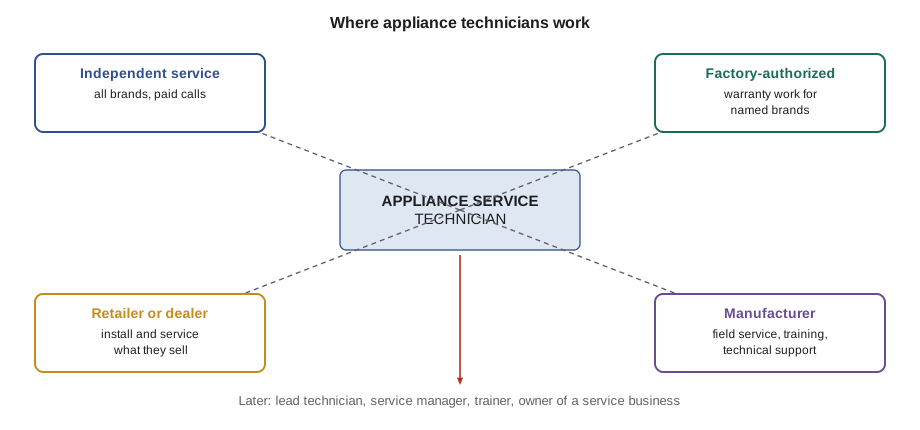
Where appliance technicians work
Appliance technicians work for several kinds of employer, and many move between them over a career:
- Independent service companies, like Penfold, repair most brands and take calls directly from homeowners, landlords and property managers.
- Factory-authorized servicers are independent companies that a manufacturer has authorized to do its warranty repairs. Penfold is authorized for three brands, which means its technicians have taken those brands' training and can bill the manufacturer for warranty work.
- Retailers and dealers employ technicians to install what they sell and to handle service calls on it.
- Manufacturers employ field technicians directly in some areas, and trainers and technical support staff who help other technicians by phone.
Property management companies, hotels, universities and hospitals sometimes employ in-house technicians as well. Wherever they work, technicians spend most of the day in a service van, driving from call to call, with a stock of common parts and tools on board.
| Employer | Typical work | What it asks of the technician |
|---|---|---|
| Independent service company | All brands, paid calls, some warranty | Broad knowledge, good customer skills |
| Factory-authorized servicer | Warranty repairs for named brands | Brand training, warranty paperwork |
| Retailer or dealer | Installation and service of products sold | Installation skill, delivery coordination |
| Manufacturer | Field service, training, technical support | Deep product knowledge, teaching |
The apprenticeship and certification
In Ontario, Skilled Trades Ontario manages apprenticeship and certification for the trades. Appliance Service Technician has the trade code 445A. The program is about 6,010 hours long: about 5,280 hours of on-the-job training, roughly three years, and 730 hours of in-school training in three levels. The trade is voluntary in Ontario. You do not need a certificate to work as an appliance technician, but a registered apprenticeship gives structured training, a logbook of skills signed by a journeyperson, and at the end a Certificate of Qualification. Appliance Service Technician is also a Red Seal trade, so a technician who passes the interprovincial exam has a certificate recognized across Canada. Kiran registered as an apprentice in 445A in his first week; his Level 1 in-school training is planned for early 2027.
Two more certificates matter in Ontario. Anyone who handles refrigerants containing ozone-depleting substances or other halocarbons must hold an Ozone Depletion Prevention (ODP) card, earned by passing a one-day environmental awareness course; the card is valid for five years. And gas work is regulated separately by the Technical Standards and Safety Authority (TSSA). Connecting, converting, adjusting or servicing the gas side of a gas appliance is gas technician work that needs the right TSSA certificate. Hiro Nakashima, Penfold's senior technician, holds a G.2 gas technician certificate and does the company's gas work. Kiran does not touch the gas side of anything until he is certified for it.
Worked problem
Planning the hours
Kiran's apprenticeship asks for about 5,280 hours on the job. Penfold schedules him 40 hours a week for about 46 weeks a year once vacation, holidays and in-school weeks are removed. About how many years will it take him to log the on-the-job hours?
Show solution
- Hours per year: 40 × 46 = 1,840 hours.
- Years for 5,280 hours: 5,280 ÷ 1,840 ≈ 2.9 years.
Answer: About three years, which matches the length of the program. Overtime in the busy summer season can shorten it slightly.
A day in the van
Kiran's first day followed the pattern of most days at Penfold. Fenna Vandermolen, the office manager, had routed Dee's van for six calls across the city: two refrigerators not cooling, a dishwasher that left water in the tub, a dryer that ran but did not heat, a washer that shook across the floor, and a range whose oven would not reach temperature. Ade Oyelowo, the parts manager, had loaded the van overnight with the parts Fenna's notes suggested might be needed. Before they left, Dee walked Kiran around the van: the parts shelves, the tool drawers, the meters, the floor protection, the appliance dolly and straps, the first aid kit and the fire extinguisher.
At each call the pattern repeated. Introduce yourself. Listen to the customer describe the problem. Protect the floor. Look at the appliance, read its model and serial plate, and check the simple things first: is it plugged in, is the breaker on, is the water valve open, is the door switch working, is the filter or vent blocked. Then test, find the failed part, explain the repair and the price, and either fix it or order the part. Clean up, test the repair, explain what was done, and collect payment or sign-off. By the end of the day Kiran had watched Dee fix four of the six problems on the first visit and order parts for the other two.
On the drive back to the shop, Kiran asked what had surprised him most. "Half of them weren't really broken," he said. The dishwasher drain was blocked by a piece of a broken glass. The washer had never been levelled. Dee nodded. "That's normal. Check the simple things first, every time. And never assume. The day you assume is the day you get it wrong."
The skills of the trade
Harriet's binder had a page titled What we hire for. Every apprentice at Penfold gets the same list:
- Safety habits. Unplugging, verifying with a meter, and knowing when not to touch something are worth more than any tool.
- Electrical knowledge. Most appliance faults are electrical: switches, heaters, motors, sensors, boards and wiring. APP-120 covers this in depth.
- Mechanical sense. Belts, bearings, pumps, hinges, door seals and drive systems wear out.
- Refrigeration knowledge. Refrigerators and freezers are a large share of calls, and sealed system work needs certification.
- Reading. Service manuals, tech sheets and wiring diagrams are the technician's map.
- Customer skills. You work in people's homes, often on a bad day. Being clean, polite, clear about prices and honest about what you find keeps customers.
- Organization. A good technician keeps the van stocked, the paperwork complete and the day on schedule.
Kiran's delivery experience gave him a head start on one item: moving appliances without damaging floors, walls or backs. Dee told him that would count for something in lesson three. Everything else he would learn one call at a time.
The trade today
Appliance service is changing. Electronic control boards, inverter-driven compressors and motors, Wi-Fi-connected appliances, induction cooktops and heat pump dryers have made appliances more efficient and harder to diagnose without the right information. Many newer appliances have built-in diagnostic modes that display fault codes, and some can report faults to the manufacturer over the internet. Refrigerators made in recent years use hydrocarbon refrigerants such as isobutane (R-600a), which are flammable and need extra care. At the same time, customers keep appliances for years, parts are expensive, and a good repair is often better for the customer's wallet and for the environment than a new machine. A technician who keeps learning has steady work.
Harriet ended the orientation with the same advice her father gave every new hire: keep a notebook. Write down every model you see, every fault you find, every test value you measure and every trick a journeyperson shows you. Kiran bought a pocket notebook at a gas station on the way home. By Friday it had eleven pages filled.
Working in customers' homes
An appliance technician works in other people's homes all day, and that brings responsibilities a factory or a construction site does not. Customers let a stranger into their kitchen, often with children, pets or elderly relatives at home. They judge the company by how the technician behaves. Penfold's rules are simple: arrive when promised or call if you are late, wear the company shirt and identification, put on shoe covers, ask before moving anything, keep pets and children away from open appliances and tools, and leave the room cleaner than you found it. Never use the customer's bathroom, phone or tools without asking, and never comment on the home or the customer's belongings.
Some calls bring situations a technician has to handle with care: a customer who is unwell, a home that is unsafe or unsanitary, a customer who is upset about the cost or the age of the appliance, or a tenant and a landlord who disagree about who pays. Dee's advice to Kiran was to stay calm, explain what he found and what it will cost in plain language, and let Fenna or Harriet handle disputes about money. If a home is unsafe to work in, the technician leaves politely and reports it to the office. APP-410 covers customer service in depth.
Learning on the job
Apprentices in Ontario record their on-the-job training in the training standard for the trade, a logbook of skills that a journeyperson signs as the apprentice shows each one. At Penfold, Kiran's logbook skills are grouped by appliance type, and Dee signs them off as she sees him do each one correctly and safely on real calls. He also attends Penfold's Friday afternoon training sessions, where technicians share difficult repairs and manufacturers' trainers present new models.
Manufacturers' training matters in this trade more than in many others, because each brand designs its electronics, diagnostic modes and repair procedures its own way. Penfold sends technicians to online and in-person courses for the three brands it is authorized for, and the certificates from those courses are what allow the company to do warranty work for them. Over his first two years, Kiran will take more than a dozen such courses.
Kiran's first-week notebook already showed the pattern. Of the 26 calls he rode on, 19 were finished on the first visit, five needed a part ordered, and two turned out to be problems with the house rather than the appliance: a tripped breaker that the customer had not found, and a water valve that had been closed during a renovation. Every one of them started with the same checks.
Common mistakes
MistakeThinking appliance service is mostly about replacing parts.
InsteadMost of the job is diagnosis; replacing the right part once is what the customer pays for.
MistakeSkipping the simple checks because the problem looks complicated.
InsteadCheck power, breakers, water supply, filters, vents and settings first on every call.
MistakeAssuming any appliance technician can connect a gas range.
InsteadGas work needs the right TSSA gas technician certificate; Kiran does not touch the gas side until he is certified.
MistakeOpening a refrigerant circuit without the ODP card.
InsteadOnly certified people may handle halocarbon refrigerants in Ontario.
MistakeNot logging hours and skills as you go.
InsteadLog hours and skills every week and get them signed while the work is fresh.
Summary and key terms
- Appliance technicians install, maintain, diagnose and repair household appliances, and most of the work is diagnosis.
- They work for independent service companies, factory-authorized servicers, retailers and manufacturers.
- In Ontario, Appliance Service Technician (445A) is a voluntary Red Seal trade of about 5,280 hours on the job and 730 hours in school in three levels.
- Refrigerant handling needs an ODP card and gas work needs a TSSA certificate.
- Check the simple things first on every call, and never assume.
- Appliance service technician
- A tradesperson who installs, maintains, diagnoses and repairs household appliances.
- Factory-authorized servicer
- An independent service company authorized by a manufacturer to do its warranty repairs.
- Certificate of Qualification
- The certificate issued in Ontario to a person who completes an apprenticeship and passes the certification exam.
- Red Seal
- The interprovincial standard that makes a trade certificate recognized across Canada.
- ODP card
- Ontario certificate required to handle refrigerants containing ozone-depleting substances or other halocarbons.
- Diagnosis
- Finding which part of an appliance has failed, and why.
- Service van
- The technician's mobile workshop, stocked with tools, meters and common parts.
Practice problems
Work each problem on paper first, then reveal the answer to check.
What is Ontario's trade code for Appliance Service Technician?
Show answer
445A.
About how many in-school hours does the 445A program include, and in how many levels?
Show answer
About 730 hours, in three levels.
Is Appliance Service Technician compulsory in Ontario?
Show answer
No, it is voluntary, but it is a Red Seal trade.
What card do you need to handle halocarbon refrigerants in Ontario?
Show answer
An Ozone Depletion Prevention (ODP) card.
Name four kinds of employer for appliance technicians.
Show answer
Independent service companies, factory-authorized servicers, retailers and dealers, manufacturers.
Lesson quiz · 5 questions
Score 60% or more to complete this lesson.
Create a free account to save your progress, take quizzes and earn a certificate.