
APP-110 · Lesson 4 of 12 · 24 min
Hand tools and specialty tools
▶ Video coming soon A video version of this lesson is on the way.
Thursday, October 22, started with Dee opening every drawer in her van while Kiran took notes. "You'll buy your own hand tools over the next year," she said. "Penfold supplies the meters, the dolly and the specialty tools. Buy good ones, buy them once, and put every tool back in the same place every time. At five o'clock on your sixth call, you won't have time to look for a 5/16 nut driver."
Appliance technicians carry a surprisingly small set of everyday hand tools and a larger set of specialty tools used only on certain appliances or brands. The everyday set fits in a small bag that comes into the house on every call; the specialty tools stay in the van until they are needed. This lesson covers both, how to choose and care for them, and how to use them without damaging the appliance or the customer's home.
The everyday bag
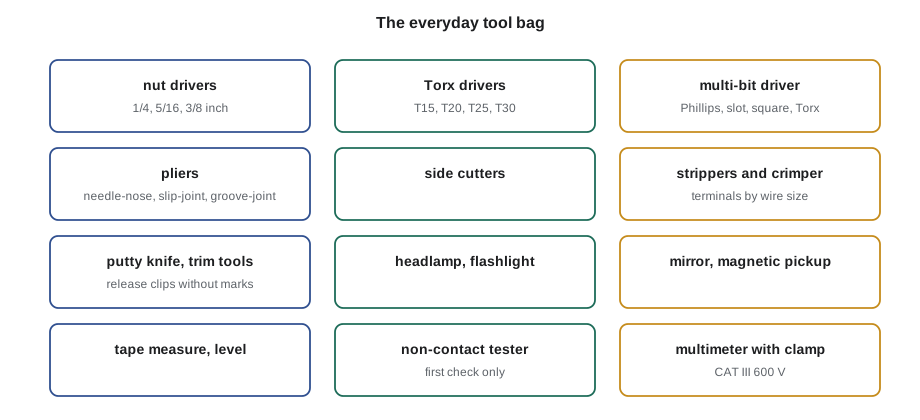
Most household appliances are put together with a handful of fastener types. Nearly all sheet metal screws on North American appliances have hex washer heads in two sizes, 1/4 inch and 5/16 inch, and many also have a slot or a recess for a screwdriver. Torx screws, with their six-point star recess, are common on newer appliances, in sizes T15, T20, T25 and T30. Phillips and Robertson (square-recess) screws appear too. Dee's everyday bag holds:
- Nut drivers in 1/4, 5/16 and 3/8 inch, with a magnetic tip on the two smallest, and a short-handled set for tight spaces.
- A multi-bit screwdriver with Phillips, slotted, square and Torx bits, and a set of Torx drivers in T15 to T30.
- Pliers: needle-nose, slip-joint, groove-joint for hose clamps and fittings, and side cutters.
- Wire strippers and a terminal crimping tool.
- A putty knife and plastic trim tools for releasing panel clips without scratching the finish.
- A headlamp and a small flashlight, an inspection mirror and a magnetic pickup tool.
- A tape measure, a short spirit level and a small adjustable wrench.
- A non-contact voltage tester and a digital multimeter with a clamp (lesson 5).
- Towels, a small pan, shoe covers and a drop cloth for protecting floors.
Worked problem
Metric or inch?
Kiran's metric socket set has 7 mm and 8 mm sockets. A screw head is 5/16 inch across the flats. Which metric socket is closest, and why does Dee still carry a 5/16 inch driver?
Show solution
- 5/16 inch = 5 ÷ 16 = 0.3125 inch.
- 0.3125 × 25.4 mm = 7.94 mm.
- The 8 mm socket is closest, 0.06 mm larger.
Answer: The 8 mm socket will usually turn a 5/16 inch head, but the small gap can round off a soft or painted head. Using the exact size avoids damage, so Dee carries both inch and metric drivers. Some appliances made for world markets use metric fasteners.
Using hand tools without damage
An appliance has painted and stainless steel panels, plastic trim, glass and electronic boards, all of which are easy to damage. A scratch on a stainless steel door can turn a fifty-dollar repair into a complaint. Good habits:
- Lay a drop cloth or towel on the floor and on any counter where you put panels, screws or tools.
- Use the right size driver so that it seats fully; a loose fit rounds off the head.
- Release plastic clips with a putty knife or trim tool slid in at the clip, not by prying at the panel edge with a screwdriver.
- Keep screws from each panel together in a magnetic tray or a cup, and photograph wiring before you disconnect anything.
- Do not overtighten screws into plastic bosses; stop when the screw is snug.
- Pull wire connectors by the connector body, not the wire, and release any locking tab first.
On a dishwasher call that morning, Dee showed Kiran how the console panel on one popular brand is held by hidden clips. She slid a putty knife into the gap at the marked points, pressed down to release each clip, and lifted the panel away without a mark. Kiran's first try with a screwdriver would have cracked the plastic.
Wiring, terminals and crimping
Many repairs involve disconnecting and reconnecting wires: a heating element, a door switch, a motor or a board. Most connections in appliances use push-on quick-connect terminals, often 1/4 inch wide, or multi-pin plastic connectors. When a terminal is burned, loose or corroded, it must be replaced, because a poor connection gets hot and can burn the wire, the part and eventually the cabinet. A terminal crimped on correctly grips the wire firmly and carries the current without heating.
Insulated crimp terminals are colour-coded by the wire sizes they fit:
| Insulation colour | Wire size (AWG) | Typical appliance use |
|---|---|---|
| Red | 22 to 18 | Control and sensor wiring |
| Blue | 16 to 14 | Motors, valves, lamps, many element leads |
| Yellow | 12 to 10 | Heavy element leads, range and dryer power |
Heating elements and their terminals get hot. For element connections, use the high-temperature terminals and wire specified by the manufacturer, which are usually uninsulated nickel-plated or stainless terminals, sometimes with a high-temperature sleeve. An ordinary vinyl-insulated terminal will melt next to an oven element. Strip only as much insulation as the terminal barrel needs, crimp with the right die, tug test the crimp, and check that no strands are loose.
Worked problem
Choosing a terminal
A dryer's heating element has burned its terminal. The element is rated 5,400 W at 240 V and its lead is 12 AWG high-temperature wire. What current does it carry, and what terminal should Kiran use?
Show solution
- Current: I = P ÷ V = 5,400 W ÷ 240 V = 22.5 A.
- 12 AWG wire takes a terminal for 12 to 10 AWG.
- The connection is next to a heating element, so it must be a high-temperature terminal.
Answer: About 22.5 A. Use an uninsulated high-temperature 1/4 inch terminal for 12 to 10 AWG wire, as specified in the parts list, crimped with the right die and tug tested. Also check the element terminal itself: if it is burned or loose, replace the element too, or the new terminal will fail the same way.
Insulated tools
Even though Penfold's rule is to work with power off, Dee carries a few tools with insulated handles and shafts rated to 1,000 volts, tested to the international standard for insulated hand tools. They protect against an accidental contact with a live part that you did not know was there, such as the second supply in an appliance with two circuits, or a capacitor that was not discharged. Insulated tools are a backup, not a reason to work live. Check them before use: a cracked or nicked insulation layer no longer protects, and the tool should be replaced.
Specialty tools in the van
Beyond the everyday bag, appliance technicians carry specialty tools that are used on certain kinds of appliance or brand:
- Spanner wrenches and tub nut tools for removing washer tubs, agitators and spin baskets.
- Bearing and seal pullers and drivers for washer tub bearings.
- A condenser coil brush and vacuum for cleaning refrigerator condensers, and a fin comb for straightening bent fins.
- Thermometers with probes for measuring refrigerator compartment temperatures and oven temperatures.
- A wet/dry shop vacuum for draining water from washers and dishwashers and cleaning up spills.
- Appliance-specific tools: a test cord for running a motor or pump directly, a door switch defeat tool supplied by a manufacturer for diagnosis, and diagnostic adapters or software for brands that need them.
Refrigerant tools, such as gauges, a vacuum pump, a recovery machine, a refrigerant scale and a leak detector, are carried only by technicians certified to handle refrigerants. In Ontario, anyone who handles halocarbon refrigerants needs an ODP card. Kiran will use these tools in a later course, under supervision.
Gas tools, such as a manometer for measuring gas pressure, a combustible gas detector and leak detection solution, are used by Hiro and other technicians holding the TSSA gas technician certificate required for the work.
Care, inspection and organization
A technician's tools are how they earn a living. Dee checks hers each Monday morning: driver tips not rounded, pliers jaws not cracked, crimper dies clean, insulation on insulated tools intact, meter leads not cut or cracked, batteries charged. Damaged tools come out of service. Each tool has a place in the bag or drawer, so a missing tool is noticed at once, often before it is left behind in a customer's dishwasher.
Van organization matters as much as the tools. Penfold vans have shelves labelled by part type: fasteners and terminals, door switches and lid switches, thermal fuses and thermostats, belts, pumps, valves, elements and igniters. Ade restocks each van from the parts room every night based on what was used. A van that carries the right common parts means more repairs are finished on the first visit, which customers value most.
Worked problem
Planning a tool budget
Penfold gives each first-year apprentice a 600 dollar tool allowance. Kiran's list is a nut driver set at 45 dollars, a Torx driver set at 55, a multi-bit screwdriver at 30, four pairs of pliers at 120, wire strippers and a crimper at 85, a headlamp at 50, an inspection mirror and magnetic pickup at 25, a tape measure and level at 40, and a tool bag at 90. What does the list cost before tax, and how much of the allowance is left?
Show solution
- Total: 45 + 55 + 30 + 120 + 85 + 50 + 25 + 40 + 90 = 540 dollars.
- Allowance left: 600 − 540 = 60 dollars before tax.
Answer: 540 dollars before tax, leaving about 60 dollars for a set of insulated screwdrivers or a second flashlight.
Personal protective equipment
Hand tools are only part of what goes into a house. Dee's PPE goes too, and she wears it without being reminded:
- Safety glasses whenever she works under or behind an appliance, cuts, crimps, cleans a condenser or works with springs; dust, debris and spring clips go straight for the eyes.
- Cut-resistant gloves when handling sheet metal panels and the sharp edges inside cabinets, removed when she needs fine control near wiring.
- Safety footwear with a protective toe for every call, because appliances get dropped and dollies roll over feet.
- Knee pads, because a large share of appliance work is done kneeling on hard floors.
- A dust mask or respirator when cleaning heavily soiled condensers, lint-packed dryer cabinets or areas with mould, following Penfold's respiratory protection program.
- Hearing protection is rarely needed in homes, but heat and burn protection is: let ovens, dryer heaters and elements cool before touching them, and check with a hand held near the part first.
Ladders and step stools
Some appliance work is overhead, such as an over-the-range microwave oven, a range hood or a wall oven, and the temptation is to stand on a chair or the countertop. Penfold vans carry a fibreglass step ladder, which does not conduct electricity, and a sturdy step stool. Set the ladder fully open with its spreaders locked on a level floor, face it while climbing, keep three points of contact, never stand on the top step or the top cap, and do not overreach. Lifting a microwave oven onto its mounting plate is a two-person job, with one person holding it and the other fastening it.
Buying tools
Good tools last a career; cheap ones round off heads, break and cost more in the end. Dee's advice to Kiran: buy the everyday drivers and pliers from a reputable maker with a lifetime warranty, buy specialty tools only when you need them, and borrow Penfold's before you buy your own. Mark every tool with your initials. And buy two of the tools you use most, the 1/4 and 5/16 inch nut drivers, so that a lost one does not stop your day.
Kiran's first purchase was a second 5/16 inch nut driver. By the end of the month he had lost neither, but he had lent one to a customer's handyman and got it back only after a phone call. Dee laughed when he told her. Tools leave in other people's pockets far more often than they break, which is one more reason to mark them.
Common mistakes
MistakeUsing a screwdriver to pry off a plastic panel.
InsteadRelease clips with a putty knife or trim tool at the clip points.
MistakeUsing a near-fit metric socket on an inch screw head.
InsteadUse the exact size to avoid rounding the head.
MistakeCrimping a vinyl-insulated terminal on a heating element lead.
InsteadUse the high-temperature terminal specified for element connections.
MistakeReplacing a burned terminal without checking the part it connects to.
InsteadCheck the element or switch terminal too; a damaged one will burn the new terminal.
MistakeDisconnecting wiring without a photo or a note.
InsteadPhotograph or sketch the wiring before you disconnect anything.
MistakeTreating insulated tools as permission to work live.
InsteadInsulated tools are a backup; work with power off.
Summary and key terms
- Most appliance fasteners are 1/4 or 5/16 inch hex washer heads or Torx T15 to T30; carry the exact sizes.
- Protect finishes and floors, release clips at the clip points, and keep screws and wiring photos organized.
- Burned or loose terminals must be replaced; use the right size and, at heating elements, high-temperature terminals.
- Insulated tools rated to 1,000 V are a backup, inspected before use.
- Specialty tools cover washers, refrigerators and diagnosis; refrigerant and gas tools are for certified technicians.
- Inspect tools weekly and keep the van organized so that more repairs are finished on the first visit.
- Nut driver
- A screwdriver-style tool with a hex socket for turning hex-head screws.
- Torx
- A screw drive with a six-point star recess, in sizes such as T15, T20, T25 and T30.
- Quick-connect terminal
- A push-on flat terminal, often 1/4 inch wide, used for many appliance connections.
- Crimp terminal
- A terminal fastened to a wire by squeezing its barrel with a crimping tool.
- High-temperature terminal
- An uninsulated plated or stainless terminal used next to heating elements.
- Insulated tool
- A hand tool with insulation rated to 1,000 V as a backup against accidental contact with live parts.
- Trim tool
- A plastic prying tool for releasing clips without scratching panels.
Practice problems
Work each problem on paper first, then reveal the answer to check.
What are the two most common hex screw sizes on household appliances?
Show answer
1/4 inch and 5/16 inch.
What colour is the insulation on a crimp terminal for 16 to 14 AWG wire?
Show answer
Blue.
Why must an element connection use a high-temperature terminal?
Show answer
An ordinary insulated terminal melts in the heat near the element.
What current does a 5,400 W element draw at 240 V?
Show answer
22.5 A.
Who uses refrigerant gauges and a recovery machine?
Show answer
Only technicians certified to handle refrigerants.
Lesson quiz · 5 questions
Score 60% or more to complete this lesson.
Create a free account to save your progress, take quizzes and earn a certificate.