
APP-110 · Lesson 6 of 12 · 29 min
Reading model and serial plates
▶ Video coming soon A video version of this lesson is on the way.
Monday, October 26, began with a call that went wrong before it started. The customer had booked a repair for a dishwasher that would not drain and had given Fenna the model number from the box in her garage. Ade had loaded the van with the drain pump for that model. When Dee pulled the dishwasher door open and read the plate on the edge of the tub, the model number was the same, but the last two characters, the revision code, were different. The pump in the van did not fit. "Every call starts here," Dee told Kiran, tapping the plate. "Not the box, not the manual in the drawer, not what the customer remembers. The plate."
Every household appliance carries a rating plate, sometimes called a data plate or serial tag, that identifies it exactly and states its electrical, gas and refrigerant ratings. Reading it correctly is the first step on every service call: it decides which parts fit, which service information applies, whether the appliance is under warranty, and whether a safety recall affects it. This lesson covers where to find the plate, what it says and how to use it.
Where to find the plate
Manufacturers put the plate where it can be read without taking the appliance apart, but the location varies by type and brand. Typical locations are:
| Appliance | Typical plate locations |
|---|---|
| Refrigerator | Inside the fresh food compartment on a side wall or the ceiling; behind the crisper drawer; on the frame behind the kick plate |
| Range or wall oven | On the frame behind the storage drawer or warming drawer; on the oven door frame; on the back of the range |
| Dishwasher | On the edge of the tub or the inside edge of the door; under the console |
| Washer | Under the lid or around the door opening; on the back or under the control panel |
| Dryer | Inside the door opening; on the back; behind the lint filter housing |
| Microwave oven | Inside the door frame; on the back or the bottom |
Some plates are hard to read because of grease, scratches or fading. A flashlight held at a low angle, a photo taken with flash and enlarged on a phone, or a little cleaner on a cloth usually makes them readable. Penfold technicians photograph the plate on every call and attach the photo to the work order, so the parts counter and the warranty office see exactly what the technician saw.
What the plate tells you
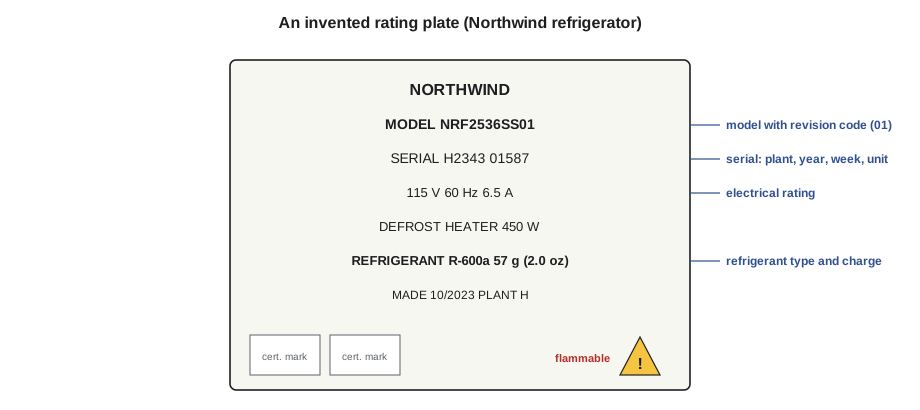
A rating plate typically shows:
- The brand and the model number. The model number identifies the exact product, and usually includes a series, a size, features, a colour code and a revision or engineering code at the end.
- The serial number, which identifies the individual unit and usually encodes where and when it was built.
- The electrical rating: voltage, frequency, current in amperes and often power in watts or the rating of the main heater or motor. Ranges and dryers often show ratings at both 240 V and 208 V.
- For a gas appliance, the type of gas it is set up for (natural gas or propane), the input rating in kilowatts and Btu per hour, the manifold pressure and sometimes the orifice sizes and the maximum altitude without adjustment.
- For a refrigerator or freezer, the refrigerant type and the charge, and for flammable refrigerants such as R-600a (isobutane) or R-290 (propane), a warning and a flame symbol.
- The certification marks of the testing organizations that certified the appliance to its safety standard, and often an energy efficiency mark.
The model number is what parts and service information are looked up by. Two appliances that look identical, and even share most of a model number, can have different pumps, boards or wiring if their revision codes differ. Always give the parts counter the full model number including the revision, and confirm the part against the parts list for that exact number.
Decoding the serial number
Most manufacturers build the date of manufacture into the serial number, but each uses its own code, and codes change over the years. Some use a letter for the year and a letter or two digits for the month or week; others use the first digits for the year and week. The manufacturer's service information, technician support line or training material gives the code for each brand. Never guess at an unfamiliar code; look it up.
Worked problem
Decoding an invented serial number
Northwind, an invented brand used in Penfold's training binder, codes its serial numbers as a letter for the plant, two digits for the year, two digits for the week of the year, and then a sequence number. What does the serial number H2343 01587 tell you?
Show solution
- Plant letter: H.
- Year: 23, so 2023.
- Week: 43, so the 43rd week of 2023, late October.
- Sequence: 01587, the 1,587th unit that week.
Answer: The unit was built at plant H in late October 2023, so it is about three years old in October 2026. If its warranty covers parts for five years, it is still covered. Remember that this code is invented for practice; real brands use different codes.
The build date matters for more than warranty. Service bulletins and updated parts often apply only to units built before or after a certain date, and a safety recall may cover a range of serial numbers.
Ratings and what they mean in service
The electrical rating on the plate is the current the appliance is designed to draw in normal operation, usually with its largest loads running. It is useful when diagnosing: if the measured current is far above the plate rating, something is overloaded or shorted; if it is far below with the appliance trying to heat or run, a load is not working.
Worked problem
Comparing measured current with the plate
A dryer's plate says 240 V, 60 Hz, 24 A. With the dryer running on high heat, Kiran clamps L1 and reads 24.6 A and clamps L2 and reads 22.4 A. Are these readings reasonable?
Show solution
- L2 carries only the heating element: about 22.5 A for a 5,400 W element at 240 V.
- L1 carries the element current plus the 120 V motor and controls: 24.6 − 22.4 = 2.2 A for the motor and controls.
- Both are close to the plate rating of 24 A.
Answer: Yes. The element and the motor are both drawing normal current. If the element were open, L2 would read close to zero and the dryer would not heat.
Worked problem
Converting gas input
A gas range's plate lists the oven burner input as 18,000 Btu/h. What is that in kilowatts? (1 Btu/h = 0.000293 kW)
Show solution
- 18,000 × 0.000293 = 5.27 kW.
Answer: About 5.3 kW. Some plates show both units.
Worked problem
Refrigerant charge
A refrigerator's plate lists a charge of 57 g of R-600a. How many ounces is that, and why does the small number matter? (1 oz = 28.35 g)
Show solution
- 57 ÷ 28.35 = 2.0 oz.
Answer: About 2.0 oz. Hydrocarbon refrigerators use very small charges, and the amount of flammable refrigerant allowed in a household refrigerator is limited by its safety standard. The small charge must be weighed exactly when a sealed system is recharged, a job for a certified technician in a later course.
Flammable refrigerants: read the label
Most refrigerators and freezers built in recent years use isobutane (R-600a), and some use propane (R-290). Both are hydrocarbons: excellent refrigerants with very low global warming potential, but flammable. A refrigerator with a hydrocarbon refrigerant carries a warning label, often red or yellow with a flame symbol, on the rating plate and near the compressor. The label means:
- Never braze, solder or use an open flame on the sealed system without first recovering the refrigerant and following the manufacturer's procedure.
- Use only replacement parts, such as relays and start devices, approved for that model; they are designed not to spark where refrigerant could collect.
- Keep ignition sources away from the compressor area and ventilate if a leak is suspected.
Ontario's refrigerant rules under the Environmental Protection Act cover halocarbons such as R-134a and do not cover hydrocarbon refrigerants, but the fire hazard is real, and manufacturers' safety procedures apply. Sealed system work on any refrigerant is a later course.
Warranty, bulletins and recalls
With the model and serial numbers in hand, a technician can check three more things before starting work:
- Warranty status: the build date or the purchase date, whichever the manufacturer uses, tells whether parts and labour are covered. Factory-authorized servicers like Penfold check this through the manufacturer's online portal.
- Service bulletins: manufacturers issue technical bulletins for known problems, often with an updated part or a new procedure. Checking first can save an hour of diagnosis.
- Safety recalls: Health Canada publishes recalls and safety alerts for consumer products, including appliances, and manufacturers run recall programs. If a unit is under recall, the recall procedure, not an ordinary repair, applies.
Later that Monday, a dishwasher call showed why this matters. Before starting, Dee typed the model and serial number into the manufacturer's portal. A bulletin came up: units built in a range of weeks had a door latch that could fail, and an updated latch kit was available. The customer's unit was in the range, the symptom matched, and the kit was covered under the bulletin even though the warranty had ended. Kiran wrote in his notebook: check bulletins before you check anything else.
Gas appliance plates: gas type and conversions
A gas range, cooktop or dryer is built for one gas, natural gas or propane, and its plate says which. The two gases burn differently: propane carries more energy per litre and is supplied at a higher pressure, so a propane appliance has smaller burner orifices and its regulator is set to a different pressure. Running an appliance on the wrong gas makes yellow, sooty flames and carbon monoxide, or flames too small to light the oven safely. Most gas appliances can be converted with a kit from the manufacturer: new orifices or adjustments to them, a change to the regulator and, on some models, new parts for the oven burner. After a conversion, a label is fixed next to the rating plate to show the new gas and who did the work.
Converting an appliance is gas work under TSSA rules, done only by a certified gas technician, and the conversion label is part of the record. When Kiran reads a gas appliance's plate, he checks that the gas listed, or the conversion label, matches the gas in the house, and if it does not, he tells Hiro or the office rather than lighting the appliance.
High altitude also affects gas appliances, because air is thinner and burners need less gas. Plates often state the maximum altitude without adjustment. Hamilton is far below the usual limits, so altitude rarely matters on Penfold's calls, but it does for technicians who work in mountain regions.
When the plate is missing
Sometimes the plate has been painted over, torn off or worn away. Before giving up, check the other places the manufacturer may have put it: some appliances carry a second label inside a panel, on the back or on the tech sheet envelope. The customer may have the original paperwork, a receipt with the model number, or a registration e-mail from the manufacturer. Parts suppliers and manufacturers' support lines can sometimes identify a model from photographs of the appliance and of part numbers stamped on major parts such as the control board or the compressor. Without the model number, a technician can still diagnose with a meter, but ordering the right part becomes guesswork, so Penfold technicians record any number they can find and note on the work order that the plate was missing.
Worked problem
Checking a dryer on 208 V
Apartment buildings with three-phase service sometimes supply 208 V instead of 240 V to ranges and dryers. A dryer element rated 5,400 W at 240 V is run on 208 V. What power does it give, since its resistance does not change?
Show solution
- Element resistance: R = 240² ÷ 5,400 = 57,600 ÷ 5,400 ≈ 10.67 Ω.
- Power at 208 V: P = 208² ÷ 10.67 = 43,264 ÷ 10.67 ≈ 4,055 W.
- Ratio: 4,055 ÷ 5,400 ≈ 0.75.
Answer: About 4,050 W, roughly three-quarters of the rated heat, so drying takes longer. This is why plates often show ratings at both 240 V and 208 V, and why some manufacturers offer 208 V elements. A slow dryer in an apartment building may have nothing wrong with it.
Common mistakes
MistakeTaking the model number from the box, the manual or the customer.
InsteadRead it from the rating plate on the appliance, including the revision code.
MistakeOrdering a part by the first part of the model number.
InsteadUse the full model number and confirm against that model's parts list.
MistakeGuessing the build date from an unfamiliar serial code.
InsteadLook up the manufacturer's code.
MistakeIgnoring the flammable refrigerant label.
InsteadNo open flames on the sealed system, approved parts only, and keep ignition sources away.
MistakeStarting diagnosis before checking bulletins and recalls.
InsteadCheck warranty, bulletins and recalls with the model and serial numbers first.
Summary and key terms
- The rating plate identifies the appliance exactly and states its electrical, gas and refrigerant ratings.
- Read the model number from the plate, including the revision code; parts depend on it.
- Serial numbers encode the build date and plant in each manufacturer's own code.
- The plate's current rating helps diagnosis; compare it with measured current.
- Hydrocarbon refrigerants are flammable; the label means no flames and approved parts only.
- Use the model and serial numbers to check warranty, service bulletins and recalls before starting.
- Rating plate
- The label on an appliance that gives its model and serial numbers and its ratings.
- Model number
- The code that identifies the exact product, including its revision.
- Revision code
- The characters at the end of a model number that identify a design change.
- Serial number
- The number that identifies an individual unit, usually including its build date and plant.
- Service bulletin
- A manufacturer's technical notice about a known problem and its fix.
- R-600a
- Isobutane, a flammable hydrocarbon refrigerant used in most new household refrigerators.
- Certification mark
- A mark showing that a testing organization has certified the product to its safety standard.
Practice problems
Work each problem on paper first, then reveal the answer to check.
Where is the rating plate usually found on a refrigerator?
Show answer
Inside the fresh food compartment on a side wall or ceiling, or behind the crisper or kick plate.
Why does the revision code matter?
Show answer
Units with the same base model but different revisions can need different parts.
What does a flame symbol on a refrigerator label mean?
Show answer
It uses a flammable hydrocarbon refrigerant such as R-600a or R-290.
How many kilowatts is 18,000 Btu/h?
Show answer
About 5.3 kW.
What three checks use the model and serial numbers before diagnosis?
Show answer
Warranty status, service bulletins and safety recalls.
Lesson quiz · 5 questions
Score 60% or more to complete this lesson.
Create a free account to save your progress, take quizzes and earn a certificate.