
APP-110 · Lesson 8 of 12 · 27 min
The service call from booking to invoice
▶ Video coming soon A video version of this lesson is on the way.
On Wednesday, October 28, Kiran spent the morning in the office instead of the van. Fenna Vandermolen sat him next to her at the dispatch desk with a headset. "Every call you'll ever run starts here," she said. "If I book it badly, you show up with the wrong parts, at the wrong time, for the wrong problem. If you write it up badly, I can't bill it, the manufacturer won't pay the warranty claim and the customer calls back angry. So today you learn the other half of the job."
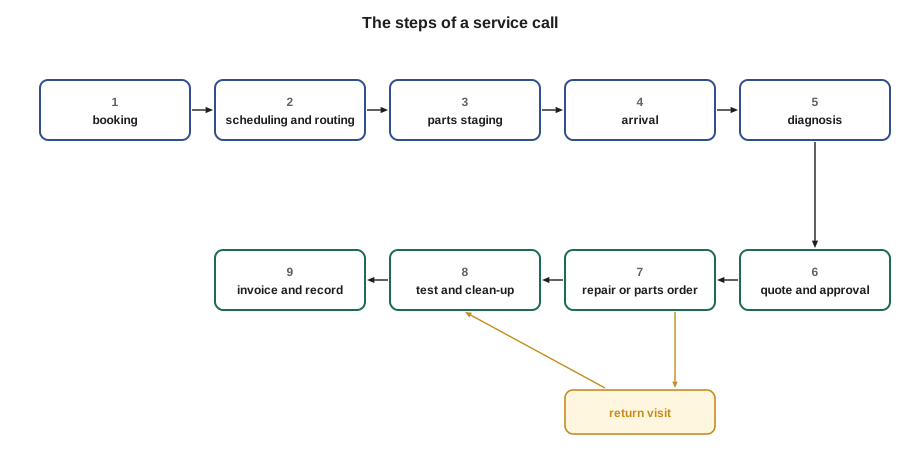
A service call is more than a repair. It is a chain of steps that starts when a customer phones or books online and ends when the invoice is paid and the record is filed. Each step affects whether the technician can fix the problem on the first visit, whether the customer is satisfied and whether the company is paid. This lesson walks through the chain. APP-410 covers customer service and the business side in depth.
Booking the call
Most calls are booked by phone or through the company's website. Fenna's booking screen has required fields that she fills in on every call:
- The customer's name, address, phone number and e-mail, and the name of the person who will be home if it is different.
- The appliance type, brand, model and serial number. Fenna asks customers to read them from the rating plate (lesson 6) or to text a photo of it.
- The symptom in the customer's words, and the answers to a few standard questions: when did it start, does it happen every time, are there any error codes or noises, has anything changed, such as a move or a power failure.
- The approximate age of the appliance, and whether it is under the manufacturer's warranty, an extended warranty or a service plan.
- Access and site notes: parking, stairs, pets, a building with a service elevator, a lockbox.
Some calls can be solved on the phone. Fenna asks a few safe questions first: is the breaker on, is the appliance plugged in, is the child lock or the control lock on, has the dryer's lint filter been cleaned. A customer whose dishwasher would not start because the control lock was on saves the cost of a visit, and remembers the company. Fenna never asks a customer to open panels, test anything electrical or work on gas.
Scheduling, routing and parts staging
Fenna books calls into time windows, usually morning or afternoon, and builds each technician's route to cut driving time. She matches calls to technicians: gas calls to Hiro, warranty calls for each brand to technicians trained on it, and simpler calls to the apprentice's van when Dee is riding with him. Every evening, Ade looks at the next day's routes and loads each van with the parts that the booking notes suggest might be needed, such as a drain pump for a dishwasher that will not drain, or a door boot seal for a front-load washer with a leak at the door.
Worked problem
Planning a day
Fenna is planning Dee's day. Penfold's records show an average of 50 minutes on site per call and 20 minutes of driving between calls in the city. Dee's day is 8 hours, including a 30-minute lunch. How many calls can Fenna book?
Show solution
- Working time: 8 h − 0.5 h = 7.5 h = 450 minutes.
- Time per call including driving: 50 + 20 = 70 minutes.
- Calls: 450 ÷ 70 ≈ 6.4.
Answer: Six calls, leaving about 30 minutes of slack for a call that runs long or a parts stop. On days when Dee is training Kiran, Fenna books five, because teaching takes time.
Arrival and first impressions
The customer's first impression of the company is the technician at the door. Penfold technicians call ahead when they are on the way, arrive in a clean company shirt with photo identification, introduce themselves and the company, and put on shoe covers before stepping inside. Then they listen. Dee's habit is to ask the customer to describe the problem again in their own words, even though it is on the work order, and to show her what happens if they can. Customers often remember details on the second telling, and the problem they describe may be different from the one written down.
Before touching the appliance, the technician protects the floor and nearby surfaces, asks where the breaker panel and the water and gas shutoffs are, and looks around for anything that could make the job unsafe, such as a flooded floor, a smell of gas, a damaged cord or a receptacle that is scorched.
Diagnosis, quote and approval
Diagnosis follows the habits from earlier lessons: read the plate, check bulletins, check the simple things, read the tech sheet, then test. When the fault is found, the technician explains it in plain language, shows the customer the failed part or the reading if they want to see it, and gives a quote before doing any work beyond the diagnosis.
Penfold charges a service call fee that covers travel and diagnosis, and applies it to the repair if the customer goes ahead. Repairs are priced by flat-rate labour for each kind of job, from Penfold's price book, plus the parts. A flat rate means the customer knows the price before the work starts, whether the job takes Dee 30 minutes or Kiran 60. The technician writes the quote on the work order, and the customer approves it by signing on the tablet. If the repair is not worth doing, for example a major part on an old appliance, the technician says so honestly; repair-or-replace decisions are covered in APP-410.
For warranty work, the manufacturer pays for parts and labour at its own rates, and the customer usually pays nothing. The technician must record the model, serial number, purchase date, the fault found, the parts used and often photos of the failed part and the plate, because the manufacturer reviews every claim.
Repair, return visits and clean-up
If the part is on the van, the technician repairs the appliance on the spot. Penfold's records show that about three calls in four are fixed on the first visit. If the part has to be ordered, the technician orders it from the tablet, tells the customer when it is expected, and Fenna books the return visit. Some parts, such as control boards, are expensive and are often ordered only after the customer approves the quote and, at Penfold, pays a deposit.
Worked problem
First-visit completion
Last month Penfold's technicians ran 140 calls and completed 109 of them on the first visit. What is the first-visit completion rate, and how many return visits were needed if each unfinished call needed one?
Show solution
- Rate: 109 ÷ 140 ≈ 0.779, or about 78 in 100.
- Return visits: 140 − 109 = 31.
Answer: About 78 in 100, with 31 return visits. Every return visit is another trip, another time window for the customer and another day without the appliance, so better booking notes and better van stock raise the rate.
After the repair, the technician tests the appliance properly, through a full cycle where possible, rather than just seeing that it starts. Then the technician puts all panels back with all their screws, reconnects every ground strap, pushes the appliance back into place with its anti-tip device engaged and its hoses and vent unkinked, cleans up, takes away the old parts unless the customer wants them, and explains what was done and how to avoid the problem in future, such as cleaning a dishwasher filter or a lint screen.
Invoice, payment and records
The invoice lists the service call fee, the labour, each part with its number, the taxes and the total. Penfold technicians produce it on the tablet and the customer pays by card or by an online link; Fenna follows up any unpaid invoices.
In Ontario, appliance repairs are subject to the Harmonized Sales Tax (HST) at 13 in 100 on parts and labour. The HST is shown as a separate line on the invoice with Penfold's HST registration number.
Worked problem
Writing up an invoice
Kiran writes up a dishwasher repair: a service call fee of 95 dollars, flat-rate labour of 120 dollars for replacing a drain pump, and the pump at 68.50 dollars. HST is 13 in 100. What is the total?
Show solution
- Subtotal: 95 + 120 + 68.50 = 283.50 dollars.
- HST: 283.50 × 0.13 = 36.855, which rounds to 36.86 dollars.
- Total: 283.50 + 36.86 = 320.36 dollars.
Answer: 320.36 dollars. The invoice lists each line, the part number of the pump and the HST separately.
The work order is also the company's record. Fenna needs it to be complete and accurate for billing; the manufacturer needs it for warranty claims; and the next technician needs it if the customer calls again. A good write-up says what the customer reported, what the technician found and measured, what was done, and any advice given or safety concern found, such as an ungrounded receptacle or a missing anti-tip bracket. Penfold also offers a 90-day warranty on its labour, and the work order is the proof of when the work was done.
At the end of the morning, Fenna showed Kiran a work order from another technician that said only replaced part, works. "What part? Why? What did you measure?" she said. "If that customer calls next week, nobody knows what was done." Then she showed him one of Dee's: complaint, readings, cause, part number, tests, advice to the customer. "Write them like Dee," she said.
Unsafe conditions found on a call
Sometimes a technician finds something unsafe that is not part of the appliance being repaired: a scorched receptacle, an extension cord feeding a refrigerator, a dryer vented into the attic, a gas connector kinked behind a range, a missing anti-tip bracket, water leaking near a panel. Penfold's rule is to fix what is within the technician's scope and the customer's approval, explain the rest clearly, write it on the work order and, where the hazard is serious, leave the appliance off with a tag or note explaining why. The work order protects the customer, who gets a written record, and the company, which can show it warned the customer.
A smell of gas is an emergency. If a technician smells gas strongly on arrival or during a call, the rule is to stop work, not operate switches or create sparks, get everyone out of the house, and call the gas utility's emergency line or 911 from outside. Gas safety in Ontario is overseen by the TSSA, and the gas utility and certified gas technicians deal with leaks; an appliance technician without a gas certificate does not try to find or fix one.
Handling a difficult call
Not every call goes smoothly. A part fails again, a customer disputes the price, a repair is not worth doing, or the technician makes a mistake. Dee's rules for these moments are the same each time: listen first, without interrupting; say plainly what happened and what can be done; never blame the customer, the manufacturer or another technician; never promise what the office has not approved; and pass money disputes to Fenna or Harriet. If you made a mistake, such as scratching a panel or leaving a hose loose, say so at once and report it to the office. Customers forgive honest mistakes far more readily than hidden ones.
Price is the most common source of friction. A customer who sees the invoice may not realize that the service call fee covers the trip, the diagnosis and the technician's training and tools, or that a part costs what it costs. That is why Penfold quotes before work starts, explains each line, and gives customers the option to decline the repair after the diagnosis and pay only the service call fee. A customer who chose the repair knowing the price rarely complains about it afterwards.
Worked problem
Labour time and flat rate
Penfold's flat rate for replacing a dishwasher drain pump is 120 dollars. Dee usually takes 35 minutes; Kiran took 70 minutes on his first one. What labour rate does each earn the company per hour on this job?
Show solution
- Dee: 120 dollars ÷ (35 ÷ 60) h = 120 ÷ 0.583 ≈ 206 dollars per hour.
- Kiran: 120 dollars ÷ (70 ÷ 60) h = 120 ÷ 1.167 ≈ 103 dollars per hour.
Answer: About 206 and 103 dollars per hour. The customer pays the same either way, which is fair to the customer; the company carries the cost of the apprentice learning. As Kiran gets faster, the job earns more without costing the customer more.
Common mistakes
MistakeBooking a call without the model and serial number.
InsteadAsk the customer to read them from the plate or text a photo.
MistakeStarting work beyond diagnosis without a quote and approval.
InsteadQuote first, in writing, and get the customer's approval.
MistakeTesting only that the appliance starts after a repair.
InsteadTest through a full cycle where possible.
MistakeLeaving panels, screws or ground straps off.
InsteadReassemble completely and reconnect every ground before leaving.
MistakeWriting replaced part, works on the work order.
InsteadRecord the complaint, readings, cause, part numbers, tests and advice.
MistakeAsking a customer to test wiring or gas on the phone.
InsteadAsk only safe questions such as the breaker, the plug and the control lock.
Summary and key terms
- A service call runs from booking through scheduling, parts staging, arrival, diagnosis, quote, repair, test, invoice and record.
- Good booking notes, with the model and serial numbers and the symptom, let the right parts be on the van.
- Listen to the customer, protect the home, and check for hazards before touching the appliance.
- Explain the fault, quote the price and get approval before repairing.
- Test fully, reassemble completely, clean up and explain the repair.
- Invoices show each line and the HST; the work order is the record for billing, warranty and the next visit.
- Work order
- The record of a service call, from booking details to the repair and invoice.
- Service call fee
- A charge for travel and diagnosis, often applied to the repair.
- Flat-rate pricing
- A fixed labour price for each kind of repair, set in a price book.
- First-visit completion
- Fixing the problem on the first visit, without a return trip.
- Warranty claim
- A request to a manufacturer to pay for a repair covered by its warranty.
- Parts staging
- Loading the parts likely to be needed onto the van before the call.
- Return visit
- A second visit to install an ordered part or finish a repair.
Practice problems
Work each problem on paper first, then reveal the answer to check.
Name four things Fenna records when booking a call.
Show answer
Customer details, appliance model and serial, symptom, age and warranty, access notes.
Why does Dee ask the customer to describe the problem again?
Show answer
Customers often add details, and the problem may differ from the booking.
What does flat-rate pricing give the customer?
Show answer
A known price before the work starts.
What is the HST on a 283.50 dollar subtotal at 13 in 100?
Show answer
36.86 dollars.
What should a good work order record?
Show answer
The complaint, readings, cause, part numbers, tests and advice given.
Lesson quiz · 5 questions
Score 60% or more to complete this lesson.
Create a free account to save your progress, take quizzes and earn a certificate.