
APP-110 · Lesson 12 of 12 · 27 min
A first service call
▶ Video coming soon A video version of this lesson is on the way.
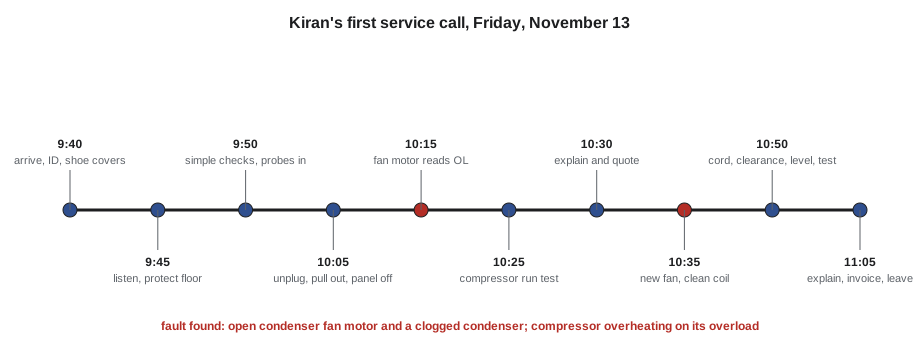
On Friday, November 13, at the end of his fourth week, Kiran ran his first service call. Dee rode along but stayed in the background, as she had told him she would: "You run it from the door to the invoice. I'll stop you if you're about to hurt yourself or the customer's house. Otherwise I'm just watching." Fenna had picked the call for him: a refrigerator that was not keeping food cold, at the home of Lorraine Abernethy, a retired nurse living in a 1960s bungalow in the Hamilton neighbourhood of Rosedale. This lesson follows that call from the booking note to the filed work order, and brings together everything in the course.
The booking note
Fenna's booking note on the tablet said: Refrigerator, bottom freezer, brand Northwind, model and serial from a photo of the plate the customer texted. Fresh food section warm for two days, milk spoiling. Freezer still frozen but softer than usual. Customer hears a clicking from the back every few minutes. Bought about 2016. No error codes. Single-storey house, kitchen at the back, driveway parking. Ade had loaded the van with a condenser fan motor, an evaporator fan motor and a start relay for that model, the three parts most often behind that symptom.
Kiran read the note twice in the van and looked up the model's tech sheet and bulletins on the tablet before they left the shop. One bulletin applied to the model's ice maker, which this unit did not have. No recall. He noted the plate details on his pad: 115 V, 60 Hz, 6.2 A, refrigerant R-134a, 142 g. "Not a hydrocarbon unit," he said to Dee. "But I'm not touching the sealed system anyway."
Clicking every few minutes from the back of a refrigerator that is warm often means the compressor is trying to start and its overload protector is tripping, because the compressor is overheating or has a starting problem. A dead condenser fan can cause exactly that, because without the fan the condenser cannot get rid of heat and the compressor runs hot. Kiran listed his suspects in his notebook before he arrived: condenser fan, dirty condenser, start relay, compressor.
Arrival and listening
Kiran called Ms. Abernethy from the end of her street, parked so as not to block the driveway, and knocked at 9:40. He introduced himself and Dee, showed his Penfold identification, put on shoe covers and asked her to show him the problem. She opened the fresh food door: the shelves were half empty, and she had moved her medicines to a cooler. "The clicking is louder at night," she added, something that was not in the booking note. "And it's been running all the time, then nothing, then clicking."
Kiran laid floor runners from the kitchen door to the refrigerator, put a towel on the counter for his tools and asked where the breaker panel was. He also noticed that the refrigerator was plugged into a receptacle behind it on an extension cord, which the installation instructions do not allow, and wrote it down to raise later.
Safety and simple checks first
Before pulling the refrigerator out, Kiran made his simple checks. The temperature controls were at their normal settings. The doors closed and sealed: he closed a strip of paper in each door and felt it drag as he pulled it out. Nothing blocked the air vents inside the fresh food section. He placed thermometer probes in the middle of each compartment and left them for ten minutes while he went on.
Worked problem
Reading the compartment temperatures
After ten minutes the fresh food section reads 9 °C (48 °F) and the freezer −12 °C (10 °F). The tech sheet's normal values are about 3 °C (37 °F) and −18 °C (0 °F). How far off is each?
Show solution
- Fresh food: 9 − 3 = 6 °C too warm.
- Freezer: −12 − (−18) = 6 °C too warm.
Answer: Both compartments are far too warm, by about the same amount. A problem in only the fresh food section would point to air flow from the freezer; both warm together points to the refrigeration system not removing enough heat, which fits a condenser or compressor problem.
With Dee watching, Kiran unplugged the refrigerator from the extension cord, kept the plug in sight, and took everything off the top. He slid appliance glides under the front feet, rolled the refrigerator forward far enough to reach the back, keeping it upright, and removed the lower rear access panel, a thin metal cover held by four 1/4 inch screws.
Finding the fault
Behind the panel were the compressor, the start relay and overload, the condenser coil and the condenser fan. The condenser coil was matted with a thick grey blanket of dust and pet hair. The fan blade could be turned by hand but felt stiff. Kiran checked the tech sheet: the condenser fan motor is a 115 V shaded-pole motor with a winding resistance of about 180 Ω, and it should run whenever the compressor runs.
Worked problem
Testing the condenser fan motor
With the refrigerator unplugged, Kiran disconnects the fan motor's connector and measures across its two terminals. His meter reads OL. He then measures from each terminal to the motor frame and reads OL. What does this show?
Show solution
- Expected winding resistance: about 180 Ω.
- Measured: OL, so the winding is open.
- Terminal to frame: OL, so there is no short to ground, but that does not matter once the winding is open.
Answer: The condenser fan motor's winding is open, so the fan has not been running. With a dirty condenser and no fan, the compressor overheated and its overload kept tripping, which made the clicking. The fan motor must be replaced and the condenser cleaned.
Kiran also wanted to be sure the compressor and its start relay were not damaged. Following the tech sheet, and with Dee checking each step, he plugged the refrigerator back in with the fan disconnected and clamped the compressor's supply lead with a line splitter at the cord. The compressor started, drew about 9 A for a second and then settled to about 1.6 A, and ran. "So the compressor starts and runs when it's cool enough," Dee said quietly. "Good thinking. Now unplug it before you go back in there." He did, and checked zero with his meter before touching anything.
Explaining and quoting
Kiran explained the fault to Ms. Abernethy in plain words: the small fan that cools the back of the refrigerator had burned out, the coil it blows air across was clogged with dust, and without them the compressor had been overheating and shutting itself off. He showed her the meter reading and the dust. He quoted the repair from Penfold's price book: the service call fee, the flat-rate labour for a condenser fan motor, which includes cleaning the condenser, and the part. He also told her about the extension cord: the instructions call for the refrigerator to plug directly into a grounded receptacle, and the extension cord was warm to the touch.
Worked problem
The quote
The quote is a service call fee of 95 dollars, flat-rate labour of 110 dollars and a condenser fan motor at 54.90 dollars. HST is 13 in 100. What is the total?
Show solution
- Subtotal: 95 + 110 + 54.90 = 259.90 dollars.
- HST: 259.90 × 0.13 = 33.787, which rounds to 33.79 dollars.
- Total: 259.90 + 33.79 = 293.69 dollars.
Answer: 293.69 dollars, which Ms. Abernethy approved on the tablet.
The repair
The fan motor was on the van. With the refrigerator unplugged and zero confirmed, Kiran removed the old motor and its blade, fitted the new motor on the same bracket, transferred the blade and checked that it turned freely and cleared the shroud, and reconnected the connector until it clicked. He vacuumed and brushed the condenser coil clean, front and back, and wiped up the dust. He refitted the access panel with all four screws.
Before pushing the refrigerator back, he dealt with the extension cord. Penfold technicians do not do receptacle work, but the refrigerator's own cord reached the receptacle behind it once the refrigerator was in its proper position; the previous owner had used the extension because the refrigerator had been pulled forward. He removed the extension cord, plugged the refrigerator directly into the grounded receptacle, checked the receptacle with his meter (hot to neutral 121 V, hot to ground 121 V, neutral to ground 0 V), and pushed the refrigerator back to leave the 25 mm gap at the back that the instructions require. He checked that it was level and that the doors swung closed from half open.
Testing and explaining
With power restored, the compressor and the new condenser fan started together. Kiran clamped the cord through the line splitter: 1.8 A with both running, within the plate rating of 6.2 A. He felt warm air leaving the front grille. A refrigerator takes hours to pull down to temperature, so he could not prove the repair by temperature before leaving. Instead he recorded the readings he could take: the fan running, normal running current, warm discharge air from the condenser, and the freezer evaporator starting to frost after 15 minutes. He told Ms. Abernethy to keep her food and medicines in the cooler until the evening, and that Penfold would phone her on Monday to check the temperatures.
Worked problem
Time on the call
Kiran arrived at 9:40 and left at 11:05. Penfold's planning average is 50 minutes on site per call. How long was his call, and how does it compare?
Show solution
- Time on site: 9:40 to 11:05 = 1 hour 25 minutes = 85 minutes.
- Over the average by 85 − 50 = 35 minutes.
Answer: 85 minutes, 35 more than the average. Dee called that normal for a first call with careful checks. Speed comes with experience; checks do not get skipped to save time.
Kiran explained what he had done and gave Ms. Abernethy two pieces of advice: vacuum the front grille every few months, because the condenser gets its air through it, and do not use an extension cord with the refrigerator. He collected payment on the tablet.
The work order
In the van, Kiran wrote up the work order the way Fenna had shown him:
- Complaint: fresh food warm for two days, freezer soft, clicking from the rear every few minutes, louder at night.
- Found: fresh food 9 °C, freezer −12 °C. Condenser fan motor open (OL; tech sheet about 180 Ω). Condenser coil heavily clogged. Compressor cycling on overload. Compressor starts and runs, about 1.6 A running. Refrigerator on an extension cord; extension removed, unit plugged directly into its grounded receptacle (readings normal).
- Repair: replaced condenser fan motor (part number recorded), cleaned condenser coil, set rear clearance, levelled.
- Test: fan and compressor running, 1.8 A total, warm discharge air, evaporator frosting after 15 minutes.
- Advice: clean the grille every few months; no extension cords; food in a cooler until evening. Follow-up phone call booked for Monday, November 16.
Dee read it, signed off the skills in his logbook (safe isolation and verification, meter use, reading a tech sheet, diagnosis of a fan motor, customer communication, documentation) and handed the tablet back. "Good first call," she said. "You found it, you proved it, you fixed it, and you left her safer than you found her. That's the job."
What the first month taught
On the drive back, Kiran listed in his notebook what each lesson of his first month had added up to on that call:
| Lesson | Where it showed up on the call |
|---|---|
| 1 The trade | Diagnosis first; checking the simple things; staying off the sealed system |
| 2 Safety | Unplugging, keeping the plug in sight, verifying zero, live test set up with care |
| 3 Moving | Floor runners, glides, keeping the refrigerator upright |
| 4 Tools | The right nut driver, clean reassembly, all screws back |
| 5 Meters | Winding resistance, receptacle readings, clamp current |
| 6 Plates | Model with revision, R-134a charge, plate current for comparison |
| 7 Tech sheets | Fan motor value, test procedure, bulletin check |
| 8 Service call | Listening, quoting, invoice, work order, follow-up |
| 9 Installation | Rear clearance, no extension cord, levelling |
| 10 Water | Not needed on this call, but checked under the unit for leaks |
| 11 Disposal | Not needed: the refrigerator was worth repairing |
The follow-up
Penfold's follow-up call to Ms. Abernethy was booked for Monday morning, November 16. Fenna's script for follow-ups is short: ask whether the appliance is working, ask for the temperatures if the customer has a thermometer, and ask whether anything else needs attention. If the refrigerator is still warm, a return visit is booked at no charge. Follow-ups catch the rare repair that does not hold, and they show customers that the company stands behind its work.
Common mistakes
MistakeSwapping the first likely part without testing it.
InsteadMeasure the suspect part against the tech sheet value and prove the fault.
MistakeReplacing the fan motor without cleaning the condenser.
InsteadFix the cause as well as the failed part; a clogged coil overheats the new motor and the compressor.
MistakePromising that the refrigerator is fixed before it reaches temperature.
InsteadRecord the readings you can take and book a follow-up.
MistakeLeaving a refrigerator on a warm extension cord.
InsteadPlug it directly into its grounded receptacle; refer any receptacle work to a licensed electrical contractor.
MistakePushing the refrigerator tight against the wall.
InsteadLeave the rear clearance the instructions require for air flow.
MistakeWriting a vague work order.
InsteadRecord the complaint, readings, cause, parts, tests, advice and follow-up.
Summary and key terms
- A first service call uses everything in the course: booking notes, safety, moving, tools, meters, plates, tech sheets, installation rules and documentation.
- List the likely causes before you arrive, then check the simple things and measure.
- Prove the fault with a reading that disagrees with the tech sheet.
- Fix the cause as well as the failed part, and correct any unsafe installation you find within your scope.
- Test what you can, explain clearly, invoice correctly and book a follow-up when the result takes hours to show.
- Write a work order that the next technician could act on.
- Condenser fan
- The fan that blows air across a refrigerator's condenser coil to remove heat.
- Condenser coil
- The coil where a refrigerator gives off the heat removed from its compartments.
- Overload protector
- A device that switches off a compressor when it overheats or draws too much current.
- Shaded-pole motor
- A simple, low-power single-phase motor often used for small fans.
- Follow-up call
- A planned check with the customer after a repair whose result takes time to confirm.
- Sealed system
- The closed refrigerant circuit of a refrigerator, worked on only by certified technicians.
Practice problems
Work each problem on paper first, then reveal the answer to check.
Why did a dead condenser fan make the compressor click?
Show answer
The compressor overheated without condenser cooling and its overload kept tripping.
What reading proved the fan motor had failed?
Show answer
OL across its winding instead of about 180 Ω.
Why could Kiran not prove the repair by temperature before leaving?
Show answer
A refrigerator takes hours to pull down to temperature.
What did Kiran do about the extension cord?
Show answer
Removed it and plugged the refrigerator directly into its grounded receptacle after checking it.
How long was the call?
Show answer
85 minutes, from 9:40 to 11:05.
Lesson quiz · 5 questions
Score 60% or more to complete this lesson.
Create a free account to save your progress, take quizzes and earn a certificate.