
AERO-300 · Lesson 1 of 12 · 27 min
Governing equations of fluid flow
Borealis Aerospace has decided to give the Tern a new wing. The airline customers like the aircraft, but they want it to use shorter and rougher strips in northern Manitoba, to burn less energy in cruise and to stall more gently when a pilot gets slow on a gusty approach. The first version of the wing was designed quickly, using handbook data and a lot of experience. The Block 2 wing will be designed properly, from the airfoil sections up. Tomasz Wierzbicki, who leads the aerodynamics group, has asked Arjun Mehta, now on his third co-op work term, to follow the design from start to finish. Arjun has met lift and drag coefficients in earlier courses. This course shows where those coefficients come from. It starts with the equations that every aerodynamic method, from a hand calculation to a supercomputer simulation, is built on.
Describing a flowing fluid
Air is made of molecules, but at the scale of a wing we never track them one by one. Instead we treat air as a continuum: a smooth substance whose density \(\rho\), pressure \(p\), temperature \(T\) and velocity \(\mathbf{V} = (u, v, w)\) have definite values at every point and every instant. The continuum idea works when the mean free path of the molecules, about 70 nanometres at sea level, is tiny compared with the smallest length that matters, such as the thickness of a boundary layer. It fails only in very thin gas, high in the atmosphere or in some microdevices, which is not the Tern's world.
There are two ways to describe the motion. In the Lagrangian view, we follow individual fluid particles and record what happens to each one. In the Eulerian view, we stand at fixed points and record the velocity, pressure and density of whatever fluid is passing. Wind tunnels and computer programs almost always use the Eulerian view: a pressure tap on a model measures the pressure at one place as the air streams past. The two views are linked by the substantial derivative, which gives the rate of change felt by a particle moving with the flow.
The first term is the local change at a fixed point. The other three are the convective change, which happens because the particle moves to a place where conditions are different. In a steady flow around a wing the local term is zero, yet a particle still accelerates strongly as it moves from the stagnation point at the nose to the low-pressure region on the upper surface. That convective acceleration is what the pressure field must supply.
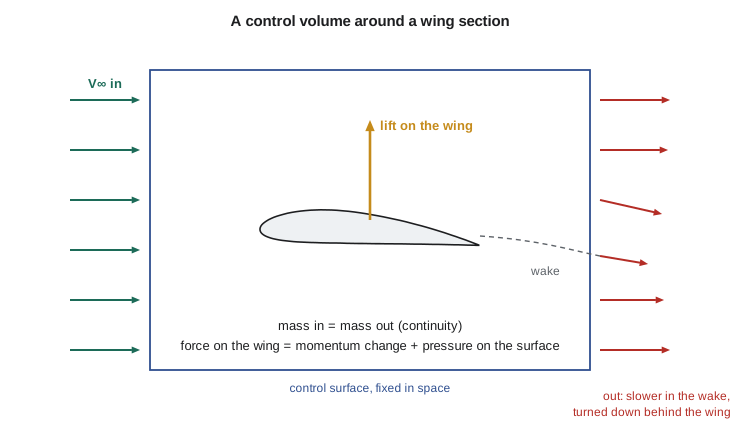
Three physical principles govern the flow: mass is conserved, Newton's second law holds for every piece of fluid, and energy is conserved. Each can be written for a control volume, a region fixed in space through which fluid passes, or for an infinitesimal fluid element. The control volume form gives powerful overall results, such as the drag of a wing from measurements in its wake. The differential form gives the detailed flow field that computer methods solve.
Conservation of mass: the continuity equation
Mass cannot be created or destroyed. For a control volume, the rate at which mass inside increases must equal the net rate at which mass flows in through the surface. Shrinking the volume to a point gives the continuity equation in differential form.
When the density is constant, the equation becomes simply \(\nabla\cdot\mathbf{V} = 0\): the velocity field must have zero divergence, so any fluid that speeds up in one direction must be fed from another. The flow is then called incompressible. Air is of course compressible, but its density changes very little when the flow speed is well below the speed of sound. The density change between the free stream and a point where the flow has been brought to rest is roughly \(M^2/2\), so at Mach 0.3 it is about 4.5 percent. The usual rule is that flows below about Mach 0.3 can be treated as incompressible. The Tern cruises near Mach 0.32, right at the edge, which is why the Block 2 team will apply a compressibility correction to its cruise numbers. That correction is a topic for AERO-310; this course treats the flow as incompressible, which is accurate for take-off, landing and the climb, where the high-lift questions are decided.
Continuity is a powerful check on any proposed velocity field. If someone hands you a formula for \(u\) and \(v\), you can verify that it could represent a real incompressible flow by testing whether \(\partial u/\partial x + \partial v/\partial y\) is zero everywhere. The program in this lesson does exactly that, numerically, for the field of a two-dimensional source, which you will meet again in Lesson 3.
Newton's second law for a fluid: Euler and Navier-Stokes
A fluid particle accelerates because forces act on it. Body forces such as gravity act on its mass; surface forces act on its boundaries. The surface forces are pressure, which always pushes normal to the surface, and viscous stresses, which arise because neighbouring layers of fluid slide past one another. Writing \(\rho\,D\mathbf{V}/Dt\) equal to the sum of these forces per unit volume gives the momentum equation. For a Newtonian fluid such as air, with constant viscosity \(\mu\) and constant density, it takes the form known as the Navier-Stokes equation.
The Navier-Stokes equations, together with continuity, describe essentially every flow an aircraft meets at subsonic speed, including turbulence. Their difficulty is that the convective acceleration makes them nonlinear, and for flows at the Reynolds numbers of real aircraft the solutions contain eddies over an enormous range of sizes. Directly computing all of those eddies around a whole aircraft is still far beyond practical computing power, which is why engineers use simplified forms and models.
The most important simplification is to drop the viscous term. The result is the Euler equation, which describes an inviscid fluid. It sounds drastic, since every real fluid has viscosity, but for air flowing around a streamlined body at high Reynolds number the viscous stresses matter only in a thin boundary layer next to the surface and in the wake. Outside that layer the flow behaves almost exactly as if it were inviscid. This split, an inviscid outer flow plus a thin viscous layer, was Ludwig Prandtl's great insight in 1904, and it organizes this whole course. Lessons 2 to 9 study the inviscid outer flow, which determines lift. Lessons 10 to 12 return to the boundary layer, which determines skin-friction drag, stall and much of what high-lift devices do.
Bernoulli's equation and the pressure coefficient
Integrating the Euler equation along a streamline for steady, incompressible flow, with gravity negligible as it is for air over a wing, gives Bernoulli's equation: the static pressure plus the dynamic pressure is constant along the streamline. If the flow comes from a uniform free stream and has no vorticity, a condition explained in Lesson 2, the same constant holds everywhere in the flow.
Aerodynamicists rarely quote pressures in pascals. They use the pressure coefficient, which compares the local pressure with the free-stream pressure in units of the free-stream dynamic pressure \(q_\infty = \tfrac{1}{2}\rho V_\infty^2\). Combining its definition with Bernoulli's equation shows that, in incompressible flow, the pressure coefficient depends only on the local speed ratio.
At a stagnation point, where the flow comes to rest, \(C_p = 1\), the highest value possible in incompressible flow. Where the flow moves at free-stream speed, \(C_p = 0\). Where it moves faster, \(C_p\) is negative: suction. On a lifting wing the upper surface near the leading edge can reach \(C_p\) of minus 3 or lower, meaning the local speed is twice the free-stream speed. Because lift comes mainly from that suction, the shape of the \(C_p\) curve along the chord is the single most informative plot in airfoil design, and you will see many of them.
Similarity: the Reynolds number and the Mach number
Wind tunnel models are smaller than the aircraft and usually tested at different speeds and air densities. The results apply to the full-size aircraft only if the flows are dynamically similar. Making the Navier-Stokes equation dimensionless shows that, for an incompressible flow over geometrically similar shapes, the flow pattern depends on one number, the Reynolds number, the ratio of inertial to viscous forces. When compressibility matters, a second number, the Mach number, also enters.
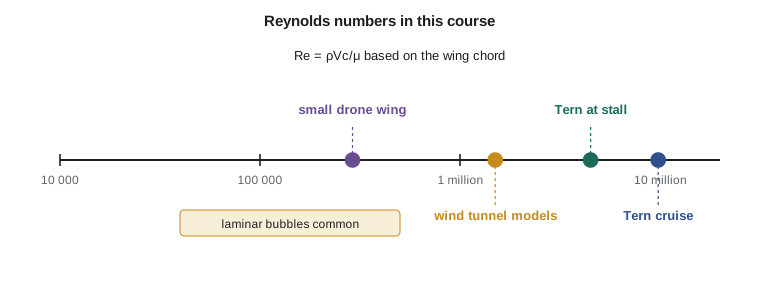
The program below computes these numbers for the cases this course keeps returning to. The Tern's wing at cruise works at a Reynolds number near 10 million on its mean chord. The same wing near the stall, slow and close to the ground, works at about 4.5 million, and its small tip chord at about 2.6 million. The Borealis Aerospace Skiff-W cargo drone, slow and small, flies at under 300 000. These differences are not academic. As Lesson 11 shows, a wing section can behave very differently at 300 000 than at 3 million, and the data in airfoil catalogues are always tied to a Reynolds number.
# Flow conditions for the Tern and the Skiff-W, and a numerical check of the continuity equation
import math
def isa(h):                                   # ISA troposphere: temperature, pressure, density
    T = 288.15 - 0.0065 * h
    p = 101325 * (T / 288.15) ** 5.2559
    return T, p, p / (287.05 * T)
def mu(T):                                    # Sutherland's law for the viscosity of air
    return 1.458e-6 * T ** 1.5 / (T + 110.4)
cases = [  # name, altitude m, speed m/s, reference length m
    ('Tern cruise, wing MAC', 3000, 105.6, 1.73),
    ('Tern landing stall, MAC', 0, 37.8, 1.73),
    ('Tern tip chord at stall', 0, 37.8, 1.02),
    ('Skiff-W wing chord', 0, 13.3, 0.32),
]
for name, h, V, c in cases:
    T, p, rho = isa(h)
    a = math.sqrt(1.4 * 287.05 * T)
    Re = rho * V * c / mu(T)
    q = 0.5 * rho * V ** 2
    print(f"{name:26s} Re = {Re:9.3g}  M = {V / a:.3f}  q = {q:7.0f} Pa")
# Continuity check: u = x/(x^2+y^2), v = y/(x^2+y^2) is the field of a 2D source
def vel(x, y):
    r2 = x * x + y * y
    return x / r2, y / r2
h = 1e-5
for (x, y) in [(1.0, 0.5), (-0.7, 2.0), (3.0, -1.0)]:
    dudx = (vel(x + h, y)[0] - vel(x - h, y)[0]) / (2 * h)
    dvdy = (vel(x, y + h)[1] - vel(x, y - h)[1]) / (2 * h)
    print(f"at ({x:4.1f},{y:4.1f}) du/dx + dv/dy = {dudx + dvdy: .2e}")
# Bernoulli: local pressure coefficient where the flow speeds up by 25 percent
for ratio in (0.0, 1.0, 1.25, 1.5):
print(f"V/V_inf = {ratio:4.2f} Cp = {1 - ratio ** 2:6.3f}")Tern cruise, wing MAC Re = 9.81e+06 M = 0.321 q = 5069 Pa Tern landing stall, MAC Re = 4.48e+06 M = 0.111 q = 875 Pa Tern tip chord at stall Re = 2.64e+06 M = 0.111 q = 875 Pa Skiff-W wing chord Re = 2.91e+05 M = 0.039 q = 108 Pa at ( 1.0, 0.5) du/dx + dv/dy = 3.05e-11 at (-0.7, 2.0) du/dx + dv/dy = -1.39e-12 at ( 3.0,-1.0) du/dx + dv/dy = 6.94e-13 V/V_inf = 0.00 Cp = 1.000 V/V_inf = 1.00 Cp = 0.000 V/V_inf = 1.25 Cp = -0.562 V/V_inf = 1.50 Cp = -1.250
The divergence check returns values of order \(10^{-11}\) or smaller, which is round-off: the source field satisfies continuity everywhere except at the source point itself, where the formula breaks down. The last lines show how quickly suction builds: a 25 percent speed-up gives \(C_p = -0.56\), and a 50 percent speed-up gives \(-1.25\).
Testing the Block 2 wing in a wind tunnel
The Block 2 wing will be tested as a large half model, one wing mounted on the floor of the National Research Council 9 m wind tunnel in Ottawa, which has a test section 9.1 m square and a top speed of about 55 m/s. A one-third-scale half wing, with a mean chord of about 0.58 m, reaches a Reynolds number near 2 million at 50 m/s. That is less than half of the full-size value at the stall, so Tomasz's team will use the tunnel data mainly to compare design options and to study how the stall spreads along the span, and will correct the absolute lift and drag numbers for Reynolds number before they go into performance calculations.
Matching both Reynolds number and Mach number on a small model is very hard. Some research tunnels raise the Reynolds number by pressurizing the air, which raises the density, or by cooling it to cryogenic temperatures, which raises density and lowers viscosity. Commercial programmes more often accept the mismatch and correct for it, using computer predictions and previous experience to bridge the gap, and confirm the result in flight test.
Worked problem
Pressure on the Tern's wing in cruise
In cruise at 3000 m the Tern flies at 105.6 m/s, where \(\rho = 0.909\ \text{kg/m}^3\) and \(p_\infty = 70.1\ \text{kPa}\). A pressure tap at 10 percent chord on the upper surface reads \(C_p = -1.1\). Treating the flow as incompressible, find the local pressure and the local flow speed.
Show solution
- Dynamic pressure: \(q_\infty = \tfrac{1}{2}\times 0.909\times 105.6^2 = 5068\ \text{Pa}\).
- Local pressure: \(p = p_\infty + C_p q_\infty = 70\,100 - 1.1\times 5068 = 64\,525\ \text{Pa}\).
- Local speed: \(V/V_\infty = \sqrt{1 - C_p} = \sqrt{2.1} = 1.449\), so \(V = 153\ \text{m/s}\).
- Check the Mach number: at 3000 m the speed of sound is about 328.6 m/s, so the local Mach number is 0.47.
Answer: The pressure on the upper surface is about 5.6 kPa below ambient, and the local flow is 45 percent faster than the free stream. The local Mach number of 0.47 is a reminder that even a slow aircraft has regions where the incompressible assumption is strained, which is why compressibility corrections are applied at cruise.
Worked problem
Drag from a wake survey
In the tunnel, a rake of total pressure probes behind a two-dimensional wing section at 40 m/s finds a wake 0.10 m wide, in which the velocity deficit is triangular: zero at the edges and 6 m/s at the centre. The model chord is 0.50 m and \(\rho = 1.20\ \text{kg/m}^3\). Estimate the section drag coefficient.
Show solution
- For a thin wake with small deficit, the momentum loss per unit span is \(D' \approx \rho \int V(V_\infty - V)\,dy \approx \rho V_\infty \int \Delta V\,dy\).
- The integral of a triangular deficit is half the base times the height: \(\int\Delta V\,dy = 0.5\times 0.10\times 6 = 0.30\ \text{m}^2/\text{s}\).
- So \(D' \approx 1.20\times 40\times 0.30 = 14.4\ \text{N/m}\).
- Section drag coefficient: \(c_d = D'/(q_\infty c) = 14.4/(0.5\times 1.20\times 40^2\times 0.50) = 0.030\).
Answer: A section drag coefficient of 0.030 is high for a clean airfoil, so this section is probably near the stall or has separated flow. A wake survey measures profile drag directly, which is why it remains a standard tool even when force balances are available.
Common mistakes
MistakeTreating the incompressible Bernoulli equation as valid across a boundary layer.
InsteadBernoulli's equation holds for inviscid flow along a streamline. Inside the boundary layer viscosity removes energy, so the total pressure there is lower.
MistakeAssuming tunnel data apply directly to the aircraft because the shapes match.
InsteadGeometric similarity is not enough. The Reynolds number, and at higher speeds the Mach number, must match or be corrected for.
MistakeCalling any flow below Mach 0.3 exactly incompressible.
InsteadThe rule only says density changes are small, about 4.5 percent at Mach 0.3. For accurate cruise work near that limit a compressibility correction is still applied.
MistakeForgetting the convective acceleration in a steady flow.
InsteadSteady means nothing changes at a fixed point. Particles still speed up and slow down as they move, and that acceleration requires pressure gradients.
Summary and key terms
- Aerodynamics rests on three conservation laws: mass (continuity), momentum (Navier-Stokes, or Euler when viscosity is neglected) and energy.
- At subsonic speeds below about Mach 0.3 the density can be taken as constant, so continuity becomes zero divergence of velocity and Bernoulli's equation links pressure and speed.
- The pressure coefficient \(C_p = 1 - (V/V_\infty)^2\) summarizes the surface pressures.
- Prandtl's split into an inviscid outer flow and a thin viscous boundary layer organizes this course.
- Wind tunnel results transfer to the aircraft only when the Reynolds and Mach numbers match or are corrected for.
- Continuum
- A model that treats a fluid as a smooth substance with properties defined at every point.
- Substantial derivative
- The rate of change experienced by a fluid particle as it moves with the flow.
- Continuity equation
- The differential statement that mass is conserved.
- Navier-Stokes equations
- The momentum equations for a viscous fluid.
- Euler equations
- The momentum equations for an inviscid fluid.
- Pressure coefficient
- The difference between local and free-stream pressure divided by the free-stream dynamic pressure.
- Reynolds number
- The ratio of inertial to viscous forces, ρVc/μ.
- Dynamic similarity
- The condition in which a model and the full-size flow have the same dimensionless parameters.
Practice problems
Work each problem on paper first, then reveal the answer to check.
Find the Reynolds number for a 0.25 m chord wing at 30 m/s at sea level (ρ = 1.225 kg/m³, μ = 1.79 × 10⁻⁵ Pa·s).
Show answer
Re = 1.225 × 30 × 0.25/1.79 × 10⁻⁵ = 5.1 × 10⁵.
A point on a wing has C_p = −2.0. What is its local speed as a multiple of the free-stream speed?
Show answer
V/V∞ = √(1 − C_p) = √3 = 1.73.
Is the velocity field u = 2x, v = −2y a possible incompressible flow?
Show answer
Yes: ∂u/∂x + ∂v/∂y = 2 − 2 = 0.
Is u = x², v = xy a possible incompressible flow?
Show answer
No: ∂u/∂x + ∂v/∂y = 2x + x = 3x, which is not zero everywhere.
A model is tested at one-fifth scale in air at the same density and viscosity as the full-size condition. What speed would match the Reynolds number?
Show answer
Five times the full-size speed, which is usually impossible at subsonic speeds and would change the Mach number anyway.
In the program, change the Skiff-W speed to 20 m/s. What is the new Reynolds number?
Show answer
It scales with speed: about 2.91 × 10⁵ × 20/13.3 = 4.4 × 10⁵.
Lesson quiz · 5 questions
Score 60% or more to complete this lesson.
Create a free account to save your progress, take quizzes and earn a certificate.