
AERO-300 · Lesson 9 of 12 · 23 min
Prandtl lifting-line theory
Lesson 8 quoted results for elliptical wings and gave numbers for tapered ones. This lesson derives them. Prandtl's lifting-line theory, published between 1918 and 1919, was the first practical theory of the finite wing, and in the form Hermann Glauert gave it a few years later it is still used every day in early design. It predicts how lift is distributed along the span, the induced drag and the span efficiency, and, crucially for the Block 2 wing, which part of the wing will stall first. Arjun uses it to choose the taper ratio and the twist.
The lifting line
Prandtl replaced the wing by a single bound vortex along the quarter-chord line, the lifting line, whose strength \(\Gamma(y)\) varies along the span. Wherever the strength changes, Helmholtz's theorems require vorticity to leave the line and trail downstream, so a vortex sheet of strength \(-d\Gamma/dy\) per unit span streams back from the wing. Each element of that sheet induces downwash at every point on the lifting line, and the total downwash at a station \(y_0\) is an integral over the whole span.
Each section is then assumed to behave like a two-dimensional airfoil at its effective angle of attack, which is its geometric angle less the induced angle \(w/V_\infty\). The section's lift from two-dimensional data must equal the lift implied by the local circulation through the Kutta-Joukowski theorem. Equating the two gives Prandtl's lifting-line equation, an integro-differential equation for the circulation.
Here \(c(y_0)\) is the local chord, \(\alpha(y_0)\) the local geometric angle of attack including any twist, and \(\alpha_{L0}(y_0)\) the local zero-lift angle. All the geometry of the wing, its planform, twist and section choice, enters through these three functions. The theory assumes a straight, unswept wing of moderate to high aspect ratio, attached flow and incompressible conditions. For the Tern, with aspect ratio 10.3 and almost no sweep, it is an excellent model below the stall.
Glauert's Fourier solution
Glauert made the equation solvable by hand. Change the spanwise variable to an angle with \(y = -\tfrac{b}{2}\cos\theta\), so \(\theta\) runs from 0 at one tip to \(\pi\) at the other, and write the circulation as a sine series. Each term automatically vanishes at both tips, as the circulation must.
Substituting into the lifting-line equation, the downwash integral can be done exactly for each sine term, and the equation becomes a simple algebraic condition at each angle \(\theta\). Writing \(\mu = c\,a_0/(4b)\), it reads as follows.
Choosing \(N\) stations along the span gives \(N\) linear equations for \(N\) coefficients. For a symmetrical wing at symmetrical flight conditions, only the odd terms appear, so stations on one half of the span are enough. The program uses 12 odd terms and 12 stations from the tip to the root, which is more than enough: the results do not change in the third decimal place with more terms.
Once the coefficients are known, the wing's lift and induced drag follow from remarkably simple formulas. Only the first coefficient contributes to lift; the higher terms change how the lift is distributed and add induced drag.
The elliptical distribution is the case in which only \(A_1\) is nonzero, so \(\delta = 0\) and \(e = 1\). Any other distribution adds higher harmonics, each of which adds induced drag in proportion to its square. That is the formal proof that elliptical loading minimizes induced drag.
# Prandtl lifting-line theory solved by Glauert's Fourier method for a tapered, twisted wing
import math
def solve(A, b):
    n = len(b); M = [r[:] + [b[i]] for i, r in enumerate(A)]
    for k in range(n):
        p = max(range(k, n), key=lambda r: abs(M[r][k])); M[k], M[p] = M[p], M[k]
        for r in range(k + 1, n):
            f = M[r][k] / M[k][k]
            for c in range(k, n + 1): M[r][c] -= f * M[k][c]
    x = [0.0] * n
    for k in range(n - 1, -1, -1): x[k] = (M[k][n] - sum(M[k][c] * x[c] for c in range(k + 1, n))) / M[k][k]
    return x
def wing(alpha_deg, taper, washout_deg, b=17.0, S=28.0, a0=2 * math.pi * 0.96, aL0_deg=-4.0, N=12):
    cr = 2 * S / (b * (1 + taper))
    odd = [2 * k + 1 for k in range(N)]                 # symmetric loading: odd Fourier terms only
    th = [math.pi / 2 * (i + 1) / N for i in range(N)]  # stations from tip (small theta) to root (pi/2)
    A, rhs = [], []
    for t in th:
        y = -b / 2 * math.cos(t); eta = abs(2 * y / b)
        c = cr * (1 - (1 - taper) * eta)
        twist = -washout_deg * eta                      # linear washout: tip pitched down
        mu = c * a0 / (4 * b)
        A.append([math.sin(n * t) * (mu * n + math.sin(t)) for n in odd])
        rhs.append(mu * math.sin(t) * math.radians(alpha_deg + twist - aL0_deg))
    An = solve(A, rhs)
    AR = b * b / S
    CL = math.pi * AR * An[0]
    delta = sum(n * (An[i] / An[0]) ** 2 for i, n in enumerate(odd) if i > 0)
    e = 1 / (1 + delta)
    def cl_local(eta):                                  # section lift coefficient at spanwise position eta = 2y/b
        t = math.acos(-eta) if eta < 1 else 1e-9
        c = cr * (1 - (1 - taper) * abs(eta))
        G = 2 * b * sum(An[i] * math.sin(n * t) for i, n in enumerate(odd))   # circulation / V
        return 2 * G / c
    return CL, e, cl_local
for taper, wash in ((1.0, 0.0), (0.45, 0.0), (0.45, 2.5), (0.3, 0.0)):
    CL, e, clf = wing(4.0, taper, wash)
    cls = [clf(-eta) for eta in (0.0, 0.4, 0.7, 0.9)]
    peak = max(range(19), key=lambda i: clf(-i / 20) / CL) / 20
    print(f"taper {taper:4.2f}, washout {wash:3.1f} deg: CL = {CL:.3f}, e = {e:.4f}, cl/CL at eta 0/0.4/0.7/0.9 = "
+ " ".join(f"{c / CL:.2f}" for c in cls) + f", peak cl/CL near eta = {peak:.2f}")taper 1.00, washout 0.0 deg: CL = 0.685, e = 0.9154, cl/CL at eta 0/0.4/0.7/0.9 = 1.11 1.08 1.00 0.79, peak cl/CL near eta = 0.00 taper 0.45, washout 0.0 deg: CL = 0.703, e = 0.9792, cl/CL at eta 0/0.4/0.7/0.9 = 0.95 1.04 1.04 0.92, peak cl/CL near eta = 0.55 taper 0.45, washout 2.5 deg: CL = 0.609, e = 0.9715, cl/CL at eta 0/0.4/0.7/0.9 = 1.05 1.06 0.96 0.79, peak cl/CL near eta = 0.15 taper 0.30, washout 0.0 deg: CL = 0.705, e = 0.9803, cl/CL at eta 0/0.4/0.7/0.9 = 0.91 1.03 1.07 0.99, peak cl/CL near eta = 0.70
Choosing the Block 2 planform and twist
The program compares four candidate wings, all with the Block 2 span of 17 m, area of 28 m² and NACA 44-series sections, at 4 degrees angle of attack. A rectangular wing, with constant chord, has a span efficiency of only 0.915 and its local lift coefficient is highest at the root. A wing tapered to 0.45 at the tip is almost elliptical, with \(e = 0.979\), and produces slightly more lift at the same angle. But its local lift coefficient, relative to the wing's, peaks at about 55 percent of the semispan and is still 0.92 at 90 percent. A taper of 0.3 is slightly more efficient again, \(e = 0.980\), but pushes the peak out to 70 percent of the semispan.
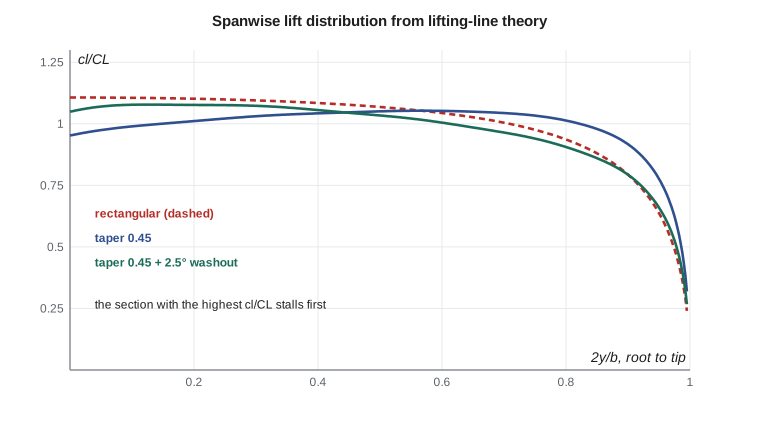
Why does the location of the peak matter so much? A wing begins to stall where its sections first reach their maximum lift coefficient. If that happens near the tip, the stall starts outboard, where the ailerons are, and if it spreads unevenly the aircraft can roll sharply and lose aileron control just when the pilot needs it. If the stall starts near the root, the outer wing keeps flying, the ailerons keep working, the turbulent wake from the stalled root buffets the tail as a natural warning, and the nose drops as the root lift is lost behind the centre of gravity. Certification rules in both countries require that the aircraft can be controlled in roll and that it gives clear warning before and during the stall, and aircraft designers almost always aim for root-first stall.
Tapering a wing is good for induced drag and for structure, since it moves the lift inboard and reduces the root bending moment, but it moves the section lift peak outboard, which is bad for stall. The tip sections also have a smaller chord and so a lower Reynolds number, which lowers their maximum lift. The standard cure is washout: twisting the wing so the tip is at a lower angle of attack than the root. With 2.5 degrees of linear washout, the program shows the peak moving all the way in to about 15 percent of the semispan, with the local lift coefficient at 90 percent of the semispan falling to 0.79 of the wing's. The price is a small loss of span efficiency, from 0.979 to 0.972, and a lower wing lift coefficient at the same angle, because the tips now carry less load. Tomasz's team chose the taper of 0.45 with 2.5 degrees of washout. The extra induced drag in cruise is about 0.7 percent of the induced drag, or roughly 7 N, a price everyone agreed was worth paying.
Beyond the classical lifting line
Lifting-line theory does not apply well to swept wings, low-aspect-ratio wings or wings with strong flow variations along the chord, because one line cannot represent how the load varies in the chordwise direction. The vortex lattice method extends the idea by covering the wing's planform with a grid of horseshoe vortices, several along the chord as well as along the span, and is widely used in conceptual design and for stability derivatives in AERO-330. Nonlinear versions of lifting-line theory use measured section lift curves instead of the straight-line slope, which extends the method up to the stall and lets designers estimate the wing's maximum lift, as Lesson 11 does in a simple way.
Worked problem
Wing lift and induced drag from the coefficients
For the Block 2 wing with 2.5 degrees of washout at 4 degrees angle of attack, the program gives \(C_L = 0.609\) and \(e = 0.9715\). Find \(A_1\), \(\delta\) and the induced drag coefficient.
Show solution
- \(A_1 = C_L/(\pi AR) = 0.609/(\pi\times 10.32) = 0.01878\).
- \(\delta = 1/e - 1 = 1/0.9715 - 1 = 0.0293\).
- \(C_{D,i} = C_L^2(1 + \delta)/(\pi AR) = 0.3709\times 1.0293/32.42 = 0.01178\).
Answer: The induced drag coefficient is about 0.0118, only 2.9 percent above the elliptical minimum for the same lift.
Worked problem
Root bending and taper
Lifting-line theory shows that tapering moves the lift inboard. Taking the spanwise lift distribution as elliptical for a rough estimate, the lift on each half wing acts at \(4b/(6\pi)\) from the centreline. Find the root bending moment of one Block 2 half wing in 1 g flight at 6500 kg, and compare it with a uniform distribution.
Show solution
- Lift on each half: \(63\,765/2 = 31\,883\ \text{N}\).
- Elliptical: arm \(= 4\times 17/(6\pi) = 3.61\ \text{m}\), so \(M = 31\,883\times 3.61 = 115\ \text{kN·m}\).
- Uniform: arm \(= b/4 = 4.25\ \text{m}\), so \(M = 135\ \text{kN·m}\).
Answer: The near-elliptical loading of the tapered wing reduces the root bending moment by about 15 percent compared with a uniform load. Washout moves the load further inboard and reduces it a little more, a welcome bonus for Marcus Webb's structures group.
Common mistakes
MistakeApplying classical lifting-line theory to a highly swept or very low aspect ratio wing.
InsteadUse a vortex lattice or panel method, which represents chordwise load variation.
MistakeAssuming the most efficient planform also stalls best.
InsteadTaper improves span efficiency but moves the section lift peak outboard. Washout is usually needed for a root-first stall.
MistakeIncluding even Fourier terms for a symmetrical wing in symmetrical flight.
InsteadOnly odd terms appear. Even terms describe asymmetrical loading, such as from deflected ailerons.
MistakeForgetting that only A₁ contributes to lift.
InsteadHigher terms redistribute the load and add induced drag but do not change C_L.
Summary and key terms
- Prandtl's lifting-line theory represents a wing by a bound vortex of varying strength along the quarter chord, shedding trailing vorticity wherever the circulation changes.
- Each section is treated as an airfoil at its effective angle of attack, giving an equation for the circulation that Glauert's Fourier series turns into linear equations.
- C_L depends only on A₁, the higher odd coefficients add induced drag through δ, and e = 1/(1 + δ).
- Taper brings a wing close to elliptical loading but moves the section lift peak outboard, so washout is used to make the root stall first.
- Lifting line
- A bound vortex of varying strength along the quarter-chord line that represents a finite wing.
- Trailing vortex sheet
- The vorticity shed downstream wherever the bound circulation changes along the span.
- Glauert method
- Solution of the lifting-line equation by a Fourier sine series in the spanwise angle.
- Taper ratio
- Tip chord divided by root chord.
- Washout
- Twist that gives the tip a lower angle of attack than the root.
- Root-first stall
- A stall that begins near the wing root, preserving aileron control.
- Vortex lattice method
- A method that covers the wing planform with a grid of horseshoe vortices.
Practice problems
Work each problem on paper first, then reveal the answer to check.
A wing has A₁ = 0.020 and AR = 9. Find C_L.
Show answer
C_L = π × 9 × 0.020 = 0.565.
For A₃/A₁ = 0.05 and A₅/A₁ = 0.03, find δ and e.
Show answer
δ = 3 × 0.0025 + 5 × 0.0009 = 0.012; e = 0.988.
Why does washout reduce the wing lift coefficient at a given root angle of attack?
Show answer
The outer sections fly at a lower angle and carry less lift.
In the program, try a taper ratio of 0.6 with no washout. Where does the section lift peak move and what is e?
Show answer
The peak moves inboard to about 45 percent of the semispan, and e falls slightly to about 0.966.
Why does a stall that starts near the tip threaten roll control?
Show answer
The ailerons are outboard; separated flow there reduces their effectiveness and can cause a wing drop.
The Block 2 wing has a root chord of 2.27 m and a tip chord of 1.02 m. Check the taper ratio and the area.
Show answer
λ = 1.02/2.27 = 0.45; S = (2.27 + 1.02)/2 × 17 = 28.0 m².
Lesson quiz · 5 questions
Score 60% or more to complete this lesson.
Create a free account to save your progress, take quizzes and earn a certificate.